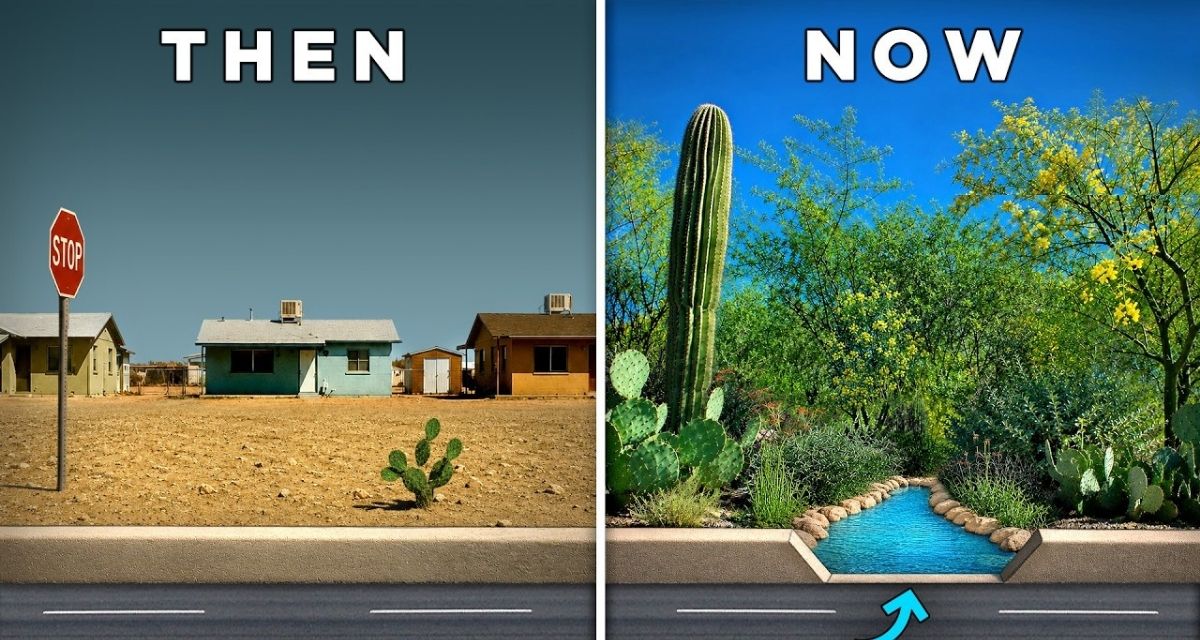
When you live in a hot, desert city that only gets 11 inches of rainfall per year, water is a precious resource. And yet, laws in Tucson, Arizona, long impeded people’s ability to utilize rainwater efficiently. That is, until Brad Lancaster took a handsaw to his curb and showed the city the result.
In 1998, Lancaster sawed through the curb in front of his house in six places, creating channels to divert rainwater into the space between the street and the sidewalk. Cutting into the curb was illegal, but city officials remained unaware of it for three years, until Lancaster himself told them what he’d done.
The transformation was simply too remarkable to keep to himself. Watch:
Simple rainwater diversion creates edible oases
Lancaster shared with permaculture expert Andrew Millison how channeling rainwater wisely creates a thriving landscape, providing both cooling shade and food for the public. Instead of sending it down concrete curb edges and into storm drains, cuts in the curb move water toward native trees and plants. As Millison says, this simple change is key to “turning depleted neighborhoods into thriving ecosystems.”
Lancaster showed Millison how the landscape in his neighborhood has evolved since his initial curb cuts nearly 30 years ago. Not only has he created an impressive rainwater harvesting system on his property, but he’s helped transform the public land adjacent to it as well.
A series of streetside basins capture and successively channel rainwater. Each basin holds plant life, much of which is native and edible. It may not look like a traditional orchard, but the trees have edible flowers, cactuses produce fruit, plants produce edible seeds to toss in a salad, and more.
“This is the neighborhood rain-irrigated food forest street,” Lancaster explains, “where we’re using the street to water the street trees that shade, cool the street, and feed all those living along the street.”
An ancient practice made new again
Looking at the Sonoran Desert in its natural state, it’s easy to think it’s not really compatible with human life. It’s hard to tell if the plants are actually alive, much of the flora and fauna look like they could kill you, and you find yourself feeling thirsty just looking at the dry, dusty, sun-baked ground.
But more than five million people in the U.S. call that desert home, and Indigenous people have lived there since time immemorial. With less than an inch of rainfall on average per month, there isn’t enough rain to provide adequate water for the human population. The city of Tucson gets 90% of its drinking water from underground aquifers and the Colorado River, but that doesn’t mean the rain the city does get doesn’t make a dent in its water needs.
Rainwater harvesting is part of what made human settlement possible in Arizona’s Sonoran Desert. Ancestral peoples of that land were experts in canal-building, diverting water from rivers for irrigation. They also built earthworks, landscape features that direct rainwater and capture it in soil for direct use by plants. In Millison’s video, Lancaster shows examples of earthwork basins created in his neighborhood, including one right in the middle of a roundabout intersection. These are not new ideas, but rather ancient practices being implemented in modern desert cities.
How Tucson finally changed its laws
It may have been illegal at the time, but Lancaster’s guerilla action helped change city policy. Tucson created a whole department for harvesting rainwater and growing trees called Storm to Shade. Homeowners get a $2,000 rebate for adding streetside rainwater harvesting basins to their properties. The city also requires all new commercial properties and road construction to incorporate rainwater harvesting.
Storm to Shade program manager Blue Baldwin gives Lancaster credit where it’s due. “The Storm to Shade program truly is the city’s adoption and institutionalization and elevation of all of the pioneering work that Brad did over years and years, below the radar but then bringing it to the city,” she says in Millisons’ video. “Brad has been cutting curbs for a very long time,” she adds. “He did it so well with the technology he had available to him. And now we have standard details and construction documents that actually tell construction contractors exactly how to cut a curb.”
Who’d have imagined one man’s renegade water diversion would change a whole city’s laws and landscape?
You can learn more about rainwater harvesting methods on Lancaster’s website, harvestingrainwater.com, and follow Andrew Millison on YouTube for more amazing permaculture transformations.
This article originally appeared in July. It has been updated.