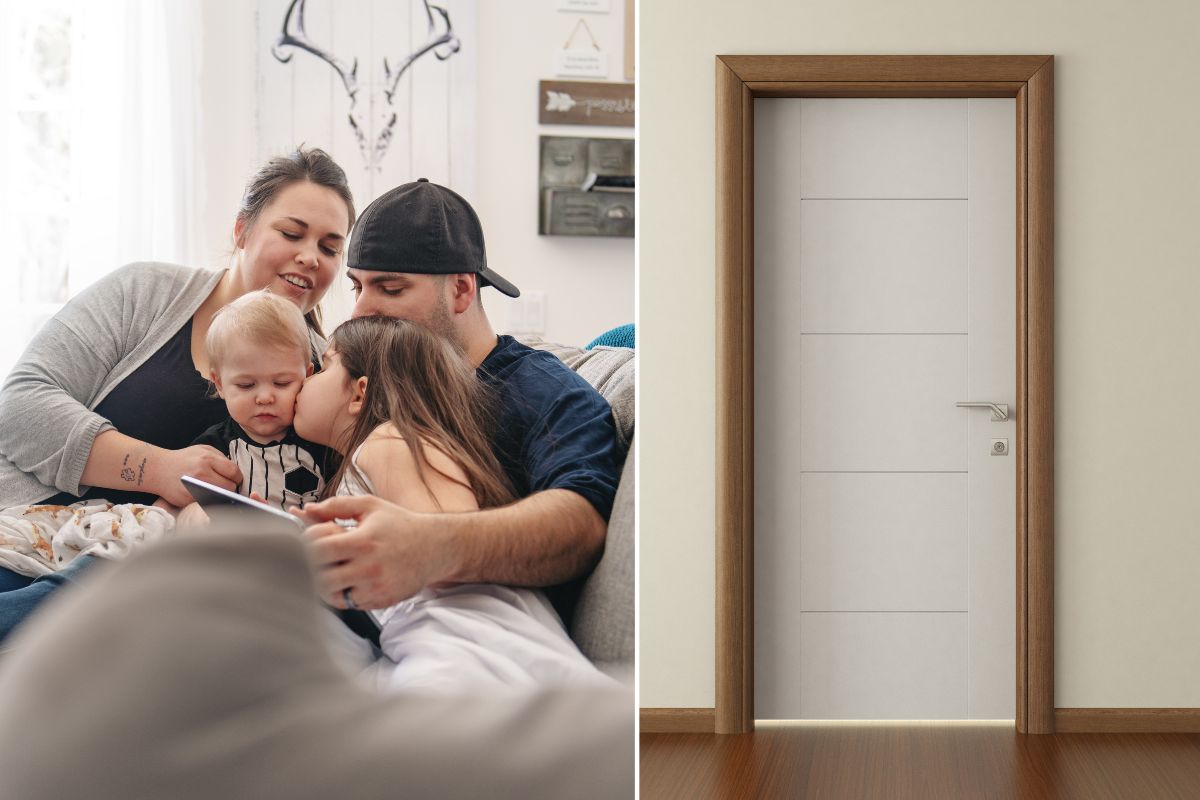
Did you grow up in a “living room family” or a “bedroom family?” It’s a question that’s been gaining steam on social media since the concept gained widespread attention online around 2024.
People in “bedroom families” spend their time behind closed doors, mostly alone in their bedrooms. The kids play, hang out, and amuse themselves in their own space, and are usually forbidden from entering their parents’ bedroom sanctuary. “Living room families” are more open—everyone’s out and about in the house most of the time, and bedrooms are rarely used for anything but sleeping.
Every family is different, but there’s certainly been a cultural shift in recent decades. Many Millennials and Gen Xers grew up in childhood households with ornately decorated living rooms, couches draped in plastic, and “no-shoes-allowed” carpets. And many of them are now trying to raise their own kids in a more open and connected way.
Modern parents weigh in on the culture shock of having “living room kids”
A simple observation on Threads recently sparked hundreds of comments. One user wrote, “Bedroom child raising living room children is absolutely wild.”
The thread was off and running from there, with throngs of Millennial and Gen X parents weighing in on their own experiences growing up in families that did things separately, orderly, and privately—and now having their own children roam more freely through the house.
Here are just a few things that parents are noticing about having a living room family:
Overstimulation
“Omg. I am overstimulated ALL of the time”
“For reeeeal. I love you guys but PLEASE ITS SO LOUD.”
“Literallyyyyy like, i love you but can you take that mountain of toys to your room?!”
Lack of personal space
“These kids are ‘whatever room mom is in’ kids. I made my house a safe space but like.. maybe a little too safe? Let me breathe a little”
“Right like your room is so cool why are you driving a race car across my forehead”
“I was always holed up in my room to escape the chaos in my home. I also was never affectionate with my mother. Now I have children who are always out in the living room, and they’re always attached to me. When I’m on the couch watching TV with them, all 3 of them are either on top of me or cuddled up next to me”
Zero peace and quiet
“Bedroom introvert child who grew up alone raising living room children who don’t stop talking”
“My 4 year old burst into the bathroom while I was wiping my ass because she missed me and wanted to give me a hug. Child, I’ve been in here for 5 minutes. Why don’t you try that on your father when he spends an hour in the bathroom?”
Everything’s a mess
“Constantly cleaning the living room because none of them want to be in their rooms”
“And I’m constantly cleaning after him cause the way my mama didn’t play about keeping a clean house. She had 7 kids and people were always blown away at how clean the house was. She drilled into my head nobody got to know you have kids when they step into your home. Now my living room kid be having my streeeesssed!”
Ultimately, feelings of safety and connectedness
In the end, most parents of “living room kids” say they wouldn’t trade it.
“Wait no but i LOVE that he’s a living room child… like the fact that ive created an environment and provided a home where he feels safe enough to want to hang out outside of his bedroom!? it feels like such a huge win”
“Exactly ! They have taken over all the spaces outside of our room and I love that for them because I could neeeeeever! Happy they feel safe enough to do so … It’s so healing”
Experts say living room vs bedroom debate is not black and white
Many experts view the shift to more open households as a good thing, even if it’s a bit messy:
“We have developed and cultivated a space where [the kids] feel comfortable to express, and be and feel, and that makes me feel good,” clinical psychologist Amber Thornton told HuffPost about her own household. “So if you are also a millennial that you’re raising ‘living room kids’ when you were a bedroom kid, shoutout to you because something’s going right.”
But this kind of setup does come with its costs. Even though the comments in the viral thread are tongue-in-cheek, parenting today has gotten more hands-on, time-intensive, and intense. The openness and connection in households sometimes comes at the detriment of parents’ mental health.
Bedroom families, while having a reputation as closed-off, isolated, and less warm and nurturing, do have some upsides. Boundaries between kids and adult life are not necessarily a bad thing, and even the kids sometimes need a quiet place to escape every once in a while.
Ultimately, every family will need something a little different. There’s no right or wrong way to run your household. But it’s good to know that just because you were raised one way doesn’t mean it’s the only way, even if breaking that cycle feels a little uncomfortable.