Dad’s video sharing ‘hardest part of co-parenting’ has other separated parents relating

“I wish for peace and quiet, as does every parent when they’re overwhelmed. But then I hate it when I have it.”

coparenting, singele dad tiktok
“Now I cherish every scream, every dirty hand print, and every spill.”Photo credit: @ainjole/TikTok

Very often, the right choice isn’t easy. Co-parenting is a prime example of this—no matter how amicable a break-up is, single parents inevitably lose time with their children after a divorce and must deal with the resulting loneliness that happens once the child leaves to spend time with the other parent. Knowing that you’ve made the right decision doesn’t necessarily take away the pain.

That’s why one dad’s video sharing his own experience of his child’s empty room is resonating with other single parents over on TikTok.

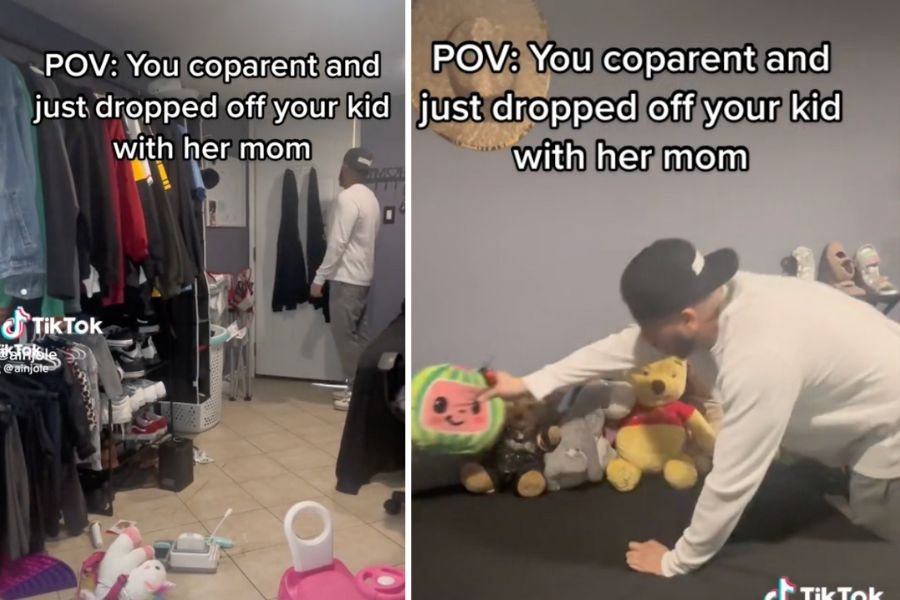
The dad, whose name appears to be Angel but goes by @ainjole on the platform, confessed in his video’s caption, “I think the hardest part of coparenting (for me) is dropping my daughter off with her mom and coming home to silence.”


He continued, “Of course when she’s rowdy and loud, I wish for peace and quiet, as does every parent when they’re overwhelmed. But then I hate it when I have it.”

The video itself shows Angel closing the door after his daughter, Penny, leaves to be with her mom. He is left behind with a mess of toys scattered on the floor—remnants of the fun they shared together.

As heartfelt piano music from Pixar’s “Up” plays, Angel picks up the toys, sweeps and dusts, makes the bed…removing any traces of the past few days.

The video ends with Angel lying alone on the bed, surrounded by carefully arranged stuffed animals, just before he turns off the light.

@ainjole I think the hardest part of coparenting (for me) is dropping off my daughter with her mom and coming home to silence. Of course when she’s rowdy and loud, I wish for peace and quiet, as does every parent when they’re overwhelmed. But then I hate when i have it. #fyp #coparenting #coparentingstruggles #dadsoftiktok #dadtok #singledad #girldad ♬ beauty of pixar – nilsodinson

The father later wrote in the comments, “Now I cherish every scream, every dirty hand print, and every spill.”

The touching video struck a chord in single parents. Angel is clearly not the only one to experience deep sadness during that first silence after a child leaves.

“Damn that’s so accurate. Tired. Sad. Relieved. It’s a weird feeling,” one person wrote.

“Dam bro I do that every Monday don’t have the heart to clean Sunday night after I drop them off,” another added. “The mess reminds me of them.”

One wrote “I miss my daughter everyday till I have her again.I always snuggle with her favorite teddybear till she comes back.”

Several shared how it’s a feeling that never completely goes away.

“I still cry to this day when my kids leave with their dad and it’s been 2 years. It’s something you never get used to,” confessed one parent.

Another added, “Been doing it for 16 years. It’s always rough. I’ve done the lay in their bed in the dark countless times.”

Several others tried to encourage Angel by reminding him that he’s still making the right decision.

“I’ve been doing it for 10 years now and it doesn’t get any easier, but just know 2 happy homes is better than 1 toxic home,” one person shared. “Proud of you.”

Despite feeling sad, Angel seems to be taking things in stride, writing in the comments that “it’s painful to see them go but even more special when they come back.”

Kudos to Angel for sharing this vulnerable moment. This is something that many single parents go through, and while nothing replaces time spent with loved ones, maybe through open conversation there can be a little less loneliness surrounding the subject.


  • Mom explains how her 1st grader’s second-day of homework already crushed his spirit
    A young boy doing his homeworkPhoto credit: Cassi Nelson/Facebook
    ,

    Mom explains how her 1st grader’s second-day of homework already crushed his spirit

    “He already doesn’t get home from school until 4 pm. Then he had to sit still for another hour plus to complete more work.”

    Debates about homework are nothing new, but the ability of parents to find support for homework woes from thousands of other parents is a fairly recent phenomenon. A mom named Cassi Nelson shared a post about her first grader’s homework and it quickly went viral. Nelson shared that her son had come home from his second day of school with four pages of homework, which she showed him tearfully working on at their kitchen counter.

    “He already doesn’t get home from school until 4 pm,” she wrote. “Then he had to sit still for another hour plus to complete more work. I had to clear out the kitchen so he could focus. His little legs kept bouncing up and down, he was bursting with so much energy just wanting to go play. Then he broke my heart when he looked up at me with his big teary doe eyes and asked…. ‘Mommy when you were little did you get distracted a lot too?!’ Yes sweet baby, mommy sure did too! I don’t know how ppl expect little children to sit at school all day long and then ALSO come home to sit and do MORE work too….”

    Nelson tells Upworthy that she felt “shocked” that kindergarteners and first graders have homework, much less the amount expected of them. “We didn’t have homework like this when we were in these younger grades.”

    Expert opinion and research is somewhat mixed on the homework front, but there is no conclusive evidence that homework is universally beneficial for students and too much homework can actually be harmful. As a standard, the National Education Association (NEA) and the National Parent Teacher Association (NPTA) support a limit on homework of “10 minutes of homework per grade level.”

    With that as a guide, a first grader shouldn’t have more than 10 minutes of homework on any given school day, but it’s not unusual for young kids to have two or three times the recommended limit of homework. That can be stressful for both kids and parents, cutting into valuable family time and limiting kids’ time to decompress, play and freely engage in imaginative activity.

    Homework, School, Kids, Child Development, Homeschooling
    Kids working on their homework. Photo credit: Canva

    As Nelson concluded, “It’s breaking their spirit and it robs them of what little fun and family time they have when they come home after a long day of school.”

    Most parents and even most teachers in the comments agreed with her that four pages of homework is too much for a first grader, especially on only the second day of school:

    “Poor little man. Children below a certain grade should not be given homework! Small children have a hard time sitting still for a long period of time yet alone expected to sit and do hours of homework, for what??? They are SMALL CHILDREN! Let them snack, play, laugh and all the other fun things when they get home. You are only a child once, they don’t need that taken away from them. Let them embrace their inner creativity, imagination, recipes, etc.”

    “This breaks my spirit. Our schools are huge scams. You’re exactly right Cassi. Homework is ridiculous. Kids til the age of 10 primarily learn through real life situations and play scenarios.”

    “I hate that for him! My little one has ADHD and doing homework after sitting in class all day is very stressful to him and makes him hate school. They are in school for 7 hours they shouldn’t have homework. That definitely takes away any kind of family time and that’s why kids never spend time with parents anymore because they have all this homework to do after being gone all day. I feel that if it can’t be done in the 7 hours they have the kids then it should wait until the next school day.”

    “I don’t make them do homework at home when they are that little. It’s not fair!They are at school allllll day! And it’s already sooooo much for their little bodies and brains! I’ve never had a teacher upset about it either.. and even if I did oh well!”

    “That breaks my heart. 4 pages is absolutely ridiculous for young kids. My daughter is going into 2nd grade next month, the 2 years in school it was always 1 page of homework sometimes back and front if it was math. And to read.”

    “I don’t send homework home with my students , 8 hours a day is enough for little minds to be going . They need and deserve a break,” a teacher wrote. “As a second grade teacher, I don’t believe in sending homework home. I do send a reading log home and ask that they complete an hour of reading for the entire month, but I understand they are just kids and need to be kids!” another added.

    “I was in this boat with my son…conversation with the principal and teachers helped dramatically!! It’s too much and we have to advocate for them.”

    The response to her post, which Facebook users shared over 90,000 times, blew Nelson away. “I NEVER thought me sharing my thoughts openly about how my heart hurt watching my little guy struggle would connect to so many others worldwide going through the same thing,” she says.

    Many parents shared that excessive homework led them to the decision to homeschool their children, which Nelson took to heart. The week after sharing her viral homework post, she shared that they had had their first day of homeschooling. It was “A HUGE SUCCESS!!!!” she wrote, with her son getting far more work done in a far shorter amount of time, sitting for classes for just 1 hour and 45 minutes total.

    Nelson tells Upworthy she felt totally intimidated to try homeschooling. “I seriously thought there was no way,” she says. “But I knew I had to set my fear aside and just take the leap for my kids. I told myself I’d figure it out one way or another. And here we are three days in and it’s been the easiest and best choice I’ve ever made.”

    Homeschooling is not the right solution for every family, however, so the question of homework remains an important issue for kids, parents, teachers, and schools to work out.

    This article originally appeared last year.

  • Mom says pretend play is the ‘secret’ to getting her angsty teen to open up
    A teen and her mom having fun with sunglasses.Photo credit: Canva
    ,

    Mom says pretend play is the ‘secret’ to getting her angsty teen to open up

    “I revived a fun way to defuse the teen-angst vibe and connect to our girls.”

    Psychologists say one of the best ways to get a child to open up is not to ask direct questions, which may put them on their heels, but to play a game with them.

    “Research demonstrates that parent and child brains ‘sync up’ during play and that they literally become ‘on the same wavelength’ as they play,” Robyn Koslowitz, PhD, writes at Psychology Today. “This makes it much easier for the child to feel comfortable expressing their feelings.”

    Research shows that play brings young children and parents together. Alyson, a mom who works in sports marketing, says it’s a total game-changer—and “the secret”—to getting her angsty 14-year-old daughter to share what’s really happening in her life.

    “I revived a fun way to defuse the teen-angst vibe and connect to our girls,” Alyson writes in a TikTok post. “Used it when my kids were little simply to entertain and now use it to joke her out of the teen-funk we all know and love.”

    @thebusinessofgolf

    Teen Girl Mamas: I revived a fun way to defuse the teen-angst-vibe and connect to our girls. Used it when my kids were little simply to entertain and now use it to joke her out of the teen-funk we all know and love. Here’s to raising the vibe and trying to keep the peace! #mom #teenmom #parenting #parentinghack #connection #playing #fyp #girlmom #silly #family

    ♬ original sound – Alyson

    Mom says playing with her teenage daughter helps her open up

    Alyson realized the power of play when her daughter had a total meltdown over not having anything to wear on Christmas Eve. So, she took on the role of a high-end fashion shopkeeper.

    “I brought her into my closet, and I did this whole big, ‘Oh, are you shopping with us today? Please, let me get you a treat,’” she says. “And I gave her a chocolate, and I gave her a beautiful flute of apple cider or something. And I was like, ‘Let me show you some pieces. I have a few pieces to show you today.’ And her attitude went from ‘I hate my life, I don’t like what I’m wearing’ to, like, ‘Oh, this is kind of fun.’”

    teen, mom, parenting, mom and daughter, cool mom
    A mom and her teen. Photo credit: Canva

    The same technique worked when Alyson pretended to take her daughter to a fancy spa.

    “I will go upstairs now, and I will blow out her hair, and she will spill the tea, just like you do in the salon,” she says. “So while she’s snacking and noshing and feeling like she’s being pampered and taken care of, we can have an interaction that’s kinder, softer, gentler than our typical, like, ‘Oh my God, you’re so annoying. Why do you keep asking me these questions?’ kind of situation.”

    Commenters loved Alyson’s method for getting her daughter to talk

    teen, mom, parenting, mom and daughter, cool mom
    A mom and her teen. Photo credit: Canva

    “These are the things that when she gets older, she will look back and think, my mom didn’t just love me, she also liked me,” a commenter writes.

    “I think they still like to ‘play’ and nobody realizes it, it just has to fit their age! This makes so much sense,” another adds. “When I was her age, I had much younger siblings, and as a teenager, I loved getting to still do ‘kid stuff’ with them! So this is kind of connecting the dots for me.” 

    Teenagers want to be close to their parents, but they’re also at a stage where they need to find independence, which can put them in a real bind. In her video, Alyson shows that with a little extra effort and cleverness, parents can break down barriers and make a meaningful connection with their teens.

  • Mom tears up describing her idea for a Pirate’s Booty ad. Now everyone’s crying with her.
    Kelsey Pomeroy shares her moving idea for a Pirate's Booty ad.Photo credit: @kelsewhatelse/Instagram
    ,

    Mom tears up describing her idea for a Pirate’s Booty ad. Now everyone’s crying with her.

    Just pay this woman and make the commercial already, because DANG.

    In the Internet age, our relationship with ads has gotten a little…well, weird. Traditional television commercials still exist, of course, but it feels like their quality has been circling the drain for a while. (Looking at you, Super Bowl LX.) Truly clever or emotionally moving ads feel rarer and rarer.

    And yet, here we are, witnessing people cry real tears over an advertising idea. Not an actual advertisement, mind you—just a verbal description of a hypothetical commercial. It starts with a mom named Kelsey Pomeroy stepping on a piece of Pirate’s Booty at Target and ends with thousands of people needing a moment to collect themselves.

    From the get-go, Pomeroy could barely keep it together as she shared the Pirate’s Booty ad idea that hit her while she was shopping.

    “I have the best ad idea for Pirate’s Booty,” she said, wiping her eyes, “’cause I just lived it.”

    She explained that she was shopping by herself at Target while her kids were in school when she heard a crunch. “I looked down and I’d stepped on a piece of Pirate’s Booty,” she said. “And I immediately get emotional because every mom knows what that means.”

    (If you’re not a mom or don’t know what that means, a dropped piece of booty likely means a mom had been giving her little one Pirate’s Booty to keep them occupied while she shopped.)

    “So here’s the ad,” Pomeroy continued. “A mom is shopping in a store, and she steps on a piece of Pirate’s Booty that’s been dropped. And immediately, she’s kind of emotional, and she has these flashbacks of pushing her little toddler or younger preschooler in the cart at the store, entertaining them and trying to distract them with the Pirate’s Booty to just bargain for one more aisle. It flashes back to the present and the screen widens a little bit, and you can see that she’s with the older version of her kid. He’s in some sort of sports gear, right? And he’s like, ‘Hey Mom, we needed to get some snacks for the game,’ and she goes over and she picks up a box of Pirate’s Booty, and she puts it in the cart.”

    “On the way out of the store with her older son,” Pomeroy continued, “she passes the mom who’s got the toddler and the Pirate’s Booty in the cart. And they just kind of lock eyes with each other. And it says something like, ‘Pirate’s Booty: with you for every version of them’ or something.”

    Then she lost it again, saying, “I just can’t.”

    Yeah, nobody can, apparently. The comments are filled with people’s lip-quivers and full-on tears:

    “Did not expect to cry about @piratesbooty today but it was worth it 😭 I see my son in that sports gear! Can’t wait to watch the actual ad one day 👏”

    “Before watching: why is she crying over a hypothetical ad for a pirates booty?? After watching: WE BOTH CRYING OVER THIS HYPOTHETICAL AD NOW😭😭😭😭😭😭”

    “Sobbing thinking of how my 3 year old won’t call it ‘booty pirates’ forever 🥲🥲🥲”

    “Husband- ‘why are you crying’
    ‘Someone on the internet had an idea about pirates booty.’ 😭😭”

    “I’m too pregnant to hear this 🥲.”

    “Hi. Don’t have children and I’m crying. 😭”

    “I’m crying. I’m in the teenager stage and toddler stage of parenting. It hits hard.”

    “So we’re all collectively crying about pirates booty now, right?”

    A preschooler sits in a grocery cart at Target
    The years of shopping with a little one are challenging but fleeting. Photo credit: Canva

    Even the Pirate’s Booty account responded, “I think I got some sand in my eyes 🥲.”

    People are clamoring for Pirate’s Booty to make the ad a reality and pay Pomeroy for her clearly effective idea. Target thought it was a great idea, too.

    What hits home about this ad concept is that it’s so very real. Pirate’s Booty is beloved by kids of all ages. Moms are well aware of this. So it’s perfectly natural to tie the product to the emotional experience of watching your kids grow. Tapping into a flashback or time-jump moment that moms experience is a powerful and brilliant way of showcasing the product. It doesn’t feel forced. We’d all know it’s an ad, but people appreciate ads that reflect our lived reality.

    For moms, feeling wistful about time going too fast with our kids is real. The fact that Pirate’s Booty spans all ages is real. (My kids are young adults and still love it.) Everything Pomeroy described feels real. And now the brand has people begging them to make this ad. How often does that happen?

    Do the right thing, Pirate’s Booty. Bring this heart-tugging ad to life—the idea quite literally fell at your feet like a dropped snack.

    You can follow Kelsey Pomeroy on Instagram for more.

  • A dad said he takes his young daughter to the women’s restroom. Then women chimed in.
    A dad sparked a huge response when he asked other parents which restroom they take their kids into.Photo credit: Alex Vigilante/Instagram
    ,

    A dad said he takes his young daughter to the women’s restroom. Then women chimed in.

    “I would rather feel awkward or uncomfortable than having my daughter feel uncomfortable.”

    It’s one of the all-time classic “girl dad” problems: you’re out with your young daughter and she needs to “go potty.” Do you take her into the men’s room or the women’s room?

    Most guys would go to the men’s room without a second thought. But one dad has people wondering if there might be a better way.

    Alex Vigilante coaches high-achieving men to “live a more aligned life, be more present, [and be] more whole.” He also shares content about fatherhood and his own life as a dad.

    Question goes viral

    Recently, Vigilante posed a question to fellow girl dads on Instagram: “When you’re out in public and your daughter has to go to the bathroom, which restroom do you take her to if there’s not a gender-neutral restroom?”

    He took his viewers by surprise with his answer: “Today, I took her into the women’s restroom. … I think that is the better route than taking her to the male restroom.”

    In the caption to his post, Vigilante outlined his reasoning. One point in particular was especially thought-provoking.

    “I would rather feel awkward or uncomfortable than having my daughter feel uncomfortable,” he wrote, adding that he didn’t feel it was appropriate to have his young daughter around grown men using the facilities. Vigilante also noted that he prefers to go in when no women are inside and will openly announce himself so as not to startle anyone.

    The now-viral Reel drew more than six million views, and needless to say, a passionate discussion ensued.

    Men react

    First came the dads who vehemently disagreed and said they would never set foot inside a women’s restroom, even with a toddler girl in tow.

    “Men’s restroom, respectfully. Handicap stall. Clorox wipes and Lysol travel size spray in hand. The potential for a misunderstanding isn’t one I’m willing to entertain.”

    “Imagine two or three dads in the women’s restroom…no bro, just use the dudes’ and go in the stall with her if she’s a little one, if she’s older, find a better solution. Don’t go in the girls restroom.”

    “The world doesn’t revolve around me or my daughter, & it’s not fair for an innocent adult female to walk into me in her safe place.”

    dads, fathers, parenting, girl dad, girls, kids, family, public restrooms, bathrooms, gender, debate, viral instagram
    Urinals in a men’s bathroom. Photo credit: Canva

    Women react

    Then moms and women at large began to chime in. Their collective response was surprising and heartwarming.

    Though not a monolith, of course, a majority of women who responded to Vigilante’s video were strongly in favor of dads bringing their daughters into the women’s room. Many recalled being young and feeling intimidated by the presence of grown men in the men’s room, even with their fathers there.

    “Please use the women’s restroom we really don’t mind. We were once little girls who needed protected too.”

    “As a woman I support dads bringing their daughters to the woman’s room.”

    “Absolutely! I have been in places before and if I see a man bringing his daughter towards the restroom I always offer to announce it in the bathroom and I stand at the entry door and keep everyone informed that comes in until they are finished. It takes a village!”

    “I’d rather feel a little uncomfortable and know a child is safe in the women’s restroom than have a little girl in the men’s room where there’s urinals and what not.”

    Honest discussion changed the minds of at least a few dads

    Several admitted they always “hated” bringing their daughters into the men’s room but didn’t see another way. After the warm response from moms, they were inspired to give it a try.

    “I’ve literally never considered this. Dude, thank you for bringing up. My first reaction was that I would never want to make other women afraid or uncomfortable if I was in there with my baby girl. And then I read the comments. WOW. Women are incredible. Sad that we have to even worry about this, but grateful to know my daughter has other women who freely have her back without even knowing her.”

    However, the opposing view is also valid, making this a complex issue. It could even become a legal one. While it’s not generally considered illegal for a man to enter a women’s restroom, the situation can become murky if someone feels threatened and raises a complaint.

    For his part, Vigilante said he’s never had an issue taking his daughter to the women’s room, but would happily leave if he made anyone uncomfortable.

    A better solution?

    It seems there should be a better solution by now, and fortunately, there has been incremental progress in this area.

    For starters, more men’s rooms have changing tables than in years past. This not only allows dads with babies to avoid going into the women’s room to change them, but also helps rebalance the distribution of childcare labor, which has historically been skewed toward moms.

    There’s also a push to “ditch the gap” in public restroom stalls, offering greater privacy for all.

    There’s even been a steep rise in the availability of family or gender-neutral bathrooms in public spaces, which helps everyone. In some places, they’re required by law.

    There are other solutions as well. For girls old enough to go in alone, many dads choose to stand outside the bathroom, sometimes with the door propped open so they can hear what’s going on and talk to their daughter for comfort.

    In the end, it’s an individual choice that requires dads to be mindful of others, as well as their daughter’s comfort level.

    “My daughter’s safety comes first…so I feel empowered to keep doing this,” Vigilante wrote in the comments. “I respect the opinion of parent who think otherwise, as they just want their kids to be safe as well.”

  • Millennial dad of 3 challenges boomer parents over unreasonable holiday expectations
    An upset father talks on the phone while his son looks onPhoto credit: Canva
    ,

    Millennial dad of 3 challenges boomer parents over unreasonable holiday expectations

    “Yeah, not this time,” he said. “I think for the holidays I’m just gonna stay in and relax.”

    The holidays are supposed to be a time for enjoying special moments with family, but often they become a source of stress. Traveling, navigating familial relationships and tensions, talking politics at the dinner table, and handling the all-encompassing issue of “presents” can wear down even the most patient and even-keeled person. It can be especially challenging for parents with young kids who are expected to travel long distances in the name of “family togetherness.”

    A TikTok video posted by @carrerasfam is going viral, with over 300,000 views, because so many millennial parents can relate to the frustration of grandparents having unrealistic expectations related to visiting with the kids.

    In the satirical video, a husband stages a conversation with his “practically retired” baby boomer dad, in which he explains politely but firmly that he’s not taking his 3 young kids on a 400-mile drive to their house for the holidays.

    Carerras Fam is a popular TikTok page about “all things postpartum and mamahood.” Together, the mom and dad share funny skits and slices of their life with three little ones.

    The husband opens the conversation with his dad by explaining all the inconveniences of taking 3 young kids on a long road trip. “I know you want us to drive down for the holidays, but it’s kinda ridiculous that you want me to pack my 3 kids with their portable beds with my clothes, their clothes, the formula, everything that goes on with raising 3 kids and having them feel comfortable. Drive down for over four hours just so that we could spend some time in your house?” the husband says while absurdist music plays in the background.

    Holidays, Travel, Millennials, Baby Boomers, Family Dynamics
    A family prepares for a road trip. Photo credit: Canva

    It’s obviously inconvenient for the couple to pack up their kids and drive 4 hours, but it’s also unsafe because the house is not baby-proof. “I’m gonna have to run around, make sure that they don’t break any of your stuff, and which you will ‘take care of them,’” the husband continues using sarcastic air quotes. Most parents eventually realize that visiting with the kids does not equate to getting help with them — no, it means chasing them around frantically yourself until it’s time to leave.

    The dad brings up another great point: His parents are in good health, so why don’t they drive to their house? “You could visit—you don’t have little kids,” the dad continues. “You don’t have anything going on. Why is it that every time I have to make the effort for you, yet you can’t do the most basic thing for me?”

    It’s clear from the phone call that the dad understands that traveling with the kids and staying in a house that isn’t correctly set up for young kids will make the holiday a struggle. Instead of making memories, they’ll most likely be running around bent over trying to save their kids from breaking something or hanging out at Target buying electrical socket plugs and a bottle brush because they left theirs at home. What’s especially frustrating is the pressure and expectations. Parents are often guilted for not wanting to pack up the kids and travel, even though it’s not hard to see why they hate it so much.

    The video struck a chord with many millennial parents. Nearly 500,000 people watched the clip, with hundreds and hundreds pouring in to vent their own similar frustrations.


    “First holiday with a kid… parents are confused why I won’t drive 9 hours with a 3mnth old for Christmas,” too_many_catz writes.

    “The ‘not baby proofed’ part hit my soullllllll. It’s so stressful having to chase your kids around and ask to close doors, move pictures, block stairs, etc. And nobody takes you seriously!” OhHeyItsIndy added.

    It’s also expensive for young families to travel. “Add to it they want us to spend money on gas, airfare, etc. when we live paycheck to paycheck and rent while they own homes and live comfortably off a pension,” another user wrote.

    “My mom asked me to drive 13 hours with our 2 month old…she doesn’t work and has flight points,” one mom added.

    This one hit hard: “They always act like you’re asking the world of them, yet they will willingly go on any other vacation that they choose,” Mackenzie Byrne wrote.

    “They can never make the trip for us but they can make them trips to Europe and cruises to the Caribbean,” another user noted.

    TX Travel Chick may have hit the nail on the head with her explanation for why boomer parents expect their children to road trip it to their house for the holidays. “Because we are used to following their orders!!! REVOLT,” she wrote.

    Ultimately, it would be interesting to learn why boomer parents want to inconvenience their kids when it would be much easier for them to take a trip to see them, especially if they can afford a hotel. One wonders if they are being entitled or if they’ve forgotten how hard it is to travel with young kids. In some cases, it’s a little more complicated — many baby boomer grandparents are still working and have less time and resources than previous generations did to help with the kids.

    “Yeah, not this time,” the dad sums up in the video. “I think for the holidays I’m just gonna stay in and relax.”

    It’s a hilarious and relatable video, but ultimately, it’s a skit. The power of boomer-grandparent guilt remains undefeated in many households, so the smart money says the Carreras family sucked it up and traveled for the holidays despite their annoyance. Here’s hoping that together, we can eventually break the generational curse when our kids become parents one day.

    This article originally appeared last year. It has been updated.

  • Dad shares list of 10 things he tells his kids ‘100 times’ for emotional resilience
    A father holds his daughter. Photo credit: Canva
    ,

    Dad shares list of 10 things he tells his kids ‘100 times’ for emotional resilience

    His powerful phrases inspired other dads to share their own.

    Present dads have an overwhelmingly positive impact on their kids’ lives—and the data supports it.

    A 2026 study published in Early Childhood Research Quarterly found that father involvement is “closely and positively linked to children’s social-emotional development, playing a crucial role in fostering emotional well-being, social competence, and emotion regulation in early childhood.”

    The study goes on to explain that this happens through direct engagement and interaction between dads and their kids, including play, teaching, and shared experiences. Even the smallest moments together can have a big impact, and one dad shared how he fosters that development through language.

    A dad explains his role in developing emotional resilience

    Reddit user Medium-Put-4976 opened up to fellow fathers on the platform about how he’s helping build his kids’ emotional resilience. He says he has a short list of impactful phrases he hopes to instill in them.

    He writes, “10 things to say to your kids at least 100 times before a time/event when they’ll need to hear it. (And mean it. Clearly saying it, but not living it, is counterproductive).”

    The post continues, explaining why repetition matters.

    “I’d like to think in the right moment I’d say the right thing, but on the fairly decent chance I don’t, I will make sure my kids have heard these things enough before the time they really need it,” he adds.

    He also shares the impact he hopes it will have on his kids.

    “For the same reasons that routines make kids feel safe, being a predictable parent is a stabilizer,” he writes. “Start now to develop your own mouth-muscle-memory.”

    He concludes the post with wisdom about his role as a father and about being someone his kids can feel secure with.

    “When this stuff falls out of my mouth easily, and frequently, I’m more likely to get it right when it matters most,” he writes. “And if not, they’ll at least know where I stand, not just in a crisis.”

    10 things to tell kids “100 times”

    Here are the phrases he shared with fellow dads, which he hopes will inspire them in their fatherhood journey:

    1. “I’m so glad you told me.”
    2. “I love you.” and “I love you, no matter what.”
    3. “I’m sorry.”
    4. “I was wrong. How can I make it right?”
    5. “I don’t know. Let’s figure it out together.”
    6. “I’m ready to listen.”
    7. “Do you want me to help, or just listen?”
    8. “You can always come home.”
    9. “I have your back.”
    10. “The world needs your __. (Reference a specific attribute and be prepared to back it up with examples of how your kid has it. Eg: ideas, enthusiasm, energy, art, voice, grit, style, friendship, kindness.. whatever fits)”

    Fellow dads share more impactful phrases

    The inspirational post ends with a callout to dads to share the important parenting phrases they say to their kids. Here are six fathers and their go-to phrases:

    Dad #1:

    “I recently saw a video that had some good ones. Pasting details below:

    Your feelings make sense.
    I was wrong.
    I love watching you figure things out.
    Tell me more about that.
    That took courage.
    You can change your mind.” – GrrATeam81

    Dad #2:

    “I have so much fun hanging out with you.
    I’m grateful for the person you are and the young man you’re growing up to be.
    I’m proud of you for doing the right thing even though it was difficult.
    Everyone makes mistakes, has accidents, and makes bad decisions. Learn from the consequences; we’ll get through it.
    What do you think about _?

    Also, I’ve always told my son ‘I promise that you’ll never regret telling me about anything.’ My parents said I could talk to them but they’d get mad or hold it against me later. When my son tells me about something he did wrong upfront, I thank him for being honest and tell him that taking responsibility voluntarily and knowing when to ask for help shows maturity and good judgment.” – CertainMedicine757

    Dad #3:

    “This is a great list. I learned two other ones recently: ‘I’m so glad you’re here’ (i.e. their presence is worthwhile) and ‘I love watching you figure things out'(the process is what I love, not results).” – Friendly-Land-1873

    Dad #4:

    “‘We are problem solvers’ is something I’ve tried to engrain in my kids.” – slidingscrapes

    Dad #5:

    “I run a slightly more Star Wars flavor on 2B. ‘I love you more than anything you could ever do wrong.’” – jeconti

    Dad #6:

    “I got this from a video, I wrote it in my notes and say it to my kid often when dropping her off at school. She loves it and even responds adding to it lol.

    It’s okay to not know it all.
    It’s okay to make mistakes.
    It’s okay to be yourself.
    It’s okay to ask for help.
    It’s okay to start over.
    It’s okay to say no.
    It’s okay to cry.
    It’s okay to feel upset.

    And recently added this to my notes and have started saying this to her when she’s working on something unfamiliar (‘difficult’):

    This feeling means your brain is growing.
    It’s okay that this is hard, hard is how we all learn.
    Stay with it. I believe in you and I’m right here.” – factsonlynomisinfo

  • Mom stopped taking teen’s phone as punishment and switched to something more helpful
    A teen girl is buried in her cell phone.Photo credit: Canva
    ,

    Mom stopped taking teen’s phone as punishment and switched to something more helpful

    “I started using consequences that actually match what I’m trying to correct.”

    When it comes to disciplining teens, every generation and every parent has their own style. Back in the Gen X days, when someone got grounded, we often heard things like, “No TV for two weeks!”

    Of course, cell phones didn’t exist back then, so removing them wasn’t an option.

    Many Gen X parents now choose to take away cell phones as punishment. But one mom, Carol, has gone viral on Instagram for declaring that she doesn’t agree with that approach. In fact, she believes it can make matters worse.

    Over a video of kids playing in a park, a chyron reads, “I’m not taking away my teen’s phone anymore as a fast consequence.”

    A new approach

    “You know when your teen messes up and your first instinct is to go straight for the phone?” Carol asked. “Yeah… that used to be me. Disrespectful tone? Phone. Didn’t follow a rule? Phone. Endless fighting with siblings? Phone. And yes… it ‘worked’ fast. They’d stop right away.”

    “But it didn’t sit right with me,” she wrote. “Because the behavior stopped but the conversation stopped too. They shut down, got defensive, and I ended up feeling like the worst mom in the world.”

    At some point, she realized that a phone can be a source of support and connection for some teenagers:

    “What slowly changed things for me was realizing this: for teens, their phone isn’t just a distraction. It’s where their friends are. Where they vent. Where they feel connected.

    So, when I took the phone away in the heat of the moment, I wasn’t just taking away a privilege… I was cutting them off from their world right when emotions were high. Another thing: the consequence wasn’t even connected to what they did. So it didn’t really correct the behavior. It just felt unfair to them and built resentment.”

    Instead, she tried to make the punishment fit the crime:

    “So I tried a small shift. I started using consequences that actually match what I’m trying to correct.

    If the tone is disrespectful?

    I don’t raise my voice. I hold the line and say we’ll talk when they can speak to me respectfully.

    If siblings can’t agree?

    The thing they’re fighting over is paused until they work it out (like both wanting the TV at the same time, they have to agree on turns and who goes first).

    And when I do believe phone access needs to be limited, I say it ahead of time, explain the boundaries, so next time it’s not a surprise.

    And the energy in our house changed. Less shutting down and resentment. More real conversations.”

    Many relate

    The post clearly resonated with parents. It has more than 72,000 likes and hundreds of comments, many in agreement and others vehemently disagreeing, sparking an interesting discussion.

    One Instagrammer, a teenager, waded into the conversation. Not surprisingly, they agreed with the assessment:

    “As a teenager, I would love to have parents who understand that taking away a phone will ‘fix’ things quickly but never in the long run and that these methods are soooo much better.”

    Another commenter disagreed:

    “What’s the consequence for disrespect? You actually don’t have one. The phone often is the cause of disrespect for my kid, and I am sure others, as she has spent too much time on it. When she is away from devices, she is a calmer and happier person, so yes, I will take it away and put limits on it. Kids need parents that will actually have boundaries and backbones.”

    Expert opinions

    Upworthy spoke with a few experts on teens. Cindy Shuster, who holds a master’s degree in elementary education and is the founder of Partner in Parenting, said, in part:

    “Teens do need to be accountable for their behavior and choices, but I see too many parents relying on the phone, and it becomes a constant battle of a back-and-forth. Nothing ever changes. Parents need to work with their teens to problem-solve through bad decisions and mistakes.”

    Shuster noted, however, that if the issue is the phone, it should be taken away:

    “Sometimes, the phone comes into play because it is the phone that may have been used to break a rule, or its use may have led to poor grades. In this case, the conversation centers around how the phone led to the outcome, and therefore there will be new rules around the phone. However, if a child did not do well in school and it is unrelated to the phone, it does not make sense to use the phone as a punishment. Instead, it is best to sit down with the child and try to understand what broke down. Help them discover what caused them to not do their best and what they could do differently moving forward.”

    Jeanette Lorandini, founder and clinical director at Suffolk DBT, had a different approach:

    “I don’t think the question is simply whether taking away a phone is ‘good’ or ‘bad.’ In DBT [Dialectical Behavior Therapy], we take a dialectical approach, looking for the middle path.

    On the one hand, a teen’s phone can be an important way for them to cope, connect, and regulate. On the other hand, limits and boundaries are still necessary. The goal isn’t to choose between connection and limits. It’s to create both. Before taking a phone away, it can help to ask what role it’s playing. Is it about connection, coping, or avoiding something painful? Punishment alone doesn’t teach skills. Teens need to learn what to do instead.

    A middle-path approach might look like setting limits on certain apps or times while still allowing connection and support. When parents are clear, consistent, and collaborative, teens are more likely to stay connected to expectations and to the relationship.”

    Many parents and teen therapists believe children and young adults have too much access to their phones in the first place.

    Brooke Sundin, a licensed marriage and family therapist, shared:

    “It’s important for families to remember that a phone is a privilege, not a right. As a mental health therapist, I encourage the parents I work with to empathize with their teen’s experience while confidently stepping into their parental authority when limits are needed.

    While many teens view their phone as a primary source of social connection, it is important to recognize the highly engaging and addictive nature of this technology. Constant screen-based connectivity can have real negative consequences for sleep, mood, and overall well-being. Real-life interactions are not the same as screen-based interactions, and screen-based communication can take away valuable opportunities to practice in-person communication.”

  • Father and son to cycle 9,600 miles to visit all 30 MLB parks and raise $1M for a children’s hospital
    Ethan and Scott Pesch are raising money for St. Jude Children's Research Hospital.Photo credit: The Pesch Family & St. Jude Children's Research Hospital
    ,

    Father and son to cycle 9,600 miles to visit all 30 MLB parks and raise $1M for a children’s hospital

    “This is well beyond us. It’s about everybody. Especially those young kids.”

    Thirty-two years ago, Scott Pesch and a group of track-and-field friends from college took on a crazy challenge: cycling across the United States to visit every Major League Baseball stadium. They came up eight stadiums short due to a player strike, but still raised $15,000 for their local Boys & Girls Club.

    On March 26, Scott and his son Ethan, a recent graduate of the University of Arizona, will recreate the ride, this time visiting all 30 MLB stadiums with a loftier goal: raising $1 million for St. Jude Children’s Research Hospital.

    On the Bike 2 Ballparks ride, the Pesches will be joined by friends and cyclists across the country who wish to take part. The journey begins in Seattle, Washington, for a Mariners–Cleveland Guardians matchup and ends on September 26 in Miami, Florida, with a Marlins–Atlanta Braves game.

    Finding a beneficiary for the ride was an emotional experience

    The Peschs’ decision to ride for the children’s hospital came after experiencing its work firsthand when Scott’s beloved professor at Cal Poly Humboldt, Dr. Richard Stull, lost his 12-year-old daughter to cancer. “It’s such a memorable ride, you have to do it for something. St Jude Children’s Research Hospital, that’s who we chose,” Scott said in a statement. “And I’m so glad we did. Because, man, that team over there is so fantastic.”

    The Pesch family visited the hospital, and the experience humbled them. “The campus is very impressive,” Scott told Upworthy. “The fact that the scientists and doctors are there, looking to cure cancer and treat cancer. And then you walk into the children’s hospital. That’s the most sobering spot. It just stands you up. It’s crazy.”

    Map of the United States showing where the Major League Baseball teams are located.
    The Peschs’ journey to all 30 ballparks. Photo credit: Bike 2 Ballparks

    Ethan has been training for more than two months to get in shape for the ride of a lifetime. “I’ve been cycling four or five times a week, probably since January, just trying to get into physical shape,” he told Upworthy.

    “Physiologically, you’re sore. Your butt’s going to hurt. You know, you just have to get used to these things,” Scott added. “But psychologically, you just have to mentally prepare for what we’re doing.”

    The Pesches have some added motivation to get them through the toughest parts of their trip: the children at the hospital. “It kind of puts things in perspective,” Scott said. “If you’re having a bad day, just think about the kids of St. Jude who are the beneficiaries.”

    One place they’ll need all the encouragement they can get is en route to Coors Field. “The biggest elevation gain is going to be going up to Denver, Colorado, when you have to climb the Continental Divide,” Scott said.

    The duo is most excited about games in San Francisco and Chicago

    The father-and-son team can’t wait for their third game in San Francisco, where they’ve been invited to throw out the first pitch at Oracle Park. “That is something that is like a dream come true. I grew up a Giants fan,” Ethan said.

    Scott is excited to relive one of his favorite moments from the ’94 ride. “I think the part that I’m looking forward to is being at Wrigley Field on the Fourth of July,” he said. “Oh, wow. Because we had that same schedule back in ‘94. We were in Chicago. We watched the Cubs play the St. Louis Cardinals on the Fourth of July.”

    The Pesch family at Wrigley Field in Chicago.
    The Pesch family. Photo credit: The Pesch family (used with permission)

    They also can’t forget about the food. Given how many calories they’ll be burning on the road, they’re free to eat and drink whatever they like at the ballpark. “I’m looking forward to going to San Diego, and they have these carne asada fries,” Ethan said. “I lived in San Diego for a little bit, and every time I went to a game, that’s all I was getting because it’s good.”

    Ultimately, the 9,600-mile trip is all about supporting children and their families in the fight of their lives. “We have even more purpose to get this thing done because of those young kids who have cancer. And it just breaks your heart. It just does,” Scott said. “But it really wakes you up. And there’s more out there than just us. This is well beyond us. It’s about everybody. Especially those young kids.”

    The Peschs’ ride is open to anyone who wants to join and support St. Jude Children’s Research Hospital. You can track their progress across the country at Bike 2 Ballparks and follow the ride on Instagram. If you’d prefer to donate, you can do so here.

Making Sense of Science

‘Windfall time’: Why unexpected free time feels so much better than the kind we plan

Education

10 uncommon words that perfectly capture feelings that feel impossible to explain

Nostalgia

People share inconveniences from back in the day that would ‘break’ us in 10 minutes now

Making Sense of Science

What it means to look at the ground while walking, according to psychology