When a couple has their first child, they start out with the greatest of intentions and expectations. The child will only eat organic food. They will never watch TV or have screen time and will always stay clean.
But soon, reality sets in and if they have more kids, they’ll probably be raised with a lot less attention. As a result, first-born kids turn out a bit differently than their younger siblings.
“Rules are a bit more rigid, attention and validation is directed and somewhat excessive,” Niro Feliciano, LCSW, a psychotherapist and anxiety specialist, told Parents. “As a result, firstborns tend to be leaders, high achievers, people-pleasing, rule-following and conscientious, several of the qualities that tend to predict success.”
However, it’s not just laziness that makes parents change their M.O. As parents gain experience, they learn not to sweat the small stuff and to have a bit more faith in their children.
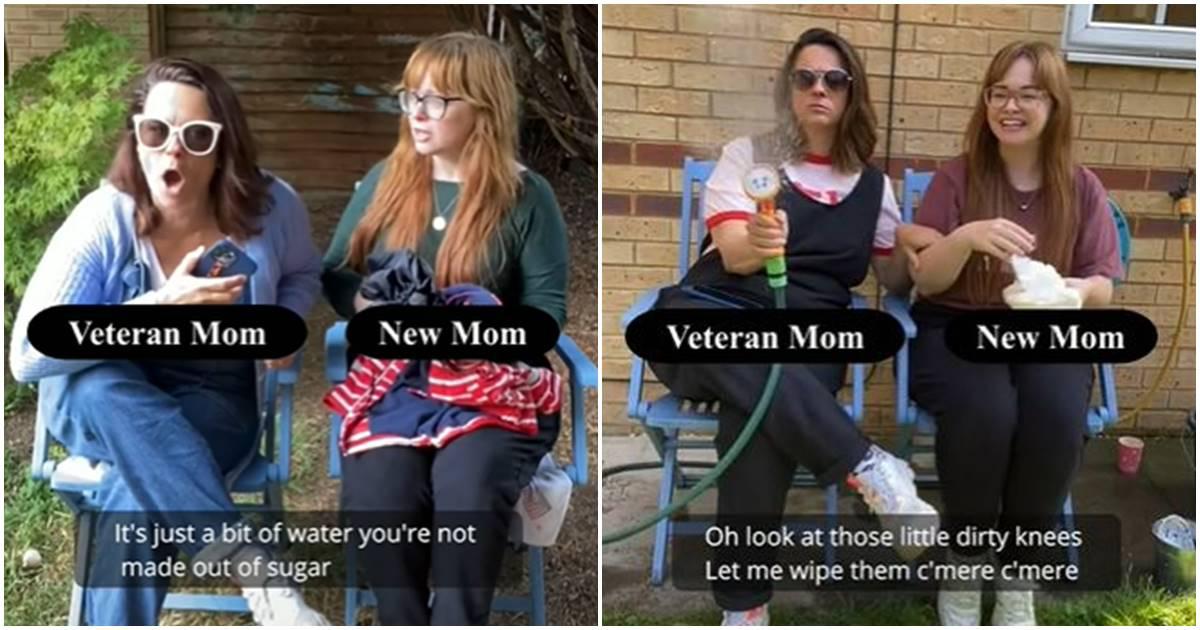
Tova Leigh is a writer and performer who creates funny sketches on TikTok about parenting and feminism. To point out the differences between new and veteran moms she made a series of funny sketches with fellow mom Riona O Connor.
In the first video, the two mothers deal with fighting children. The new mommy uses a sweet voice and quietly suggests, “Oh honey, no, no fighting, sweetie. Gentle hands” to the brawling kids. When that doesn’t work, the veteran mother screams, “We said stop fighting!”
The video must have hit a nerve with parents everywhere because it went viral, racking up more than 3 million views. “As a mum of 5… this is 100% accurate,” Lora Bora wrote in the comments. Kira agreed saying, “I got 4…. And I felt this in my soul.”
While the video was funny, it should also provide some comfort to young mothers who feel overwhelmed by the pressure to be perfect. As blogger Constance Hall points out, the need to be perfect can rob us of precious time with our kids.
“We are only half present for them all of the time due to the constant pressure to have everything perfect,” Hall wrote in a viral Facebook post. “To go to the gym, answer that email, pay that bill, cook that organic kale, blend it, get it into a patty so no one knows it’s kale, get to the doctors…. Make the kids lunches cos if you order them again you will be JUDGED!”
In the second video, the two mothers have very different approaches to making a puree.
Kids grow up fast and if you blink an eye, you just may miss it. So regardless if you’re a new mom or a veteran mom, take a page out of these mothers’ books, relax a bit and have fun being a parent. Your kids will probably forget your vegan kale puree, but they’ll always remember the time you spent just being present.
A single door can open up a world of endless possibilities. For homeowners, the front door of their house is a gateway to financial stability, job security, and better health. Yet for many, that door remains closed. Due to the rising costs of housing, 1 in 3 people around the world wake up without the security of safe, affordable housing.
Since 1976, Habitat for Humanity has made it their mission to unlock and open the door to opportunity for families everywhere, and their efforts have paid off in a big way. Through their work over the past 50 years, more than 65 million people have gained access to new or improved housing, and the movement continues to gain momentum. Since 2011 alone, Habitat for Humanity has expanded access to affordable housing by a hundredfold.
A world where everyone has access to a decent home is becoming a reality, but there’s still much to do. As they celebrate 50 years of building, Habitat for Humanity is inviting people of all backgrounds and talents to be part of what comes next through Let’s Open the Door, a global campaign that builds on this momentum and encourages people everywhere to help expand access to safe, affordable housing for those who need it most. Here’s how the foundation to a better world starts with housing, and how everyone can pitch in to make it happen.
Volunteers raise a wall for the framework of a new home during the first day of building at Habitat for Humanity’s 2025 Carter Work Project.
Globally, almost 3 billion people, including 1 in 6 U.S. families, struggle with high costs and other challenges related to housing. A crisis in itself, this also creates larger problems that affect families and communities in unexpected ways. People who lack affordable, stable housing are also more likely to experience financial hardship in other areas of their lives, since a larger share of their income often goes toward rent, utilities, and frequent moves. They are also more likely to experience health problems due to chronic stress or environmental factors, such as mold. Housing insecurity also goes hand-in-hand with unstable employment, since people may need to move further from their jobs or switch jobs altogether to offset the cost of housing.
Affordable homeownership creates a stable foundation for families to thrive, reducing stress and increasing the likelihood for good health and stable employment. Habitat for Humanity builds and repairs homes with individual families, but it also strengthens entire communities as well. The MicroBuild® Initiative, for example, strengthens communities by increasing access to loans for low-income families seeking to build or repair their homes. Habitat ReStore locations provide affordable appliances and building materials to local communities, in addition to creating job and volunteer opportunities that support neighborhood growth.
Marsha and her son pose for a photo while building their future home with Southern Crescent Habitat for Humanity in Georgia.
Everyone can play a part in the fight for housing equity and the pursuit of a better world. Over the past 50 years, Habitat for Humanity has become a leader in global housing thanks to an engaged network of volunteers—but you don’t need to be skilled with a hammer to make a meaningful impact. Building an equitable future means calling on a wide range of people and talents.
Here’s how you can get involved in the global housing movement:
Speaking up on social media about the growing housing crisis
Volunteering on a Habitat for Humanity build in your local community
Travel and build with Habitat in the U.S. or in one of 60+ countries where we work around the globe
Join the Let’s Open the Door movement and, when you donate, you can create your own personalized door
Every action, big and small, drives a global movement toward a better future. A safe home unlocks opportunity for families and communities alike, but it’s volunteers and other supporters, working together with a shared vision, who can open the door for everyone.
When the holidays roll around, it’s time for families to decide where they will meet to celebrate. For the most part, parents with younger kids dread packing their bags and traveling to a family member’s house where things aren’t set up for young children. You fumble around setting up the pack ‘n plays, can’t find your bottle brush, and freak out because the electrical sockets aren’t child-proof.
However, many grandparents aren’t keen on enduring the mental and physical strain of traveling at an older age. So, who’s right? Grandma Jan, founder of Grandma Camp and a TikTok influencer who shares fun ideas for grandparents and grandkids, argued that parents should pack up their kids and visit Grandma.
“Okay, so, here’s the debate: families say, ‘Grandma, why don’t you come visit us?’ But let’s be honest, Grandma’s house is where the traditions are, the cookies are, and all of the toys are,” Grandma Jan begins. “But if grandma is driving, flying, hauling all the gifts, and packing up her car to come see you, maybe it’s time to flip the script. When did it become normal for Grandma to pack up all her stuff and come see you? Should the kids pile into the car, bring all their toys, and just go visit grandma? Bring all that love and chaos to her?”
So she asked her followers: “Should grandmas be the one on the road or should families pick everything up and drive to her?” Just about everyone in the comments said that grandparents should have to travel to see their grandchildren.
“Nope. I want Christmas morning in pajamas with my family. I want my traditions. My parents and in-laws (the grandparents) got all of this how they wanted. It’s my turn now,” Maggie wrote. “Gramma is retired and now has a shit ton of time. Kids and parents have a very finite amount of time off in the holidays that they do not want to spend on the road,” Mrs. Wright added.
Some grandparents also checked in to disagree with Grandma Jan. “Why would I put that on my kids and grandkids? It’s so hard traveling with kids, not to mention expensive to fly for more than one person,” Populustultus wrote. “What a weird way to think about that. Why wouldn’t you help your kids create magic in their home? Signed a grandma,” LifestylebyKat added.
The response inspired Grandma Jan to release a follow-up video clarifying her opinion. She admits she came up with the idea after seeing older people having a hard time getting through the airport. “[I saw] older grandparents struggling their way through airports carrying their own heavy bags while managing a walker or a plane or a wheelchair, struggling through all on their own with no one to assist,” Grandma Jan said. “And as an occupational therapist, that actually broke my heart. For younger, healthier grandparents, travel can be fun, but for the older generation, it can be quite a struggle.”
Ultimately, Grandma Jan didn’t intend to put anyone out; she just wanted to have a conversation about what’s best for families as a whole. “And Grandma Camp by Grandma Jan is about having those conversations, not making rules. And at the end of the day, it’s about connection, not distance,” she concluded her video.
This article originally appeared last year. It has been updated.
TikTok user alexxx1915 recently posted a short video with the caption: “I just learned the term ‘living room family’ and I never understood why my kids never played in their rooms when I always did as a kid.” She briefly shows her kids hanging out in the living room with their pet dog and some toys scattered around the floor, before panning to her own face and giving a sort of sentimental look. The simple, ten-second clip struck a huge nerve with parents, racking up over 25 million views and thousands of heartfelt comments.
What are ‘living room families’ and ‘bedroom families’?
This idea has been going around for a while on social media.
Simply put, a living room family is a family that congregates in the living room, or any common space in the household. Kids play in the same space where the adults relax and things are often messy, as a result. Everyone interacts with each other and spends lots of time together. Bedrooms are reserved mostly for sleeping and dressing.
A bedroom family, on the other hand, is where the kids spend more time in their rooms. They play there, watch TV, and maybe even eat meals. Typically, the main rooms of the house are kept neat and tidy. You won’t find a lot of toys scattered about, and family time spent together is more structured and planned ahead rather than casual.
A living room family is more communal
A family congregates in their living room. Canva Photos
In my household, we’re definitely a living room family. We’re around each other constantly, and the house is often a mess because of it. Learning about this term makes me feel a little better that my kids want to be around us and feel comfortable enough to get their ‘play mess’ all over the living room. The mess is a sign of the love and comfort we all share together.
There’s so much that’s great about having a family that lives out in the open, especially if you were raised feeling like you had to hide in your room.
“I thought my kids hated their rooms turns out they like me more” said another. “You broke a generational curse. Good job mama!” said yet another.
The implication of being a bedroom family, or having ‘room kids’, is that perhaps they don’t feel safe or comfortable or even allowed to take up room in the rest of the house, or to be around the adults. “I remember my brother coming round once and he just sat in silence while watching my kids play in the living room. After a while he looked at me and said ‘It’s so nice that your kids want to be around you’” one commenter said on alexxx1915’s video.
A bedroom family enjoys some alone time
A boy in his bedroom playing a guitar. Canva Photos
Being a bedroom family is by no means a bad thing. In fact, alone time is important for parents and kids alike, and everyone needs different amounts of it to thrive. Kids with certain special needs, like being on the autism spectrum, may be absolutely thrilled to spend lots of time in their rooms, for example.
But it really doesn’t have to be one or the other, and neither is necessarily better. Making your kids feel relegated to their room is, obviously, not great. It’s not a good thing if they feel like they’re not allowed to exist in and play in the rest of the house. But if they just like hanging out in their room? Nothing wrong with that at all. And same goes for parents.
In 2023, there was a similar debate on TikTok where parents sounded off on whether they were bedroom parents or living room parents. In this situation, the parents spent the majority of the time in their bedroom, while the kids were in the living room, or they spend time in the living room with their kids. According to Marissa Kile, the video’s creator, this made the parents’ bedroom feel like a “scared space” where the kids didn’t feel comfortable.
Of course, every household is different and the right answer is the one that works for them. And if you feel like living on the edge, you can always just be both.
This article originally appeared 2 years ago. It has been updated.
Even for the parents who prioritize showing up for their kids, missing a child’s event now and then might be unavoidable. But certain occasions are more painful than others when a parent can’t show up, and fatherless father-daughter dances undoubtedly fall into this category.
In June 2024, a work commitment kept Harper’s dad from attending her dance studio’s annual summer showcase, which meant the six-year-old was at risk of missing out on the father-daughter dance entirely.
An act of brotherly love
Thankfully, her brother Micah, who was 14 at the time, is the coolest brother in the world and stepped up to take her dad’s place so she wouldn’t miss out.
In a mega-viral video posted to Instagram by Harper and Micah’s mom, Patrice Thompson, we see the duo having a blast as they twirl in circles, fist bump, and end with an adorable lift for their “Barbie and Ken” themed routine.
“Core memory for the team today,” Thompson wrote in the caption. “I don’t know if he knows what an impact he’s making as her big brother, but she’ll never forget this.”
Micah didn’t just have an impact on Harper. So many people left comments sharing how impressed and moved they were by his kindness.
“In a world of boys he is a gentleman,” one person wrote, referencing a Taylor Swift lyric.
Another offered a touching truth, writing, “As a man whose dad walked away from me, this makes me so emotional. You are raising your son to be the cycle breaker. He won’t end up repeating cycles of toxic masculinity like so many of the men we see today. He will be a better man. And his little sister will grow up knowing what a real man should be like, because she has her big brother to show her.”
One comment commended Micah for stepping out of his comfort zone, saying, “Bless his sweet heart. I know how big that is for a 14 year old to put himself out there. Major props!”
“Watching him lift her up at the end got me i can’t lie i teared up ” another shared.
“As a girl who had my older brother participate in my “father-daughter” dances for drill team in high school, this made me soo emotional! this is a special moment they will remember forever,” reminisced another.
And perhaps the best (and truest) comment of them all, was this one: “Does your son know he’s a legend?”
Good Morning America sure does.
Mom is proud but not surprised
In an interview with Newsweek, Thompson shared that while she is “so proud” of her son, especially since most boys his age “would rather do anything else than perform a routine in front of their peers and during summer when he could be off with friends.” However, she is “not super surprised” by what he did. “That’s the young man he is!” she exclaimed, adding “he truly understands the meaning of being selfless.”
Here’s the family all together: Mom, Dad, Micah, Harper, and the newest addition born earlier this year, baby Christian. Hopefully the new baby boy knows he won the sibling lottery.
To all the brothers who would show up for their siblings in this way – thank you. Your generosity and compassion really do help make the world a better place, and it doesn’t go unnoticed.
This article originally appeared two years ago. It has been updated.
Even for those who enjoy the thrill of making vacation itineraries…it’s work. And obviously when the planning has to be done for an entire family, there’s even more effort needed to be put in. Imagine going through all the rigamarole of booking flights, hotels, rental cars, restaurant reservations, entertainment venues, last minute store runs for toiletries…without getting so much as a “thank you.”
Odds are you’d be a little miffed, even if planning is your thing. This was the scenario that a mom Alexis Scott found herself in after planning a summer vacation for her husband and two teen children. Thankfully, the now-viral TikTok post venting her frustrations inspired several folks to give her some much deserved support.
In the video, Scott began, “I’m on a family vacation right now with my two teenagers and my husband. We flew in late last night. We think we got in at like 12:15 a.m. and headed to get a rental car and then got to our Airbnb. And I am frustrated.”
Scott had tried and tried to get any input from her family about what they might want to do, and each time got the same reply: “‘Whatever you want, mom. I don’t care. Okay. I don’t care.’”
“Great. Glad I’m planning this vacation for everybody to not care,” Scott lamented.
Still, she did the planning because someone had to do it. But as soon as the vacation started, all her decisions were met with complaints. From being called “cheap” for getting too small of an SUV rental car to being told “Mom is never going to be in charge of booking the Airbnb again. She can’t even this, that and the other,’” after the family found out their AirBnb was three stories with quite a few stairs.
“Then this morning, we wake up and it’s an urban setting. We live in a very quiet suburban setting and my husband’s saying how he barely slept and this and that. And I’m just like, enough!” she said.
All of this happened within the first 24 hours of the trip. It’s easy to see why Scott needed to vent.
Her video concluded with:
I have been the only one to put in all the effort in planning this trip. And I know there’s videos on mental load, but this is prime time example of me. I’m shouldering the mental load for my entire family and everybody has something to say about it. So, yeah, I’m frustrated. Please pray for me that we can all turn our attitudes around and have a great day.”
A family enjoying a vacation together. Photo Credit: Canva
The internet had her back immediately
Down in the comments, viewers could totally empathize with Scott for feeling burnt out and disappointed.
“Oh gosh the mental load of planning every detail and then knowing if something goes wrong or isn’t perfect it’s all on you. Been there,” one person shared.
Another added, “I tell my husband that I haven’t been on vacation since I was a child and he’s alway confused bc to him, ‘we’ go on vacation every year. Only other moms would understand what I mean.”
Many suggested that she do something for herself instead.
“Just Irish goodbye one morning, go to brunch alone, hit the spa or a pool and come home after dinner,” one person wrote.
“Go and do whatever you want to do!! Spa day sounds perfect and take yourself out for fabulous meals!!” echoed another.
On a positive note: this story does have a happy ending. In a follow-up video, Scott shared how she showed her family the TikTok video she made, and it did turn things around.
“We have actually had a really, really great day today,” she said. “Everyone has had positive attitudes. I’ve heard a lot of thank you’s and my kids have been buying their little side purchases with their own money and not even asking me to pay for it… but they have been really self-sufficient in that space.”
All in all, Scott recognizes that her family is “human,” and a big part of being human is apologizing when a mistake is made and moving forward.
“We love each other. This was a learning experience.”
How to make family vacation planning actually work
The thing is, when families do the travel planning together, it often ends up being a more rewarding experience for everyone. There are lots of ways to go about it, like watching movies featuring the upcoming locale, having every family member choose one activity, selecting lodging as a group, voting from a handful of selected excursions, etc.
Of course, this requires willing participation for every family member, which is what Scott (like many other moms) certainly did not have. But hopefully other moms facing this same laissez-faireness can whip up this video to inspire some gumption into their vacation companions.
This article originally appeared two years ago. It has been updated.
At Upworthy, we love sharing the “best of humanity” with our audience, and this story out of Utah, originally reported by CBS News’ Steve Hartman, shows the power of love to break down barriers.
When Schauna Austin was 20 years old, she got pregnant and knew she wasn’t ready to raise a child, so she made the difficult decision to give the baby up for adoption.
She gave birth to a son she named Riley and only had three days to spend with him before surrendering him to his new family. So, she held him tight for 72 hours straight.
“It was perfect,” Austin said about those three emotionally-charged days. “I knew I would have him for a short time, so I made every minute count of it. I didn’t sleep for three days.” It must have been tough for Austin to give up her son because the grieving process of surrender and adoption can be incredibly difficult.
The beginning of an unlikely journey
Riley was placed with Chris and Jennifer Schoebinger through a closed adoption, and they decided to rename him Steven.
In a closed adoption, the birth mother, Austin, would not receive any information about the adoptive family. In Utah, closed adoptions are a rarity these days, with about 95% allowing some exchange of information between the birth and adoptive parents. Usually, the birth parents have a good deal of input over whether they prefer to have regular contact or not with the adoptive family.
However, about a week later, the Schoebingers made a major decision.
The Schoebingers decided Austin should be involved in Steven’s life. They wanted to officially open the closed adoption.
You can imagine that it’s a big and potentially risky decision for adoptive parents to bring in a birth parent. It could complicate things, stir up difficult feelings, or even bring conflict into their lives. But the Schoebingers weren’t worried about any of that.
“It was like, ‘OK, this is the way it should be. She was part of our family,’” Jennifer told CBS News.
“You know, you can’t have too many people loving you, right? Why couldn’t he be both of ours?” Chris added.
A life documented in books and photos
Every year, the Schoebingers sent Austin pictures and bound journals showing Steven’s journey in deep detail. They even had lists of all the new words he learned each year. The books were titled “The Life and Times of ‘Riley,’” paying homage to Steven’s original name.
The hope was that one day when the biological mother and son were ready, they could pick up where they left off. That moment came when Steven was seven years old and his biological mother taught him to fish. The unique arrangement has been fantastic for both Austin and her biological son. “I was blessed beyond words,” Austin said. “I kind of got the best of both worlds, for sure,” Steven agreed. It may seem like relationships between children and those who gave them up for adoption would be complicated, but studies show that 84% of adoptees reported high levels of satisfaction when maintaining ongoing contact with their birth parents. It’s considered the standard these days unless there are specific reasons why it’s in the best interest of the child to have the adoption be closed.
Steven is now 28 and in August 2022, he and his wife, Kayla, had their first child, a boy they named…wait for it…Riley. Austin, herself, is now a grandmother.
He’s heeere!!! ? Our first grandchild. Welcome, Riley. You don’t know me yet, but our home will always be your home. No matter what life throws your way, you will be loved and accepted and we’ll eat pie! And ice cream. And you’ll wonder if that’s the only thing grandpa eats? ? pic.twitter.com/7ac8A0GVKI
The remarkable story of Austin and the Schoebinger family proves that when we put walls between ourselves and others, we are often blocking everyone off from more love and support.
It’s Father’s Day. And as a father, I’m excited for my son to soon be a new father. Still strange to think I’ll be a grandfather. But I’m really looking forward to it. ❤️ pic.twitter.com/0RZlD8cwP7
People on social media were incredibly moved by the story. Dozens of commenters chimed in on YouTube to express their gratitude for the families involved:
“Steven’s adoptive parents are WONDERFUL! They weren’t selfish, and did what was best for STEVEN, His dad said it best—–the more love a child has, the better. His bio mom lucked out with this special couple as well, especially when they sent her the books each year! This story was ABSOLUTELY BEAUTIFUL!!” one user wrote.
“Speaks volumes of his adoptive parents and also the love of his natural mother to make the hardest decision on earth,” another said.
“Thank you for including the birth mom in the raising of your son. I’m adopted and it was a closed one. the struggle of not knowing your birth parents is real. I just spent my first Christmas in 56 years with my Ukrainian birth family. Full circle family is love. Oh what a ride!” someone added.
Ultimately, Chris Schoebinger, the adoptive dad, said it best:
“I think the lesson we learned is that sometimes we create barriers where barriers don’t need to be. And when we pull down those barriers, we really find love on the other side,” Chris said.
This article originally appeared two years ago. It has been updated.
Parents might have noticed their teens feasting on a plain bowl of meat and rice. The ‘boy kibble’ craze started as a simple joke to get likes on social media. Kids are now consuming the same meal every day, no complaints.
Parents can spend years of time and energy attempting to fix how their kids eat. But this viral trend offers an opportunity to embrace a different strategy: work with what they already want to do and make it healthier.
The trending three-meals-a-day, seven-days-a-week meal plan is one simple dish on repeat. A bowl consisting of meat, usually beef, for the high iron and protein, and rice. That’s it.
Teens like it so much because it’s straightforward, easy to prepare, and removes some of the obstacles to healthy eating. It can take a lot of time to learn how to make a tasty, healthy meal.
Healthline reported that the trend is inexpensive and offers young men interested in muscle building a basic high-protein meal. Nutrition experts agree that the dish provides important nutrients. However, without modification, it has nutritional gaps. Even eating very healthy foods without variety leads to deficiencies.
Dr. Sanjai Thankachen, medical director at New Leaf Detox, explained how some eating habits can be concerning. “If eating patterns become very restrictive or tied to body image concerns, it may signal disordered eating, which is an unhealthy relationship with food and weight.”
However, Thankachen does recognize the value and draw for teens, “Trends like ‘boy kibble’ often appeal to teenagers because they simplify decision-making. Fewer choices can reduce stress and make it easier to meet basic nutrition goals, especially protein intake. That part can be useful.”
The simple truth is that ‘boy kibble’ is much healthier than typical teen diets. Avoiding highly processed foods, sodas, fast food, and sugary snacks and replacing them with more protein and consistency is a positive step in the right direction.
The Society of Behavioral Medicine suggests consistency beats chaos trends like skipping meals or binging junk food. Regular eating patterns offer better energy, nutrition, and brain function, especially in teens.
There is a real, hidden parenting upside to this new eating plan, too. A psychiatrist, Sam Zand, told Upworthy the trend was a strong starting point for modeling healthier eating habits. “One approach is by taking advantage of the ‘trend’ and have your teen continue to use easy and independent meal options, while incorporating more variety and nutritional quality.”
Zand continues, “This will also provide parents the opportunity to model how to have a flexible, unrestricted approach to eating, which can buffer their children from developing a negative self-image and/or problems with physical and/or emotional health at a later age.”
A 2025 study in the National Library of Medicine found adolescence was the critical window during which diet shapes lifelong health outcomes. Parents have a little over a decade to encourage imperfect, but better habits. Basic protein and carbs, not fast food, can have a lasting, long-term impact.
Parents understand that guiding teens in the right direction takes a strategic and patient skill set. A 2024 study in Frontiers found that overcontrolling parents led to worse eating habits. Parents who provide structure and support while allowing some autonomy bring healthier eating habits.
this was amazing and is not to be mistaken with bear dinner, as that would include berries and honey If you want help getting in the best shape of your life dm me “START” no gimmicks, just results #gym#bodybuilding#Fitness#fitnesscoach#workout
Teens don’t fail at nutrition because they’re apathetic or don’t care. They struggle because food choices can be overwhelming, and healthy options aren’t the easiest to make. It’s exactly why ‘boy kibble’ is so appealing.
These are some simple suggestions to encourage a step up to the kibble plan:
Stock the freezer with frozen veggies
Buy more healthy sauces instead of sugar-based ones that high in preservatives
Have pre-cut veggies available
Keep a variety of pre-cooked proteins
Store up on microwaveable grain options like Quinoa blends, Couscous, and Farro
Let them keep the ‘boy kibble’ and avoid shaming the repetition
Sometimes these healthy habits don’t start with perfect choices. Workable choices, however, can be easy for parents to get behind. How can you make what they’re already willing to eat a little better?
It’s a challenge every parent faces: striking that precarious balance between providing for their kids while still fostering independence. In today’s world, previous generations‘ struggles are a thing of the past, making that balance even harder to strike.
One parent recently found themselves at a loss with this predicament. They took to Reddit to see if they should “manufacture hardship” for their kids.
In their post, they explained how they and their husband grew up “poor,” but managed to create a “very comfortable upper-middle-class life.”
Because they freelance, they’re able to be a completely “engaged” parent as well—always there for “school pick-ups and getting driven around to extracurriculars.”
And while the OP’s kids don’t act spoiled with material things, they noticeably lack a “capacity for dealing with even slight inconveniences.” From getting picked up five minutes later than their normal time, to minor switches to dinner plans, to non-VIP experiences at theme parks, this parent noted “attitudes” and “unregulated frustrations.”
“If they ever face a college essay question about overcoming adversity, I don’t think they would even be able to answer it,” they wrote.
Why kids today aren’t as resilient
In an article for Psychology Today,Nancy Colier LCSW, Rev. noted the rise of “helicopter parenting” and living life via a curated social media algorithm makes unregulated kids a common dilemma. Both, she argues, are symptoms of a modern culture that “conditions us to believe that life should be how we want it to be, that we shouldn’t have to struggle, and that our children shouldn’t have to, either.”
She goes on to say that “we don’t do our kids any favors” when we erase any trace of character building discomfort, and instead, “we create people who are dissatisfied and unhappy, and ultimately, are unable to deal with real life.”
However, Dr. Kate Renshaw, Director at Play and Filial Therapy, argues that “the real issue isn’t that children’s lives are too easy, it’s that they’re too tightly managed.” Furthermore, she tells Upworthy that “manufacturing hardship” can cause more harm than good.
“Hardship without a consistent trusting relationship is confusing and stressful,” she says. “The neuroscience is clear: a child’s nervous system needs a co-regulatory anchor—a safe adult—to process difficulty in a way that builds resilience rather than artificially add to states of dysregulation.”
This is why she suggests encouraging “unstructured, child-led play” where frustration tolerance can “naturally develop.” This can look like a stuck Play-Doh lid, navigating friendship decisions about gameplay, or outdoor play where the natural elements cannot be controlled by adults.
Suffice it to say, if even experts can’t agree on which approach is best, there isn’t exactly a one-size-fits-all solution. Even in the Reddit comments, some agreed that the parent should introduce some friction, while others said the attitude might go away on its own. So at the very least, maybe parents in this situation can give themselves a little grace.
When Marypat Velasco was diagnosed with Amyotrophic Lateral Sclerosis (ALS, also known as Lou Gehrig’s disease) near the end of 2024, what she thought would be the golden age of her life quickly took an unexpected turn. The plans she had made for this next phase were abruptly altered, and new plans had to be made.
In the face of such adversity, she and her family created a bucket list. They would stop at nothing to make sure that everything was completed and checked off. But one item was proving a bit more difficult.
One of her daughters, Molly Velasco, took to Threads and tagged the New York Knicks directly:
“@nyknicks: My amazing mother Marypat, nurse of 47 years, my best friend, & everyone’s favorite person just finished her last clinical trial for ALS, also known as Lou Gehrig’s Disease. The last item on her bucket list is to see her favorite team, the New York Knicks, play at @thegarden, but all your accessible tickets are sold out. Is there ANYTHING you can do? Please help me make this happen. I have completed every other item on her bucket list. This is her last item & the last szn she has.”
Director Spike Lee responds to Molly Velasco’s Thread. Photo credit: Threads
Spike Lee entered the chat
As luck would have it, notoriously devoted Knicks fan Spike Lee entered the chat almost immediately. He even signed off on his post as though it were a letter: “DM me. Spike Lee.”
Molly jumped on the offer, replying, “OH MY GOSH! Yes! Just sent you a message!” Lee later followed up, saying he had reached out and was “waiting to hear back.”
Just his appearance in the comment section was enough to get the proverbial ball rolling. Other celebrities, including actress Yvette Nicole Brown, chimed in, tagging New York Mayor Zohran Mamdani and others. The outpouring of love was beautiful. Thousands of comments flowed in, as one might imagine.
One Threader noted the speed at which Lee chimed in: “Can we talk about how FAST Spike Lee responded? All these huge billion-dollar companies and organizations are silent, and this man is on it. Great job. No notes, Spike!”
Raising awareness for ALS
Molly shared additional updates, using them to raise awareness about ALS and highlight the disease’s rapid progression. In one post, she expressed gratitude to the many people who had reached out:
“For those of you who have been touched by ALS, my heart breaks for you. It is truly the cruelest disease. Thank you for sharing and understanding. I look forward to replying to you over the next few days and hearing about the amazing people you love.”
Marypat Velasco with family members. Photo credit: Molly Velasco
Then came the update everyone had been waiting for:
“UPDATE: WE ARE GOING TO NYC BABYYYY!!!! Thriends, WE DID IT!! Thanks to all of you & especially Trish Fuller ✨ (@trishmfuller) ✨, our new friend & fairy godmother from the original post, mere days before the last regular game of the season, THE @nyknicks reached out to us & have generously offered us tix & the opportunity to come watch warm-ups courtside! We will cross off my mom’s last bucket list item: ‘I have always wanted to see my New York Knicks at Madison Square Garden.’ Sunday, Knicks vs. Hornets!!”
Molly Velasco (left) and her mother, Marypat. Photo credit: Molly Velasco
Upworthy reached out to Molly to learn more about the family. As she packed for New York, she took the time not only to answer questions, but also to ask whether ALS had touched my family. That’s the kind of caring advocate she is.
Marypat, the “favorite” Velasco
Upworthy: Tell us anything you’d like to share about your mom.
Molly: “She is the sweetest, funniest most stubborn person you will ever meet. We all say she’s everyone ‘favorite Velasco’ because she is. She is the most incredible friend, nurse, and mom. She loves to read and instilled a love of reading in all of us. She has a green thumb so has a garden every summer and house plants year round. She adopts senior golden retrievers. Her current pup is Javier, a ten year old golden she’s had for 5 years. He’s completely blind and was formally a street dog in Istanbul, Turkey.
Marypat Velasco with her dogs. Photo credit: Molly Velasco
We share a passion for culinary and food. Her favorite song is Ventura Highway by America and she always had music playing in our house growing up. She has always been open hearted and minded. She believes everyone deserves food, safety, medical care and shelter. And has taken in any of my friends who need a family. Definitely a more the merrier person. She says adorable things like ‘holy smokies!’ And ‘wowie zowie’. And…has been a fierce advocate for mental health care.”
Always loved the Knicks
Upworthy: Has she always been a Knicks fan?
Molly: “YES! She is from Hyde Park, NY, and she and her 4 brothers all played basketball. Since she was a little girl, she had a poster of Walt Frazier on her wall. She became a fan watching the Knicks with her dad, my Pop, and her brothers.”
Upworthy: Who ended up hooking you up with the tickets?
Molly: “One of the women who saw my post—Trish—used to work at MSG. She DM’d me and asked for my email and had friends that still worked there. She followed up with them over and over until her friend Tony, who works for the Garden, passed along the message to the Knicks Social Impact team, where a member of their team, Isaiah, emailed me. I sobbed immediately when I read the email!”
The bucket list
Upworthy: What else was on her bucket list?
Molly:
“-See America in Concert
-Pet Harpita (seriously spicy cat)
-Make the kids make each others Xmas gifts for fun
-Eat David’s Halibut from the Cape
-See brothers all together in one place
-Stay in a house that opens up to the beach like a Diane Keaton/Diane Lane movie
-Eat really good New York Rye Bread
-Go back to Hyde Park and see my childhood house my dad built
-Try Korean BBQ
-Eat Crème Brulee for the first time
-See the New York Knick’s Play at Madison Square Garden
The beautiful thing about this so that she traveled with traveling nurse and lived so much her whole life she didn’t have huge things on her bucket list. She had already jumped out of a plane skydiving and got a tattoo at 50, traveled all over the US minus 4 states. She lived her whole life 💛
There are also 3 things she said would be too hard, go to Santa Fe Art galleries, see orcas in the wild, go to the inside passage, and go on safari so she made me promise I would go when she’s gone and that way she can come with me.”
How quickly life changed
Upworthy: How has her diagnosis impacted your family?
Molly: “It turned our life upside down. My mom was set to retire from nursing after an amazing 47 years in May 2025 but was diagnosed the previous December 30, 2024. She was really looking forward to her next chapter—had planned to move closer to my sister, who is in PA, from MA.
Wanted to have a garden and volunteer helping animals and just enjoy her retirement. I was working for a local nonprofit that fights food insecurity in North Central Massachusetts. I had built our youth program from the ground up and recently got some funding to grow my fun farm days, where I bring at-risk youth to historically excluded farmer organic farms, where we help out, do projects, and learn about the food system.
When we got her diagnosis, everything changed. My entire perspective shifted, and my first thought post-shock was we need to go to the beach more. She had been rapidly deteriorating in ability starting the June prior, so we knew this was a possibility. The diagnosis process is truly the beginning of the nightmare. She got her first EMG in September, and then you just have to wait three months to get tested again. All the while, she’s getting worse and worse. It was terrifying. She was getting so weak that I begged them to let her get in earlier because she was getting so much worse we were confident they would see a change.
Marypat Velasco with family. Photo credit: Molly Velasco
By the time you’re diagnosed, you are so behind already on everything. Her ALS started with arm weakness and her core muscles, which means her breathing was impacted really early. She is a stubborn nurse, though, so she kept saying she was totally fine.”
What others should know
Upworthy: What would you want other families who have received this diagnosis to know?
Molly: “Our doctors and team at the Sean Healy ALS Clinic out of Massachusetts General Hospital told us early on that the three things that cause you to progress even quicker are losing weight, falls, and feeling hopeless. So I would say to them, eat what feels good and tastes good. If that’s mashed potatoes and chocolate cake for 12 meals in a row, do that! Lean into what sounds yummy to you. Embrace equipment. It’s so hard because ALS doesn’t give you time to breathe or grieve. The sooner you embrace the tools, the more living you can do. And the hardest one, in my opinion, is trying to find hope with a disease that not only has no cure but also is so scary—you have to find a reason to keep going.”
Finding glimmers of good
Molly: “You have to find some joy in humor in these impossible circumstances. We started searching for glimmers. Some are big, like being able to go to the New York Knicks, but also sometimes it’s just an exceptionally good cup of coffee in the morning.
Or my very grumpy cat, who hates everyone, choosing to lay on my mom, purring so loudly, or right now, as I send this, my mom is sitting outside basking in the sun.
Every night before bed, we say what our glimmers were from that day. It’s helped us focus on not only the big good things but also the small good things, like three amazing songs playing in a row on shuffle or one of our many house plants I’m trying not to kill growing a new leaf. Even in my next chapter, I can’t imagine not spending the rest of my life collecting glimmers.
Not every day is good, but there is something good in every day.”