Job interviews can be stressful for even the most prepared job seekers. For some, one common question adds to the pressure: “Can you explain this gap in your resume?”
Panic can easily set in. “What if they don’t understand how I lost my last job?” “What if being a homemaker for those years hurts my chances?” Many other questions can run through your head.
Anna Papalia, a career coach, says the gap-in-resume question is usually asked for a different reason than most interviewees think.
⬇️ Employers do—and should—care about large gaps in employment. Since they invest major time and resources in screening, onboarding, and training new employees, companies must be selective about who they hire. 📄A resume gap could signal you had trouble finding a new job after a job loss, or that you have difficulty making a commitment. They may wonder what you were doing while unemployed and whether you’re trying to hide something. If you have gaps in your resume, hiring managers want to know the “why” behind that period of unemployment. 🚨More importantly, they want to be sure your absence from the workforce doesn’t imply behavioral patterns or attitudes that might make you a risky hire. 🧐What is considered a big gap in employment? According to Indeed.com, any break over six months is considered significant. ➡️How to answer “Why is there a gap on your resume?” 🔵 Be honest. It can be tempting to conceal gaps in your work history when you’re trying to present yourself in the best light possible to employers. But lying on your resume is never a good idea. Since they review so many of them, hiring managers are skilled at spotting inconsistencies and other red flags on resumes. Most verify work history and may even perform background checks. If you’re untruthful about employment dates, it’s likely you’ll be found out eventually—and you could even lose your job over it. Honesty is always the best option. 🔵 Explain employment gaps in your cover letter. In general, there’s no dedicated place on your resume to detail the reasons you were out of work for an extended period. This is where your cover letter comes in handy. Address resume gaps proactively by calling them out in your cover letter. Summarize the reasons for your hiatus—one or two straightforward sentences will do. Don’t get too wordy, since you want to keep the focus on your relevant experience and attributes and why you’re the right choice for the job. extra hard to illustrate the value you bring to a potential employer. 🔵 Highlight what you did accomplish while out of work. You may have been out of the workforce for a bit—but that doesn’t mean you sat around twiddling your thumbs. If you took on any unpaid roles or noteworthy projects during that period, be sure to say so on your resume. This shows you stayed active and engaged even though you weren’t formally in the workplace. Volunteer or caregiver roles should be listed on your resume just like a paying job. Any degrees completed or courses taken can be noted in the Education section of your resume. 📌For example: ◦ You volunteered for your community food bank. ◦ You went back to finish your degree. ◦ You brushed up on your technology skills by taking a course. ◦ You were the sole caregiver to an ailing family member. ◦ You pursued a side project important to you. ◦ You traveled extensively and explored new cultures. • 🎯Consider any transferable skills or perspectives you gained and how they make you a stronger candidate for the job. For instance, maybe you came up with a successful fundraising idea for a charity you volunteer for. Or you managed the event committee at your church and gained valuable leadership skills. Don’t hesitate to think outside of the box! #interview#howtoanswerinterviewquestions#resume#jobsearch#careertips#unemployed♬ original sound – Anna Papalia
In a TikTok video, Papalia explains that hiring managers are primarily asking this question to weed out candidates who don’t need a job.
“I know it sounds ridiculous, but they want to verify that you’re not just quitting every time you get frustrated,” she says.
Papalia says the interviewer wants to make sure the person wouldn’t just leave the job because they have a trust fund or a wealthy family member to fall back on. It’s to ensure the interviewee wants or needs the job, so they can say, “Great! We need a reliable person who needs a job, so this works out.”
Gaps in a person’s resume and career have become more common. It’s very likely that the interviewer has spoken with several candidates who have career gaps. They may have had one or two gaps on their own resume as well. So the stigma of having a gap in a resume is less of a red flag than in previous years.
How to answer “Can you explain this gap in your resume?”
While the insight Papalia provides may calm some fears, many may still wonder how to answer the resume gap question. Having an answer prepared ahead of time is still recommended. There are many reasons for gaps in a resume, but there are also some guidelines career experts recommend.
Keep it short and honest
No matter the reason for a gap in your resume, it’s better for both the interviewer and the job seeker not to dwell on it. For one, the interviewer doesn’t want or need your life story, and a detailed answer could be too personal. Secondly, the interviewee wouldn’t want to waste the limited time in the interview instead of focusing on what they can bring to the role, the job description, and the company environment.
Give a brief explanation—one or two sentences that get to the point. The best answers don’t go into unnecessary detail or leave room for second-guessing. Here are some common reasons for career gaps and stronger ways to respond:
Don’t: “I was laid off because…”
Do: “Unfortunately, I was affected by the company’s restructuring, and my role was eliminated.”
Don’t: “I wasn’t working because I was a full-time parent/caregiver and now I need a job.”
Do: “I took time away from my career to care for my young children/family member.”
Don’t: “I was fired but it wasn’t my fault because…”
Do: “I learned a lot in my last role, but it turned out to be challenging in unique ways and it wasn’t a good fit. While it didn’t work out, it was a good experience and taught me to be careful of the next role I accept.”
There may be different reasons, but overall, the advice is to keep it brief, impersonal, and focused on the positives.
Redirect the conversation to what you can offer
Another reason to keep your explanation short is to allow you to shift the focus from what happened then to what you can offer now. After your one- to two-sentence answer, spend most of your time discussing why you’re excited about the role you’re interviewing for. If it applies, share any relevant classes or certifications you acquired during your time away from full-time employment.
If you did any freelance or volunteer work during that time away, bring it up. It shows the interviewer you’ve been proactive and preparing for a full-time position rather than sitting around. It can be especially helpful if the work is relevant to the role.
Redirecting the focus to the job itself shifts the conversation back to the role rather than why you didn’t have one.
Remove the gap in the first place
Another way to answer, “Can you explain this gap in your resume?” is to remove the question entirely. Simply include a section explaining why you weren’t working during that time frame. Much like with a verbal answer, it can be brief and avoid personal details.
“Family care leave” is a valid answer. It can apply to childcare, caring for a sick loved one, or even yourself. Just be sure to make it clear that you’re ready and motivated to get back to full-time work.
Even if you were taking care of yourself… you’re a part of your family so it’s still family care leave. Also, sharing our own health issues or other challenges can activate biases in the hiring managers. We do not need to share details. ANOTHER IMPORTANT TIP: you don’t need to explain every gap. I usually say that if it’s more than a year ago or less than a year, just leave it be. #resume#cv#career#jobsearch#learnontiktok#greenscreen♬ original sound – Greg L. – Career Coach 🤓
Gaps in employment that are under six months usually don’t require an explanation. That said, you should still have an answer prepared if your resume includes multiple short gaps.
Eliminating those gaps preempts the question, and most interviewers will respect your privacy. It also reinforces that you’re proactive and intentional in your job search.
Those searching for work should mind the gaps, but there’s little reason to feel too tripped up about them.
From Pakistan to Tanzania, the most effective education solutions are community-led. Here’s how local leaders, in partnership with Malala Fund and supported by Pura, are mobilizing entire communities.
When asked to describe what Tanzania smells like, Grace Isekore closes her eyes and breathes in deep. For a moment, she’s somewhere else entirely. Tanzania is a rich tapestry of sights and scents, from the smell of sea mist that permeates the coastline to the earthy cardamom and cloves she cooks with in her kitchen. But when Grace emerges from her reverie, her answer is unexpected.
“Tanzania smells like peace,” she says, her eyes still closed. “I see a beautiful country where we are free to move, free to speak. And there is peace within the community.”
For Grace, that sense of peace isn’t just something she smells; it’s something she works toward every day. As a project coordinator with Pastoral Women’s Council (PWC), a women-led organization that empowers pastoralist communities in northern Tanzania, she has seen firsthand how girls flourish when they have the opportunity to attend school. Like scent, education not only connects girls to their own culture, but also helps broaden their horizons, realizing new possibilities for themselves and others. That transformation reshapes entire communities and ripples outward, with the potential to change countries and transform the world for the better.
Different scents, different approaches, and communities driving change
Spices in Tanzania. Captured by James Roh for Pura
For Grace and others around the world, education is freedom, as well as a pathway to a stronger community. Rooted in that shared belief, Pura, a home fragrance company, was inspired to build on their four-year partnership with Malala Fund to create something truly unique: a fragrance collection that connects people through scent to communities in Tanzania, Nigeria, Pakistan, and Brazil, where barriers to girls’ education are among the highest.
Using ingredients from each region, the new Pura x Malala Fund Collection uses scent to transport people to these regions directly. “Future in Bloom,” for example, invokes Pakistan’s lush valleys through notes of jasmine, cedarwood, and mango; while Tanzania’s fragrance, “Heart on Fire,” evokes the spirit and joyfulness of the girls who live there through cardamom, lemon, and green tea.
The new Collection honors the work Malala Fund does every day, partnering with locally-led organizations in these four countries to ensure every girl can access and complete 12 years of education. Each scent celebrates the joy, tenacity, and courage of the women and girls driving change on the ground, while also augmenting Pura’s annual grant to Malala Fund by donating eight percent of net revenue from the Pura x Malala Fund Collection to Malala Fund directly.
Just as each country’s scent is unique, so too are their needs related to education. But with support from Malala Fund and Pura, local leaders are coming up with creative ways to mobilize entire communities (parents, teachers, elders, and the students themselves, in their pursuit of solutions, understanding that educating girls helps everyone thrive. Here’s how their efforts are creating real, durable impact in Tanzania and Pakistan, and creating a ripple effect that changes the world for the better.
Parent-teacher associations help Maasai girls and their communities in Tanzania problem-solve
A girl’s school in Tanzania. Captured by James Roh for Pura
Northern Tanzania, Grace’s home, is home to pastoralist communities like the Maasai, a nomadic people who have moved with the seasons to nurture the land and care for their livestock for centuries. The nomadic nature of this lifestyle creates significant and unique barriers to girls’ education. Longstanding gender roles have enabled Maasai to survive in the harsh environment and have placed great value on both women and men. Over time, as nomadic life has been threatened by the privatization of land and stationary education models have been implemented, the reality of pastoralist livelihood has shifted and introduced new complexities. Now, the sheer distance to schools is both a practical challenge and one that often comes with danger from the landscape, predators, and potential exposure to assault along the journey. Girls shoulder the responsibility of household chores and there is often cultural pressure around early marriage – both leading to boys’ education being prioritized over girls’.
“There are very, very good [pastoralist] cultural practices, which are passed from generation to generation,” says Janet Kimori, an English teacher at Lekule Girls Secondary School in Longido, Tanzania. But when cultural practices act as educational barriers, “you have to sit down and look for where you are going to assist. As a school, as an individual, the school administration—all of us will chip in and know how we are going to deal with this problem.”
PWC works to ensure girls are able to exercise their right to an education while also preserving pastoralist culture. One successful approach, the organization found, has been the formation of Parent Teacher Associations (PTAs), created with help from Malala Fund. In PTA meetings, students, parents, teachers, elders, and government officials meet, discuss educational barriers, and come up with community-led solutions that preserve and honor their culture while advancing educational outcomes.
PTA meeting in Tanzania. Captured by James Roh for Pura
One recent PTA meeting highlights how these community-led solutions are often the most effective. At Lekule Girls Secondary School, the lack of fresh water forces girls to walk long distances to collect water for the school’s kitchen during the school day, and these long journeys not only disrupt class time but can leave girls vulnerable to sexual assault in isolated areas. Through facilitated discussion, PTA members landed on a solution: installing a borehole to pipe in fresh water to the school. Reliable access to water creates a better learning environment for the girls, but it also benefits the community at large, as local governments are then more likely to invest in health clinics and other community resources nearby.
With a solution in place, the PTA was then able to discuss ideas and map out a course of action. The women would raise money for the cost of the borehole, while the men would recruit workers to dig the hole and lay the pipe. Together, they would ask government officials to match their investment.
The benefits of PTA meetings within the pastoralist communities are undeniable. “The girls are talking and addressing issues in a confident way, and parents feel they are part of the resource team to solve challenges happening at school,” Grace says. One unexpected benefit: The larger cultural impact these PTA meetings have created. Thanks to the success of PTAs within pastoralist communities, the models are now being endorsed on a national level, and schools across Tanzania are starting to use them to solve problems in their own communities. When a community creates opportunities for girls to learn, everyone benefits.
Safe spaces in rural Pakistan help students and their parents connect, then drive change
Safe space for girls meeting in Pakistan. Captured by Insiya Syed.
A continent away in Pakistan, the country’s northernmost region of Gilgit-Baltistan seems like a land untouched by time. The region’s looming mountains, snow-capped peaks, lush valleys and crystalline lakes draw nature lovers and landscape photographers from around the world, but living among this kind of breathtaking scenery has its drawbacks. Schools in the region are few and far between, and the area’s harsh climate often makes roads inaccessible for travel. Poverty and gender-based discrimination are additional obstacles, making school even further out of reach, and girls are affected disproportionately. Going up against these barriers requires a persistent, quiet strength that’s found in the women who live there and reflected in Pakistan’s signature scent.
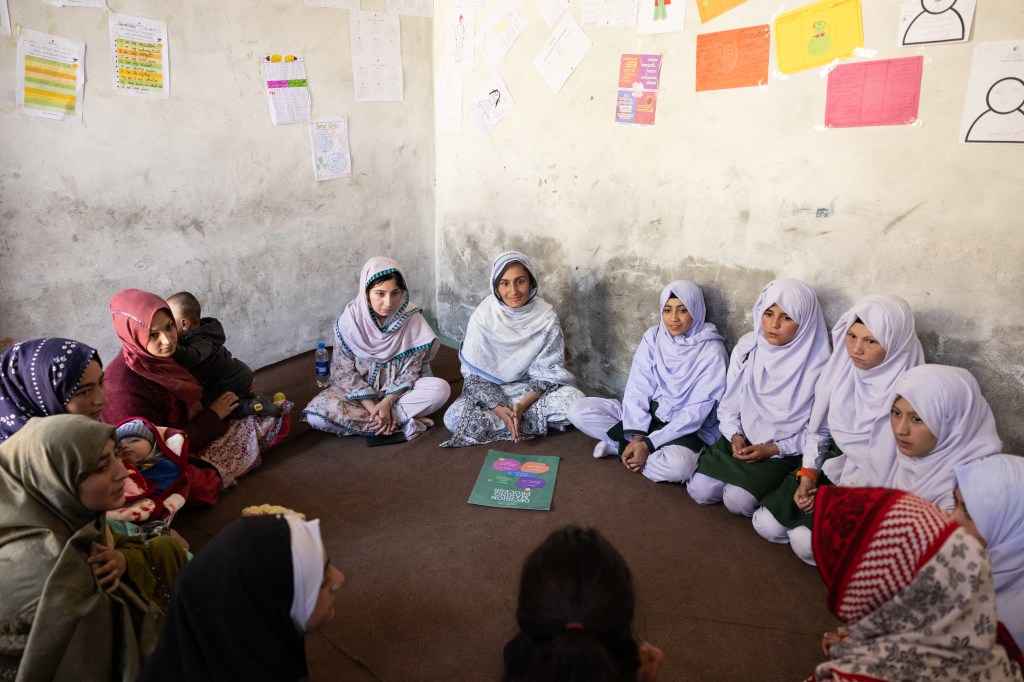
Saheli Circles are how local leaders in Gilgit-Baltistan are bridging the gap between girls and education. An Urdu term for “female friend,” Saheli Circles are after-school safe spaces where girls explore subjects like art and climate change, while also developing skills that help them manage emotions, set goals, and build positive relationships. Girls study in groups, visit the library, play sports, and tackle filmmaking and photography projects, all designed to develop self confidence and teach the girls how to advocate for issues that matter to them. But the work doesn’t stop there.
“What we’re trying to achieve here will only be impactful if it trickles down to the home environment and the school environment,” says Marvi Sumro, founder and program director of Innovate, Educate, and Inspire Pakistan (IEI), the local organization that developed the Saheli Circles model and partnered with Malala Fund in 2021 to make it a reality. Ever since, Saheli Circles have grown to involve teachers, elders, and parents to encourage relationship building that’s essential for young girls and adolescents. “Our spaces can give mothers and daughters an opportunity to interact a little differently—do an art activity, or have a cup of tea together, or some good conversation,” Marvi says.
The relationship building is what makes the biggest positive impact throughout the community. Recently, one Saheli Circle was able to bring together parents, teachers, and administrators to advocate for better education at their local school, and together they convinced the department of education to hire a science teacher. Another Saheli Circle organized a fund where members of the community can contribute monthly to pay for uniforms, books, and other school expenses for the girls in their village, eliminating those small, hidden costs that are often a barrier to education for many. A third Saheli Circle was able to produce a short film about how gender-based household chores can take away valuable study time from girls, leaving them at a disadvantage. “The girls put the film together and showed it to the mothers, and the response from the mothers was just beautiful,” Marvi says.
Girls smiling in Pakistan. Captured by Insiya Syed.
The education and relationship building that the girls receive in Saheli Circles connects them to larger opportunities and economic freedom that are not possible in their hometown. “For girls in Gilgit-Baltistan, education is extremely important because of the fact that we’re so far away from where the economy is, where the opportunity is. Education becomes this bridge for us, for our girls, to access all the opportunity and economy that exists in [larger cities].”
From rural Tanzania to remote Pakistan, local organizations prove every day that prioritizing girls’ education benefits everyone. Communities that lift up girls are able to secure resources like clean water and well-staffed schools, as well as build stronger relationships.
These outcomes are only possible because of the women and girls who work tirelessly in these regions to overcome barriers and drive progress. The Pura x Malala Fund Collection is a way to honor them, celebrate their achievements, and unite people the world over around a shared belief that education is freedom. Like scent, that belief can build, travel, and has the possibility to transform the world.
Experience the Pura x Malala Fund Collection here, and connect with the stories of real girls leading change across the globe.
For folks who struggle with social anxiety, an awkward silence in a conversation rings like a death knell. Strategies for avoiding those moments feel like both cheat codes and life preservers, which is why people are loving the three tips for never running out of things to say shared by Smartish Stuff.
“Being good at conversations isn’t about being confident,” the video states. “It’s about skill. And like any other skill, from playing an instrument to writing well, it can be learned.”
Here are three things to do when you don’t know what to say:
1. Ask intentional questions
At their core, conversations are a back-and-forth of questions and answers and related statements. Mastering the questions part gives you a lot more control over how the conversation goes.
when there's an awkward lull in the conversation and u try to think of any conversation starter pic.twitter.com/dLkvegEHQh
— buffysummere.bsky.social (@buffysummere) June 20, 2016
The example given in the video is someone saying, “I went golfing over the weekend.” How do you respond?
You might say, “Oh, that’s cool.” But that’s where the conversation dies.
Instead, you can ask questions like, “Where do you usually play?” or “How long have you been playing? Do you play competitively?”
“Even if you don’t care about golf, this shows genuine interest or at least creates the feeling of interest,” the video points out. “It also keeps the conversation alive and gives you control to guide it wherever you want.”
2. Listen more than you speak
It might seem logical that talking more will make you a better talker. But in reality, the best conversationalists are skilled listeners.
“Not the fake kind of listening where you’re just waiting for your turn to talk, but active listening,” the video says. “That means paying full attention, not preparing your next line in your head. Because when you do that, you often miss the point completely and end up saying something random or off topic.”
Saying something random because you weren’t really listening is just as mortifying as awkward silence, so active listening is an important skill to master. It also ties into the asking intentional questions tip. As the video states:
“Active listening gives you real material to work with. You’ll pick up details, emotions, or small clues that lead to better follow-up questions. That’s how you keep the flow going, not through clever lines, but through genuine attention. There’s a quote that sums this up perfectly. Most people don’t listen with the intent to understand. They listen with the intent to reply. Don’t be that person. The world has enough of them already.”
Easier said than done when you’re stressed about what to say, but just remember that keeping the focus on really listening will actually give you more to talk about.
Active listening means not trying to think of what you’re going to say next. Photo credit: Canva
3. Find common ground
Sharing interests, experiences, values, tastes in music or food, etc. can help us connect with people quickly. But how do we determine what we might have in common with a person we’re just striking up a conversation with?
The answer to that question will depend on the specific conversation, of course. But employing the first two tips will usually lead you to some kind of common ground.
“Once you find that shared point, steer the conversation there,” the video suggests. “Suddenly, it stops feeling like effort. It becomes natural, fluid, and even fun.”
Will that happen every time? No. And that’s where a bonus tip comes into play: Accept that awkward lulls happen.
“Let’s be honest. Not every conversation will flow perfectly,” the video states. “Some will still hit dead ends. There will be awkward pauses and silent moments. That’s okay. Silence isn’t failure. It’s just space. Learn to be comfortable with it and it’ll stop feeling like pressure.”
I wish people didn’t think silence was awkward, just enjoy it. Not every space has to be filled with words
The goal is not to convince people you’re interesting
The Smartish Stuff video wraps up with some wise words about what makes a good conversation:
“The truth is, good conversations aren’t about charm or confidence. They’re about curiosity, patience, and presence. If you apply these three methods, asking intentional questions, listening actively, and finding common ground, you’ll never truly run out of things to say. And over time, you’ll realize the goal isn’t to be interesting. It’s to be genuinely interested.”
People with social anxiety may still be left with questions, such as “How do I think of follow-up questions when my anxiety makes my mind go blank? How do I listen when I have loud, anxious thoughts blaring through my head? What if I can’t find common ground no matter how many questions I ask and how well I actively listen?”
Anxiety loves to come up with worst-case scenarios and imagine all of the ways something won’t work. And for people with severe social anxiety who need professional help to manage it, these tips may not be enough. But they are still worth working on, as they can help build the foundation that good conversations are based on.
For further help, talking with a therapist, doctor, or trusted friend could lower the volume on anxious thoughts.
Even though Americans and British people share the same language, there are a lot of figures of speech that don’t make a lot of sense when they go from one side of the pond to the other. The British have some unique turns of phrase that are head-scratching to Americans, such as “Bob’s yer uncle” and “Taking the Mick.”
Laurence Brown, a Brit who moved to the midwestern U.S., documents the differences between U.S. and U.K. culture on the Lost in the Pond YouTube channel. Brown created a fun video in which he explains why some American figures of speech make absolutely no sense to most British people. In the video, he explains how he first encountered each phrase and what they actually mean.
1. “It’s not my first rodeo”
“The thing is, rodeo isn’t really a common competitive sport in the UK. And so, if we are aware of it, we’re only aware of it through American movies and clips on the internet of bat crazy things that Americans do for fun. So while we can probably figure out what it means, we have absolutely no idea what it means.”
2. “As American as apple pie”
“I was baffled by the phrase ‘as American as apple pie,’ because if we have them in Britain, what’s so American about this apple pie? Well, as I’ve pointed out on this channel, nothing. Because apple pie has its origins in England.”
“Americans like to use the term “hit” metaphorically, hit the gym, hit the books, hit the gas, hit the skids. … But in hindsight, even though I was quite confused by the phrase ‘hit the books’ at first, I sort of prefer it to what we’d say in Britain, which is ‘I’m doing revision.’”
4. “The boonies”
“Anybody who’s followed this channel for a while will know that I’ve lived in Indianapolis and Chicago, the two largest cities in their respective states. But often we find ourselves driving between the two cities, where there is nothing other than farmland. In the early days of living in the US, I remember somebody referring to these parts as ‘the boonies.’ This itself was a confusing phrase at first, because I had never heard this word before.”
The phrase“Boondocks” appears to have entered the American lexicon from Tagalog, one of the languages of the Philippines. In Tagalog, bundok means “mountain.” The U.S. military began using the term and changed it to “Boondocks;” then, shortened to “Boonies” to describe the Vietnamese back country.
“‘Wazoo’ is an American slang term for the buttocks or anus. I see. So when you’re talking out of the wazoo, you’re literally talking s**t.”
6. “Get behind the eight ball”
“It is a billiards term in the UK. Billiards is not really all that popular, and so the phrase, as far as I’m aware, did not really catch on over there. Well, what does the phrase mean, Laurence? Well, it turns out that it means don’t get yourself into a sticky situation. In other words, don’t be thwarted by it.”
7. “Don’t mess with Texas”
“When I first heard it, I thought it was the state of Texas telling everyone else, ‘If you bring a fight to us, we will absolutely destroy you.’ It’s part of the reason that I haven’t properly visited Texas yet. I think a lot of people find this tagline funny because of that weirdly provocative-sounding threat. Well, British people, and anyone who’s genuinely confused by this phrase, might, depending on your perspective, be thrilled or distraught to discover that the phrase was just part of a successful anti-littering campaign.”
The phrase “Don’t Mess with Texas” comes from a 1985 anti-littering campaign by the Texas Department of Transportation. The first commercial, featuring blues guitarist Stevie Ray Vaughn, was a massive success, and the phrase soon entered the lexicon of Texans and the world beyond.
Even though Americans and British people technically speak the same language, there are some major differences in our English vernacular. For instance, if you were to give someone from the United States and someone from England this prompt:
Draw a kid in a jumper eating chips, biscuits, and flapjacks while watching football.
You would end up with two very different drawings. The words jumper, chips, biscuits, flapjacks, and football all have completely different meanings in American English vs. British English. Most of us know the football vs. soccer difference, but the others may be unfamiliar.
Football is soccer, except when it’s football. Giphy
Words in the same language having different meanings based on geography can be confusing for English language learners, especially when they’re learning how to order food in a restaurant. Here are some differences just with foods alone:
Chips
In the U.S., chips means potato chips. As in Lay’s, Ruffles, etc. In the U.K., those are called “crisps,” while chips means french fries. Hence fish and chips meaning fish and fries, not fish and Ruffles.
Biscuits
When Americans talk about biscuits, we’re talking about fluffy, flaky baked balls of dough smothered in butter and served with either soups or meat and mashed potatoes, generally. Buttermilk biscuits are an American staple. Not so in the U.K. where a biscuit simply means “cookie.” What we call a biscuit, they call a scone. We have scones in the U.S., too, but our definition is generally more limited to the triangular, sweet kind. British scones also cover what we think of as biscuits.
A flapjack in the U.S. is synonymous with pancake—the breakfast staple. A flapjack in the U.K. is a baked oat bar, almost like a granola bar.
Pudding
If you order a sticky toffee pudding in the U.K. and expect to get a custard-like substance, you’d be disappointed. Pudding is a general term for a dessert in the U.K., whereas it specifically means a custard dessert in the U.S.
There’s also the opposite issue, where we use different words for the same foods as opposed to the same words for different foods. In the U.K., a zucchini is a courgette, an eggplant is an aubergine, cilantro is coriander, a grilled cheese sandwich is a toastie, and Jell-O is jelly.
Clothing also can be confusing for folks learning English from an American vs. a Brit. Here are some words:
Jumper vs. Sweater
In the U.K., a jumper is what we call a sweater. In the U.S. a jumper is kind of like a mix between overalls and a dress—a sleeveless garment generally worn over something else.
Pants vs. Underpants vs. Trousers
What Americans call pants, folks in the U.K. call trousers. (Americans know the word trousers, but we don’t use it much.)
This one is super counterintuitive for Americans. A “vest” in the U.K. is an undershirt, like a thin t-shirt or tank top. What Americans think of as a vest, the Brits call a waistcoat.
Braces vs. Suspenders
This one is also counterintuitive for Americans. For us, braces are either the orthodontia that straightens our teeth or a supportive apparatus that stabilizes a body part (a leg brace, wrist brace, etc.). But braces in the U.K. has another meaning, which is what we call suspenders. In the U.K., suspenders don’t hold up pants—those are braces—but they do hold up stockings, which isn’t the way we use that word.
Bonnet and Boot
A bonnet is a head covering in both the U.S. and the U.K., but the Brits also use the word for the hood of a car. Boots are shoes that go above the ankle in both countries, but a boot is also the trunk of a car in the U.K.
That’s not the end of the list of words that differ between American English and British English, but it’s a good start. For folks learning English as a second language, it’s at least good to know that some things you learn will really depend on where your teacher is from so you don’t end up disappointed when you order pudding or biscuits at a restaurant and get something totally different.
This article originally appeared last year. It has been updated.
It’s hard to believe now, but communicating via the written word used to be a gigantic deal. Long before texting, social media, quick emails, or even short postcards, one of the only ways people could communicate across space and time was by writing long letters.
The 18th century is considered by some to be the peak of the Golden Age of letter writing. It was a key element of education for people wealthy enough to receive one, and it was incredibly important: business was conducted via handwritten letters, love was declared, and new introductions were made.
It was crucial, then, to choose your words extremely carefully. This was especially true in and around the Victorian Era in England, roughly between 1820 and 1914.
Victorian-era translations of everyday sayings
An English teacher from the United Kingdom has been delighting followers with Victorian-era translations of everyday sayings.
Abram Elenin runs Berber English, where he says, “I help professionals master British English… and communicate more effectively.”
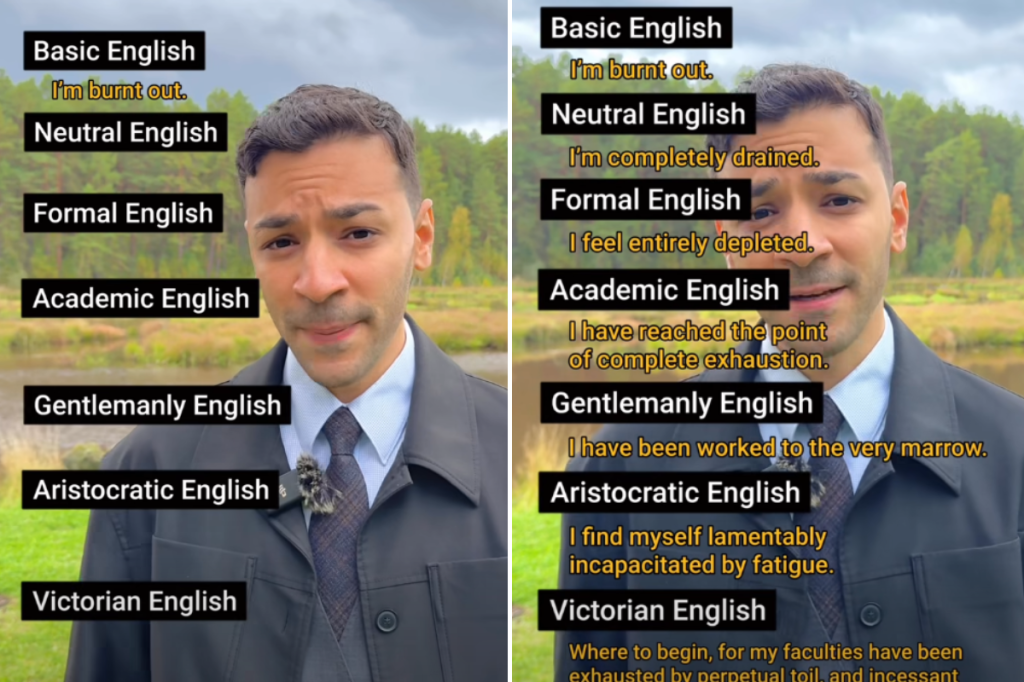
He also likes to have a little fun with his work as a linguistics expert and accent coach. In a wildly popular series of Instagram Reels, he performs “tiered” translations of common phrases, transforming them into increasingly formal variations. Victorian English is usually the final resting point and comedic punchline.
In one popular video, “I’m burnt out” becomes “I’m entirely depleted” in formal English, and “I have been worked to the very marrow” in gentlemanly English.
But Victorian English, the age of beautiful if long-winded novels like Great Expectations and Jane Eyre, takes the cake: “Where to begin, for my faculties have been exhausted by perpetual toil, and incessant application has so stripped me of vitality that I am scarcely able to summon the strength requisite for the smallest effort.”
In another Reel, “I’m poor” becomes “I find myself in a precarious financial position,” and finally:
“It is with no small measure of affliction that I acknowledge my fortunes to be sadly diminished, my purse exhausted, and my station reduced to one of grievous penury, such that I find myself abandoned to the stern tutelage of want, the harshest master to which mankind is ever subject.”
It just sounds so much better that way. Can’t you just hear Moira Rose from Schitt’s Creek saying that?
Elenin’s videos have reached millions of viewers worldwide, helping them gain a greater appreciation for Victorian-era English and language more broadly.
“‘My faculties have been exhausted by perpetual toil’ goes hard,” one Facebook commenter notes.
“Gonna use Victorian for my essays now,” someone says on Instagram.
“I just love listening to you saying these things,” adds another.
A few brave commenters tried writing their own Victorian-style passages, but it’s really a job best left to the pros, like Elenin.
Why the language died out
This gorgeous, verbose style of language unfortunately faded as literacy rates climbed and the written word became more commonplace.
However, letter writing was still commonly practiced until the telephone became a major part of everyday life in the early 1900s.
Early phonograph recordings from the late 1800s offer some of our only glimpses into what people in the Victorian era actually sounded like. Though their conversations are less flowery and long-winded than their writing, they still stand in stark contrast to casual conversation today.
While it’s a little sad for those who appreciate language that this kind of prose is mostly extinct, there is some good news: letter writing is making a comeback. As people grow weary of screens and impersonal digital communication, the trusty pen and paper are experiencing a much-needed revival.
Maybe now is the perfect time to brush up on your Victorian English, or at least take some inspiration from the way they could make anything sound interesting or profound.
Job interviews can be equal parts anxiety-inducing and exciting. A new opportunity, and possibly a different future, can await. Then, after the interview, you check your inbox: “We regret to inform you…” “Unfortunately, while your qualifications were impressive…” “We’ve decided to go in another direction at this time.” Rejection after an interview can feel defeating. However, there are ways (and reasons) to feel like you’ve won anyway.
Several career experts and job search professionals spoke to Upworthy to share their advice on managing the emotions that come with job rejection. They also offered tips and data to boost your confidence and help you return to the job search feeling like a winner. Here are five of their recommendations.
1. Feel the feelings
“Give yourself permission to feel how you feel,” said career coach Dante Rosh. “If you’re feeling rejected, feel rejected. Acknowledge the feeling, but don’t allow yourself to sit in it too long. Put a timer on your pity party. This may sound like, ‘I’m going to feel bad for the rest of today, but tomorrow is a new day and I’m going to continue my search.’”
“Rejection after a job interview can be challenging, but the most important thing you can do is protect your mindset,” said Jasmine Escalera, a career expert for LiveCareer. “Take a moment to pause, breathe, and step away instead of rushing right back into applications. So many candidates push through without processing it, but giving yourself that space supports your mental and emotional health. And when you do that, you come back stronger, more grounded, and more resilient for the remainder of your search.”
2. Know that you aren’t alone, and that there will likely be many rejections before a “yes”
Ellen Raim, a former chief human resources officer turned career advisor, said the job market is difficult. She shared data showing that it can take 50 applications to get a job interview and 200 interviews to land a job. She encouraged new job seekers to keep going.
“In today’s market looking for a job is like being in sales. Good salespeople know they won’t close every deal,” said Raim. “On the hard days, remember: every effort you have made counts; you’re closer than you were yesterday. You have a great product. You will make the sale; keep going.”
“Rejection has a finite time frame,” said Lacey Kaelani, CEO of job search engine Metaintro. “According to our data, the average number of applications received for any position is in the approximate excess of over 250. Reaching the interview stage could mean that an applicant is in the top 2% of all applications. That in itself is a win.”
You can still land jobs at companies who have rejected you in the job search. If you went through their hiring process, that means you have good skills and are compatible with the team, just the timing or role wasn’t quite right. So many of my clients land jobs at companies who once rejected them by using Job Shopping strategies. You can do this too! Don’t let these relationships go to waste. Follow for more! #jobsearch#jobtips#hiring#business#worklife#careercoach#jobmarket
3. Reframe and redirect negative thoughts and rumination
“Reframe your negative thoughts,” said Rosh. “While we can’t always control what thoughts pop into our heads, we can control the power and energy we give them. Instead of accepting ‘I’m unhireable’ as fact, try reframing it. ‘My mind is telling me I’m unhireable and I’m working on not buying into that.’”
Peter Franks, a former executive search firm headhunter who’s currently the editor at No Latency, said to focus on the facts of the situation rather than ruminate on the rejection.
“As humans, we’re naturally competitive and want to succeed,” said Franks. “Being rejected hurts our pride but it’s worth remembering that only one person can win any recruitment process. If you apply for a role and get invited for an interview, you’ve already beaten 80%+ of the market. If you make it to the second or third interview, you’ve probably surpassed 90% of the candidate pool.”
In short, if you don’t get a job offer after a third interview, you didn’t lose 0-1—you won 2-1. This reframing could lead to a 3-0 win in the future.
4. Write down what went right and what you learned
Lucas Botzen, a human resources manager and CEO of Rivermate, recommended writing down three moments in which candidates felt confident, thoughtful, or had a strong rapport with the interviewer. Botzen said this shifts the focus from what could have gone wrong to what went right. He also recommended keeping a log after every interview.
“Write a skills success log for each interview,” Botzen said. “This is a log that should record not only what worked but also what [the interviewee] learned about themselves and their skills.”
Writing down what you did right helps you see the wins you’ve achieved and offset any feelings of loss.
5. Send a thank-you note to the interviewer for your own confidence
“After being rejected for a job, the best thing you can do is send the hiring manager a brief thank you note with a question about how you can improve your resume or skills to ‘hopefully’ land a job at that company one day,” said Kaelani. “You might end up receiving an answer that provides insight.”
While this advice is typically recommended as a courtesy, it’s not just about professionalism. It also allows you to get the last word.
“By sending a thank you note to the interviewer in which you reference an idea that you discussed during the interview, you are taking control of the situation,” added Botzen. “This gives you a sense of power and professionalism, even if the company decided to go in another direction.”
Rejection is common. While it hurts, these insights can help job seekers feel better, knowing that landing a job is not a question of “if,” but “when.”
The word “girl” evokes the thought of a female child, while “boy” conjures the thought of a male child. This is true for most people, regardless of their country of origin. But according to Harvard University linguist Sunn m’Cheaux, the word “girl” was originally considered gender-neutral.
What sparked the revelation was a video showing a woman calling her male friend “girl” during a conversation. The short, seemingly amusing clip sparked a firestorm of comments from men who found the unintentional gaffe insulting. Some men viewed the term as emasculating, while women claimed it was gender-neutral.
Sunn m’Cheaux originally added his voice by pointing out that when women use the term with men, it reflects a closeness in the friendship.
“Quick FYI: If you’re in a conversation with a Black woman who inadvertently calls you ‘girl,’ do not get offended. She is not ‘emasculating you’—she’s comfortable with you,” the language expert says in a TikTok video, as women in the comments agree.
After seeing comments saying that women simply didn’t know the etymology of the word, m’Cheaux jumped back in to break things down. The confusion, he explains, is that the once gender-neutral term became gendered, losing its original meaning. In a follow-up video posted to his social media pages, he explains the etymology of “girl” for naysayers.
“The good news is, if you think that most of the women and girls who inadvertently call y’all ‘girl’ don’t actually know the etymology of the word ‘girl,’ you’re probably right,” the linguist says. “Most English speakers don’t know the etymology of the word ‘girl.’ But see, that’s where the bad news comes in for you. You see, the word ‘girl’ was originally gender-neutral. That’s right. For centuries, the word ‘girl’ simply meant a child of either sex.”
He further explains that male children were called “knave girls,” distinguishing them from female children. The word “boy,” on the other hand, originally meant servant. This gender-neutral usage didn’t stop with “girl”—he adds that “man” was also used for both sexes.
“To distinguish a human female from a human male, that would be a ‘wifman’ for a female,” m’Cheaux explains. “Later, the term ‘wife’ would mean the companion of a man, but you actually didn’t originally have to be the companion of a man to be a ‘wife.’”
In the video, he also addresses the terms “midwife” and “gossip,” explaining how they became associated with women. He impressed viewers with the impromptu etymology lesson.
One person writes, “I feel like I just attended a really great lecture and I should probably rewatch and take notes! So much info!”
Another says, “Oh, how I love these etymology breakdowns!!! So much fun learning how words/language evolve! But I’ont think anybody does this as well as you do.”
“You’ll have to start charging for these seminars. That was at least one credit’s worth of knowledge!” Someone else chimes in.
“I love this! May I use this in my class when we talk of pronouns and how they have evolved?” an eager professor shares. “Some of my future journalists are battling they/them conundrums outside our Emerson bubble. I’d love to add this to the conversation.”
“Sir, you make my brain hurt in the best possible way. Appreciate you,” another person notes.
If this sounds familiar, you’re not alone. Introverts make up one-third to one-half of the population, but our conversation norms—both online and off—are designed for extroverts.
Susan Cain, author of the bestselling book Quiet: The Power of Introverts in a World That Can’t Stop Talking, calls this phenomenon the “New Groupthink.” It’s a culture that favors constant collaboration and rapid-fire replies over stillness and deep thought. We live in a world that measures contribution by the number of messages sent, and it’s easy to feel like you’re falling behind when you go silent.
But what if this isn’t about falling behind? What if silence is just a different way of engaging? If you’ve ever wondered why you go quiet in group chats, consider these 10 signs you might be an introvert.
Unlike their extroverted counterparts, introverts take time to think about their responses before firing off a text. Photo credit: Canva
As Cain describes in her book, introverts “listen more than they talk, think before they speak, and often feel as if they express themselves better in writing than in conversation.”
In a group chat setting, this internal processing means you might mentally prepare a response, revise it, overthink the timing (can’t be too quick or too slow, right?), and then decide the conversation has already moved on without you. The perfect response you crafted vanishes before you hit send.
2. Surface-level banter drains you
For introverts, not all conversations are created equal. You might find endless small talk, quick memes, and emoji reactions tiresome, and yearn for messages with more substance. That’s because introverts crave depth—a meaningful exchange that explores an idea, a feeling, or a genuine problem.
How would you react in this situation? I already interact too much with some of my coworkers on a daily basis so please leave me out the group chat. Thanks #groupchat#introverts#workgossip
Research published in the Journal of Personality and Social Psychology found that serious conversations are more enjoyable than people expect, yet we consistently underestimate others’ interest in them. For introverts, this inclination toward depth isn’t a personality quirk—it’s a fundamental part of how they communicate.
3. You observe everything
If you’re quiet in the group chat, it doesn’t mean you’re not paying attention. Introverts are sharp readers of context: they notice shifts in tone, track emotional undercurrents, and pick up on what’s not being said as much as what is. This ability to observe and accurately synthesize group dynamics is one of the most underappreciated traits in online communication.
Introverts are sharp readers of context—everything that’s not being said. Photo credit: Canva
Psychologist Daniel Goleman found that empathy is a core component of emotional intelligence, and that quiet people often exhibit greater empathy because they listen more deeply. So while you may not be contributing messages to the group chat, you’re still playing an active role—picking up on subtle cues, like a shift in someone’s tone.
4. Group chats drain your social battery
Group chats require a lot of mental and social energy as you process multiple conversations, competing personalities, shifting group dynamics, and implicit social cues all at once. That’s an enormous cognitive load, especially compared to one-on-one conversations, where your focus can be directed toward a single person without all the noise.
If you feel overwhelmed, muting the chat might not be a bad idea. You need to manage—and maintain—your energy well.
5. You refuse to break the silence with noise
You won’t send a message just to be seen. While some group chat members are happy to drop a fire emoji or send an “lol” to stay visible, introverts tend to hold back unless they have something substantial to contribute. They’re committed to authentic communication.
Blake Griffin Edwards, a licensed marriage and family therapist, explains it this way: “Introverts must think it out before they are able to talk it out very well.”
As a result, your communication style is built on intention rather than impulse. You may send fewer messages, but when you do, they’re more meaningful.
6. Group chats can feel overwhelming, even for good writers
Here’s a paradox many introverts recognize: writing often feels more natural than speaking. Text removes the social pressure of real-time performance, giving you space to choose your words carefully. Yet despite being text-based, group chats can still trigger overstimulation.
The problem lies with pace. A group chat doesn’t move at the same speed as a thoughtful email chain or a journal entry. It’s fast and unpredictable—like a live conversation—which creates the same timing pressures introverts face in verbal group settings. Hans Eysenck’s foundational theory of introversion suggests that introverts have a higher baseline level of cortical arousal, meaning they reach sensory overload faster than extroverts when external stimulation—like a flood of notifications—keeps escalating.
7. You tune into how others are feeling
You’re not just reading the words in a thread—you’re reading between the lines. As an introvert, you probably notice delicate emotional shifts, like a person’s messages becoming shorter, a joke that falls flat, or silence from someone who’s usually chatty. This emotional sensitivity is a strength, but it can also make group chats feel more burdensome than expected.
Emotional sensitivity can feel like a burden in group chats. Photo credit: Canva
In The Mirror, Katie Oborn observed that introverts “pick up on unspoken emotions and subtle shifts in conversation and tone.” That level of awareness means introverts are often the first to notice when something is off.
8. You don’t bend to the pressure to perform
Group chats carry an implicit social pressure: respond quickly, be entertaining, stay visible. For emotionally independent introverts, that pressure can feel crushing. People who resist the pull to perform in group settings often have a strong internal compass about what matters to them and why. They won’t chime in for the sake of it, and they won’t be dragged into drama just because the group demands a response.
9. Constant notifications break your focus
For introverts, great thinking often happens when you’re alone. There’s research to support this: studies consistently link solitude to improved emotional regulation, creativity, and decision-making. When a group chat keeps pinging you—interrupting a reading session, the workday, or a quiet moment—it fragments the kind of deep focus and flow state introverts depend on.
Studies from Microsoft Research confirm that instant message notifications slow task performance and make it more likely you’ll lose your train of thought. For introverts, who need more time to process information, these interruptions can be even more costly. The “ping” of a phone notification can disrupt deep focus.
Scroll through your messages, and you might notice a pattern—either in yourself or in your introverted friends. Long periods of silence often lead to a single, valuable message that adds meaning to the conversation. That’s what strategic participation looks like: waiting for the right moment, then contributing something meaningful.
Embracing your strength
For introverts, hanging back and staying quiet in a group chat isn’t withdrawal. It’s a form of meaningful participation that favors observation, thoughtful processing, and intentional engagement over simply making noise.
If you recognize these signs in yourself and want to start engaging more on your own terms, these small shifts can help:
Try preparing your thoughts before or at the start of a lively group conversation.
Remember, writing is your natural way in. A thoughtfully crafted message at the right moment can carry more weight than a dozen impulsive replies.
Feel free to set notification boundaries without guilt.
When you’re ready to chime in, trust your timing and insight.
As Susan Cain reminds us, being the loudest in the chat doesn’t mean having the best ideas. The quietest voice may actually be paying the closest attention—and when their words are shared deliberately, they can shift the entire conversation.
Many people are looking to improve their public speaking skills, whether for work or to feel more comfortable in social situations. While taking classes and getting advice from speech coaches can help, some people have difficulty finding either the money or the time to access professional help. But one speech expert believes you can significantly improve your verbal communication skills just by using your phone.
In a YouTube video, communication professional and speaker Vinh Giang offers a daily exercise that can help improve public speaking: sending voice messages instead of texts. Giang notes that one benefit of texting is being able to review a message before sending it to fix potential communication issues or miscues—and argues that you can do the same with voice messages.
Recording a voice message lets you hear yourself in a low-stakes situation, with the option to re-record again and again if necessary. Each time you listen back, you can pick up on your volume, speed, clarity, and word choice and be more mindful in the next one. You’ll be able to see (well, technically hear) where you’re lacking and what to improve, whether that means fixing an issue right away or identifying exactly what you need to work on in your speech.
Speech professionals agree voice notes help improve speaking abilities
Other professionals in public speaking and speech therapy spoke to Upworthy about voice messages and how they can help people improve their speaking skills.
“In the speech therapy world, the process of using voice messaging to improve public speaking would be considered a method called self-monitoring through biofeedback,” said speech pathology expert Ryann Sutera. “Rehearsing running speech through the use of recordings can help assess intelligibility, rate of speech, and word choice.”
“Using voice memos as a low-stakes tactic to improve communication and public speaking skills is something we find helps prep our clients for media opportunities,” said public relations director Lauren Guess. “Most of our clients are on the go, and sending a voice memo back in response to the reporter’s question is a great practice for creating usable, digestible sound bites.”
Guess said voice messages not only help communication with media outlets, but also help refine clients’ public speaking skills and sharpen their talking points.
“We prefer this approach because we find it quickly strengthens confidence in speaking on their subject matter and enhances their ability to nail their key messages, compared to submitting quotes via email or text,” Guess said.
Whether you want to improve your public speaking for professional reasons, like giving a presentation at work or running for political office, or to get better at conversations and connecting with friends, it might be worth recording a voice note instead of talking through your fingertips.