upworthy
Add Upworthy to your Google News feed.
Google News Button
Culture

'Twitter Queen' Dionne Warwick opens up about her social media fame

Dionne Warwick twitter, Dionne warwick tiktok, Dionne warwick today show

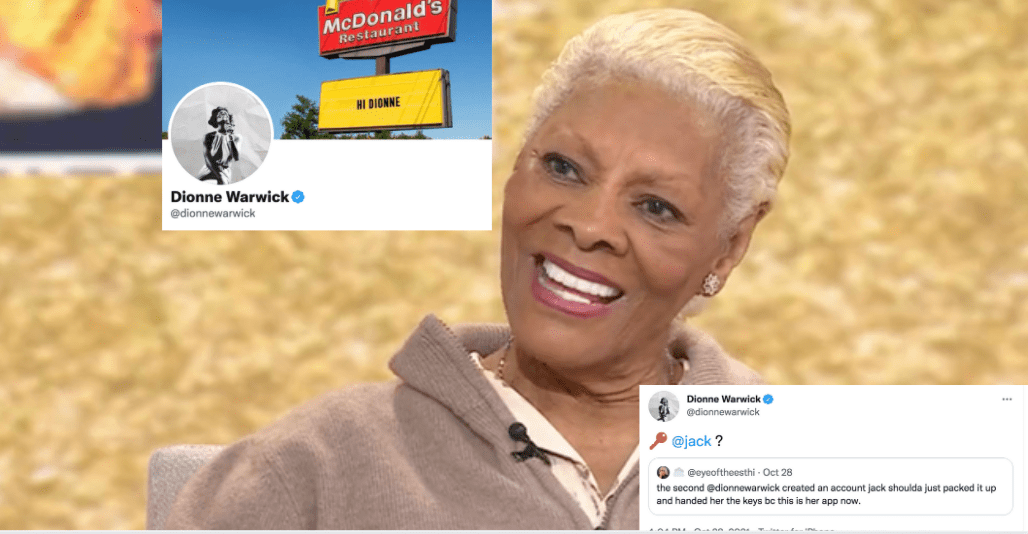
Dionne Warwick on 'The Today Show' via Twitter.

What makes a social media star? Usually it's a perfect blend of direct honesty, zesty wit and a down-to-earth way of communicating on the fly. So really, is it any surprise that sensational music icon Dionne Warwick has won the title Queen of Twitter? I think her thousands upon thousands of followers—or as she calls them, her "babies"—would give a resounding "no."

"The Today Show" recently interviewed Warwick to discuss adding internet fame to her many, many, many accolades. The pop icon noted that learning the platform gave her "a chance to to meet some really wonderful kids … and some grown ups that finally figured out how to do it."

"Auntie" Dionne first came to Twitter at the suggestion of her social media savvy niece, Brittani Warwick. Brittani, also Dionne's branding director, knew her auntie's inherent "nosiness" would be well received. She told People, "The great thing about Aunt Dionne is she brings such joy just by being herself, even if she's being very firm and stern with you, it's through love."

Though she is "not writing a bio," Dionne has been delighting celebrities, corporations and fans alike. Everyone is fair game.

Revisiting some of her top-tier tweeting moments—both infamous and obscure—it's easy to see why this 80-year-old woman is dominating the app while making friends (not to mention endorsement offers) along the way.


The tweet to Snoop Dogg that started it all.

Warwick's playful spirit showed up in her tweet asking "How do send a tweet to @SnoopDogg? Did I do this correctly?"

Yes, Dionne, you nailed it. We don't even care about the improper grammar.

(And yes, Snoop Dogg did reply eventually)

Which led to roasting Chance the Rapper…

Warwick must have gotten the hang of the platform pretty quickly. Only two days later she jokingly called out Chance the Rapper's stage name.

"Hi, @chancetherapper. If you are very obviously a rapper why did you put it in your stage name? I cannot stop thinking about this." She went on to start calling herself "Dionne the Singer."

…and The Weeknd…

On a savage streak, Dionne chose to hit R&B artist The Weeknd, tweeting: "The Weeknd is next. Why? It's not even spelled correctly? @theweeknd"

…​​and​​ a music collaboration for charity.

What started as social media comedy has now turned into a collaboration. Dionne (the singer), Chance the Rapper and The Weeknd have a new song coming out this week (on Nov 26). The single, titled "Not Impossible," will go to support charities SocialWorks, Hunger: Not Impossible and Kind Music Academy; and it will help launch 12 Days of Giving, a campaign focused on keeping those in need warm and fed during the cold winter months. Warwick always uses her imminent power for good.

Her honorary staff position at Twitter

Warwick's tweets (or "twotes," as she prefers to call them) have made such a digital splash that Twitter CEO Jack Dorsey told her he wanted Warwick on his staff, referring to her as "Employee of the Month." Dionne immediately let the world know about her new position.

When she gave some loving advice to a stranger

Proving that she really is "everybody's auntie," Dionne dished out some wisdom to a stranger having a rough time.

Her airport humble brag

In her defense, Dionne is cute everywhere she goes. And she did just apologize.

That time she reached out to let us know she is, in fact, not dead

As one commenter wrote, "you ain't famous until a media source says you're dead while you're trying to eat breakfast."

When she became a Swiftie

A kinship was already forged when Warwick initially tweeted to Taylor Swift wishing her good day. But she also weighed in on the case of Taylor's missing red scarf (the one Jake Gyllenhaal was rumored to still have post-breakup). She even offered to pay postage for Gyllenhaal to return it.

The whole thing sparked an online debate as to whether or not the scarf was really a scarf at all, or whether it was actually a metaphor for Taylor's … well … let's just say something else that can be lost but not returned.

Her hilarious and "unnecessary" brand deal audition

She told Twitter: "All these children, babies, youngsters, are grabbing on all of these wonderful commercial that they're doing. somethings wrong with this picture. Why aren't these brands coming after people with my age demographic?"

Then she decided that maybe they were waiting for an audition.

Her video included a hilarious throwback to Hellmann's mayonnaise, where she reiterated that she was a hell no for mayo in coffee.

All of the brands replied back to tell Miss Warwick that an audition was not necessary. Rightfully so.

Becoming the new face of Oreo

People were quick to eat up this branded co-op idea.

One person tweeted "I would buy them in a heartbeat."

Though Dionne promises not to pick a weird flavor, I think people would even flock to an Oreo that tasted like salmon, if her image appeared on the packaging.

When she championed Megan Thee Stallion, and women everywhere

When one person responded to Dionne's tweet saying "miss Warwick, you're a hot girl??? what you know about Megan?" she had the perfect response:

"I know that she is a smart young lady with a good heart!" she replied.

She added "I don't know what a 'hot girl' is, but women support women in this house! I am happy to see kind people receive recognition. That's all. (I'm turning 80. Please do not tell me what a 'hot girl' is )."

Her sweet reminder that she's spreading love, not throwing shade

I think this person sums up our collective response: "I'll take Auntie shade or love or whatever you throw my way."

And lastly, her SNL appearance, meeting "herself"

Dionne's Twitter fame is so vast that "Saturday Night Live" featured a scene where Dionne Warwick tells herself (played by Ego Nwodim) "Darling, I'm not perfect. I'm just very very good."

Indeed she is. Thank you Miss Warwick for brightening up the internet and bridging the gap between generations, inspiring everyone to engage in more lighthearted interactions.


ideas, homelessness, prodigy, social work, solutions
Photo credit: @ribalzebian on Instagram

Ribal Zebian is going to test a house he designed by living in it for a year.

Ribal Zebian, a student from the city of London in Ontario, Canada, already made headlines last year when he built an electric car out of wood and earned a $120,000 scholarship from it. Now, he's in the news again for something a little different. Concerned with homelessness in his hometown, Zebian got to work creating a different kind of affordable housing made from fiberglass material. In fact, he’s so confident in his idea that the 18-year-old plans on living in it for a year to test it out himself.

Currently an engineering student at Western University, Zebian was concerned by both the rising population of the unhoused in his community and the rising cost of housing overall. With that in mind, he conjured up a blueprint for a modular home that would help address both problems.


Zebian’s version of a modular home would be made of fiberglass panels and thermoplastic polyethylene terephthalate (PET) foam. He chose those materials because he believes they can make a sturdy dwelling in a short amount of time—specifically in just a single day.

“With fiberglass you can make extravagant molds, and you can replicate those,” Zebian told CTV News. “It can be duplicated. And for our roofing system, we’re not using the traditional truss method. We’re using actually an insulated core PET foam that supports the structure and structural integrity of the roof.”

Zebian also believes these homes don’t have to be purely utilitarian—they can also offer attractive design and customizable features to make them personal and appealing.

“Essentially, what I’m trying to do is bring a home to the public that could be built in one day, is affordable, and still carries some architecturally striking features,” he said to the London Free Press. “We don’t want to be bringing a house to Canadians that is just boxy and that not much thought was put into it.”

Beginning in May 2026, Zebian is putting his modular home prototype to the test by living inside of a unit for a full year with the hope of working out any and all kinks before approaching manufacturers.

“We want to see if we can make it through all four seasons- summer, winter, spring, and fall,” said Zebian. “But that’s not the only thing. When you live in something that long and use it, you can notice every single mistake and error, and you can optimize for the best experience.”

While Zebian knows that his modular homes aren't a long-term solution to either the homeless or housing crisis, he believes they could provide an inexpensive option to help people get the shelter they need until certain policies are reformed so the unhoused can find affordable permanent dwellings.

@hard.knock.gospel

What to buy for the homeless at the grocery store. 🛒 Most people get it wrong. After being there myself, these are the survival items that actually matter 💯 The 2nd to last one is about more than survival—it’s about DIGNITY. We are all one circumstance away from the same shoes 🙏 SAVE this for your next grocery run. 📌 IG@hardknockgospel Substack@ Outsiders_Anonymous #homelessness #helpingothers #kindness #payitforward #learnontiktok

Zebian’s proposal and experiment definitely inspires others to try to help, too. If you wish to lend a hand to the unhoused community in your area in the United States, but don’t know where to look, you can find a homeless shelter or charity near you through here. Whether it’s through volunteering or through a donation, you can help make a difference.

Germany; German; smiling; culture; cultural norms; smiling at strangers; customer service

A German man explains why smiling at strangers in public is weird in Germany

Americans have such an interesting reputation internationally, but one that seems to give our nationality away in Germany is our habit of smiling. That's not to say that Germans don't smile because of course they do! But they don't smile while passing strangers on the street or use it as a social nicety.

Some may consider the constant smiling that many Americans do as fake or disingenuous because it's not part of their cultural norms. Dominik, a German man who runs the YouTube channel Get Germanized, explains that Americans may be taken aback by the lack of smiling by German citizens in public settings.


In America, it's considered polite to smile when greeting people or even when entering a place of business while passing another customer. It's a social norm that signals to the other person that you're acknowledging them. Sometimes this can be followed by a good morning or a thank you if the person in question held the door. There are places in the country where this is not as prevalent, but even in large cities where everyone seems to be in a rush, smiling still seems to be an understood custom.

Germany; German; smiling; culture; cultural norms; smiling at strangers; customer service Smiling girl chatting outdoors with a friend.Photo credit: Canva

Cultures vary from state to state, so it's no surprise that German social niceties are different than those in the U.S., Dominik explains, "Smiling is social lubricant everywhere else. [In] Many cultures, especially English-speaking ones, smiling is a social default. You smile at strangers. You smile to soften social interactions. You smile even when you don't mean it. It's a universal, friendly, 'I'm harmless' gesture. In Germany, that's suspicious. People will think, 'Why is this person smiling at me?'"

He goes on to share that the German smile is rare because it is only used when they're familiar with the person and are genuinely happy or amused. According to Dominik, a German offering up smiles to random people could "feel fake, intrusive, or overly familiar." It can also be seen as nervousness, insecurity, or manipulation. Germans don't smile to soothe the discomfort of themselves or others. Instead, their faces remain neutral until they experience an emotion that would elicit change.

"German communication is built on honesty. Not just in words, their body language too. If they're tired, you'll see it. If they're annoyed, you'll feel it. If they're happy, they'll show it, but only when they actually are. No forced cheerfulness. No plastic service smile. No, 'How are you? Fine,' dance. It's refreshing once you get used to it. Like taking off a mask you didn't know was there," Dominik says.

The no-smiling cultural norm extends to the service industry in Germany. Customer service employees are there to solve the customer's problems, not to be entertaining. Dominik explains that Germans trust professionals who look focused while working. Even on public transportation, no smiling is going on between commuters; people mind their own business. They're not unfriendly, they're respecting your space." Dominik shares.

Germany; German; smiling; culture; cultural norms; smiling at strangers; customer service Smiling warmly in a cozy sweater, feeling relaxed and happy.Photo credit: Canva

The German culture enthusiast assures viewers that Germans smile a lot, but it's reserved for friends, families, and cute puppies. They also smile at people they like, so it's not that Germans think Americans are strange for smiling; their cultural norms are just different.

washer, washing machine setting, how to use washing machine, laundry, laundry tips
Image courtesy of @granolabarpan/Instagram (with permission)

Stay-at-home mom Catrina shares shock at learning what the 'heavy' setting on her washer means.

Knocking out loads of laundry is a feeling of accomplishment that is unmatched. Depending on what needs to be washed, washing machines offer a variety of settings for the ideal clean. But even the most seasoned laundry pros can admit that they don't fully understand how to use them properly.

One stay-at-home mom shared her funny and relatable washing machine mistake. Catrina (@granolabarpan) got the shock of a lifetime when she realized that she had been using the "heavy" setting on her washer wrong for years.


"POV: today years old when it clicks why my blankets are sopping wet!!! I thought HEAVY meant heavy items being washed," she wrote in the video's overlay.

"Heavy on my machine means heavily soiled," she went on to add in the comments. "I thought it meant the stuff I was putting in the machine was heavy in weight/pounds."

Some moms are also realizing this for the first time. "Ok.. so I am 66 years old learning this???!! I always thought that heavy meant weight also😂," one person commented. Another person wrote, "Well I was today years old when I learned what heavy meant too…😂"

Others expressed confusion with so many settings, and reminiscing on simpler times. "Wait a minute. 😂. I think I need to for once go and read the manual because I have been wondering about all of the options," another user wrote. And another chimed in, "I want my old $250 3 options hot/warm/cold on/off washer back. It didn’t die it rusted out but took 25yrs to do it. I had 5 kids, plus my ex in-laws living with me."

Washing machine settings, explained

Struggling to understand the settings on your washing machine? You're not alone.

"Knowing these settings helps avoid common laundry mistakes, such as using the heavy cycle for heavy fabric weight instead of heavy soil, which can lead to ineffective cleaning or damage over time," Vanessa Ruiz, a professional organizer at Sparkly Maid San Antonio, tells Upworthy.

These are five washing machine settings and how they work:

1. Normal/Regular Cycle
Ruiz explains that this is your typical setting for day-to-day loads such as t-shirts, jeans, sheets, and underwear.

"These laundry loads are typically washed in warm water and the setting is rinsed with medium spin speeds through agitation in order to properly clean moderately soiled garments," she says. "This cycle is safe enough to wash a variety of different fabric content with a somewhat dirty load."

2. Delicate/Gentle Cycle
Ruiz notes that the delicate cycle is created specifically for delicate fabrics—lingerie, silk, lace, or embellished clothing—that may become damaged in a normal or regular wash.

"This cycle will use moderate spin speeds through gentle agitation to thoroughly dry clean and not damage clothes too easily," says Ruiz. "This is the preferred cycle when laundry items that require extra care or are labeled 'delicate' or 'hand wash' need to be washed."

3. Heavy Duty Cycle
The heavy duty cycle is specifically for heavily soiled items like work clothes, kitchen towels, and bedding.

"This setting uses higher water temperatures, longer wash times, and powerful agitation to remove stubborn dirt and grime. It’s perfect for those tough laundry jobs, but not recommended for delicate fabrics," explains Ruiz.

- YouTube www.youtube.com

4. Bulky/Bedding Cycle
This cycle is often confused with "heavy."

"This cycle accommodates larger, heavier items that absorb a lot of water, such as comforters, pillows, and sleeping bags," says Ruiz. "It uses more water, medium spin speeds, and longer wash times to thoroughly clean bulky items without causing damage or imbalance."

5. Quick Wash
In a rush? This is the perfect setting to use.

"It is an accelerated wash cycle designed for small loads of lightly soiled clothes, usually lasting 15 to 40 minutes," says Ruiz. "It’s great for when you need clean clothes fast and can save energy compared to longer cycles."

This article originally appeared last year.

senior citizen, elderly, karaoke, music, Barry Manilow, singing
Photo Credit: Canva

An elderly man sings karaoke. Barry Manilow poses for a headshot.

Sometimes, people just want to sing. They imagine themselves belting out their favorite tunes to whomever will listen. But for many, anxiety overtakes their fantasy. The thought of messing up or sounding bad is just too terrifying, and they end up keeping their songs to themselves.

Luckily for a 79-year-old man named Colin in Barnsley in the UK, the opportunity to turn this fantasy into a reality presented itself. Singer/songwriter Ruth Lisgo had begun recording karaoke on the street, occasionally handing out a microphone to those who wanted to join in on harmonizing or singing a verse or two.


Colin first went viral after singing "Words" by the Bee Gees. Lisgo states on an Instagram post that "over one million have now viewed that video."

@ruthlisgomusic

Replying to @Sir Nick the Naughty I absolutely agree Nick. So often when I’m busking I come across people who have so many stories to tell and often in life it just takes a few minutes to really make a difference with someone by listening ❤️ 🙏 Colin has many stories I’m sure #words #beegees #busking #takethetime

Well, Colin has returned a few times, most recently to belt out "Mandy" by Barry Manilow. An added bonus is that he dedicated his rendition to none other than his dental hygienist.

In a chyron over the clip, Lisgo explains, "This man asked if he could sing on my mic. He told me he only sang karaoke at home when he was younger, but always loved singing and music. But he was afraid of forgetting words and being on a stage. He came back today to sing this for his dental hygienist who had seen the video of him singing 'Words' by the Bee Gees, and she requested him to sing this ahead of her going to a Barry Manilow concert in 2026."

Clad in a warm coat and beanie, Colin grasps the microphone. His hands seem to shiver in the cold, but what comes out of his voice is pure warmth and perfection. He begins, "I'm standing on the edge of time. I've walked away when love was mine." For a moment, he blanks on the following lyric, "Caught up in a world of uphill climbing, the tears are in my mind and nothing is rhyming." But Lisgo steps in to help him find his way.

Now for the chorus and a key change: "Oh Mandy! Well, you came and you gave without taking, but I sent you away. Oh Mandy! Well, you kissed me and stopped me from shaking. And I need you today. Oh Mandy!"

The clip jump cuts to both Colin and Lisgo caught up in the moment. You can clearly feel the pride, smiles, and applause as Lisgo flips the camera to reveal a small crowd has formed. Lisgo asks commenters under her Instagram post to please share where they live so Colin can feel love from all over the world.

Over 5,500 people (and counting) did just that. Chiming in from Canada to Turkey to Finland to Sweden, compliments poured in by the hour. "Wonderful moment for him and for us," one Instagrammer writes.

Another addresses their comment directly to Lisgo, praising her for bringing so much joy. "I don't know you, but I actually watched your reaction to him singing and it was beautiful. I could see the heart and kindness in your face." Lisgo replies sharing how moved she was, writing, "I was brought to tears and I was feeling so much in this moment. It really was special and magic - thank you!"

Another commenter shares what so many of us believe: "Barry Manilow will be proud."

Colin sings full-version of "Mandy" by Barry Manilow. www.youtube.com, Ruth Lisgo

Friendship

Real people say this post-hangout question helps keep friendships alive

"It's such a simple and effective way to show love..."

friendships, hangouts, friends, organizers, adult friendships, how to stay friends,
Photo credit: Canva, alvarog1970 from alvarostock (main image) / anlomaja (text box)

People think this post-hangout question can be a friendship game-changer.

It's not always easy to maintain close friendships as an adult. Everyone's busy and to some degree exhausted, and free time is scarce. So how do we maximize our friend time? And how do we reach out without looking too pushy? A regular person offered a suggestion: asking one thoughtful post-hangout question that's made their friendships "so much stronger."

It's pretty simple: "When's the next time I'll see you?"


Here's their logic: "You're showing enthusiasm for seeing your friend again, reassuring them you had a good time, and planning the next time you'll see each other all in one go," they wrote on Reddit. "Obviously this requires the friend to reciprocate, but it's such a simple and effective way to show love that has had consistent, lasting effects on my friendships. I don't typically say this to new friends; it's for people that I'm confident I want consistently in my life."

- YouTube www.youtube.com

Their trending post earned hundreds of replies, as people weighed in with their perspectives.

One person appeared to echo the OP's sentiment, talking about the importance of having a "chooser" in friendships—someone who will take on the role of making plans. "'Be a chooser' is the best advice I ever received," they wrote. "People want to hang out, but very few want to make the decision to hang out and organize it. Be the chooser…people will follow."

In reply, someone added, "I'm the planner and the calendar friend. For a long time, I took it so personal that no one else really planned things. But actually, people appreciate this. If they didn't, they'd make excuses to not hang out or would just say no instead of enthusiastically agree."

Here are more interesting comments, including some with a different perspective:

"This works because it removes guesswork"

"I have a group of girlfriends from college that get together every month for brunch, and most of them are also in a book club with me. At the end of each hang, whether it's brunch or book club, we get our calendars out and plan the next one. Occasionally we skip a month if there's a ton of conflicts, and not every person makes every single hang, but they happen very regularly and have been happening regularly for about 2 1/2 years now. We're all late 30s-mid 40s with careers and (in their cases,) spouses and families. 10/10 everyone should do this!"

"It rules that this works for you! I have to say, if someone asks me this, unless we're super duper bestest friends I'm just gonna say, 'hopefully soon- let's talk!" and not much will change. Seeing friends is more of a time issue than a desire issue IMO. Even if we want to plan things, we're busy a lot."

friendship, happiness, adult friendships, staying close with friends, friendship dynamics Two friends hugging. Photo credit: Canva, mododeolhar from Pexels

"I see the usefulness of this, but also I think this would low-key give me a panic attack if I just got done hanging out with someone and they wanted to plan the next one. I'm fully prepared to believe this is a 'me' thing"

"Agree with you in spirit but phrasing it that way puts a lot of pressure on them to figure out a date in advance, and some people don't like to plan far in advance."

"Instead I usually go with something like 'what's our next thing?' Easier for another person to figure out what something is than when on the spot"

"I love this because it shows intention without being clingy. So many friendships fade just because no one makes the next step explicit. This feels simple, warm, and very human."

"If this isn't your speed, you can also text them the next day. This works well for anxious people because it also sends them an affirmation/aftercare if they are worried about the hangout."

"This works because it removes guesswork. Clear interest plus a next step keeps friendships from fading by accident."

- YouTube www.youtube.com

"Focus on the reception"

While some people felt the question could come off as pushy, the OP clarified their stance with a few key points: they don't ask it every time they see someone, particularly people they see often, and they always make sure to read the room. They continued, "You do NOT do this after an exhausting event, or with people who do not like planning. Sometimes it's a conversation opener; others it's a time to pull out the calendar. This works well for busy people who also like consistent quality time. If that is not you, that's okay."

While every friend dynamic is unique, it's natural to feel like you're constantly initiating hangout plans.

Friendship coach Danielle Jackson explored this idea in a 2021 YouTube video, explaining that there are three key things you can do if you feel like the "giver" in a relationship: give the other person the "opportunity to initiate," reframe how you view their contributions, and "focus on the reception" rather than the initiative. "At the end of the day," Jackson says, "it's less about who's asking and more about who's saying yes."

- YouTube www.youtube.com