upworthy
Add Upworthy to your Google News feed.
Google News Button
Family

Childless people over 50 are honestly reflecting on whether they made the right decision

Spoiler alert: They’re totally fine with it.

childless couples, kid-free life, regrets of seniors
via Pexels

Childless people over 50 discuss their decision.

People who decide not to have children are often unfairly judged by those who chose a different life path. People with children can be especially judgmental to women who’ve decided to opt out of motherhood.

“You will regret it!” is one of the most common phrases lobbed at those who choose to remain childless. Why do people think they’ll have such awful regrets? Because they often say they’ll wind up “lonely and sad” when they’re older.

They also say that life without children is without purpose and that when the childless get older they’ll have no one to take care of them. One of the most patronizing critiques thrown at childless women is that they will never “feel complete” unless they have a child.

However, a lot of these critiques say more about the person doling them out than the person who decides to remain childless.

Maybe, just maybe, their life is fulfilling enough without having to reproduce. Maybe, just maybe, they can have a life full of purpose without caring for any offspring.

Maybe the question should be: What’s lacking in your life that you need a child to feel complete?


Studies show that some people regret being childless when they get older, but they’re in the minority.

An Australian researcher found that a quarter of child-free women came to regret the decision once they were past child-bearing age and began contemplating old age alone.

People revealed the reasons they’ve decided to be childless in an article by The Upshot. The top answers were the desire for more leisure time, the need to find a partner and the inability to afford child care. A big reason that many women decide not to have children is that motherhood feels like more of a choice these days, instead of a foregone conclusion as it was in previous decades.

Reddit user u/ADreamyNightOwl asked a “serious” question about being childless to the AskReddit subforum and received a lot of honest answers. They asked “People over 50 that chose to be childfree, do you regret your decision? Why or why not?”

The people who responded are overwhelmingly happy with their decision not to have children.

A surprising number said they felt positive about their decision because they thought they’d be a lousy parent. Others said they were happy to have been able to enjoy more free time than their friends and family members who had kids.

Here are some of the best responses to the Askreddit question.

1. Never had any desire.

"I explain it to people like this - you know that feeling you get where you just can't wait to teach your kid how to play baseball? or whatever it is you want to share with them? I don't have that. Its basically a lack of parental instinct. Having children was never something I aspired to. My SO is the same way.

"Don't get me wrong, I have nothing against children. And I get really angry at people who harm them or mistreat them. I just never wanted my own." — IBeTrippin

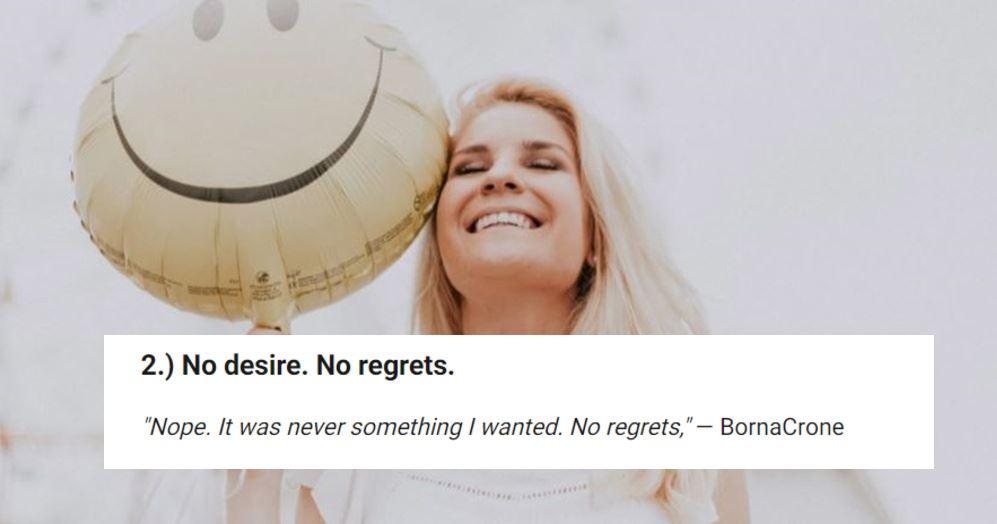
2. No desire. No regrets.

"Nope. It was never something I wanted. No regrets." — BornaCrone

3. Mixed feelings.

"I have mixed feelings. I don't care much for children and I think it would have been disastrous for us to have them. I was also able to retire at 52. Pretty sure that wouldn't have happened with kids. So yeah, absolutely the right decision.
But I love my family and I do wonder what it would be like to have my own, to teach my child the things I know and not to be without someone who cares about me at the time of my death.

"But again, absolutely the right decision and at 55 I'm very happy NOT to have them. This is reinforced every time I'm exposed to other people's kids." — ProfessorOzone

4. They never visit.

"My wife worked at a nursing home for years. Imagine seeing for years that over 95% of old people never have family visit. Till they die and people want a piece of the pie. This when I learned that the whole 'well who is gonna visit you or take care of you when you're older' line is complete bullshit. We decided to not have kids ever after that. Made great friends and saw the world. No regrets." — joevilla1369

5. It wasn't an option.

"I don't necessarily regret not having them, but I regret the fact that I wasn't in a healthy enough relationship where I felt I COULD have children. I regret not being stronger to leave the abuse earlier, if I had been stronger, I think maybe I could have had the choice at least. So yeah... I have regrets." — MaerakiStudioMe

6. Grandkids are cooler.

"No. I knew what I was getting into when I agreed to marry my husband. He had two sons from his first marriage and a vasectomy. He was worried because I was so young (comparatively, he's 10 years older). I did think it over seriously and concluded that a life with him compared to a life without him but (perhaps!) with a baby I didn't even have yet was what I wanted. It worked out for us, we've been together for 26 years. As a bonus I have 9 grandchildren. All the fun without the work of the raising!" — Zublor

7. I'd be a bad parent.


"Not one bit. I have never believed that I would be a good parent. I have a short temper, and while I don't think I would have been physically abusive, my words and tone of voice would be harsh in a very similar way to my own father. I wasn't happy growing up with that kind parent and I wouldn't want to subject any child to that kind of parenting."
— Videoman7189

8. I'd rather be the cool aunt and uncle.

"No and I found a partner who feels the same. We are the cool aunt and uncle." — laudinum

9. Loneliness is underrated.


"54 yrs.old. I've lived the past 30 years alone. Presently my dog and I are chillin' in a nice hotel on a spur of the moment vacation. I'd maybe be a grandfather by now?! I can't imagine what it would be like to have family. I picture a life lived more "normally" sometimes. All sunshine and roses, white picket fence, etc. but I realize real life isn't like that. No I don't regret being childfree or wifefree for that matter. My life can be boring at times but then I look back at all the drama that comes with relationships and think I've dodged a bullet. I spent 20 years trying to find a wife to start a family. Then I realized the clock had run out, so fuck it, all the money I'd saved for my future family would be spent on myself. Hmmmmm...what do I want to buy myself for Christmas?" — Hermits_Truth

10. No diaper changes and no regrets.

"Nope. I never had the urge to change diapers or lose sleep, free time and most of my earnings. Other people's kids are great. Mostly because they are other people's. When people ask 'Who will take care of you when you're old' I tell them that when I'm 75 I will adopt a 40-year-old." — fwubglubbel

11. Zero desire.

"I’m 55 (F) and never wanted children. I just don’t much like them, and 20+ years of motherhood sounded (and still sounds) like a prison sentence. Maternal af when it comes to cats and dogs, but small humans? No chance.

"And I’m very happy to be childless. Cannot imagine my life any other way." — GrowlKitty

12. D.I.N.K.

"Dual income no kids = great lifestyle!" — EggOntheRun

13. Some regrets

"Over 50 and child free. My only regret is that my wife would have been a great mother, and sometimes I feel like I deprived her of that, even though we both agreed we didn’t want kids. Sometimes I wonder if I pushed her into that decision. She works with the elderly every day and sees a lot of lonely folks so it gets to her sometimes. I was always afraid I’d screw up the parenting thing, so I was never really interested in the idea. I’m a loner by nature though." — Johnny-Virgil


This article originally appeared on 02.08.22
Joy

5 ways people are going "All In" this week

From the silly to the sentimental, there are so many ways people like to go “all in” on something. Here are our five favorite examples this week.

5 ways people are going "All In" this week
True

When you hear the words “all in,” what do you think? You might think of getting groovy at a nursing home, a french bulldog having a total breakdown in the drive-thru, or maybe even a snack bar company promoting self care. Whatever you picture, the idea is the same: Going “all in” means doing something with total commitment—literally giving it your “all” and going completely over the top. No second guessing, no holding back—just full-throttle enthusiasm with some creativity and flair thrown in. That’s how we get those viral internet moments we can’t stop watching.


This DWTS dance trend 

If you’ve been watching TV or on the internet this week, you might have seen the viral dance move Dylan Efron and Daniella Karagach performed while on Dancing With The Stars (DWTS) last week. The one particular move, where Dylan holds Daniella as she does a mid-air horizontal walk, is going viral with over 8k videos using the sound. Some of my personal favorites include a mom and her baby, two girls or a girl and her cat, proving this dance trend is truly for anyone to try.

All In on Fiber

Speaking of trends, there’s one that really is about going “all in”, it’s called #fibermaxxing. After years of protein being the biggest nutrition trend, it looks like fiber might be taking over. For good reason too, while protein can cause issues with digestion, fiber can lead to better digestion, blood sugar management, weight control and reduced disease risk. Our friends at All In made a video explaining the #fibermaxxing trend. Each All In bar has 6 to 7 grams of fiber , plus they are delicious. Don't take our word for it, though: Click here to try it yourself (for free).

This child's long hair

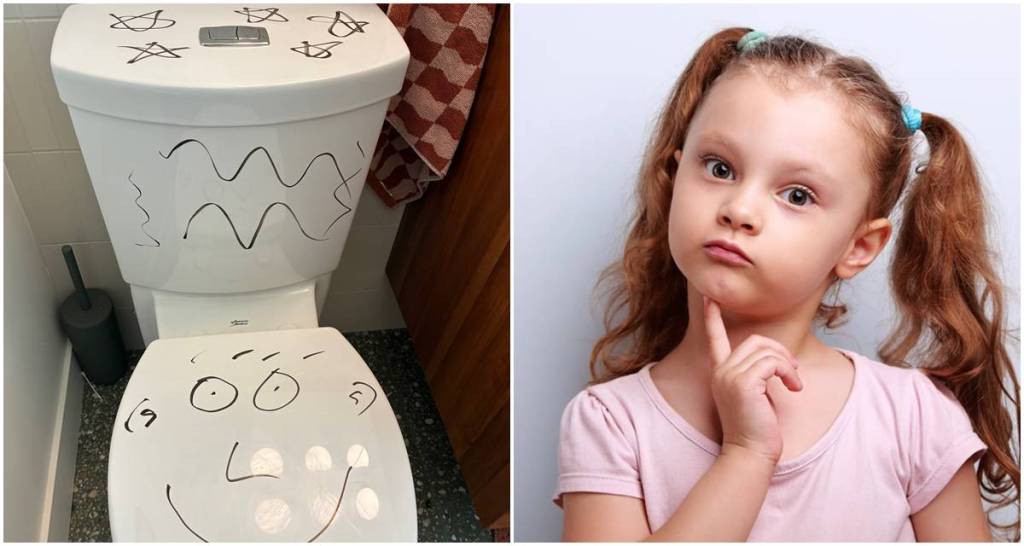
This creator went all in… on pranking the audience. I don’t want to give away the contents of this video, but let’s just say it’s creative- and it made me quite literally laugh out loud. There are a lot of "momfluencers" out there who make content that uses their children, and as relatable and heartfelt as it is, sometimes a little satire break is worth appreciating.

Two entrepreneurs getting down to business


Lots of people dabble in entrepreneurship. These two went "all in" on helping others learn it. After four years of interviews with CEOs , research, edits, and a Penguin Random House book deal (yes, seriously), their book, Down to Business, has made its way into classrooms and libraries around the world. Now they are teaching other kids that age is not a barrier to entry in entrepreneurship; the earlier you start, the further you can go—and an entrepreneurial mindset will serve you no matter what you do in life.

Bridesmaids who went all in

Last on our list; two bridesmaids who committed to the bit. These ladies went “all in” in their remake of the legendary scene from the movie “Bridesmaids”. If you haven’t seen the original movie, starring Kristen Wig and Maya Rudolph, this might be your sign.

In the viral TikTok this bride, Caroline, had no idea what was coming when she put on her favorite movie while getting ready for her big day. The fact that she wanted to watch her favorite show before her bridesmaids surprised her, makes this going “all in” surprise all the better.

Snag your free (!!) snack bar here while this deal lasts. Just pick up a bar at Sprouts and text a pic ofv your receipt to get it for free. Enoy!

beavers, beaver dam, animals, wildlife, ecosystem, nature, earth, sustainability, deserts, waterways, rivers, pollution, climate change

Can outsider beavers save this dried up river?

It's not easy being a river in the desert under the best of circumstances. The ecosystem exists in a very delicate balance, allowing water sources to thrive in the harsh conditions. These water sources in otherwise extremely dry areas are vital to the survival of unique wildlife, agriculture, and even tourism as they provide fresh drinking water for the people who live nearby.

But man-made problems like climate change, over-farming, and pollution have made a tough job even tougher in some areas. Rivers in Utah and Colorado part of the Colorado River Basin have been barely surviving the extremely harsh drought season. When the riverbeds get too dry, fish and other aquatic creatures die off and the wildfire risk increases dramatically.


About six years ago, one team of researchers had a fascinating idea to restore the health of some of Utah's most vulnerable rivers: Bring in the beavers.

beavers, beaver dam, animals, wildlife, ecosystem, nature, earth, sustainability, deserts, waterways, rivers, pollution, climate change Beaver on riverbank. Canva Photos

In 2019, master's student Emma Doden and a team of researchers from Utah State University began a "translocation" project to bring displaced beavers to areas like Utah's Price River, in the hopes of bringing it back to life.

Why beavers? Well, it just makes dam sense! (Sorry.)

In all seriousness, beaver dams restrict the flow of water in some areas of a river, creating ponds and wetlands. In drought-stricken areas, fish and other wildlife can take refuge in the ponds while the rest of the river runs dry, thus riding out the danger until it rains again.

When beavers are present in a watershed, the benefits are unbelievable: Better water quality, healthier fish populations, better nutrient availability, and fewer or less severe wildfires.

It's why beavers have earned the title of "keystone species," or any animal that has a disproportionate impact on the ecosystem around them.

beaver, dam, dam building, nature, ecosystem Pbs Nature Swimming GIF by Nature on PBS Giphy

Doden and her team took beavers who were captured or removed from their original homes due to their being a "nuisance," interfering with infrastructure, or being endangered, and—after a short period of quarantine—were brought to the Price River.

Despite the research team's best efforts, not all the translocated beavers have survived or stayed put over the years. Some have trouble adapting to their new home and die off or are killed by predators, while others leave of their own accord.

But sine 2019, enough have stayed and built dams that the team is starting to see the results of the effort. In fact, beaver projects just like this one have been going on all over the state in recent years.

- YouTube youtu.be

The water levels in the river are now the healthiest they've been in years. The fish are thriving and Utah residents are overjoyed with the experiment's results.

According to an early 2025 column in The Salt Lake Tribune (i.e. six years after the beaver translocation began) the revitalization of the Price River has "helped save [our] Utah town."

"A tributary of the Colorado River, the Price River runs through downtown Helper," wrote column authors Lenise Peterman and Jordan Nielson. "On a warm day, you’re likely to find the river filled with tourists and locals kayaking, tubing and fishing along its shore. A decade ago, it was hard to imagine this scene—and the thriving recreation economy that comes with it—was possible."

Of course, it wasn't JUST the beavers. Other federal water cleanup investments helped remove debris, break down old and malfunctioning dams, and place tighter regulations on agriculture grazing in the area that depleted vital plant life.

But the experts know that the beavers, and their incredible engineering work, are the real MVPs.

beavers, beaver dam, animals, wildlife, ecosystem, nature, earth, sustainability, deserts, waterways, rivers, pollution, climate change An actual beaver dam on the now-thriving Price River Public Domain

In other drying, struggling rivers in the area, researchers are bringing in beavers and even creating manmade beaver dams. They're hoping that the critters will take over the job as the rivers get healthier.

Utah's San Rafael River, which is in bleak condition, is a prime candidate. In one area of the river, a natural flood inspired a host of beavers to return to the area and "riparian habitat along that stretch had increased by 230%, and it had the most diverse flow patterns of anywhere on the river," according to KUER.

It's hard to believe that beavers nearly went extinct during the heyday of the fur trapping industry, and continued to struggle as they were considered nuisances and pests. Now, they're getting the respect they deserve as engineer marvels, and their populations have rebounded due to better PR and conservation programs.

It's about dam time!

This article originally appeared in June.

boys left unsupervised; girls left unsupervised; boys experiment; girls experiment; gender roles; girls vs boys experiment

Experiment of boys and girls left unsupervised returns eye-opening results.

What would kids do if left completely to their own devices without any adult intervention? If you read Lord of the Flies in high school, you might have some idea. If not, you're surely in for a surprise.

In 2016, Boys Alone (Social Experiment Documentary) took 10 boys ages 11-12 and left them unsupervised in a house for five days. Before the boys were left alone, they were given cooking classes and other life skills lessons to give them all a more even starting ground.


They repeated the social experiment with girls in Girls Alone (Social Experiment Documentary). The girls are given the same life skills lessons as the boys before being left to their own devices for the better part of a week. Both groups of children were left with cameras watching their every move as adults monitored from outside of the home, but there was no interference. When the camera crew was present, they did not interact with or attempt to parent the children in any way.

Last year, clips of these experiments resurfaced on social media when the now-deleted account Mr. Cult Daddy (restarted by the same creator, Taylor Perkins, under his new handle, Iamtaylorperkins) uploaded them on TikTok.

His condensed version of the clips, along with his commentary, gave viewers a quick overview of the vastly different results.

@iamtaylorperkins

10 boys. No adults. Total chaos. What does this say about human nature? 🧠💥 #psychologyfacts #masculine #masculineenergy #BoysAlone #socialexperiment #greenscreenvideo

"Imagine this, 10 boys all from the ages of 11 and 12 were put into a house with no adult supervision for five days. And if you heard me say that and thought to yourself that sounds like a total 'Lord of the Flies' situation, you're not wrong because it did not take long for them to completely descend into chaos," the creator shares.

He explains that the boys essentially destroyed the house by drawing on the walls, flipping furniture, and "trashing everything." The boys didn't use their new cooking skills, relying solely on snacks and sodas. Eventually, the chaotic fun turned into power struggles, breaking into different groups, fighting each other, and even tying someone to a chair.

"But what's interesting about this whole thing is just how quickly their social structure that they developed just completely fell apart. What started out as excitement turned into isolation depression," Perkins says.

The TikTok creator jumps into sharing commentary from others about societal expectations that boys can get away with more, which people feel impacted how these boys behaved.

boys, girls, experiment, social experiment, society, expectations Boys will be boys. y.yarn.co

On the flip side, the girls' experiment had wildly different results. The girls were the same age as the boys, but instead of immediately descending into chaos, they actually worked together.


@iamtaylorperkins

Replying to @mrcultdaddy In contrast, the girls displayed more responsibility and cooperation. They created a chore chart, divided up tasks, and took turns cooking meals. They even organized a DIY beauty salon to cheer up a girl who was feeling down. While the girls had some disagreements, they handled them more maturely and left the house in a clean and orderly state. The experiment showcased a sense of teamwork and care, unlike the boys' experience​ #boysvsgirls #patriarchy #psychologyfacts #greenscreenvideo


One commenter writes about the boys, "Grown men live like this too. It’s not an age thing," with another person saying, "That’s the least shocking outcome ever."

"As we know, the boys descended into chaos relatively quickly, so you might say to yourself, 'Oh, we can expect the same things from these girls,' no. From the start the girls organize themselves. They made a freaking chore chart, took turns cooking, cleaning. meals were planned, they didn't just survive off the snacks like the boys did. They really created this team," he shares.

The girls also painted on the walls, but it was productive, artistic painting like murals, not mess-making. Evidently, the girls all worked together and provided each other emotional support, according to the creator. They even cleaned the house before they left. It would seem that people in the comments were not at all surprised by the stark contrast in the girls-and-boys experiment.

One woman tells the creator, "by 12 I could have run a whole household."

"I think it's probably 15-20% prefrontal cortex and 75-80% conditioning. I was expected to wash the dishes every night by myself from a young age, while my male sibling went to bed. I was made to do his homework, even tho I was 2y younger, so he'd have free time to "be a typical boy." I'm the reason he passed elementary school, but I refused after that, and his grades crashed," another woman reveals.

"I think it shows the difference in raising. Girls are taught to behave, be smart. Boys tend to be spoiled by moms and dads. They don’t usually receive the learning of being nice, cordial," someone else shares.

"It's conditioning (at least 80%) my brother is 9 years older, and I had to teach him how to do his own laundry when I was 14 (he was ripe ol' age of 23) bc my mom taught me from a young age and didn't," one commenter explains.

In 2023, Impact shared about the experiment on their Instagram account, providing a carousel of photos and videos explaining the details, outcomes, and some insightful takeaways:

While many people agree that the culprit is social conditioning combined with brain development, others pointed out that it may simply be American culture. That also likely plays a large role in the outcome of these experiments, but what do you think? If the experiment were completed again today, would the results be the same?

You can watch the entire boys' experiment here, and the girls' experiment here.

This article originally appeared last year. It has been updated.

what men like, what men love, aubrey hirsch
via Unsplash

What do these men love?

Writer and illustrator Aubrey Hirsch jokingly asked her followers on Twitter what’s a “universal thing that most men like?” because she was writing a comic and “just realized I don’t actually know any men in real life." The tweet inspired an avalanche of funny responses.

Hirsch is the author of “Why We Never Talk About Sugar,” a collection of short stories, and her work has appeared in The New York Times, Child, American Short Fiction and Time.


The interesting thing about the responses is that they weren’t the typical stereotypes about men. She didn’t get a ton of people talking about sex, sports or toxic masculinity. Instead, there were a lot of folks that mentioned very specific male behaviors as if they were talking about a bizarre species they discovered in the wild.

There were two things that got the most comments on her post. First, men enjoy throwing heavy objects into bodies of water. Preferably, the larger the rock, the deeper the body of water and from the highest vantage point possible.

The other is watching construction sites. Evidently, the phenomenon is so popular in Italy that there is a specific word for this type of person in Italian.

Here are 19 of the best responses to the question, “What’s a universal thing that most men like?”

1.

When asked why men enjoy watching construction sites so much, a poster on Reddit named justdaps had the perfect response. "I just find it really satisfying and interesting to see the process behind things being built," he wrote.

2.

3.

4.

I have seen dudes do this and I have done it plenty of times myself. I usually stand while watching TV when I want to really focus on what’s happening and do not want to be distracted. This usually happens while watching sporting events or the news. It's also a great way to use your body language to let other people know that there is something very important happening on the television.

5.

When we do this 99% of the time we’re pretending that the sign is 10 feet high and that we have the ability to dunk a basketball. There are two types of men, those that can dunk and mere mortals.

6.

As a man, this one is near and dear to my heart. I can’t tell you the number of hours I have spent with my friends just throwing lines from “The Big Lebowski” back and forth.

“Nice marmot.”

“The Dude abides.”

“Say what you want about the tenets of national socialism, Dude. At least it’s an ethos.”

A movie that's running up the ranks of being among the most quotable is another dude buddy pic, "Once Upon a Time ... In Hollywood."

"All right, that's too hot. Anything we can do about that heat?" ... "Rick, it's a flamethrower.”

7.

8.

9.

10.

11.

Evidently, after reading the responses, Hirsch knew what was going to happen next. No need to feel ashamed about going viral. It just means you created something that people love.


This story originally appeared two years ago.

deep cleaning, clean tok, cleaning kids rooms, moms of tiktok, cleaning hacks, parenting, entitled kids, millennial parenting
@organizedchaos4/TikTok

"It costs you nothing, and it creates this ripple effect of kindness."

The extremely niche but surprisingly popular corner of the internet devoted to grime and muck being scrubbed away to oh-so satisfying perfection, otherwise known as #CleanTok, is mostly wholesome, cathartic fun. But every once in a while, controversy comes in. For a mom named Audrey (who clearly has a passion for cleaning hacks, given her TikTok handle of @organizedchaos4), that moment came after she filmed herself doing a deep clean on her 12-year-old daughter’s room. Several people chimed in to accuse her of spoiling her kid, more or less.

Granted, Audrey admitted that she had posted the video “hoping that the trolls would get those thumbs a-movin’.” So when they did indeed come after her, she was ready. “I surprised my daughter by cleaning her room for her. She's been getting herself up for 6 a.m. practices, she gets herself to school, she's out of the house before the rest of us have even woken up,” Audrey says in the clip.


“Keep in mind she's 12. In return for all that she's been doing, I thought it would be a nice treat if I just did a quick speed clean of her room. It was no big deal.”

Audrey goes on to say that the point of her follow-up video was to reiterate the importance of “extending grace.”

@organizedchaos4

When we throw empathy out the window, we throw grace out the window. If you saw the video and your first reaction was to say, “why isn’t she doing it herself?” Ask yourself, “have I EVER left a room messy because I was overwhelmed, tired, busy?” If so, then you are in no position to judge a child for the same thing. #grace #kindness #help #parenting #cleaning #kids #mom

"That's what I did for my daughter. She had fallen behind on her room and I helped her,” she says. “It costs you nothing, and it creates this ripple effect of kindness. We all have setbacks, we all have failures, we all make mistakes and if you say you don't you're lying. By extending grace we are spreading kindness, we are spreading compassion. If you can't extend grace to your own children then there's no way you're going to extend it to anyone else in the world and that's a scary world to live in.”

Audrey then argues that being kind to others often makes it “easier” to be kind to ourselves, which is “vital for our mental health.”

She then concludes, “so if you watched the video yesterday or you're watching this one today and you're thinking negative thoughts, ask yourself, ‘Am I quick to judge, be resentful, be negative or am I quick to extend grace or ask yourself have I ever stumbled and wish grace had been extended to me?’”

Down in the comments, we see that Audrey is certainly not alone in her thinking.

“Kindness costs nothing and provides everything,” one person wrote.

“This will only inspire your daughter to keep working hard and give back when she has a chance to, and know she can rely on you when she struggles,” added another.

Several other moms even chimed in about doing something similar for their kids.

“Exactly I did the same thing for my 23-year-old daughter who works full-time and is a full-time college student. She’s 100% independent. I just want to take some off stress off her plate,” one mom shared

Another said, “I do this for my daughter still, and it's her house.”

As with all things in parenting, balance is key. Of course we don’t want to instill laziness, but at the same time, kids can’t be expected to overachieve in all areas, at all times. Adults can’t even manage this without a little help. Sounds like this is truly a case of a good kid acting as responsibly as humanly possible, and a mom just wanting to help out where she can, all why'll teaching her the world can be a safe place. Hard to see anything wrong with that.

Cleary, none of the negative comments have dissuaded Audrey from taking care of her daughter this way. In fact, in one video, she mentions that, due to her love language being "acts of service," she actually enjoys doing it.


@organizedchaos4

For everyone in yesterday’s video saying “if she can’t keep it clean she doesn’t deserve it” let’s apply that logic to you, as well. If you’ve ever had a semi-messy home, you don’t deserve it. 😉 See the problem with that logic? We all allow our homes to get messy once in a while. No shame in it. Welcome help if it’s offered. ❤️ We’re all about grace and generational wealth over here. 👏🏻 #cleaning #clean #cleaningmotivation #kids #cleanwithme #organization #organize


And for those of us adults without a parent to help clean, Audrey has some pretty great organizational tips on her TikTok for you to peruse.

This article originally appeared last year. It has been updated.

kids, raising kids, kid psychology, parenting, child psychologist, parenting tips ,formative years, bad habits

A kid with their head down in class.

From the time they're aware of the pregnancy, couples make strenuous efforts to plan their parenting. Right from the diet, morals, school and lifestyle choices, parents leave no stone unturned in opting for what's best. Some of these practices may be influenced by parents' beliefs, lifestyles, skills and so on. However, not all may be beneficial and recommended for children. Practices that may seem great initially can have unwanted long-term effects. Child psychologist Dr. Roseann Capanna-Hodge revealed 6 striking habits you want to keep out of your child's life, per Parade. She urges parents and grandparents to leave out these 6 factors and find alternatives that are more fruitful and efficient.

1. Using screentime to keep kids busy

kids, raising kids, kid psychology, parenting, child psychologist, parenting tips ,formative years, bad habits A child on an iPad. Photo credit: Canva


It’s no secret that screens are a lifesaver when parents are exhausted, cooking dinner, or juggling work and childcare. But relying on them too often comes with downsides.

A 2023 Common Sense Media report found that children ages 0–8 now average over 2.5 hours of screen use per day, more than double what it was a decade ago. Research shows this can affect attention span, sleep, mood regulation, and social development.

“Children need a variety of play-based activities that foster growth in areas like visual-motor skills, physical exercise, and socialization,” Capanna-Hodge explains. And when screens become a default soother, it can also crowd out precious bonding moments.

Try instead:

✔ Create a 5-minute “connection ritual” at meals or bedtime (a story, a silly rhyme, a question of the day).
✔ Keep a small “quiet kit” nearby — crayons, fidget toys, or mini puzzles.

2. Forgetting that kids learn by watching us

kids, raising kids, kid psychology, parenting, child psychologist, parenting tips ,formative years, bad habits A mom showing her child how to play the drum. Photo credit: Canva

Kids absorb far more from what we do than what we say. When adults argue harshly, shut down emotionally, or treat others disrespectfully, children internalize those patterns.A 2023 Child Development study found that children’s emotional regulation skills strongly reflect the emotional modeling they see at home.Capanna-Hodge stresses that when conflicts happen—and they will—how parents respond matters. “Demonstrating respectful conflict resolution sets a powerful example,” she notes.Why parents fall into this:Small homes mean no private space. Stress runs high. Many adults are still unlearning the conflict habits they grew up with.

Try instead:

✔ Narrate your emotions: “I’m frustrated, so I’m taking a breath.”

✔ If conflict starts escalating, say out loud: “Let’s pause and try again later.”

3. Letting negativity become a pattern

kids, raising kids, kid psychology, parenting, child psychologist, parenting tips ,formative years, bad habits A mom scolding her son. Photo credit: Canva

When you combine the financial stress, sleep deprivation, and the expectations of “doing it all" that comes with modern day parenting, patience wears thin, fast. But frequent yelling or criticism can shape a child’s sense of safety and self-worth.“Regularly raising your voice creates an environment of fear, anxiety, and poor stress management,” Capanna-Hodge says.

Try instead:

✔ Use a whisper voice (kids actually tune in more).

✔ Step away for 10 seconds before responding.

✔ Offer specific praise: “You tried really hard on that.”

4. Using guilt to influence behavior

kids, raising kids, kid psychology, parenting, child psychologist, parenting tips ,formative years, bad habits A mom guilt-tripping her daughter. Photo credit: Canva

Guilt-based language often comes from older generational patterns. Many grandparents grew up hearing, “After all I’ve done for you…” and simply repeat what they know. But today’s research is clear: guilt-based parenting can stick with children for life.Multiple studies link guilt-inducing messages to anxiety, people-pleasing, and low autonomy later on.Phrases like “Grandma will be so upset if you don’t…” don’t build responsibility. They build shame.

Try instead:

✔ Teach accountability: “How can we fix this together?”

✔ Validate feelings while redirecting behavior: “You’re upset AND we still need to clean this up.”

5. Inconsistency with rules and discipline

kids, raising kids, kid psychology, parenting, child psychologist, parenting tips ,formative years, bad habits A teacher establishing rules to her class. Photo credit: Canva

Many parents worry their kids don’t listen, but the issue is often inconsistency, not disobedience. Kids learn best from predictable boundaries.

“Inconsistent rules create confusion and insecurity,” Capanna-Hodge says. Research on children with ADHD shows that harsh or inconsistent parenting is linked with more behavior problems, while consistent routines predict better emotional and behavioral outcomes—especially for kids who struggle with attention or self-regulation.

Try instead:

✔ Post simple, predictable rules on the fridge.
✔ Use the same consequence each time for the same behavior.
✔ Build a short daily rhythm: snack → play → cleanup → bedtime.

6. Comparing kids to each other

Photo credit: Canva

Comparison often comes from anxiety. Parents worry their child is “behind” or not meeting milestones. But comparison undermines a child’s confidence and can spark resentment or pressure to overperform.“When grandparents openly compare grandchildren, it diminishes a child’s sense of self-worth,” Capanna-Hodge says. Each child needs space to grow on their own timeline.Try instead:

✔ Celebrate individuality: “You’re so curious!” You’re great at building!”

✔ Focus on progress, not peers.

Here’s the hopeful part: none of these negative habits define you as a parent. Every adult slips into patterns they wish they could change. What matters most is noticing, adjusting, and reconnecting. Small shifts, practiced over time, create lifelong impact. And every day is another chance to choose connection over perfection.

This article originally appeared 3 months ago.