upworthy
Add Upworthy to your Google News feed.
Google News Button
Culture

This essential photography lesson shows how selfies distort what we really look like

Don't be fooled!

selfie, image, focal length, dysmorphia

What you look like in a selfie camera isn't really what you look like in real life.

We've all done it: You snap a selfie, look at it, say, "OMG is my nose swollen?" then try again from a different angle. "Wait, now my forehead looks weird. And what's up with my chin?" You keep trying various angles and distances, trying to get a picture that looks like how you remember yourself looking. Whether you finally land on one or not, you walk away from the experience wondering which photo actually looks like the "real" you.

I do this, even as a 40-something-year-old who is quite comfortable with the face I see in the mirror. So, it makes me cringe imagining a tween or teen, who likely take a lot more selfies than I do, questioning their facial features based on those snapshots. When I'm wondering why my facial features look weird in selfies it's because I know my face well enough to know that's not what it looks like. However, when a young person whose face is changing rapidly sees their facial features distorted in a photo, they may come to all kinds of wrong conclusions about what they actually look like.

Not that it should matter, of course. But we're talking about people living in a society obsessed with personal appearance. It's going to matter to a lot of people, and if they get the wrong impression of their face, some people will go to all sorts of lengths to change it. That's why understanding a bit about how focal lengths on cameras can impact what we see in photographs is vital.

Writer Evey Winters shared some of that education in a post on Facebook. She writes about this topic through a trans and dysmorphia lens, but it applies to everyone.

Winters points out that if someone is thinking of doing surgery to change their bodies, they should seek sources outside of themselves and a cellphone camera.

"I have dysmorphia and recognize that in myself," she wrote, "but even if I didn’t, there’s not a selfie I’ve ever taken that would accurately help me make choices about my face. Mirrors are slightly better only for their minimal distortions."

"If you want the best chance at getting good feedback pre-op about what you might want to change," she added, "I’d recommend a skilled photographer take a series of photos of you at different focal lengths and even then none of these will be entirely accurate as none of these employ humans binocular vision and filtering."

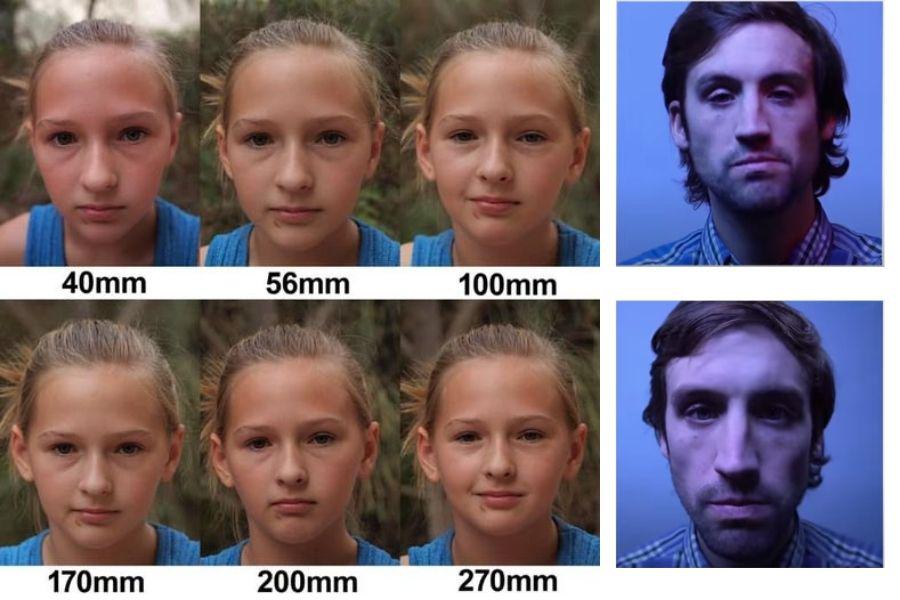
Winters shared a collage of photos of the same girl's face at different focal lengths to show the significant difference it makes. "Notice how in different photos this child’s eyes may appear to be slightly hooded," she wrote. "The nose appears enlarged disproportionately. Hairline seems to shift with every snap. So does jaw shape, face shape, and even the width and size of the ears."

The difference between each of these photos is significant, but the difference between the first and the last is stunning. Cellphone selfie cameras usually have an even smaller focal length than the 40 mm shown here (Winters points out that the iPhone 13 Pro Max selfie camera has the equivalent of a 23 mm focal length), so they distort facial features even more. It also depends on how far away from the camera you are—the closer you are, the more distortion you'll see. Lighting matters, too, but even the best lighting can't cancel out what the focal length is doing.

Vox shared a video specifically about the "big nose" phenomenon with selfies, showing how drastic the distortion can be.

As a parent of two teens and a young adult, I find these photos to be fantastic tools for teaching my kids not to put too much stock in what they see in a selfie. Far too many people are increasingly seeking out plastic surgery to change a nose or a forehead or a jawline that doesn't even really exist. Imagine looking in a funhouse mirror and thinking you need to do something to change how you look. Selfie cameras are basically mini funhouse mirrors. Smartphones and apps are getting better at making filters that adjust for those distortions, but none of us should be relying on selfies of any kind to see what we really look like, much less taking major measures to alter our appearance based on what we see in them.

Even if you have some physical feature you simply can't accept and want to change, make sure you get a skilled photographer to give you the most accurate picture of what it actually looks like. As Winters concluded at the end of her post: "Make sure you’re not reshaping your body for a you that only exists in selfie cams."

Thank you for the reminder, Ms. Winters.


This article originally appeared three years ago.
1970s, '70s, generations, food, meals

Kids in the 1970s pretending to cook

"What's for dinner?" has been asked by kids for millennia, probably, and the most common answers depend on both where and at what time in history it was asked. In ancient times, people were limited to what they could hunt or gather. Medieval recipes look different than what people ate in the 19th century. And what our grandparents ate when they were children was different from what our kids eat today.

Obviously, people couldn't DoorDash Chipotle in the '70s, but when someone on Reddit asked people born before 1970 what they ate for dinner most weeks, there were some standard meals a lot of Americans clearly ate regularly growing up. Lots of meatloaf and beef stroganoff. Pork chops and chop suey. Convenient assistance from Shake n' Bake, Hamburger Helper and TV dinners. Canned fruits and veggies. So much Jell-O.


Here are some of the most popular responses:

"Overcooked pork chop, minute rice, canned green beans, canned fruit cocktail

Spaghetti with ground beef and sauce made from a packet (Durkee?)

Pot roast (whatever cut of meat was on sale) cooked with Lipton onion soup mix. Frozen peas. Canned peaches.

Meatloaf with mashed potatoes and canned green beans. Canned pears

Shake n bake chicken and scalloped potatoes from a box. Canned fruit of some kind.

On awesome days Chef Boyardee pizza mix from a box.

I liked LaChoy chop suey.

Always with a jug of milk on the table."

1970s, '70s, generations, meals, meatloaf Meatloaf was a staple dinner.Photo credit: Canva

"So I think many of our moms went to the same home ec classes. Our house also had on rotation:

Goulash: It wasn’t what I have come to understand is Hungarian Goulash, but ground beef/spices/tomatoes.

Chicken Diane: Way overcooked chicken with rosemary, thyme and other seasonings.

Meatloaf: Yes, ketchup on top.

And the ever-present rice. Dad bought an aluminum rice cooker from his time in Japan and we had rice (he added soy sauce on top) 3x per week. The other side was baked potatoes.

The big treat!!!??? Chef Boy Ar Dee pizza from a tube on Friday once per month. Mom had a round aluminum baking pan and make dough, spread the included sauce on the dough, add the Parmesan Cheese (in the included packet). That was the biggest treat - and in all honesty I would go back to that day cause I miss my mom. Best pizza ever."

- YouTube www.youtube.com

"Hamburger patty or braised round steak, green salad, canned vegetable (peas, beans, corn, beets). Occasionally a baked potato. Sometimes my mom would toss chicken in a flour/seasoning mix and bake it and we'd have oven fried chicken--maybe once every couple of weeks. We got beef from a cousin so it was cheap, and chicken was expensive.

Mom also made spaghetti with ground beef, and beef stew with the tougher cuts of the cow. Oh--and liver--God how I hated liver night.

We always had cheap grocery store 'ice milk' in the freezer for dessert."

1970s, '70s, generations, food, meals, spaghetti Spaghetti is still a classic.Photo credit: Canva

"Sunday - Spaghetti/macaroni and homemade spaghetti sauce and a salad.

Monday - Roast chicken, a side (potatoes, Rice-a-Roni), and a veg.

Tuesday - Pork chops, a side (potatoes, Rice-a-Roni), and a veg.

Wednesday - Spaghetti/macaroni and homemade spaghetti sauce and a salad.

Thursday - Rump or sirloin steak, a side (potatoes, Rice-a-Roni), and a veg.

Friday - breaded and fried fish (ugh--haddock, halibut, or cod if the latter was on sale), a side (potatoes, Rice-a-Roni), and a veg.

Saturday - Rump or sirloin steak, a side (potatoes, Rice-a-Roni), and a veg.

Dessert would be supermarket ice cream (carton, usually Neopolitan), Jello chocolate pudding, Table Talk pie (usually apple)."

1970s, '70s, generations, food, meals, pork chops Why were pork chops so popular?Photo credit: Canva

"Typical meals: stroganoff made with ground beef and egg noodles. Pot roast. Swiss steak. Chicken cacciatore. Fried chicken. This was in California, but my parents were from the Midwest so pretty meat-and-potatoes. There was always a side vegetable and a starch. Rarely bread or rolls. Occasionally salad but not always until the 1980s. No formal/planned dessert except for special occasions like birthdays and holidays, but sometimes there was ice cream in the freezer or there were cookies (store bought; my mom wasn't a baker). In the late 70s my mom loved Julia Child and started to be more adventurous with cooking; later she took Asian cooking classes too."

"Beef stroganoff, fried bologna, weiners wrapped in bacon and then broiled, baked beans, (from scratch) liver.

Jello 1-2-3 (so space age!) Bundt cake, canned fruit salad, canned pears, canned peaches."

- YouTube www.youtube.com

"When we had some money (early in the pay period):

Spaghetti with sausages and homemade sauce

Liver and onions

Chop suey

Spare ribs and sauerkraut

Pork chops with mashed potatoes and gravy

Beef stew

Boeuf bourguignon

Beef stroganoff

When we were short on money:

Spam & scrambled eggs

Homemade macaroni & cheese

Cold cereal

That’s all I can think of right now.

We very rarely ever had dessert and almost never ate out. We never had fast food, the only fast food chain in town was Burger King, and McDonald’s was a town away and only open about six months of the year."

Here's to all the meals that nourished us in every era of our lives.

Culture

Frugal people share the best money-saving advice from parents and grandparents they still use

"My mother taught me how to compare prices per item or ounce rather than by the package."

frugal, frugal lifestyle, frugal advice, frugal living, money saving tips
Images via Canva/spxChrome, irynakhabliuk

People who live frugal lifestyles share best frugal advice from older generations.

For those with great grandparents, grandparents, and parents from the Greatest Generation (those born 1901 to 1927) and the Silent Generation (those born 1928 to 1945), much can be learned from how to live a frugal lifestyle. These two generations lived through the Great Depression and World War II, two events that forced Americans to become more resourceful due to difficult financial situations, food scarcity, and rations.

Today, people who consider themselves frugal are always looking for more ways to save money. To glean frugal wisdom from older generations that would still be applicable today, one frugal person posed the question on Reddit: "What frugal lesson from your parents or grandparents you still use today?"


And many frugal people offered their best money-saving tips from their relatives that they still use today. From how to save on money to utilities, these are the best frugal tips from Redditors:

- YouTube www.youtube.com

Reuse from your kitchen

"My grandma rinsed and reused foil until it crumbled. I rolled my eyes then, now I catch myself doing it. Funny how those 'silly' habits end up smart. Mine also saves glass jars, labeled lids with tape, turned t-shirt into rags, and froze veg scraps for stock. :)" - YourxCherry

"I save butter wrappers in the fridge to use for greasing baking pans. To get everything out of empty condiment bottles, I pour a little vinegar, milk or whatever is fitting, then shake it up and use that for salad dressing or other cooking needs." - so-many-cats

"I love Tostitos salsa jars. Whatever I cook, such as soup, ground beef, pasta, the extras, or leftovers, everything goes into these jars. They are so perfect for portioning. One jar = one person's meal portion. I literally have more than 30 jars, and they are incredibly convenient!" - Proud_Possibility256

"I do not go grocery shopping until my fridge is empty including my freezer zero food waste. I have become very creative with recipes. Saves me money. Always take lunch to work." - Samantha-the-mermaid

"My grandmother took care of her five siblings during the depression after her parents died on .45¢ an hour. I make more money in an hour than she made in a week. She never wasted ANYTHING. She taught me to save bacon grease for seasoning, bread ends for bread pudding, leftovers for soup, and coffee grounds and eggshells for the garden. We didn't carve our pumpkins- we painted them and made pumpkin pie out of it after Halloween." - That-Response-1969

"I sometimes hate it that I am like this, but one of the first odd things that come to mind is labeling bottles of home goods like dish soap, body wash, bars of soap, hand soap, etc. so you know which one lasts the longest after purchase. Keep in my mind, my grandmother grew up during the Great Depression. I also spent a majority of my days with her making food (predominately just standing around doing nothing useful). All of the meals we hold dear to our hearts are actually just frugal meals to stretch out. She would get extremely nervous if she came to your home and there were not canned goods. This is winter in the upper Midwest during the Great Depression to put it into perspective, along with canning and preparing for everything. This is a person that lived by candle light basically. When she finally had a icebox, every last meal had to be frozen. No matter what you made, it had to be able to sit there when necessary. You make no meal that cannot be eaten for three days or frozen solid for the next month. I still live by this routine." - WideRoadDeadDeer95

- YouTube www.youtube.com

Make your money go further

"My mother taught me how to compare prices per item or ounce rather than by the package." - Chicpea09

"My parents always framed purchases by how much time I would have to exchange for the item. So when I was in 6th grade and I wanted a TV for my bedroom and it was $120, I would have to do 6 to 10ish baby sitting jobs - then ask myself is it worth that exchange. This is still how I frame most purchases." - BagNo349

"My grandfather told me as a teenager that debt is how other people control you. I didn't realize how true this was until my early 20s when I got into mild debt problems. Since then I have been majorly debt averse." - Egon88

"Mine told me if you cant pay the milkman 6pence this week, how will you pay him 12pence next week? Lesson learned. I pay my bills on time ALWAYS." - Mundane_Sail_4155

"My dad always said it's not a deal if you can't afford it. Of course he didn't have slickdeals either lol." - JasonG5

"My grandpa always said ‘Pay yourself first.’ Even when money was tight, he’d stash $5–10 in savings before paying bills. I thought it was silly but that habit built a nice cushion over time." - samdaz712

- YouTube www.youtube.com

Save on utilities and living expenses

"I hang dry my clothing whenever possible. I find it strangely relaxing to stand outside and carefully hang everything up so it has good airflow. It reminds me of helping my grandmother hang out laundry on their farm. The only thing I changed was painting the tips of my clothespins so I can see them better and don’t forget them on the line accidentally." - SpecificSkunk

"MAINTAIN and REPAIR what you already own. Lubricate, tighten, clean. Change filters. Replace belts. Flush. Air out. Condition. Resurface. Store properly. Take care of your stuff." - i_know_tofu

"I patch and repair clothes that can be repaired instead of immediately buying new. For instance, we have a comforter that has gotten holes from the washing machine - cheap materials. I'm learning the Japanese art of Shashiko to patch it over my Thanksgiving week break. I find a used item instead of buying new immediately, when our dryer went out, I bought one from an estate sale for the same price as repairing the old one would have cost (and since it was on it's 3rd repair - heavy eye roll on cheaply made crap - I don't feel so bad. I line dry a lot of things. Not everything but a lot." - LeftwingSH

"I put on hoodies and blankets and refuse to turn the heater on until the outside temps are about 45 degrees." - thedoc617

"How to drive in order to maximize your miles per gallon and reduce wear and tear on the car. Accelerate slowly and try to keep under 2 RPMs. Leave a wide berth between yourself and other cars. Anticipate traffic/stopping, then let off the gas and cruise. Don't ride the brakes." - OrdinarySubstance491

This article originally appeared last year

Joy

People from around the globe share 15 signs that someone is obviously an American

"An Italian told me that Americans walk confidently in the wrong direction."

tourists, american tourists, us tourists, vacation, american style

Americans on vacation.

One of the fun things about traveling to different countries is that you not only get to learn about other cultures, but you also learn some things about your own. Americans who travel abroad often learn that people around the world appreciate them for being open, friendly, and good at spreading hope and optimism.

On the other hand, people in other countries can often tell when an American is coming from a mile away because they speak loudly, whether indoors or outdoors. Americans also have a very peculiar body language and are known to lean on things when they have to stand for an extended period.


A Reddit user posed a question in the AskReddit subforum to learn more about how Americans stand out abroad: What's an "obvious" sign that someone is American? The post received more than 35,000 responses, with an overwhelming number of commenters noting that Americans are all smiles and love to make small talk, something most people appreciate.

According to Redditors, here are 15 "obvious" signs that someone is American:

1. They have a unique confidence

"An Italian told me that Americans walk confidently in the wrong direction."

"Been taught to walk fast, and look worried.. People think you know what you're doing."

2. They're friendly

"I worked as a cashier in a tourist place in Paris, I always recognised Americans because they were kinda friendly to me and they always left tips."

"I guess there are worse things than friendly and generous."


3. Time = distance

"If someone asks how far away something is, an American will tell how you long it takes to get there as opposed to a physical distance."

"It actually pisses off some Americans to give a distance in miles, unless they're calculating gas mileage. In some places, you have to give with and without traffic options. I think it's more valuable info in time than in distance."

4. Grinning at strangers

"The gentle grins you give to strangers if you make eye contact with them as you pass by, at least in the Midwest. was not well received in Germany."

"I dated a European man here in the US. When we walked together, every time I made eye contact with someone on our path I would smile at them, and they would always smile back. Boyfriend was so confused at all these strangers smiling at me. Kept asking if I knew all these people. It was hilarious."


5. They like personal space

"How much personal space they give themselves. Americans like at LEAST an arm's length."

"We're conditioned to fill spaces evenly. I noticed when i worked delivery, spending lots of quality time on elevators that for every new person that enters, everybody shuffles to even things out. Similar thing plays out in social gatherings and bars. Not sure if that's universal or not, but I find it interesting. I think the size of our personal bubbles is because our spaces are generally much larger because we've got the space (heh) to build bigger buildings, sidewalks, roads etc. Might also explain why we're louder. Used to filling larger spaces with volume."

Body language expert Joe Navarro says that among Americans, the social zone for acquaintances and casual interactions is four to 12 feet, while family and close friends stand 1.5 to four feet apart. The intimate zone, for those closest to us, ranges from the skin to about 18 inches.


6. They lean

"According to the CIA, when training to be a spy, you have to unlearn how to lean. Americans tend to lean on things when standing still."

All of this is true, according to Jonna Mendez, the former chief of disguise at the CIA, who has shared some of her tips and tricks for making Americans seem more European. "So we would de-Americanize you," Mendez told NPR. "They think that we are slouchy, a little sloppy. And they think that they can almost see that in our demeanor on the street because they stand up straight. They don't lean on things."


7. They don't have an indoor voice

"I've lived in America for 25 years, and it still irritates me that instead of lowering their voices in restaurants so everyone can hear, Americans just scream over each other and make their restaurants as loud as clubs."

"For some reason, my otherwise smart and wonderful American friends will speak in the same volume, diction, and speed regardless of any outside factor unless specifically asked."

8. Dessert for breakfast

"In my homestay in London, I was told that I was 'so American' for enjoying a piece of cake for breakfast (not frosted cake, but like a nuts and dried fruit spiced coffeecake kind of thing). Apparently, that's exclusively for like a 4 pm snack, and breakfast is more of a savory meal."

"A lot of American breakfast items in my mind are desserts (pancakes, muffins, waffles, etc.). It doesn't mean I won't eat them, but it's kinda weird to do so."

9. They wear their clothes differently

"A British man once told me he knew I was American because I was wearing a baseball cap backwards."

"An Italian told me they could tell I was American because I wore my sunglasses on the top of my head when I wasn't using them."


10. Exposed soles

"While visiting Turkey, I was told that I looked American because I was sitting with one leg across the other, and the bottom of my shoe was exposed. Apparently, it's rude idk."

"In a lot of places outside of the US, showing the bottom of your shoe is rude."

11. Tactical gear

"Tactical sunglasses."

"I'm in the US, and virtually anything marketed towards men has the word 'tactical' in front of it."

12. They love small talk

"I'm from California (though a smallish town), and we wave to neighbors on our road, even if we haven't met, and start conversations in the grocery line with people if the opportunity presents itself. Also, smiling and saying hello to someone you happen to walk by and make eye contact with is quite normal. We are a social species, it would be so weird not to be friendly, even to strangers, for me, and I'm not even that social of a person."

"What really gets me to it is not that Americans do small talk constantly, but the fact that they are so good and fast at it. I mean, I say 'yeah, it's hot,' and they reply with some interesting fact or make a connection to their hometown. I feel less of myself after this. They must have some small talk class in school or some sh*t."

13. They like to point

"I've always observed my US friends like to point at stuff while walking and say what it is…. We were out walking around Amsterdam recently and they were like 'hey look it's a smoke shop'…. 'Oh look a sex shop'…. 'Oh hey, it's a prostitute' …. 'Look at the canal'…. 'Wow it's another prostitute'….. 'another canal' etc etc. It was like watching Netflix with Audio Descriptions turned on."

"You know that little voice inside your head, your internal monologue? Americans seem to monologue their thoughts."


14. Optimism and enthusiasm

"Dunno in all context, but Americans in Europe stand out with their ceaseless optimism and enthusiasm."

"I'm reminded a lot of Ted Lasso. Everyone I know (all Americans) loves the show. I wonder what kind of European fan base it has."

"Americans are so positive and have such a thirst for life. It sickens me."

15. They eat while walking

"When I lived in Europe, people said only Americans eat while walking. I'd be eating a bagel or something on the way to work or class, and multiple people asked if I was American lol."

"Jay Leno said on Top Gear, I think it was, that Americans are also the only people who eat while driving. I don't do this, but I constantly see people who do, haha, especially in LA, where people spend a lot of time in their cars."

beaver, project, california, environment, sustainability

Checking in on California's beaver project.

Deep in the Sierra Nevada foothills on the Tule River Indian Reservation, tribal member Kenneth McDarment had passed by an ochre-red pictograph countless times throughout his life—a simple yet unmistakable image of a beaver with four paws and a distinctive paddle tail. Estimated to be between 500 and 1,000 years old, this ancient artwork adorned the walls of a rock shelter alongside other paintings of wildlife, humans, and geometric designs created by the Yokuts people.

To McDarment, this beaver image seemed like just another beautiful piece of Native art. That is until he looked at it again—this time seeing it clearly with fresh eyes.


beaver, project, california, environment, sustainability Newly introduced beaver swimming through the water.Credit: CDFW

When severe drought struck the reservation about a decade ago, McDarment and other tribal leaders began searching for innovative ways to conserve water. The answer, it turned out, had been staring at them from the cave walls all along.

"Sometimes you need to just look at things more often," McDarment told researchers.

Glancing back up at the beaver, the pictograph suddenly took on new meaning as McDarment and the other tribal leaders began to recognize the ancient wisdom embedded in their ancestors' art. If beavers had once thrived on these lands and helped manage water resources, perhaps bringing them back could address their contemporary drought challenges. This revelation prompted the tribe to pursue what would become California's first beaver restoration program in over seven decades.

- YouTube www.youtube.com

From ancient wisdom to modern partnership

The revelation sparked an unprecedented collaboration between California's Department of Fish and Wildlife (CDFW) and Native tribes. In the past, the Tule River Tribe and the Maidu Summit Consortium were dismissed, and told there was "no way to move beavers in California legally."

But after years of advocacy and preparation, in 2021, California finally launched its first beaver restoration program since the 1950s in partnership with both tribes.

On October 18, 2023, seven beavers were released into their new home in Tásmam Koyóm, a 2,325-acre valley in Plumas County.

"You just saw this tiny brown furball, this little nugget, catch a ride on the back of his sibling's tail, and it looked like he was surfing. I don't think it set in for days afterward, but that moment will go down as one of the highlights of my entire career. I think we were very proud of what we had done, and really optimistic about the potential that this represents for us and the good we think we can do moving forward." - Valerie Cook, the beaver restoration program manager for the CDFW.


beaver, project, california, environment, sustainability Beavers being released to explore their new territory. Credit: CDFW

Where did they find the beavers? Set a few traps and catch as many as they could? No. The efforts presented in this project represented a fundamental shift in how California approaches wildlife management and water conservation. The beaver relocation process involved identifying "problem" beavers in areas where they caused flooding, and then safely transporting them to new locations where their engineering skills could work environmental magic. For the first time in nearly 75 years, the state began relocating beavers.

"We can make our future different from our past," declared CDFW Director Charlton H. Bonham during the historic first release. "Our past is one where we treated these animals and others as varmints, as nuisances, and our culture over time ran them off the landscape. That can't be our future".

Nature's ultimate engineers get to work

The results have been nothing short of spectacular. At the Maidu Summit Consortium's Tásmam Koyóm meadow—which means "tall grass" in the Mountain Maidu language—relocated beavers have constructed an impressive 328-foot dam, effectively creating a massive wetland complex that has increased water coverage by more than 22% according to CDFW's April 2025 report.

beaver, project, california, environment, sustainability Dams like these offer shelter, a safe home for beavers, and food storage. Image by John Cannon/Mongabay.

"They are really powerful ecosystem engineers," Emily Fairfax, an assistant professor of geography at the University of Minnesota, told Mongabay. "The number of services they provide to us and ways that they build resilient landscapes is honestly too much to just rattle off all at once."

The benefits extend far beyond water storage, with those furry "ecosystem engineers" essentially transforming the landscape into a climate-resilient powerhouse:

Cultural reconnection and sovereignty

For the Mountain Maidu and Tule River tribes, the beaver restoration represents much more than environmental conservation—it's a symbol of just how far they've come in reclaiming their relationship to the land. Nearly two centuries ago, Tásmam Koyóm Meadow was forcibly taken from the Mountain Maidu tribe and was not rightfully returned until 2019. Four years later, the beaver—which the Mountain Maidu call hi-chi-hi-nem and consider as family—finally returned to their land, marking a moment of healing and deeply profound spiritual significance.

- YouTube www.youtube.com

Shannon Salem Williams, a Mountain Maidu program manager, said seeing the beavers slip into the water was a "full circle moment." Then added, "It was like a big welcoming home."

A blueprint for climate resilience

The success story of California's beaver restoration program proves that sometimes, the most efficient solution to modern issues is simply to return to ancient wisdom.

With climate change intensifying droughts, floods, and wildfires across the American West, beaver-based restoration is gaining recognition as a cost-effective, nature-based solution. The California program has become so successful that Governor Gavin Newsom signed legislation in 2024 to make the beaver restoration program permanent.

Scientists and activists remain hopeful that this trend will continue. "I think we're in kind of an idyllic [stage of] beaver literacy," advocate Heidi Perryman said. "People have begun to hear a lot of good things about beavers, and they're very hopeful that beavers can fix everything that we've messed up."


This article originally appeared last year

service dog, golden retriever, disney cruise, disney characters, good dog, dogs, pets, funny animals
Photo credit: Canva

A service dog named Forest lost his mind when he got to meet his hero: Pluto the Dog.

Service dogs are professionals who are trained to be attentive, helpful and extremely well-behaved for their owners who rely on them for everyday living. They aren't easily distracted and have solid control over their impulses because their job performance is vital to humans who need them. No one wants a service dog going rogue.

But underneath all of that self-control and professionalism, service dogs are still dogs, and they deserve to have a little fun every once in a while. An adorable recent encounter onboard a Disney Cruise Ship makes that abundantly clear.


service dog, golden retriever, disney cruise, disney characters, good dog, dogs, pets, funny animals Pluto and Goofy along with Chip and Dale. Photo by Taha on Unsplash

Ashton McGrady is a content creator who shares her adventures with her Golden Retriever service dog, Forest, who has an affinity for Disney characters. In one video, she shows Forest choosing his own stuffy at a Disney gift shop, even putting the money on the counter to pay for it himself.

In another video, McGrady takes Forest onto the high seas via a Disney cruise ship: The Wish. Onboard, Forest was lucky enough to be reunited with his favorite character, Pluto. People the world over are feeling his joy vicariously.

Watch:

@radiantlygolden

proof that distance won’t keep the very best of friends apart ❤️🚢✨ we love you pluto!!! #servicedog #servicedogteam #disneytiktok #disneycruiseline #disneycruise #hostedbydisney

Ashton calls Forest her "best pal and lifesaver," and it's clear from her videos that they make a great team. People loved seeing the good doggo get to let loose and enjoy a romp with Pluto and how the cast member interacted with him as well. Over two million people viewed the video on TikTok and hundreds chimed in to share how happy it made them.

"Those dogs are such good pups and work so hard to keep their owners safe, it’s nice to see them play for a bit ❤️"

"This is the most golden retriever golden I’ve ever seen 🥰🥰🥰"

"i just know the actor under the costume was having the best day ever."

"DID PLUTO WAG HIS OWN TAIL??? This is the best thing I’ve seen all day"

"It's like the Disney hug rule applies to dogs...but it's play with them until they are done."

"This truly made me smile"


service dog, golden retriever, disney cruise, disney characters, good dog, dogs, pets, funny animals Dogs aren't normally allowed onboard cruise ships unless they're service dogs, like Forest. Photo by Stephen Mease on Unsplash

The "Disney hug rule" referenced here is an apparently unofficial "rule" that Disney cast members when dressed in character don't end a child's hug until the child lets go—basically letting the child hug the character as long as they want to. It's not an actual rule, but it's a thoughtful practice some cast members use to make sure their young guests don't leave a character meet disappointed.

For Forest, the equivalent is playing until he (or his owner—he's on the job, after all) decides he's done.

This isn't the first time Forest has had a touching reunion with Pluto. Ashton shared another video with a similar interaction—it's clear that Pluto truly is Forest's bestie.

@radiantlygolden

I just want to go back to this moment 🥹 if you’re friends with pluto and you see this, you made our entire day ♥️ #waltdisneyworld #wdw50 #epcotfestivalofthearts #festivalofthearts #epcot #charactermeetandgreet #disneytiktok #distok #servicedog #servicedogteam #servicedogsatdisney

Ashton also uses social media to educate people about service dogs, as there are a lot of misunderstandings out there about what service animals are, how they work, and where they are allowed to be.

Though service dogs and their owners will often naturally form a bond, a service dog is not a pet; it's a working animal that assists a person with disabilities or health conditions. In fact, service animals are considered medical equipment, in the same category as a wheelchair or an oxygen tank, and they are allowed to go anywhere the person they are serving would normally be allowed to go—even if other animals are not allowed. As the Americans with Disabilities Act website states: "Under the ADA, State and local governments, businesses, and nonprofit organizations that serve the public generally must allow service animals to accompany people with disabilities in all areas of the facility where the public is allowed to go."

Service dogs are sometimes confused with emotional support animals, but they are not the same thing. Service animals are trained to do specific tasks related to mitigating a person's disability, which could range from recognizing when their owner is needing medical attention to reminding them to take a medication to guiding them around an obstacle or across a street.

@radiantlygolden

If a business is not pet-friendly, they may only ask these TWO questions! note: “emotional support” is NOT considered a valid answer to question 2. thank you @Disney Parks for this great example of how it should be done. #servicedog #servicedoglife #servicedogteam #disabilitytiktok #disneyparks

There are some guidelines and laws that govern how the general public as well as private businesses should interact with service animals. First, no one should pet a service animal unless their handler specifically invites them to. Second, there are only two questions a business owner or their staff members are allowed to ask a person with a service dog: 1) Is the dog a service animal who is required because of a disability? And 2) What work or task has the dog been trained to perform? They are not allowed to ask for documentation, ask what disability the person has or ask that the dog demonstrate what they can do.

For people who need them, service animals like Forest are a vital part of living a full life. They are also working professionals who deserve a break now and then, so it's fun to see this good doggo having the time of his life: like the time he met a pair of dolphins who were endlessly fascinated with him, or when he scored a great seat at the Taylor Swift Eras Tour. Rolling around with his best bud, Pluto, though, definitely takes the cake.

You can follow Ashton and Forest on TikTok and YouTube.

This article originally appeared in January. It has been updated.