Traveling without your baby for the first time can be tough. And if you’re breastfeeding, it can be even tougher, as you have to pump milk every few hours to keep your body producing enough, to avoid an enormous amount of discomfort and to prevent risk of infection.
But for Emily Calandrelli, taking a work trip away from her 10-week-old son was far more challenging than it needed to be.
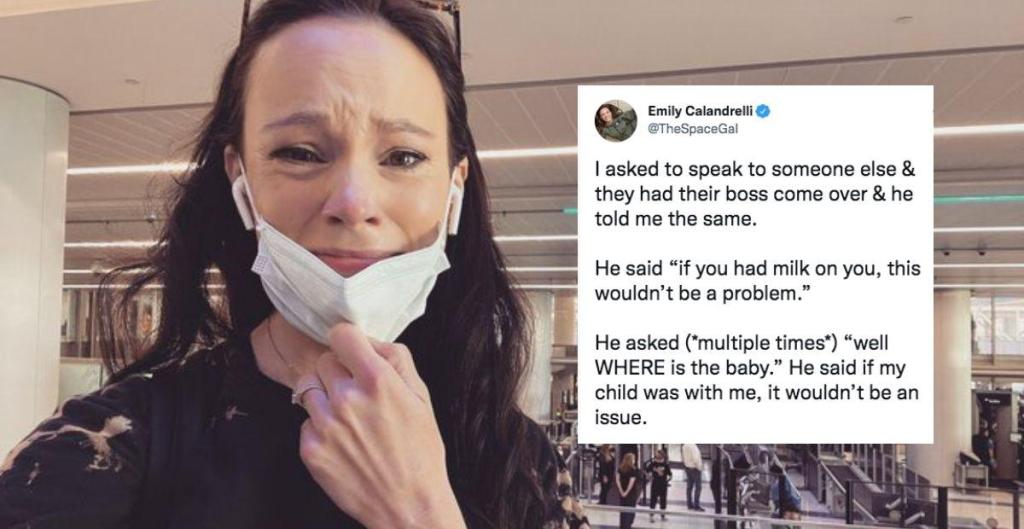
Calandrelli is a mom of two, an aerospace engineer and the host of the Netflix kids’ science show “Emily’s Wonder Lab.” She was recently taking her first work trip since welcoming her second child, which included a five-hour flight from Los Angeles to Washington, D.C. Calandrelli is breastfeeding her son and had planned to pump just before boarding the plane. She brought ice packs to keep the milk from spoiling during the flight, but when she tried to go through airport security, the TSA agents refused to let her take some of her supplies.
Calendrelli shared the whole saga in a Twitter thread, which she initially deleted because she was embarrassed and anxious about the confrontation. She reshared the story in a new thread, saying, “They make too many mothers feel this way, so I’m going to talk about it bc this needs to stop.”
She explained that she was going through LAX security with two freezer bags, one of which was frozen. She only needed one frozen bag for the departing trip, but would need both of them for her return when she’d have more milk to keep cold.
“Two male TSA agents told me I couldn’t bring my ice packs through because they weren’t frozen solid,” she wrote. “I asked to speak to someone else and they had their boss come over and he told me the same thing.” He said that if she had milk on her or the baby with her, it wouldn’t be a problem. He also asked where the baby was multiple times.
Two things: 1) Why would she have breast milk with her on a departing flight when she had just left her baby? And 2) If the baby were with her, it likely wouldn’t be an issue at all because she likely wouldn’t have needed to pump in the first place.
Calendrelli said she asked multiple times to speak to a female agent and was refused. “They escorted me out of line and forced me to check my cold packs, meaning I couldn’t pump before my flight for fear it would spoil,” she wrote.
Technically, she still could have pumped to relieve engorgement and keep her pumping schedule and just dumped out the milk rather than storing it. But throwing out breast milk isn’t ideal, especially when you’re trying to manage your supply with a baby’s demand.
And as it turns out, the TSA agents were wrong. Passengers are allowed to have gel ice packs for medical purposes, and they do not have to be frozen.
But their understanding of the policy aside, the fact that they couldn’t deduce the need for the packs based on the reality of pumping breast milk speaks to the need for a broader education about breastfeeding.
Calandrelli shared that moms had flooded her inbox with their own TSA horror stories after she shared hers. “It is infuriatingly common to encounter @TSA agents who don’t know their OWN rules around bringing breast milk/formula pumping equipment on planes,” she wrote.
“Yesterday I was humiliated that I had to explain to three grown men that my breasts still produce milk when I’m not with my child,” she added. “Yesterday I was embarrassed telling them about my fear of mastitis if I didn’t pump. Today I’m furious.”
She also shared that the TSA agent treated her like “a petulant child, trying to sneak her toy through security” when he told her not to “try to sneak it back through another time.”
“There’s so much pressure to breastfeed, but @TSA makes it impossible,” Calandrelli wrote. “It’s yet another system in place that makes it harder for women to get back to work after they’ve started a family.”
Indeed, there are so many ways in which our society is not supportive of motherhood, regardless of the lip service paid to it. According to the CDC, more than 80% of babies are breastfed as newborns and more than half are breastfeeding at six months. Not all of those babies are necessarily exclusively breastfed, but it is recommended—and not uncommon—for breast milk to be a baby’s only food source for the first six months.
So we’re talking about millions of breastfeeders at any given time, many of whom will travel at some point without their babies and need to pump. And yet we have so many people who are clueless about breastfeeding. Shouldn’t the general population have a better understanding of how it works, considering that it’s a basic biological function and common experience? Isn’t this something we should be teaching in schools? It seems like it would be far more useful and valuable knowledge than much of what we force kids to learn and memorize.
If those agents had understood how breastfeeding and pumping work, there wouldn’t have been an issue at all. Pumping is, indeed, a medical need when a breastfeeder is away from their baby for a length of time. The agents wouldn’t have asked such bafflingly clueless questions or acted like this mom was doing something wrong.
If we really want to be a society that values families and supports babies, we need to make sure the basics of biology are understood and that systems don’t make things harder on parents than they need to be.
Thia article originally appeared on 5.16.22