Feminist blogger has a fool-proof response to the question, ‘Can I buy you a drink?’

"Can I buy you a drink?" is a loaded question.

It could be an innocent request from someone who's interested in having a cordial conversation. Other times, saying "yes" means you may have to fend off someone who feels entitled to spend the rest of the night with you.

In the worst-case scenario, someone is trying to take advantage of you or has a roofie in their pocket.

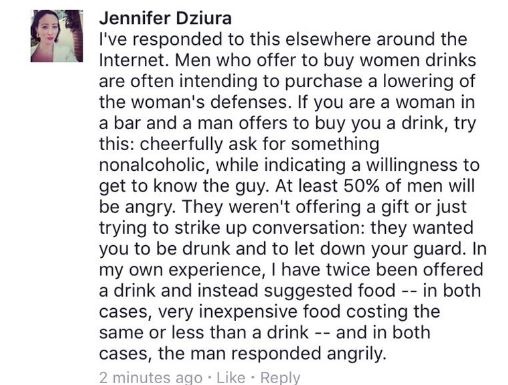
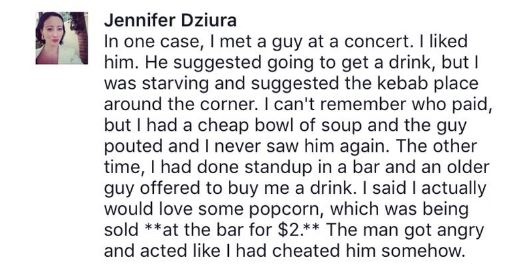
Feminist blogger Jennifer Dziura found a fool-proof way to stay safe while understanding someone's intentions: ask for a non-alcoholic beverage or food. If they're sincerely interested in spending some time getting to know you, they won't mind buying something booze-free.

RELATED: States are starting to require mental health classes for all students. It's about dang time.

But if it's their intention to lower your defenses, they'll throw a mild tantrum after you refuse the booze. Her thoughts on the "Can I buy you a drink?" conundrum made their way to Tumblr.

via AshleysCo / Tumblr


via AshleysCo / Tumblr

The posts caught the attention of a bartender who knows there are lot of men out there whose sole intention is to get somone drunk to take advantage.

"Most of the time, when someone you don't know is buying you a drink, they're NOT doing it out of a sense of cordiality," the bartender wrote. "They're buying you a drink for the sole purpose of making you let your guard down."

So they shared a few tips on how to be safe and social when someone asks to buy you a drink.

From the other side of the bar, I see this crap all the time. Seriously. I work at a high-density bar, and let me tell you, I have anywhere from 10-20 guys every night come up and tell me to, "serve her a stronger drink, I'm trying to get lucky tonight, know what I mean?" usually accompanied with a wink and a gesture at a girl who, in my experience, is going to go from mildly buzzed to definitively hammered if I keep serving her. Now, I like to think I'm a responsible bartender, so I usually tell guys like that to piss off, and, if I can, try to tell the girl's more sober friends that they need to keep an eye on her.
But everyone- just so you know, most of the time, when someone you don't know is buying you a drink, they're NOT doing it out of a sense of cordiality, they're buying you a drink for the sole purpose of making you let your guard down.

Tips for getting drinks-

1. ALWAYS GO TO THE BAR TO GET YOUR OWN DRINK, DO NOT LET STRANGERS CARRY YOUR DRINKS. This is an opportune time for dropping something into your cocktail, and you're none the wiser.

2.IF YOU ORDER SOMETHING NON-ALCOHOLIC, I promise you, the bartender doesn't give two shits that you're not drinking cocktails with your friends, and often, totally understands that you don't want to let your guard down around strangers. Usually, you can just tell the bartender that you'd like something light, and that's a big clue to us that you're uncomfortable with whomever you're standing next to. Again, we see this all the time.

3. If you're in a position to where you feel uncomfortable not ordering alcohol:
Here's a list of light liquors, and mixers that won't get you drunk, and will still look like an actual cocktail:

X-rated + sprite = easy to drink, sweet, and 12% alcoholic content. Not strong at all, usually runs $6-$8, depending on your state.
Amaretto + sour= sweet, not strong, 26%.
Peach Schnapps+ ginger ale= tastes like mellow butterscotch, 24%.
Melon liquor (Midori, in most bars) + soda water = not overly sweet, 21%
Coffee liquor (Kahlua) +soda = not super sweet, 20%.
Hope this helps someone out!

RELATED: Permit denied for 'straight pride' parade in California

If you do accept a drink from someone at a bar and you want to talk, there's no need to feel obligated to spend the rest of the night with them.

Jaqueline Whitmore, founder of The Protocol School of Palm Beach, says to be polite you only have to "Engage in some friendly chit-chat, but you are not obligated to do more than that."

If someone asks to buy you a drink and you don't want it, Whitmore has a great tip. "Say thank you, but you are trying to cut back, have to drive or you don't accept drinks from strangers," Whitmore says.

What if they've already sent the drink over? "Give the drink to the bartender and tell him or her to enjoy it," Whitmore says.

Have fun. Stay safe, and make sure to bring a great wing-man or wing-woman with you.

From Your Site Articles
Related Articles Around the Web
Images courtesy of John Scully, Walden University, Ingrid Scully
True

Since March of 2020, over 29 million Americans have been diagnosed with COVID-19, according to the CDC. Over 540,000 have died in the United States as this unprecedented pandemic has swept the globe. And yet, by the end of 2020, it looked like science was winning: vaccines had been developed.

In celebration of the power of science we spoke to three people: an individual, a medical provider, and a vaccine scientist about how vaccines have impacted them throughout their lives. Here are their answers:

John Scully, 79, resident of Florida

Photo courtesy of John Scully

When John Scully was born, America was in the midst of an epidemic: tens of thousands of children in the United States were falling ill with paralytic poliomyelitis — otherwise known as polio, a disease that attacks the central nervous system and often leaves its victims partially or fully paralyzed.

"As kids, we were all afraid of getting polio," he says, "because if you got polio, you could end up in the dreaded iron lung and we were all terrified of those." Iron lungs were respirators that enclosed most of a person's body; people with severe cases often would end up in these respirators as they fought for their lives.

John remembers going to see matinee showings of cowboy movies on Saturdays and, before the movie, shorts would run. "Usually they showed the news," he says, "but I just remember seeing this one clip warning us about polio and it just showed all these kids in iron lungs." If kids survived the iron lung, they'd often come back to school on crutches, in leg braces, or in wheelchairs.

"We all tried to be really careful in the summer — or, as we called it back then, 'polio season,''" John says. This was because every year around Memorial Day, major outbreaks would begin to emerge and they'd spike sometime around August. People weren't really sure how the disease spread at the time, but many believed it traveled through the water. There was no cure — and every child was susceptible to getting sick with it.

"We couldn't swim in hot weather," he remembers, "and the municipal outdoor pool would close down in August."

Then, in 1954 clinical trials began for Dr. Jonas Salk's vaccine against polio and within a year, his vaccine was announced safe. "I got that vaccine at school," John says. Within two years, U.S. polio cases had dropped 85-95 percent — even before a second vaccine was developed by Dr. Albert Sabin in the 1960s. "I remember how much better things got after the vaccines came out. They changed everything," John says.

Keep Reading Show less

The fasting period of Ramadan observed by Muslims around the world is a both an individual and communal observance. For the individual, it's a time to grow closer to God through sacrifice and detachment from physical desires. For the community, it's a time to gather in joy and fellowship at sunset, breaking bread together after abstaining from food and drink since sunrise.

The COVID-19 pandemic has limited group gatherings in many countries, putting a damper on the communal part of Ramadan. But for one community in Barcelona, Spain, a different faith has stepped up to make the after sunset meal, known as Iftar, as safe as possible for the Muslim community.

According to Reuters, Father Peio Sanchez, Santa Anna's rector, has opened the doors of the Catholic church's open-air cloisters to local Muslims to use for breaking the Ramadan fast. He sees the different faiths coming together as a symbol of civic coexistence.

Keep Reading Show less
Courtesy of CeraVe
True

"I love being a nurse because I have the honor of connecting with my patients during some of their best and some of their worst days and making a difference in their lives is among the most rewarding things that I can do in my own life" - Tenesia Richards, RN

From ushering new life into the world to holding the hand of a patient as they take their last breath, nurses are everyday heroes that deserve our respect and appreciation.

To give back to this community that is always giving so selflessly to others, CeraVe® put out a call to nurses to share their stories for a chance to be featured in Heroes Behind the Masks, a digital content series shining a light on nurses who go above and beyond to provide safe and quality care to patients and their communities.

First up: Tenesia Richards, a labor and delivery nurse working in New York City who, in addition to her regular job, started a community outreach program in a homeless shelter that houses expectant mothers for up to one year postpartum.

Tenesia | Heroes Behind the Masks presented by CeraVe www.youtube.com

Upon learning at a conference that black mothers in the U.S. die at three to four times the rate of white mothers, one of the widest of all racial disparities in women's health, Richards decided to take further action to help her community. She, along with a handful of fellow nurses, volunteered to provide antepartum, childbirth and postpartum education to the women living at the shelter. Additionally, they looked for other ways to boost the spirits of the residents, like throwing baby showers and bringing in guest speakers. When COVID-19 hit and in-person gatherings were no longer possible, Richards and her team found creative workarounds and created holiday care packages for the mothers instead.

Keep Reading Show less