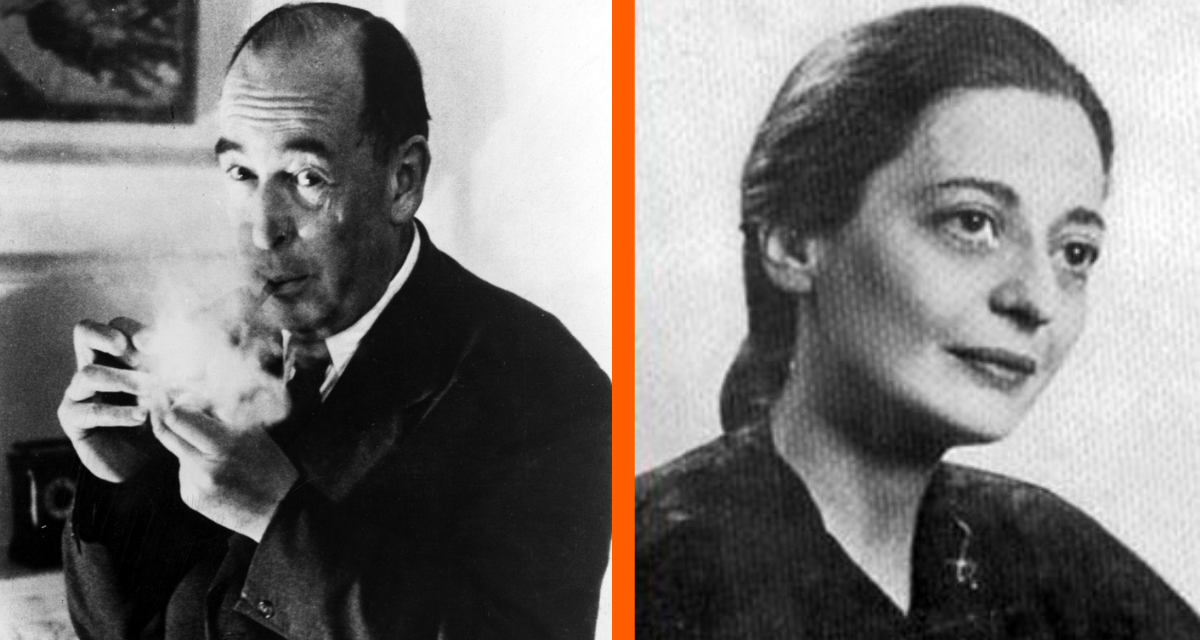
Author and lay theologian C.S. Lewis (short for Clive Staples Lewis), lived a full life steeped in education and literature. A prolific writer, Lewis authored more than 30 books across genres, including popular fantasy saga, The Chronicles of Narnia. Born in 1898 in Northern Ireland, Lewis would become one of the most esteemed writers of the 20th century.
Professionally successful, C.S. Lewis found love later in life. He fell deeply in love with American poet Helen Joy Davidman. The two married in 1956 when Lewis was 58 years old and Davidman was 41.
However, their marriage was short-lived. Davidman passed away from cancer in 1960 after struggling with tumors in her breasts that spread to her bones.
Lewis’ resulting grief turned into one of his most personal works that he had no intent on publishing: a journal he kept following her death that would later be titled A Grief Observed. Lewis used a pseudonym to publish it, N.W. Clerk, which is a pun on the Old English for “I know not what scholar,” according to the C.S. Lewis Institute.
Who was C.S. Lewis’ wife?
Helen Joy Davidman was born into a Jewish family in New York City in 1915, and went by “Joy.” She was extremely intelligent (called a ‘prodigy), and graduated high school at just 14. She went on to attend Hunter College for her undergraduate degree and Columbia University for her master’s degree.
She became a teacher and writer, and discovered her love and talent for poetry. She married a man named William Lindsay Gresham in 1942, and they had two boys. They officially divorced in 1954.
Davidsman was an atheist but searching for God, and became a Christian thanks in part to reading many of Lewis’ books, including: The Great Divorce, Miracles, and The Screwtape Letters. When she read an article on C.S. Lewis in The New York Times by a writer named Chad Walsh in 1948, her connection to Lewis began.
Walsh ultimately became her mentor, and he encouraged her to write to Lewis. She did in January 1950, and love eventually blossomed. They married on April 23, 1956.
She had battled health issues for years, and discovered in 1957 that she had serious cancer. She passed in July 1960 at the age of 45.
But their love had sustained them both. She wrote him romantic sonnets and he wrote to a friend, “It’s funny having at 59 the sort of happiness most men have in their twenties. . . [ellipses his] ‘Thou has kept the good wine till now.’”)
Lewis’ grief journey
Davidson’s death absolutely gutted Lewis. He wrote a beautiful epitaph for her:
Here the whole world (stars, water, air,
And field, and forest, as they were
Reflected in a single mind)
Like cast off clothes was left behind
In ashes, yet with hopes that she,
Re-born from holy poverty,
In lenten lands, hereafter may
Resume them on her Easter Day.
Lewis famously compared grief to fear. He wrote in A Grief Observed:
“No one ever told me that grief felt so like fear. I am not afraid, but the sensation is like being afraid. The same fluttering in the stomach, the same restlessness, the yawning. I keep on swallowing.“
He candidly expressed his process through grief in relation to fear, explaining that he feared going to “our favorite pub, our favorite wood.”
Lewis also wrote on fearing the future with grief: “This is one of the things I’m afraid of. The agonies, the mad moments, must, in the course of nature die away. But what will follow? Just this apathy, this dead flatness?“
A Grief Observed is revered for Lewis’ brutal honesty about grief, including his anger and questioning of God:
“But go to Him when your need is desperable, when all other help is vain, and what do you find? A door slammed in your face, and a sound of bolting and double-bolting on the inside. After that, silence.”
As former president of the C.S. Lewis Institute Arthur W. Lindsley wrote in 2001, “the process was not pretty or easy. The path was much clouded by fear, doubt, and anger before the gradual lifting of the darkness and breaking through of the sun.”
Lightness did come back to Lewis unexpectedly and gradually:
“It came this morning, early … my heart was lighter than it had been for many weeks… like the warming of a room or the coming of daylight. When you first notice them, they have been already going on for some time.“