The Rock surprised a group of tourists near his house and their reaction is pure joy

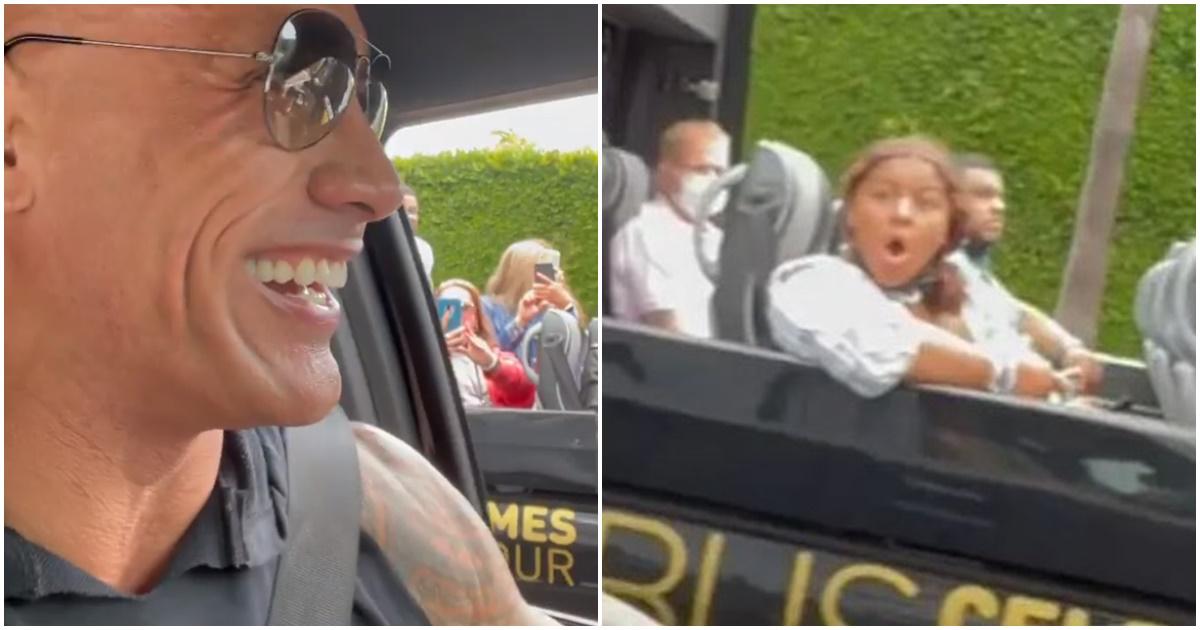
Dwayne “The Rock” Johnson gave some fans the surprise of their lives on Saturday when he pulled up beside a bus full of tourists near his home. The “Jungle Cruise” star rolled down his window and called to the group of tourists asking, “Hey you guys know where I can find The Rock?” The topless…

Array
ArrayPhoto credit: via The Rock / Instagram

Dwayne “The Rock” Johnson gave some fans the surprise of their lives on Saturday when he pulled up beside a bus full of tourists near his home. The “Jungle Cruise” star rolled down his window and called to the group of tourists asking, “Hey you guys know where I can find The Rock?”

The topless bus exploded with screams and everyone had huge smiles on their faces. In Los Angeles, it’s rather common to run across the occasional celebrity, but for these folks from out of town, it was a massive shock. Given their excitement, it’s pretty clear they got their money’s worth.


The former pro wrestler turned actor chatted with the tourists for a few moments and gave them enough time to get a picture.

After greeting the crowd, he pulled away in his vehicle laughing, saying, “Ah well, that was fun. It was a good way to start off my Saturday.”

The Rock is one of the highest-paid actors in Hollywood and lives an incredibly lavish lifestyle, but it’s good to see that he still has love for the fans who made it all happen. In a town where there are far too many entitled celebrities to count, it’s great to see someone enjoy the wonderfully blessed life they have.

“One of the cool parts of fame & my job ~ makin’ a few folks happy,” he captioned the post on Instagram.

  • Gen Xers and Boomers share what air travel was like in the ’80s and ’90s. The differences are wild.
    Flying has changed a lot over the decades.Photo credit: Canva
    ,

    Gen Xers and Boomers share what air travel was like in the ’80s and ’90s. The differences are wild.

    From smoking sections on planes to saying goodbye at the gate, so much has changed.

    Airline travel has always been an evolving business, from the first commercial flight in 1914 to the thousands of passenger flights in the air at any given moment in 2026. Those of us who lived through 9/11 as adults remember a very different time in air travel.

    On Reddit, someone asked Gen Xers and Baby Boomers what airline travel was like in the ’80s and ’90s, with specific questions like: “What was security like? What was the actual process of getting plane tickets before the internet? Was it hard to arrange rides with pay phones only? Did people smoke on planes? Did you use pay phones to call your loved ones back home and let them know you landed safe?”

    The folks on the r/AskOldPeople subreddit delivered answers, and it’s a trip down memory lane for those who lived it.

    Buying flights was a whole process before the Internet

    Today, we hop on Google Flights to compare ticket prices and book flights on airline websites right from the comfort of our couches in a matter of minutes. Back in the day, we didn’t have that luxury. Booking a flight meant making a long phone call or hoofing it to an office or kiosk, then receiving a paper ticket you had to keep track of.

    “You could either call and buy a ticket over the phone or buy it at the airport.”

    “Got a paper ticket. Mailed or picked up at airport or airline kiosks/offices at various locations (shopping malls, etc).”

    “Tickets were really precious things and you had to take care of them. They were hand-written even.”

    “Tickets were purchased directly from the airline or through a travel agent. Prior to the internet, it was much harder to research and book trips, so you hired an agency to help you.”

    “We would use travel agents in our town. You would tell them where and when and they would give you your options.  You. Would pick up your tickets at their office. They could set up your hotel and car rental.”

    Airport security was much less of a process

    It’s hard to imagine a time when you didn’t even have to show your ID to hop on a plane, but it happened. Many security measures were implemented after 9/11, though they had already been increasing incrementally before then.

    “Airport security was just a metal detector that you walked through that anyone could walk through and go to the gate to send off or greet the departing/arriving passengers. No need to be a ticked passenger, no ID check, or anything.”

    “I travelled a lot for work from about 1993 onwards. I remember flying Sydney to Chicago with a full tool case as hand luggage, a Gerber pocket knife in my pocket, no scanners hardly any security, just turn up and get on the plane.”

    “Security was easy. Just toss your stuff in a basket and go through a metal detector. I used to fly with a swiss army knife and it was no problem at all.”

    “Security was basic and relaxed. You really could run madly through the airport to catch a flight and nobody cared. You passed through a metal detector arch that was tuned way down to avoid false positives. It wouldn’t notice car keys, pens, or even small pocket knives (I once realized I had accidentally tested that).”

    “In about 1988, I bought a round trip airline ticket from NY to San Francisco off of Craigslist from a Chinese guy with a very Chinese name. Now I am as white as Wonder Bread, but I used that ticket and no one batted an eye. No ID. No questions. Nothing.”

    Smoking on airplanes was allowed through the ’80s

    Kids today can’t fathom how ubiquitous smoking was before the mid-’90s. Smoking wasn’t banned on domestic flights until 1990, and it wasn’t banned on international flights until 2000. Before that, planes had “smoking sections” with nothing separating them from the rest of the cabin. Ridiculous in hindsight, but that’s how it was.

    “Yes you could smoke on a plane…there was smoking and non smoking sections.”

    “The first time I went on a plane (mid 80s) was with my mom to go visit family, I don’t remember how old I was, but I distinctly remember there were still ashtrays in the arm rests.”

    “They used to put a complimentary four-pack of cigarettes on every meal tray. My father had at some point allowed me a puff of his cigarette through my bubble pipe, which I did not enjoy at all. So shortly after my meal tray arrived, my 4-year-old self yelled, ‘Stewardess, you can take these cigarettes away, because I quit smoking three weeks ago!’”

    “First international flight in 1997 I smoked all the way over. Pity the poor non-smokers, because even with a smoking section the smoke was all through the plane.”

    No luggage fees (but no luggage wheels, either)

    Ah, the good old days of free checked luggage. (Paying for checked luggage is actually pretty new. All airlines let you have one free checked bag prior to 2008.) But luggage was also a whole different animal. We used to have to carry suitcases. And people didn’t generally carry on suitcases with clothing in them because they’d end up smelling like smoke by the end of the flight.

    A stack of vintage suitcases from before luggage had wheels
    Suitcase wheels are a relatively new invention. Photo credit: Canva

    “Nobody was dragging their carry-on baggage throughout the terminal – checking bags was always free and everybody checked their bags. But the downside of no baggage security checks was that stuff sometimes got stolen from your bags by baggage handlers – so you always locked your bags. that is why those hard-sided Samsonite suitcases with the combination lock latches were popular.”

    “Luggage didn’t even have wheels back then!”

    “I remember the early wheeled suitcases were so awkward and top-heavy like an elephant riding on the top of a London bus. They had wheels on the bottom and a ‘leash’ attached to the top front. It was better than carrying, but if you went anything other than perfectly straight, it would topple over.”

    People dressed up to fly

    It’s not at all unusual to see people boarding flights in sweats or other uber-casual attire. On a redeye, you’ll see people basically in their pajamas. Comfort has definitely overridden traditional airplane-attire etiquette, which some people love and some people hate.

    “People dressed well, not fancy but nice. I once flew ‘standby’ (my sweet Dad was an aircraft mechanic) and I had to wear my ‘nicest’ dress just in case I got bumped to first class! And I did! It was very nice. One way, the other way i was in coach, but everyone was still dressed nicely, including me. :)”

    “Can confirm. I flew to Germany as a kid in the 80’s and my parents made me wear my ‘Church clothes’ on the plane.”

    “Night and day. It was a privilege to fly, people got dressed nice to fly, now flying like taking a bus. It’s a zoo in the air and people crazy.”

    Pick-up and drop-off happened right at the gate

    Gen Xers and Boomers who flew remember saying goodbye right before boarding the plane and greeting loved ones just after exiting the jetway. That can’t happen now. Security increases after 9/11 meant that only ticketed passengers could fully enter the terminal. At least it makes terminals less crowded?

    A woman waves goodby in an airport before heading into airport security
    Goodbyes now take place before going through security. Photo credit: Canva

    “Everyone could go to the gate and hang out. We used to go to the airport and watch the planes taking off and landing.”

    “Some time in the late 90s, I went to pick up my mother from the airport, and I brought a friend with me. They let us both go wait at the gate with no issues. We probably had to go through a metal detector but it was pretty easy.”

    “Pick up and drop off was a ton easier. Whoever was coming to get you parked somewhere and came to the gate to wait for you. For drop offs they either pulled right up to the terminal and let you out where there was a porter waiting to take your bags (hopefully to the correct flight), or you parked in the airport short term lot and walked in together —all the way to the gate if the goodbye was a difficult one.”

    “I’m glad this isn’t allowed anymore. Anytime I’ve flown, the gates have been full and I end up standing off in the walkway waiting to board. I can’t even imagine adding ‘hey, let’s all hang out with Grandma before she leaves’ into the mix.

    Another thing I remember about this was trying to get OFF the plane. People would crowd around the gate to greet their arriving family just like they do around the baggage carousel. And of course when grandma walked out the door, they’d run up and do their hugs and handshakes right there with everyone else trying to get around them. It was maddening, especially at the holidays.”

    You had to use a pay phone if you needed to call someone

    These days, nearly all airlines allow you to text for free even when you’re up in the air. The first thing many people do when the wheels touch down is text someone to let them know they’ve landed. Gone are the days of having to find a wall of pay phones or waiting until you got to your hotel to call someone.

    A wall of payphones
    Airports had walls of pay phones like this. Photo credit: Canva

    “Airports used to have huge banks of payphones all over, but I think most people would call from their hotel phone when they got checked in.”

    “There were plenty of pay phones to call people, and plenty of shops that would make change for you if you needed.”

    “Airports would have large banks of payphones, but they would also have kiosks with courtesy phones, that were basically hotline phones with no keypad that automatically dialed, this could be the shuttle bus operation, a taxi service, or your hotel that may operate their own shuttle service. Picture a kiosk near luggage pickup with a sign for Holiday Inn Airport and a phone with no number pad that directly connects you to the front desk at the nearby Holiday Inn so they could dispatch the shuttle van driver to pick you up.”

    “You didn’t call anyone when you landed, people met you at the airport. You arranged in advance. If the flight was delayed, they waited. Nobody was paying for parking at airports.”

    Other than the secondhand smoke, flying was more comfortable

    Before 1978, the government set flight prices. Since airlines couldn’t compete on price, they competed on service and passenger experience. That focus spilled over into the ’80s, but as price competition grew, so did a desire for cheaper flights. Now we pay less, but we also get less.

    “The planes were more comfortable. The seats and legroom were better in economy/coach and you got an included meal and in-flight movie on longer flights.”

    “In the ’80’s it was much nicer. Larger planes, more room, bigger seats, better food, more luggage allowed. Plus few carry on restrictions. In the 90’s airlines had begun tightening up a bit but you could still expect at least a non-alcoholic drink and a snack on anything longer than a puddle jumper flight even in economy or business. Anything longer than that and you could count on a meal.”

    “The planes were less full and seats had enough legroom even economy.”

    “Seats had more leg room because they weren’t cramming in as many as possible on discount flights.”

    Some changes in air travel have been good, and others not so great. But flying definitely isn’t what it used to be.

  • Woman ticketed for driving with phone in her ‘right hand’ has a huge surprise for police officer
    A woman hands her license to a police officer. Photo credit: Canva

    Distracted driving is a dangerous issue that police officers are taking more seriously. But when Katie, who runs the social media page Slightly Off Balance, was pulled over for the offense, she had questions. The officer writing the citation insisted that she was driving with her phone in her right hand. That didn’t make sense to her.

    The woman uploaded a clip of the interaction in which she asks the officer for clarification. According to the officer, he witnessed Katie committing the driving infraction. Katie asked for clarification several more times because it would be impossible for her to hold a phone in her right hand. Why? She doesn’t have one.

    police, traffic ticket, traffic stop, pulled over, amputee, distracted driving
    Police car seen through the rearview mirror. Photo credit: Canva

    In the video, which has been viewed nearly eight million times, Katie pokes fun at the situation. “Turns out you can still get a ticket for driving with a device in your right hand, even if you don’t have a right hand,” she says, holding up her arm. Clearly, the entire lower part of her right arm is missing.

    After cutting to the bizarre interaction between herself and the officer, Katie shows herself attempting to hold a phone with her nonexistent hand. Spoiler alert—it doesn’t work. In the video, the officer can be heard saying, “If you want to take it to court, option five on the back of the ticket. That’s how you take it to court.”

    police, traffic ticket, traffic stop, pulled over, amputee, distracted driving
    A police officer stops a driver. Photo credit: Canva

    Taking it to court is exactly what she plans to do. In a follow-up video, she shares that her court date is scheduled for mid-April. Commenters are not only gobsmacked that she could be cited for this particular infraction, but they’re also completely invested in her court case.

    @slightlyoff.balance

    Low key thought I had two hands for a minute 🤦🏻‍♀️ #palmbeach #cops #PBSO #floridaman #pulledover

    ♬ original sound – slightlyoff.balance

    One person begs, “Please take us to court with you, I want to hear the judge.”

    Another writes, “I’m glad you recorded him saying it was the right hand otherwise I guarantee he would have lied later on and claim he never said that.”

    “Ok but how would you ve able to drive with a phone in ur LEFT hand anyway,” someone questions.

    “Oh I wanna see a part 2. I know it sucks tho, cause you shouldn’t have to take time off work/life just to prove a cop wrong,” a person laments.

    One commenter shares a cheeky way Katie could have handled the situation, writing, “I would have said ‘ok I’ll see you in court’ and waved with your right hand to get his reaction. And then still gone to court to let the judge know he was lying.”

    police, traffic ticket, traffic stop, pulled over, amputee, distracted driving
    A woman being pulled over. Photo credit: Canva

    Some people wonder why she didn’t inform the officer on the spot that she didn’t have a right hand. But others argue that the officer had already proven to be untrustworthy and would likely change his story. Katie didn’t respond to those questions, but the officer could likely see that she didn’t have a hand while looking directly into her window.

    Katie appears to have a sense of humor about missing a hand, liking several comments that joke about her limb difference.

    “I would have held my right hand out for the ticket. So glad you got that admission recorded,” someone writes.

    “Cutting your hand off to get out of a traffic ticket is wild,” another jokes.

  • People were asked to share their culture’s most delicious ‘filling wrapped in dough’ snacks and they didn’t disappoint
    One thing brings all people together: a filling wrapped in dough.Photo credit: Canva

    When reading the words “filling wrapped in dough,” what pops into mind? Dumplings? Empanadas? Hostess Fruit Pies? An Instagram post has people discussing the near-universality of cultures around the world having their own version of a tasty filling encased in delicious dough.

    No matter where a person comes from, it seems like there is some form of “filling wrapped in dough” food in every country. Folks from different nations flocked to Reddit to discuss their favorites:

    “Sambousek. We make it filled with minced meat, onion, and pine nuts all mixed together with some pomegranate molasses.” (from Lebanon)

    “Cornish pasties. Or maybe sausage rolls. Then again, beef wellington is basically ‘filling wrapped in dough.’” (from the United Kingdom)

    “Pastel. Very thin and crispy dough, deep fried. National favorites include heart of palm, and cheese & ham. My favorite is shrimp.” (from Brazil)

    “Calzone.” (from Italy)

    “My French-Canadian grandma makes tourtiere in a hand pie format every Christmas and they’re incredible. I look forward to them every year.” (from Canada)

    “Here’s a curry goat patty.” (from Jamaica)

    “Pierogi, my beloved.” (from Poland)

    “Pitepalt. A potato and barley dumpling the size of a tennis ball. It is filled with salt pork and served swimming in butter and lingonberry jam.” (from Sweden)

    “Irish sausage rolls… Not to be confused with a sausage in a roll.” (from Ireland)

    “I have a steak and cheese pie for breakfast most mornings.” (from New Zealand)

    “Give me one of them handheld dessert pies from the gas station and I’ll be all over them.” (from the United States)

    Pro chefs share their favorite “filling wrapped in dough” foods and recipes

    Many professional chefs and food experts who spoke to Upworthy shared their favorite versions of dough-wrapped foods and the stories behind them.

    “I’ve rarely met a dough stuffed with filling that I didn’t like, and I also think it’s fun to reimagine popular foods and let their worlds collide,” said award-winning pastry chef Katherine Sprung. “I was a winner of the show Chopped Sweets, where our challenge was to create mash-up desserts. For my first round I made a cheesecake egg roll, made a raspberry cheesecake mixture, enclosed in an egg roll wrapper, and fried, which, luckily, the judges really loved!”

    Sprung also said that making those cheesecake egg rolls on TV inspired her to create another simple recipe: cashew butter and jelly rolls.

    “Spinach fatayer are portable and are perfect for picnics, potlucks, and special occasions,” said cookbook author Luay Ghafari. “My grandmother used to prepare them on the weekends so they would be ready to go into our school lunchboxes come Monday.”

    If you want to try this savory hand pie, Ghafari kindly provided a recipe. Ghafari said that fatayer can also be made for meat or cheese lovers.

    Spinach fatayer. Photo credit: Luay Ghafari

    A “filling in wrapped dough” started a career

    These filling-wrapped-in-dough foods aren’t just favorites springing from a chef’s imagination or family roots. In some cases, they can even inspire lifelong vocations.

    “My favorite ‘filling in wrapped dough’ food is the Himalayan momo,” said Jessica Randhawa, chef and recipe developer at The Forked Spoon. “I never knew what a momo was until my boyfriend, now husband, and I traveled to Asia for six months in 2011. Those travels are what initially got me into cooking classes and schools abroad and writing about them.”

    Jessica Randhawa and a classmate learning to make momos in Kathmandu.
    Photo credit: Jessica Randhawa

    “When I got back to Kathmandu, I had to take a cooking class to learn how to make them, which was one of my first experiences learning to cook from professionals,” she added. “So, momos are really special to me because learning about them and how to make them 15 years ago inadvertently kicked off a long and winding road that led to growing one of the largest recipe websites in the world.”

    Wrapped in dough, wrapped with love

    Celebrity chef Mariko Amekodommo told Upworthy that her upbringing and her travels while training to be a chef were filled with dough-wrapped delights.

    She recalled learning how to make handmade ravioli by watching her mom and grandma as a child. Among many other foods, she said she learned to cook and eat tamales, bánh cuốn, samosas, and ovocné knedlíky while living in Los Angeles, Vietnam, India, and the Czech Republic. While all of those dishes use different ingredients, Amekodommo saw many similarities.

    “What strikes me, having lived and cooked professionally across multiple countries, is that these aren’t really different dishes,” said Amekodommo. “They’re the same dish built from whatever the land provided—wheat in Europe and North India, corn in Latin America, rice in Southeast Asia.”

    “The form is universal because it solves the same problems everywhere: stretch protein with starch, make it portable, feed a lot of people from not very much,” she added. “And they became holiday food everywhere for the same reason—you can’t really make them alone. They require hands, time, and people around a table. That part never changes.”

    It seems that “filling wrapped in dough” brings people together, whether worldwide or within your own household.

  • Woman makes a country song out of her dad’s voice texts, and it’s an accidental hit
    A dad's failed voice-to-text attempts strike musical comedy gold.Photo credit: Canva
    ,

    Woman makes a country song out of her dad’s voice texts, and it’s an accidental hit

    “Cowboy Gary has stolen the hearts and brought tears of laughter to MILLIONS.”

    Anyone who’s ever used voice-to-text has felt the frustration of a phone hearing things very, very wrong. This is especially true for those among us with thick accents.

    However, this frustration can apparently make for musical comedy gold.

    Just ask Bri Hill, who used failed voice-to-text attempts from her father, affectionately known as “Cowboy Gary,” and turned them into a country song that’s not only hilarious but also kinda slaps.

    “This is my greatest creative achievement to date,” bragged Hill.

    And honestly, despite the fact that she’s an art teacher, she ain’t wrong. Gary’s twangy voice really lends itself to the genre. Even something as mundane as asking his sister if she’s coming to the family reunion (“Harold and Wanda will be there. Oh, and Lindsey!”) magically feels perfect.

    And of course, there’s a bit of an, ahem, misunderstanding when the phone tries to transcribe Gary talking about the BULLS on his farm. Three guesses as to what word the device thinks he’s saying.

    Watch:

    “Never know what the phone’s gonna print when I’m talkin’ to it,” Gary laments in the tune. We know your pain, Gary! He then brings it all home by saying, “I will talk to ya later when I have time to talk on the phone instead of talk to the damn phone!”

    TikTok reacts

    Without a doubt, it was an instant hit online. People praised Hill for writing a bona fide honky-tonk bop and empathized with Gary’s exasperation—so everybody found something to love.

    “You, ma’am, have written the perfect country song. David Allen Coe would be proud!”

    “Can I find this on Spotify? 🤘🏻 🎶 🤠”

    “This is a hidden gold mine.”

    “I love this! My phone constantly voice texts ridiculous things, and I say all the time, ‘Siri doesn’t speak Texan.’ I always thought I didn’t have an accent until I attempted voice texting.”

    “It sounds like text conversations with my dad! Love it!!!! my siblings, and I do a monthly recap of our text messages with our father.”

    “​​I have tears rolling down my face from laughing.”

    “As someone who voice texts, this is a very accurate conversation.”

    “Submit this to the waffle house juke box 🤣”

    “This why I don’t use voice to text. 🤣”

    As Hill put it in her caption, Cowboy Gary has stolen the hearts and brought tears of laughter to MILLIONS.”

    Getting your phone to understand your accent

    According to a survey conducted by Guide2Fluency, Southern and Texan dialects are two of the five U.S. regional accents most commonly misunderstood by AI, ranking first and fourth, respectively. Joining them are New York, New Jersey, and Boston accents. And that’s without even going into the challenges that ethnic and cultural dialects and accents face when it comes to errors.

    That said, there are ways to reduce some of these mistakes, even if they don’t disappear entirely. One is to change the specific regional dialect (e.g., British English vs. American English) in your settings. Another is to update your system’s voice recognition software to ensure better accuracy.

    Or, you could just use it to make a song. Whatever floats your boat. 

  • Man gets wave of support after tearful confession that a friend called him ‘too poor’ to get invited anywhere
    A man gets a wave of support after sharing how a friend excluded him for being “poor.”Photo credit: @father_vs_world/TikTok

    Recently, a man went on TikTok to tearfully recount being called “poor” by a close friend. He was overwhelmed by the amount of support he received from total strangers.

    On February 12, Andrey Borul explained in a video that he had fallen into medical debt after spending two weeks nearly dying in the hospital. Now, he’s “working almost twenty hours a day trying to recover.”

    Borul isn’t alone in this struggle. Studies estimate that approximately 100 million Americans have some form of medical or dental debt, with total outstanding debt around $220 billion.

    And yet, Borul’s family has tried their best to keep their spirits up and “make it work.” They’ve always managed to “bring a gift” to whatever parties they were invited to.

    “Too poor” to get invited

    So when, at one of these parties, a friend said that Borul and his wife don’t get invited anywhere because they’re “too poor,” he was “dumbfounded.”

    Things only seemed to get worse when, presumably at the same party, couples were talking about “buying houses.” Borul’s wife suggested making a group trip to the mountains so the kids could enjoy the snow together. Again, a friend immediately “shot down” the idea, saying, “You can’t afford that.”

    Tears welling up in his eyes, Borul admitted, “It’s true—we can’t.” He then shared how, the next morning, he drove up to the mountains himself to bring down some snow for his kids to play with.

    @father_vs_world

    Daughter been praying for snow and since Idaho had zero snow days i made a secret trip high into the mountains to bring snow for them to play in

    ♬ Snow Day – Tabitha Meeks & Ryan Corn

    “After our bills are paid, we have so little left over for entertainment,” he said. “I’ve been working nonstop to dig ourselves out of this financial hole…being poor sucks.”

    Borul ended his clip saying, “I feel so alone. We haven’t been invited for three months anywhere.”

    Thankfully, Borul was met with a wave of support from viewers 

    A few people shared that they had found themselves in equally disheartening situations.

    “Most of us in North America are in your shoes.”

    Many chimed in to remind him what real friendship looks like.

    @father_vs_world

    Replying to @Sandyyy.R. How can so called close “friends “ be so crule.. just thinking about it makes me cry 😭

    ♬ original sound – father_vs_world

    “Bro, you literally went to the mountain and brought your kids back snow…you’re working 20 hours a day for your family…you are THE MAN. Do not let those types of people make you feel any sort of way. Run from them. You’re the kind of guy I would be honored to call my friend.” 

    “You almost died, lost two weeks of income, and those people did not help you? They are not your friends.” 

    “This broke my heart and angered me because I’ve been in between blessings before and I remember when we planned a trip and our friends knew we were in between blessings. They ended up paying for the trip and once we got back on our feet, that’s when we paid them back (they wouldn’t take it). My point is friendship is about support (not necessarily financial), love, and grace. As hard as it’s going to be it may be time for you and your wife to leave them where they are at. Sending you love.”

    “You should not be wasting your time and energy on these people. You are richer than them in the most important way.”

    “If they were your friends, they would ask how to help you, not leave you out because you don’t have the money.” 

    And perhaps most encouraging of all, donations began pouring into Borul’s GoFundMe to help cover some of those exorbitant medical bills and give him some room to breathe. So far, a little over $30,000 has been raised, inching closer to the overall $35,000 goal.

    Understandably, Borul was overwhelmed by all the support 

    “I woke up with a total lightness in my chest,” he said. “Total strangers showed me more compassion than my own friends. I am so beyond grateful.”

    Hopefully, Borul can take solace in knowing that he does have a friend group, even if it wasn’t who he was expecting.

    If you’d like to donate to Borul’s GoFundMe page, click here

  • Generation Jones is showing off their Farrah Fawcett feather hairdos from the ’70s in all their voluminous glory
    Generation Jones shows off their Farrah Fawcett–inspired hair from the 1970s.Photo credit: Reddit/Asleep-Cow-6367 & Wikipedia

    Television in the 1970s was packed with unforgettable variety shows and iconic late-night talk shows that showcased some pretty incredible performances. One TV show that had a seismic impact on pop culture in the late 1970s was Charlie’s Angels, which debuted in 1976 and starred the gorgeous Farrah Fawcett.

    It was Fawcett’s legendary coif that set off a major 1970s hair trend. Baby Boomers and Generation Jonesers took cues from Fawcett, opting for feathered shags and voluminous hairstyles that defined the decade.

    On Reddit, users shared photos and discussed the glory of the hair trend back in the day.

    Generation Jones on their feathered hairdos

    Redditor Asleep-Cow-6367 shared a photo of her feathered ‘do, along with a few funny comments. “I wanted to look RAD! 😅,” she wrote. “I didn’t know WTH I was doing, but I had that comb in the back pocket of my H.A.S.H. jeans! Haha. Oh, that blow dryer and round brush.”

    Another Redditor commented on her ‘do: “Nice! You had your hair ‘trained’ as they used to say back when.” She replied, “Kinda. I didn’t like hairspray, so I had that mirror in my locker door, and that comb in my back pocket! Every class break, I am checking my look! LOL.”

    She inspired other Gen Jonesers to share their nostalgic thoughts and memories:

    “Some of us guys pretty much had it too….lol.”

    “I loved my Farrah feather.”

    “I had shorter hair so I had the Dorothy Hamill. I think 90% of the girls were having one or the other.”

    “God the time and hair spray spent on these hairdos!! I looked exactly the same. I’m 63 now.”

    “The wild thing about this hairstyle is it worked on guys and girls. I’m a 64 year old man and I had that exact hairstyle in 1978.”

    “I remember getting the Farrah Fawcett hair style in Junior High. I cried when I washed my hair because it was the first time I had any type of bangs and thought I was bald. Haha I wore that style for several years as a teenager. My 8th grade school picture had the FF hair cut and the ugly baby blue eye shadow. I was next level using the dark blue mascara too.”

    Farrah Fawcett hair history

    Hairstylist Allen Edwards is credited with creating Fawcett’s signature hairdo.

    “The layers around the face are shorter,” Edwards told Stylelist in an August 2009 interview, according to the Huffington Post. “What made it different was that it wasn’t full on top. It was flatter, and the ‘Farrah’ part was the edges, which went flipping back. She had a very strong, squarish jaw, and with her hair long cut [and] moving away from her face, it took your eye away from it.”

    Edwards also told Access Hollywood that he had always wanted to style Fawcett’s naturally curly hair, and that the two finally met through mutual friend Jane Brolin in the mid-1970s.

    “When she came to me they were overbleaching her, and it was dry and didn’t have the luster I gave to it,” he quipped.

  • Bridgerton’s Luke Thompson shared his favorite French phrase. We need something like it in English.
    France isn't the only country with a saying like "un ange passe."Photo credit: Canva

    Luke Thompson has achieved heartthrob status as Benedict Bridgerton, the free-spirited, second-born son of the noble family featured in the popular Bridgerton television series. The show’s fourth season focuses on Benedict’s Cinderella-esque love story with a servant named Sophie, played by Yerin Ha.

    In an interview promoting season four, Thompson and Ha read questions from Bridgerton fans. One person asked Thompson, who grew up in France and speaks fluent French, to share his favorite French phrase.

    @etalkctv

    We can’t think of a better French teacher! 🇫🇷 Luke Thompson revealed what his favourite French phrase is and taught Yerin the language of love in the process! Watch the FULL video of Yerin Ha and Luke Thompson texting fans at the link in our bio. 🔗 Part 1 of ‘Bridgerton’ season 4 is streaming NOW on @Netflix. #LukeThompson #YerinHa #Bridgerton #French #BenedictBridgerton @Yerin Ha

    ♬ original sound – etalk

    “My favorite French phrase is probably…Oh! ‘Un ange passe,’” he said.

    Ha asked what it meant, and Thompson helped her decipher it. Un = a/an. Ange = angel. Passe = pass(es). In English, “Un ange passe” means “An angel passes.”

    “What it means is, when you’re having a conversation, or like just in a group, it’s a nice way of expressing awkward silence,” Thompson explained. “But it’s just those moments where like, just, there’s a bit of a lull and no one says anything. And you say, ‘Un ange passe.’”

    “You say, ‘An angel passes,’” Ha said. “That’s really nice.”

    It is nice. And it appears to be a glaring omission from the English language, since people in the comments shared that they have similar phrases for awkward silences in their cultures:

    “OMG we say the same thing in Arabic!”

    “We say the same in Portuguese… ‘passou um anjo’ ☺️”

    “In Spanish we say that, at least in Chile ‘pasó un angel or ‘un angel pasó.’”

    “In Spanish we say the same thing!! México 🇲🇽”

    “In Philippines we have this too! Haha may dumaang anghel 😂”

    “In Malay we said: malaikat lalu.”

    “We have that phrase in Danish too. But it’s more an angel went through the room.”

    “The Dutch also have this, but a reverend walks by instead of the angel 🙈 Angel is much nicer.”

    “We say that too in Nigeria. ‘Ndị muozi na agafe.’”

    It seems that many cultures have handy phrases like this to make a conversational lull feel mystical or magical instead of uncomfortable and awkward. The wording may differ from place to place—apparently, in Russia and Kazakhstan they say, “A cop was born”—but why don’t we have anything even close to it in English?

    When silence falls over a group of English speakers, we just stand there and shift our gaze, feeling the heavy seconds tick by. Occasionally, someone might acknowledge the silence by saying, “Well, this is awkward…” but that only emphasizes the awkwardness.

    The irony here is that English speakers tend to be particularly uncomfortable with silence, at least compared to cultures in which silence is viewed more positively.

    In his research, linguist Haru Yamada found that Americans consider the length of silence in Japanese speakers’ conversations to be “unbearably long.” Unlike many other cultures, we have no sweet, playful saying to slice through the pregnant pause.

    Not all silence is uncomfortable, of course. It becomes awkward when we expect others to speak—or when we are expected to speak—and no one does.

    According to Rebecca Roache, associate professor of philosophy at the University of London, the awkward feeling of silence comes from fear of how it might be interpreted: “Specifically, we worry about one or both of two things: having others misinterpret our silence, and having others correctly interpret our silence.”

    In other words, we might worry that people think we’re boring if we don’t have something to say, which would be a misinterpretation of our silence. Then again, we might worry that people will think we’re nervous, which may be a totally correct interpretation of our silence—but just not the impression we want to give others.

    The beauty of having a standard phrase like “un ange passe” is that it allows everyone to acknowledge that lulls in conversation are a normal, universal phenomenon. It says, “This is so common, we even have a saying for it.” That alone helps lessen the awkwardness. The English language’s lack of such a phrase now feels like a big, gaping hole in our social lives.

    Where did the idea of saying “un ange passe” come from in the first place? According to the Lawless French website:

    “No one seems to know the origin of the expression, whether the angel’s passing is what causes the silence or if she is attracted by the tranquility, but either way, un ange passe is a nice way to break the tension and continue chatting.”

    Can we just start saying “an angel passes” now? Do we need to ask anyone’s permission for this? It appears to be pretty universal, so maybe we English speakers just missed the boat somewhere along the centuries. It feels well past time to remedy that.

  • Henry Cavill shared a delightful story about a boy’s teacher who refused to believe his uncle was Superman
    Henry Cavill February 10, 2013Photo credit: Sean Reynolds via Wikimedia Commons

    When Henry Cavill was cast as Superman in 2011, most people were thrilled. His nephew Thomas was thrilled too, and he wanted everyone to know about it.

    At school, during a “talk about your family” day, Thomas told his class: “My uncle is Superman.” His classmates were stunned. Nobody believed him. His teacher, less than impressed, told him plainly: “Thomas, we don’t lie in school.”

    Thomas did not back down. “My uncle is Superman,” he insisted.

    The teacher, now genuinely concerned, raised the issue with Thomas’s mother when she came to collect him that afternoon. She walked her through the whole incident, explaining that the school did not encourage children to make things up in front of their peers. Thomas’s mother listened patiently, then delivered the news as gently as she could.

    “I hate to tell you this,” she said, “but it’s all true.”

    Cavill told the story on The Tonight Show with Jay Leno in June 2013, and it got so much mileage that he retold it on Live with Kelly and Ryan in 2018. Both times, audiences loved it for the same reason: Thomas never wavered. He knew what he knew, and no amount of adult skepticism was going to change it.

    “My uncle is Superman” is not the kind of claim most teachers are prepared to receive. But from Thomas’s perspective, it was simply a fact about his life, one that happened to be harder to verify than most. As Cavill told the story, there was no drama, no grand reveal. Just a small boy, stubbornly telling the truth, and a mother who had to gently correct a teacher’s assumptions at school pickup.

    The clip from the Live with Kelly and Ryan appearance has amassed over nine million views, with fans delighting in the specifics. “I hope the teacher replied by saying ‘I’m going to need you to prove that,’” one commenter wrote. “If my uncle was Superman I would brag about it every single day,” said another.

    Thomas, for his part, appears to have handled the whole thing with exactly the composure you’d expect from someone whose uncle saves the world for a living.

    This article originally appeared last year.

Wholesome

Woman makes a country song out of her dad’s voice texts, and it’s an accidental hit

Skills

What is choremancing? Meet the practical 2026 dating trend that turns errands into relationship tests.

Skills

3 car mechanics explain what really happens when you keep driving on empty

People Skills

10 signs you’re a quiet introvert in group chats, according to psychology