Gen Xers and boomers share ‘customary good manners’ they wish would make a comeback

“Manners” are sometimes seen as old-fashioned, but thoughtfulness and courtesy are never out of style.

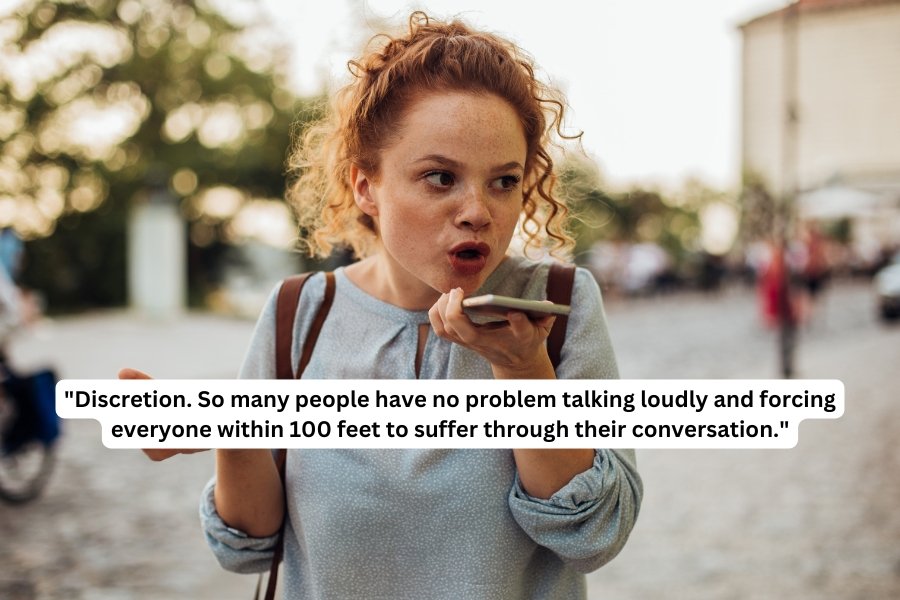
woman speaking on speakerphone
Photo credit: CanvaSpeakerphone in public? No thank you.

In the modern world, the importance of “manners” as widely agreed upon standards of behavior and habits of a civilized society feels fairly antiquated. What used to be considered rude has become commonplace, what was polite is now seen as stuffy, vulgarity ranges from tolerated to celebrated, and shared expectations of common courtesy have all but dissolved.

Depending on your age and perspective, the above statement may invoke a high five or a serious eye roll. Sure, we’ve shed some of the social norms outdated ideas about what’s right and proper, but isn’t that generally a good thing? Or have we unfortunately thrown the baby out with the bathwater?


Someone asked Gen Xers and boomers on Reddit what “customary shows of good manners” they’ve been sad to see go by the wayside, and the responses are a reminder that manners aren’t just arbitrary rules. Often, they stem from thoughtfulness and appreciation of others, which are universal values we can all get behind.

Not all manners-of-old are worth keeping, but here are some of the “good manners” Gen Xers and boomers say they’d like to see make a comeback:

Saying thank you

Expressing gratitude is good for you and feels good to the person receiving it. Anyone who does a service for you, even if they’re getting paid for it, deserves a simple “thank you.”

“Saying thank you to people whose job it is to help you in some way. Yes, it is their job, but that doesn’t mean you should just ignore them. I always say thank you, and many people look surprised before smiling and saying, ‘You’re welcome!’”

“As a little kid, I remember my mom telling me “say thank you” when someone would do something, anything, for me. Many times I’d roll my eyes and dramatically sigh “thank youuu” to people. It was expected that parents would, you know, parent in real time. Other adults understood.”

“I am always surprised at the looks I get when I say ‘thank you’ to store clerks, cashiers, baggers, etc. I can’t tell if they have never heard the words before or if no one ever says it to them. If I add ‘have a nice day’ I really get stared at.”

“Just a thank you in general is nice but often forgotten- I had to text my nephew once and said Did you get this gift because you never said anything about it.”

Heck. I even thank the AI assistant on Amazon. =-)”

Grace (as in saving others from feeling embarrassed)

The embarrassment or humiliation of others has become the basis of loads of social media content, and this kind of “grace” feels like a relic from a bygone era. Being gracious may be a lost art, but it’s a valuable one worth reviving.

“There used to be a principle taught to children called ‘grace,’ which was so important it was a common name for girls, and it didn’t mean moving gracefully and smoothly.

It meant feeling discomfort when you saw another person embarrassed, and gracefully deflecting attention from the embarrassed person.

My grandmother lives this concept in a deeply-ingrained and well-rehearsed way, if she sees someone trip or drop anything, she will loudly say something unrelated and gesticulate to draw attention away from them. She will minimize and dismiss whatever embarrassed them and change the subject.

I have never seen her express delight at the embarrassment of another person.”

“Some other examples: A ‘grace period’ for paying a bill after it’s technically due. They are overlooking the embarrassment of you not paying on time.

A gracious host will overlook a faux pas that should be embarrassing to the guest. Forget a name? The gracious host will cover it up by casually using their name in conversation. Didn’t bring anything to a dinner party? The gracious host will never mention it.

And then the most gracious of all: Don’t gossip about it later.”

“I miss the quality of grace so badly.”

Introducing people to each other

In the digital age, we’ve lost some of the basics of in-person social interactions including making sure everyone present at least gets introduced to one another.

“Introductions. Including someone in a conversation. Lisa, this is my friend John. John, we were just talking about where to get the best fries. What do you think?”

“I do this with my middle schoolers! If there’s a partner activity and someone doesn’t have a partner, I walk them to another person or group and introduce them like they’ve never met. ‘Hey, have you met my friend Tracy? Tracy, this is Alex. Can she join your group?’”

“Yes! Also responding to greetings. I teach middle school. We just had an advisory lesson on Communication. When I explained that the purpose of manners were to help people feel comfortable, something seemed to click with some of the kids.”

“I’ve been in the company of men I work with, playing in a band with them for a few years and when their wife finally comes to a gig and is standing next to them, no attempt is made to say, ‘This is my wife .’ I’ve realised only after the fact that was their partner! Someone who I see and hang out with multiple times in a week and then their partner is there and they never think to introduce.”

Being aware of your impact on a public space

How many times have you been in a waiting room, restaurant or public transportation and had a person watching a video or taking a call on speaker phone without headphones? (To be fair, it’s often the older folks engaging in this behavior, so not necessarily a generational thing.)

“Discretion. So many people have no problem talking loudly and forcing everyone within 100 feet to suffer through their conversation.”

“Cell phones on speaker in public areas have led to me hearing medical details that should really be kept personal.”

“This new trend of having your phone on speaker in public is infuriating. Not sure it is the case but the apparent arrogance of thinking that you are so important/interesting that your need to share your every moment is breathtaking. And what about privacy? Do these people not value that?”

“Omg. I’m 51 and my aunt is 70. The last time we went to lunch (her male roommate was also there) she put her phone on speaker in the middle of the restaurant to talk loudly to the doctor about her vaginal cream for ten straight minutes. I’m now dead inside.”

“Allowing kids to run around a restaurant is a pet peeve of mine – they should be taught that behavior disturbs other diners and the wait staff. I am one of 5 siblings and on the rare occasion my family went out to eat (people ate out a lot less in the ‘60s) my parents reviewed the rules before we left the house, and made sure we adhered to them once there. I remember the looks of horror on people’s faces as we paraded in single file but almost every time someone would come over and compliment my parents on our behavior. We were allowed a little slack at a place like Howard Johnson’s but knew how to behave at finer establishments. I don’t mind a child getting out of hand – I understand waiting for your food is hard – as long as the parents are doing their best to keep things under control. Child friendly should not mean child-run anarchy.”

Not dropping f-bombs indiscriminately

Everyone has different feelings about swearing, but the norms of when and where have definitely loosened, both in what people say in public spaces and what people put in their yards.

“Not saying ‘f__k’ in public. Used to be you never heard that word in public, now it’s on bumper stickers and political flags.”

“Not swearing in front of others who may not share your casual approach to language or around children/older folks. BTW when I say older folks I’m talking older (not necessarily me lol!).”

“I’m in a couple of online sewing/quilting groups and recently a new-ish member posted a question, it was about 3 sentences long, F-word used 3 times! in questions about sewing! I actually commented and replied I’m sorry I cannot begin to concentrate on your sewing issue because all I see is foul language. Other people also commented that it isn’t necessary to use that kind of language. They edited the post.”

“Clean language in the presence of children, elders and in public is gone. I’ll never accept casual F bombing of everyone within earshot with your conversations.”

Watching out for others in your path

Awareness of how you might be inconveniencing others as you move through space may have gone by the wayside, but maybe we can return to some of this common sense sensibility by simply looking up and around more.

“I don’t know if this is strictly manners, but it’s a matter of self-absorption: walking straight out into the street without pause, without waiting for cars that are very near to pass. Sometimes they’re looking down at their phones. Sometimes they’re just staring straight ahead.

Edit: the driver’s version is not stopping when someone’s standing at the crosswalk waiting to cross. Even though they’ve been standing there since you were 100 yards away or more.”

“Or another version that I encountered at Costco yesterday, the people walking to or from their cars, straight down the middle of the driving lane. One just took her time strolling in front of me and I really wanted to rev my engine. Choose a side already!”

“And walking slowly across the street while looking at their phones.”

  • 77-year-old ‘hip-hop granny’ impresses and inspires with her dance moves
    Photo credit: @fiercefitnessty/TikTok Ms. Stephanie bringing it at her hip-hop class.
    ,

    77-year-old ‘hip-hop granny’ impresses and inspires with her dance moves

    Ms. Stephanie didn’t even start formal dance lessons until she was almost 30.

    Stephanie Walsh isn’t your average hip-hop dancer. At 77, “Ms. Stephanie” is still able to hold her own on the dance floor, popping and locking with people a third of her age, and she loves it. When you see her dance (and her enviable muscle tone) you might think she’d been a trained dancer all her life. But in actuality, she didn’t take any formal dance lessons until she was almost 30.

    She didn’t start dancing until she was almost 30

    Walsh told Growing Bolder, an active lifestyle brand, that she had wanted her daughter to dance when she was little, so she got her ballet lessons, which the daughter hated. Realizing that dancing was her dream and not her daughter’s, Walsh took her kiddo out of ballet and started classes herself right away. She had always loved to dance and developing her skills only led to more and more dancing.

    These days, Ms. Stephanie gets her dance moves on at Fusion Fitness, where she encourages people to “dance like EVERYONE is watching.” One video of her dancing at Fusion has gone viral multiple times, and it’s easy to see why. Check this out:

    @fiercefitnessty

    Reposting this video of Ms.Stephanie & I since it going viral again. This video will always be a vibe. One thing Ms.Stephanie and I created was magic. We dance from our hearts. My classes are always about creating a Fierce vibe for everyone to show up and show out! . #fiercefitness #dancefit #fiercefitnessty #hiphopfitness #fyp #viral

    ♬ original sound – Fierce Fitness Ty

    “Reposting this video of Ms.Stephanie & I since it going viral again,” shared @fiercefitnessty on TikTok in 2023. “This video will always be a vibe. One thing Ms.Stephanie and I created was magic. We dance from our hearts. My classes are always about creating a Fierce vibe for everyone to show up and show out!”

    It’s not just the dancing. It’s the intensity. It’s the full presence in the moment in her face and in her movements. She’s there for it, and she brings everybody with her.

    “It’s the “I’m a badass” facial expression for me! ☺️” wrote one commenter on Facebook.

    “I dislocated my shoulder just watching that    ” shared another.

    “She can throw it back like the rest of them. You go girl!” shared another.

    Dancing has kept her going through the hard times

    Walsh shared that dancing has helped her get through many difficult periods in her life.

    A few years later, Ms. Stephanie is still thriving and dancing. She even has a fan page dedicated to her on Instagram, with posts from as recently as May 2025 showing she’s still doing what she loves:

    Love it when people prove that age truly is just a number!

    This article originally appeared two years ago. It has been updated.

  • A mechanic found hundreds of canvases in a dumpster. Now, they’re worth millions.
    Photo credit: Photo by Alfonso Navarro on Unsplash When dumpsters become gold mines.

    An odd trinket bought at a thrift shop turns out to be a bona fide antique. A small fortune is found stashed inside a piece of furniture on the side of the road. These are the magical jackpot moments that seem almost too good to be true, and yet, real stories like these keep the hope alive in our hearts.

    In September 2017, auto mechanic Jared Whipple received a call from a friend about an abandoned barn in Watertown, Connecticut, filled with several large canvases, each with bold, colorful displays of car parts. Considering Whipple’s line of work and his general love for vintage items, the friend thought the artwork would be of interest to him.

    By the time Whipple arrived on the site, all the pieces had been disposed of into a dumpster (next stop: landfill) and were covered in debris and mold. Luckily, each was individually wrapped in plastic.

    Curious, Whipple began to unwrap a few of the canvases to get a better look.

    Four years of research to solve a mystery

    Not only were they in good condition, but the quality of art was impeccable. Whipple immediately wanted to know more about the creator of these lovely works, but the answers didn’t come easy. In fact, the research ended up taking Whipple four years, but here’s what he found:

    Who was Francis Hines?

    The works were created by Francis Mattson Hines, and he wasn’t exactly a no name. According to the Mattatuck Museum, Hines’ big claim to fame was weaving giant pieces of diaphanous fabrics around the Washington Square Arch in geometric patterns back in 1980. Though his story was publicly recognized in books and documentaries, much of Hines’ fame had diminished by the time of his death in 2016, hence the less-than-fruitful Google search.

    “Not only was this artist a ‘someone,’ but he was even more well known in the New York art world than we could ever have imagined,” said Whipple.

    In 2022, Whipple collaborated with art gallery Hollis Taggart to give Hines’ work the proper respect and celebration it deserves. According to CT Insider, the gallery and Whipple set up a large exhibit in both Southport, Connecticut, and New York City that ran from May 5-June 11, 2022. Each one showcased 35 to 40 pieces, which were all available for sale.

    And just how much did a Francis Hines piece go for? CT Insider also spoke with art curator and historian Peter Hastings Falk, who estimated that his drawings could go for $4,500, and wrapped paintings around $22,000. This makes the entire collection, comprised of hundreds of pieces, worth millions of dollars.

    That’s right. What nearly went into a trash heap is now valued as a mega fortune.

    Go ahead. Pick up your jaw from the floor and read that again.

    Of course, selling the art isn’t Whipple’s main focus. In addition to keeping some pieces for himself that he fell in love with, Whipple aims to work with major galleries in New York to establish Francis Hines as “a significant artist of the 20th and 21st century.”

    The mechanic-turned-art-dealer told CT Insider his new purpose “is to get Hines into the history books.”

    Since the exhibitions have been over, images of the art pieces are now housed on Hollis Taggart’s website where viewers can check them out and even inquire about pieces that are still available.

    This article originally appeared four years ago. It has been updated.

  • Man lives on a cruise ship 300 days a year for the same cost as renting in Florida
    Photo credit: Image via CanvaA man works from his laptop while relaxing on a cruise ship

    Living permanently on a cruise ship seems like a dream of the uber-wealthy. You spend your days lounging on the deck by the pool or touring an exotic location. Nights are spent dancing in the nightclub or enjoying live entertainment. You no longer have to worry about traffic, cooking or laundry. Your life has become all-inclusive as long as you’re on board.

    At Upworthy, we’ve shared the stories of a handful of people who’ve been able to spend their lives on a permanent cruise because they’ve figured out how to do so affordably. Or, at least, at about the same cost of living on land. Insider featured the fantastic story of Ryan Gutridge, who spends about 300 nights a year living on Royal Caribbean’s Freedom of the Seas. He only leaves the ship for a few weeks a year during the holidays.

    Gutridge works in IT as an engineer for a cloud solution provider and can do his full-time job right from the ship. “I do meetings in the morning and afternoons, but I can also go to lunch and socialize or meet people at the gym,” he tells Insider. “I’ve even met people that I stay in contact with and that have come back and cruised on this ship with me multiple times since.”

    Gutridge says that living and working on a cruise ship has improved his mental health. “Working from home was isolating. I don’t have kids or pets, so it’s easy to become somewhat introverted, but cruising has really helped and made me a lot more social,” he says.

    So, how does he afford life on a permanent vacation?

    How does he afford to live on a cruise ship?

    “I have a spreadsheet that automatically records all my expenses, which helps. I also set a budget every year,” he says. “This year, my base fare budget is about $30,000, and last year when I started really looking at the numbers and evaluating how much base fare I paid to be on a ship for 300 nights, I found it was almost neck-and-neck with what I paid for rent and trash service for an apartment in Fort Lauderdale, Florida.”

    Currently, the average price for a one-bedroom apartment in Fort Lauderdale is around $2,245 a month, which would cost roughly $27,000 a year.

    The secret to making it work long term

    Gutridge believes that the key to living on the ship affordably is loyalty programs. He found he was spending less each year thanks to his loyalty status, even as he spent more time cruising.

     “Now, because I cruise so often with Royal Caribbean, I’ve moved up in its loyalty program. My drinks and internet are free. If people are going to do something like what I do, I recommend trying different brands because they all offer something different. But once you commit to one, you should stick to it so you reach those loyalty levels,” he says.

    When he’s not on the ship, he makes doctor and dentist appointments and spends time with his friends. Then, it’s back on the high seas, where he has a routine. Monday through Friday, he works, eats healthy, and goes to the gym. On the weekends he’ll let loose and have a few drinks.

    If the ship arrives at a location he enjoys, he’ll take a PTO day from work and go sightseeing.

    “I have a strong relationship with the crew on this ship,” he says. “It’s become a big family, and I don’t want to rebuild those relationships on another ship, I joke that I have 1,300 roommates.” Eventually, Gutridge wants to get rid of his apartment and sell his car, so his primary residence is a Royal Caribbean ship.

    This article originally appeared three years ago. It has been updated.

  • Simple photography lesson shows why selfies distort how you really look
    Photo credit: via Evey Winters/FacebookA selfie camera can distort how you look in real life.

    We’ve all done it: You snap a selfie, look at it, say, “OMG is my nose swollen?” then try again from a different angle. “Wait, now my forehead looks weird. And what’s up with my chin?” You keep trying various angles and distances, trying to get a picture that looks like how you remember yourself looking. Whether you finally land on one or not, you walk away from the experience wondering which photo actually looks like the “real” you.

    I do this, even as a 40-something-year-old who is quite comfortable with the face I see in the mirror. So, it makes me cringe imagining a tween or teen, who likely take a lot more selfies than I do, questioning their facial features based on those snapshots. When I’m wondering why my facial features look weird in selfies it’s because I know my face well enough to know that’s not what it looks like. However, when a young person whose face is changing rapidly sees their facial features distorted in a photo, they may come to all kinds of wrong conclusions about what they actually look like.

    Not that it should matter, of course. But we’re talking about people living in a society obsessed with personal appearance. It’s going to matter to a lot of people, and if they get the wrong impression of their face, some people will go to all sorts of lengths to change it. That’s why understanding a bit about how focal lengths on cameras can impact what we see in photographs is vital.

    Why do I look different in selfies?

    Writer Evey Winters shared some of that education in a post on Facebook. She writes about this topic through a trans and dysmorphia lens, but it applies to everyone.

    Winters points out that if someone is thinking of doing surgery to change their bodies, they should seek sources outside of themselves and a cellphone camera.

    “I have dysmorphia and recognize that in myself,” she wrote, “but even if I didn’t, there’s not a selfie I’ve ever taken that would accurately help me make choices about my face. Mirrors are slightly better only for their minimal distortions.”

    Why do people look different in selfies?

    “Almost any photo taken of you with a commonly available cell phone without additional equipment will not display anything approaching an accurate summation of you but an artistic rendering of what the camera is able to capture,” she continued. “Cameras are not people. People don’t freeze frames of time for all eternity down to the pixel and automatically enhance certain features like the darkness of pores and fine lines in your skin.”

    “If you want the best chance at getting good feedback pre-op about what you might want to change,” she added, “I’d recommend a skilled photographer take a series of photos of you at different focal lengths and even then none of these will be entirely accurate as none of these employ humans’ binocular vision and filtering.”

    selfies, photography, friends in photos, camera phone, smartphone, good selfies, bad selfies
    A group of friends taking a selfie. Photo credit: Canva

    One collage that proves your selfie camera is lying to you

    Winters shared a collage of photos of the same girl’s face at different focal lengths to show the significant difference it makes. “Notice how in different photos this child’s eyes may appear to be slightly hooded,” she wrote. “The nose appears enlarged disproportionately. Hairline seems to shift with every snap. So does jaw shape, face shape, and even the width and size of the ears.”

    The same person can look drastically different in photographs. Photo credit: Facebook

    The difference between each of these photos is significant, but the difference between the first and the last is stunning. Cellphone selfie cameras usually have an even smaller focal length than the 40 mm shown here (Winters points out that many smartphone selfie cameras have a focal length equivalent of around 23 mm), so they distort facial features even more. It also depends on how far away from the camera you are. The closer you are, the more distortion you’ll see. Lighting matters, too, but even the best lighting can’t cancel out what the focal length is doing.

    Vox shared a video specifically about the “big nose” phenomenon with selfies, showing how drastic the distortion can be.

     At a time when so many people are making decisions about their appearance based on what they see on tiny screens, this kind of education matters more than ever. A phone camera is a remarkable piece of technology, but it was built to capture moments, not to render an accurate portrait of your face. Before you book a consultation or spiral into self-criticism over a photo, take a breath and remember: the camera is distorting you, not defining you.

    This article originally appeared four years ago. It has been updated.

  • Teen confused by paper with ‘$200’ written on it. The answer was hilariously simple.
    Photo credit: CanvaA paper check, left, and a confused teenager.

    There’s a viral trick where, if you ask people to “pretend” to answer a phone, the way they hold their hand will tell you which generation they belong to.

    Maybe the same can be said for how they react to seeing a paycheck.

    Mom posts hilarious generational moment on LinkedIn

    Michelle Boggs, a senior advisor at GoFundMe, recently posted a screenshot of a text from her teenager on the professional networking platform.

    The teenager, awaiting a payment of $200, opened an envelope and was surprised to find that it did not contain the cash they were expecting—only a note on a piece of paper indicating that $200 was owed.

    The teenager elaborated: “There was no money just on papers that said my amount.”

    And that’s when Boggs realized what was really going on: “That is called a check, honey.”

    gen z, millennials, gen x, generations, generational differences, money, checks, technology, old technology, culture, humor, linkedin, funny
    Old things are hard. Photo credit: Canva

    Millennials and Gen X forget just how outdated their upbringing is

    The post spread far and wide on LinkedIn, with hundreds of likes and dozens of comments. Many people had stories about their own encounters with Gen Zers who were completely baffled by items and activities that were commonplace just a few decades ago, such as:

    Addressing an envelope: “I facilitated a training with consultants, most of whom were 23 to 25. There was an exercise at the end where you write yourself a letter that gets mailed to you in like five years time. They instructed us to tell people how to address the envelope. I thought it was a joke until the guy next to me did in fact turn to me and say, ‘What do I do here again?’”

    Saving a file on the computer: “I’ll never forget the day a young one asked me why the save icon looked like that. They’d never seen a floppy disk. I felt my bones creak in the wind.”

    Calling a landline: “How about when your 15 year old calls her grandmother and gets a busy signal?”

    Listening to music on a stereo: “We did [a run to the dump] with a 00s stereo system in the car and my eldest said ‘what is this Mom, some kind of music machine?’. To them, music is Alexa or Spotify!”

    Watching actual TV: “I also recently got rid of cable and I gave them the heads up like ‘hey guys I got rid of cable’ and my son responded ‘what’s cable?’”

    How the tables have turned

    While the older generations love getting a good laugh out of younger people not recognizing “fundamental” pieces of technology, the comedy definitely goes both ways.

    “My favorite moment was when my youngest was in my home office and told me to follow the link to a particular website. I clicked on what I thought I was supposed to click on and he scowled in disgust and said this is why old people get so much malware,” one commenter shared.

    Millennials and Gen Xers are often totally baffled by Gen Alpha slang, TikTok trends, Kik streamers, looksmaxxing, ChatGPT, and more. It’s only a matter of time until today’s teenagers are impatiently holding their parents’ hands through crypto, VR, or vibe-coding—in fact, it’s already happening.

    gen z, millennials, gen x, generations, generational differences, money, checks, technology, old technology, culture, humor, linkedin, funny
    An ancient artifact: The paper check. Photo credit: Todd Lappin/Flickr

    In true LinkedIn fashion, Boggs pulled a lesson from the humorous story, one that really does resonate.

    “Honestly, teens will keep you humble and if you’re paying attention, they’ll also keep you sharp,” she wrote. “[If something] feels slow, clunky, or outdated we’re not just behind, we’re invisible to the next generation. They’re not learning our systems. We need to learn theirs.”

    She’s right. Walden University estimates paper checks will be completely extinct any day now, replaced by direct deposit, Venmo, and other “frictionless” options.

    For the business professionals of LinkedIn, the takeaway is obvious. But all Millennials and Gen Xers need to remember that rotary phones and VCRs aren’t coming back anytime soon. Teaching younger generations about a rapidly aging way of life is probably less urgent than learning ourselves where things are heading.

  • This 4-year-old piano prodigy started playing just 8 months ago. He’s set to perform at Carnegie Hall.
    Photo credit: Charleston International Music Competition/YouTubeMichael Girgis, 4, plays the piano.
    ,

    This 4-year-old piano prodigy started playing just 8 months ago. He’s set to perform at Carnegie Hall.

    Michael Girgis plays on a piano outfitted with an adjustable pedal extender to match his small frame.

    At just four years old, Michael Girgis is solidifying his spot as an up-and-coming piano prodigy. While he always had a musical inkling, it wasn’t until September 2025 that he began playing the piano under the guidance of his teacher, Ms. Elena Ayanyan.

    By December 2025, the Montgomery County, Maryland native was playing in his first piano recital. Since then, the young boy has been stacking up piano awards. (So far, he’s earned four prizes.)

    “He reads the notes better than he reads the alphabet,” his mother, Yulia Tsaturova, told WJLA-TV.

    Girgis currently practices piano three times a week for 30 to 45 minutes each session. He also uses a piano pedal extender for a customized fit.

    “I like playing music. I like playing piano, nothing else. You have to work hard so you’ll get more money,” he told WJLA-TV.

    Who is Michael Girgis?

    Girgis was inspired to play the piano after watching his older siblings play.

    “When I was 18 months old, I watched my older brother and my two sisters playing the piano… and I couldn’t wait for my turn. Everyone said, ‘when you grow up’,” he shared in an Instagram post.

    In his bio, Girgis also offered his new fans some fun facts about himself. Besides playing the piano, he has a full life as a four-year-old.

    “I enjoy swimming, roller skating, biking, ice skating, and running,” he shared. “I have many friends and love going to birthday parties! I enjoy to visit and explore new places and try new activities.”

    He added, “two sisters and a brother. And all of them playing piano, too. I love candies and chocolates. My favorite color is blue. I love watching cartoons and my favorite cartoon is Peppa Pig.”

    Playing at Carnegie Hall

    Girgis won the 2026 American Protégé International Piano and Strings Competition in March 2026. As a result, he will be playing twice at Carnegie Hall in New York City later this year.

    He is set to make history as the youngest-ever pianist to perform at the esteemed hall. In July 2025, his fellow piano prodigy, five-year-old Alec Van Khajadourian, made his debut at Carnegie Hall. At the time, he was the youngest pianist to perform there.

    Girgis is scheduled to play during the American Protégé Winners Recital on May 31, 2026, as well as on July 14, 2026.

    “It’s something we couldn’t have dreamed of, was hoping, but it’s actually real, so we’re very, very excited about that,” Magdy Girgis, Michael’s father, told WJLA-TV.

    And his piano teacher, Ms. Elena, saw his potential from the start.

    “Michael is truly a rising star. His dedication, passion, and artistry shine through every time he sits at the keys,” she shared in a February 2026 Instagram post about her talented student. “It has been a joy to watch him grow, and seeing his hard work recognized on an international stage makes me beyond proud.”

  • Former Levi’s CEO Chip Bergh settled the debate on how often you should wash your jeans
    Photo credit: via Levi Strauss and Ricardo Gomez Angel/Unsplash Levi's CEO Charles Bergh settles the jean washing debate

    Social media has become a fertile breeding ground for conversations about hygiene. Whether it’s celebrities bragging about how little their family bathes, or battles over how often people should wash their sheets or bras, there’s no shortage of strong opinions.

    One of the debates that gets the most diverse responses is how often people wash their denim jeans.

    Denim atelier Benjamin Talley Smith tells TODAY that jeans should be washed “as little as possible, if at all.” Laundry expert Patric Richardson adds they should be cleaned “after nine or 10 wearings, like to me, that is the ideal.” At that point, they probably have stains and are “a little sweaty by that point, so you need to wash ’em,” Richardson says.

    Still, some people wash and dry them after every wear while others will hand wash and never hang dry. With all these significant differences of opinion, there must be a correct answer somewhere, right?

    What the former Levi’s CEO says about washing jeans

    The former CEO of Levi Strauss, Chip Bergh, has stepped up to set the record straight on when and how to wash your jeans. He caused a stir in 2014 when he said he only washes his jeans once a year, but it was for environmental reasons more than hygiene.

    He later clarified his thoughts in a blog post, “The Dirty Jean Manifesto” he posted to LinkedIn.

    “I made this provocative statement because I believe strongly in what our brands stand for: quality, durability and lasting products made sustainably. I also said it because I believe we don’t need to wash jeans as often as most people think we do,” Bergh wrote.

    “We learned that an average pair of jeans consumes roughly 3,500 liters of water — and that is after only two years of use, washing the jeans once a week,” Bergh wrote. “Nearly half of the total water consumption, or 1,600 liters, is the consumer throwing the jeans in the washing machine. That’s equivalent to 6,700 glasses of drinking water!”

    To add to the problem, denim jeans are often manufactured in places where water is scarce, such as India, Pakistan, Mexico, China and parts of California.

    CEO offers clarification on his comments

    Bergh spoke with CNBC’s Christine Tan and clarified his thoughts on jean cleanliness.

    “True denim heads, people that really love their denim, will tell you to never put your denim into a washing machine. So that’s what I do,” Bergh explained. “If I drop some curry on my jeans, I’m gonna clean it. But I’ll spot-clean it. And if they get really gross you know, if I’ve been out sweating or something and they get really gross, I’ll wash them in the shower.”

    However, when Bergh washes his jeans in the shower, he does it while wearing them and washing them with soap. The image that the scene conjures is of a cowboy bathing in a cartoon, clothes on and all.

    There are a lot of different opinions on how often one should wash and dry their jeans and many of them boil down to personal preference. But the debate on the topic has brought up one very big point we should all consider: when choosing how often we wash our jeans, a big part of the decision should be considering the amount of water we use.

    This article originally appeared three years ago. It has been updated.

  • Gen Xers share 17 nostalgic dishes they ate growing up—and still make for dinner
    Photo credit: Image via RedditA family enjoys dinner during the 1970s.

    Generation X (those born between 1965-1980) grew up eating classic Americana meals. During the 1970s, comfort meals like tuna casserole and salmon roquettes were popular meals.

    Gen X also grew up eating some pretty unhinged (but all the more yummy) sandwiches. These meals are steeped in childhood nostalgia.

    And to this day, Gen Xers are still fond of their favorite dishes they grew up eating. Together, they discussed on Reddit their most-loved home-cooked dishes that they still whip up, starting with sloppy joes.

    Here are 17 iconic Gen X comfort meals to keep in mind the next time you make dinner:

    “Breakfast. We will have a ‘breakfast for dinner’ at least a couple times a month. Yum!” – fadeanddecayed, KddKc

    “Pizza bread! My mom would cut Italian bread into pieces, put butter and garlic salt on them, then pour some spaghetti sauce on them, cover with mozzarella cheese, and broil for like ten or fifteen minutes. Super easy and quick to make and so tasty. I’m sure my mom loved that I was so into something that took roughly zero effort for her to make.” – hornybutired

    “Grilled cheese and soup.” – reincarnateme

    Meat loaf. I use 2 pounds ground beef, replace bread crumbs with minute rice, add 1 pkg beef soup flavoring, chop an entire onion for it, and mix BBQ sauce into mixture. Oh, important: do not overmix! Place all ingredients into bowl, then mix quickly 10 or 12 swirls of a large spoon. Grease loaf pan, carefully place mixture in, pat down & bake about an hour. (Extra info: for even better flavor, mix the night before, pat into loaf pan, cover with plastic, put into fridge overnight. Remove from fridge about an hour before baking. BE SURE TO REMOVE PLASTIC WRAP! [Esp. If in Pyrex glass loaf pan])” – jehardt, AbbyM1968

    “White guy tacos.” – najing_ftw

    “Skillet dinner. Kielbasa, bell pepper, onion, spuds in a cast iron pan. One dish. Easy peasy.” – UnimportantOutcome67

    “Chicken pot pie or chicken ala king.” – sattersnaps

    “Fried catfish, greens, and red beans and rice.” – User Unknown

    “Shepherds pie, technically cottage pie if it’s ground beef. Homemade enchiladas, usually made as a layered casserole instead because I don’t have time to roll them. Pork chops with mashed potatoes and veggies.” – XerTrekker

    “Fried rice with chicken or pork leftovers.” – AlternativeResort181

    “Hot hamburgers: hamburger patty open face on Texas toast thickness bread, cover with fries then cover that with brown gravy. Wife’s variation is hamburger patty over rice with brown gravy.” – EnricoMatassaEsq

    “Stuffed peppers. I make it much more easily by cooking it all in one large frying pan ‘deconstructed’. Sauté onions garlic and ground beef, add cut up peppers, tomatoes or tomato sauce, sometimes a little spinach, then add separately cooked rice, salt and pepper and serve. It comes together pretty quickly and tastes just as good as stuffing and baking peppers in the oven.” – Affectionate-Map2583

    “Macaroni and cheese with cut up hot dogs. Seriously, that’s what I ate tonight.” – Dazzling-Walrus9673

    “Homemade Stroganoff casserole. Ridiculously easy to make. Ingredients:

    1.25-1.5 lbs. Ground Beef
    1 each of large white onion, green pepper, and red pepper
    1 can mushroom pieces, drained and rinsed
    12 oz. Bag of wide egg noodles
    1 can cream of mushroom soup
    16 oz. Sour cream
    Worcestershire Sauce
    Louisiana Hot Sauce
    White or Black Pepper
    Panko bread crumbs

    To Make: Preheat oven to 360 degrees. Worcestershire, hot sauce, garlic powder, and pepper are all to taste, depending on how much flavor and punch you want it to have. Cook noodles per instructions. Drain. Peel and slice onion (not diced), core and cut peppers into strips Brown meat, onions and peppers along with liberal amount of Worcestershire; garlic, pepper, and hot sauce. Add mushrooms. Cook until meat is fully brown, onions are translucent and peppers are tender. Drain. Combine drained meat, etc. with whole can of soup, half of the sour cream. Gradually add noodles into the mix. Add sour cream as needed to maintain consistency. Add Worcestershire, hot sauce, and pepper to taste. Dump into large, deep Corning dish or whatever. Cover too with bread crumbs. Cover and bake for forty minutes.” – CynfullyDelicious

    This article originally appeared last year. It has been updated.

    This article originally appeared last year. It has been updated.

Education

Former teacher gets brutally honest about the ‘denial’ some parents have about their kids’ education

Pop Culture

Man lives on a cruise ship 300 days a year for the same cost as renting in Florida

Pets

Golden Retriever has the absolute sweetest reaction to toddler taking her first steps

Pop Culture

Simple photography lesson shows why selfies distort how you really look