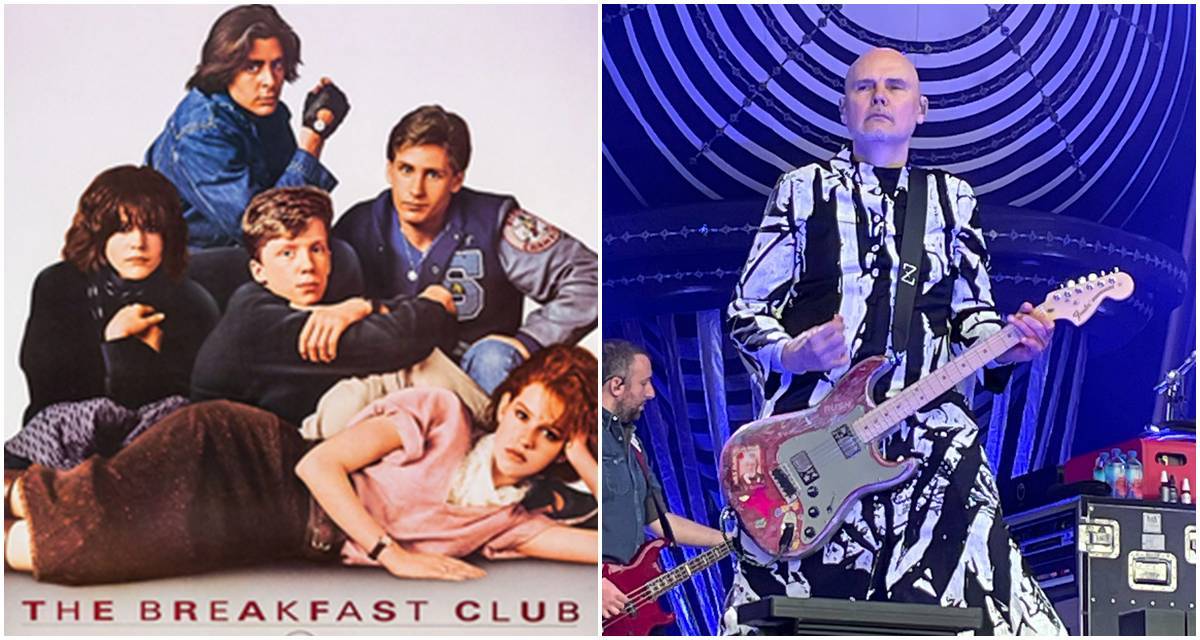
On a recent episode of The Magnificent Others podcast, the show’s host and Smashing Pumpkins frontman, Billy Corgan, attempted to share a fresh perspective on The Breakfast Club that his guest, actor Anthony Michael Hall, had never heard before. Hall admitted he can’t go a day without talking about the Gen X classic, so Corgan had his work cut out for him. In the 1985 John Hughes classic, Hall played Brian Johnson, known as “The Brain.”
“A lot of us were the latchkey kids. And the joke I always make is we were abandoned by our parents because of [deleted] and yoga,” Corgan joked. “So the reason I think that movie resonated so deeply? It’s kind of this bullying thing. I see that as a subplot. I think the key is all these kids have been abandoned by the people they should be relying on.”
Why is ‘The Breakfast Club’ so important to Gen Xers?
“I go to the most obvious point, the dynamics between the characters, let’s call it the kineticism between the characters. But the thing that started to strike me was, wait, they’re all in detention for a reason. And so, the subtext in my mind is they’ve been abandoned by something or somebody,” Corgan continued.
Corgan taps into the idea that Gen Xers (1965 to 1980) are often called the least parented generation because they grew up when divorce was at an all-time high, more women were in the workplace, and children were allowed to roam free. In some ways, Gen Xers had incredible freedom that today’s kids should envy. In other ways, growing up as a latchkey kid or with parents who weren’t around was tantamount to neglect.
Hall agreed with Corgans’ take. “You’re right. The loss that they all feel may be from their parents and what they’re not doing,” he responded. In the film, Allison Reynolds, the “Basket Case,” is clearly neglected by her parents. She tells Emilio Estevez’s character, “They ignore me.” Her strange behavior throughout the film feels like an attempt to be seen.
The characters in ‘The Breakfast Club’ are all dealing with some form of neglect
“When I think back on the film, I think it’s most clearly seen in Ally Sheedy’s character [“The Basket Case”]. That sense of neglect from her parents,” Hall added. “So, that’s a key word, and you brought up something really powerful here, which is what the parents weren’t doing that led them there.”
The rest of the main characters in The Breakfast Club weren’t necessarily neglected in the sense that they weren’t given any attention, but they all lack a real emotional connection to their parents, which is just as painful.
John “The Criminal” Bender is verbally and physically abused by his father, leading him to be rebellious. Claire “The Princess” Standish is used as a weapon in her parents’ marriage woes, making her feel like a pawn. Andrew “The Athlete” Clark’s parents push him too hard to win and be tough; he becomes a bully to overcompensate. Brian “The Brain” Johnson, Hall’s character, is so concerned with his grades that a bad mark makes him consider self-harm.
In the end, the five teenagers from different social classes and cliques learn to lean on each other to get through detention and tell the principal that they are beyond categorization.
Corgan believes this type of camaraderie mirrors the attitudes of kids in the alternative rock scene of the ’80s and ’90s that gave birth to the Smashing Pumpkins. “But at the end of the day, the reason I think it hits so hard is almost everybody in our generation was thinking ‘that’s me’ in that same dynamic, having to reach for people,” Corgan said. “One of the core ethos of alternative rock was we found community with a bunch of other weirdos because many of us were the land of lost toys. Who were we going to turn to?”