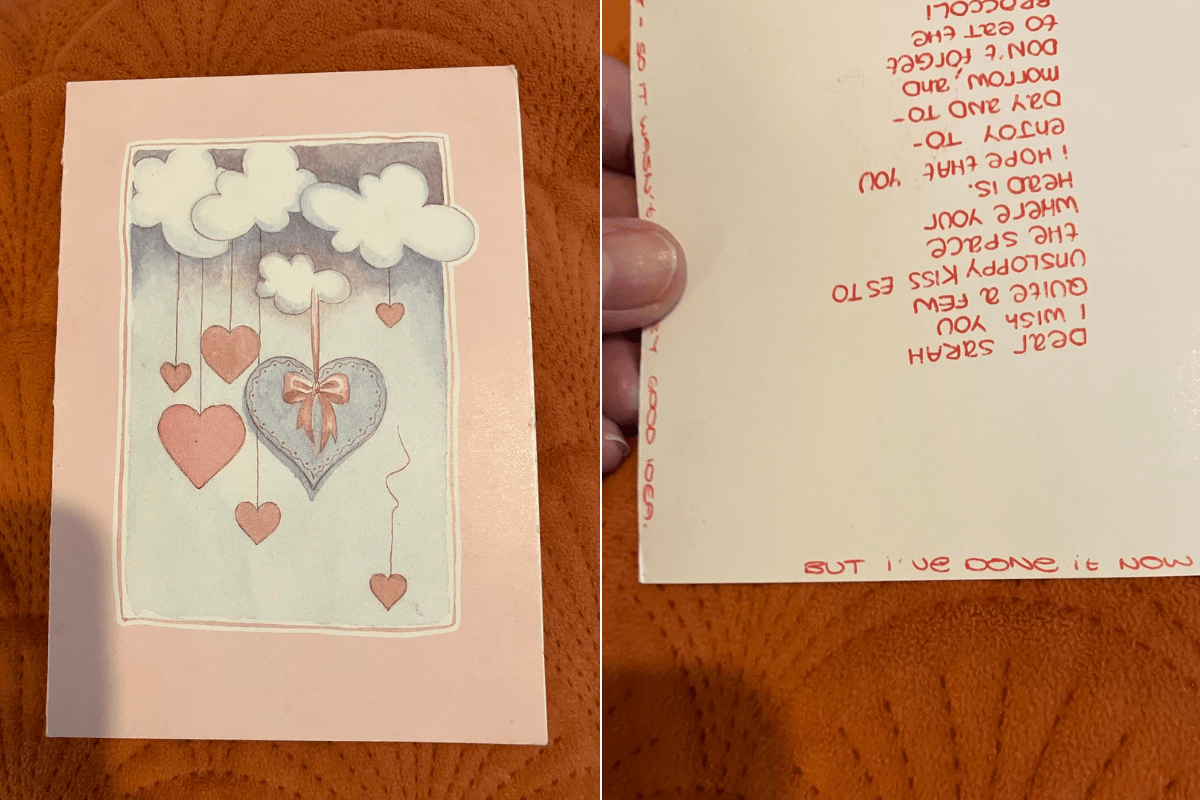
No one can resist a good mystery, least of all when love is involved. One woman recently captivated puzzle enthusiasts when she posted a juicy brainteaser in the form of a mysterious Valentine’s card she received in 1993.
In a viral post on Threads, Sarah Snop explained how she received the card on Valentine’s Day more than 30 years ago. The card was, to say the least, extremely bizarre.
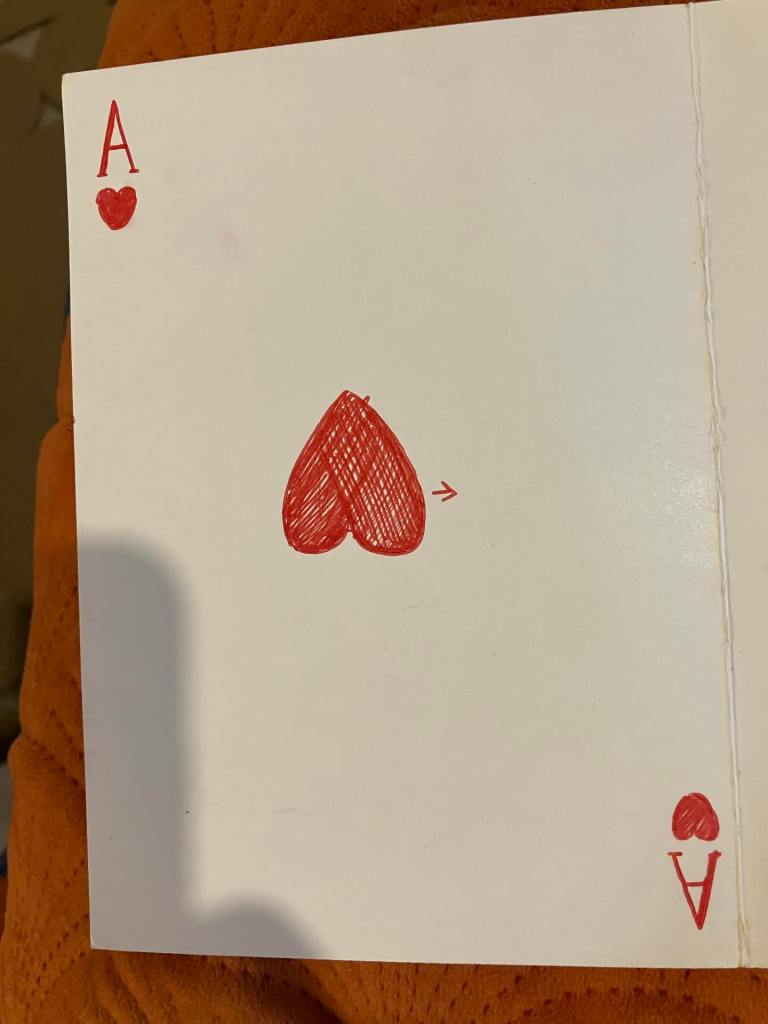
The card was a blank-inside design from the German company GRUSS GmbH. That’s strange in and of itself, since Snop was living in the United Kingdom at the time. Inside, one side of the card featured a hand-drawn ace of hearts, with the central heart marked by a peculiar arrow.
The other side featured a cryptic, nonsensical, and likely encoded note:
“Dear Sarah I wish you quite a few unsloppy kiss es to the space where your head is. i hope that you enjoy to-day and to-morrow, and don’t forget to eat the broccoli on the shorts. (And dear V-alentines day two) … Bestwisheslovefromgetwellsoonyours.”
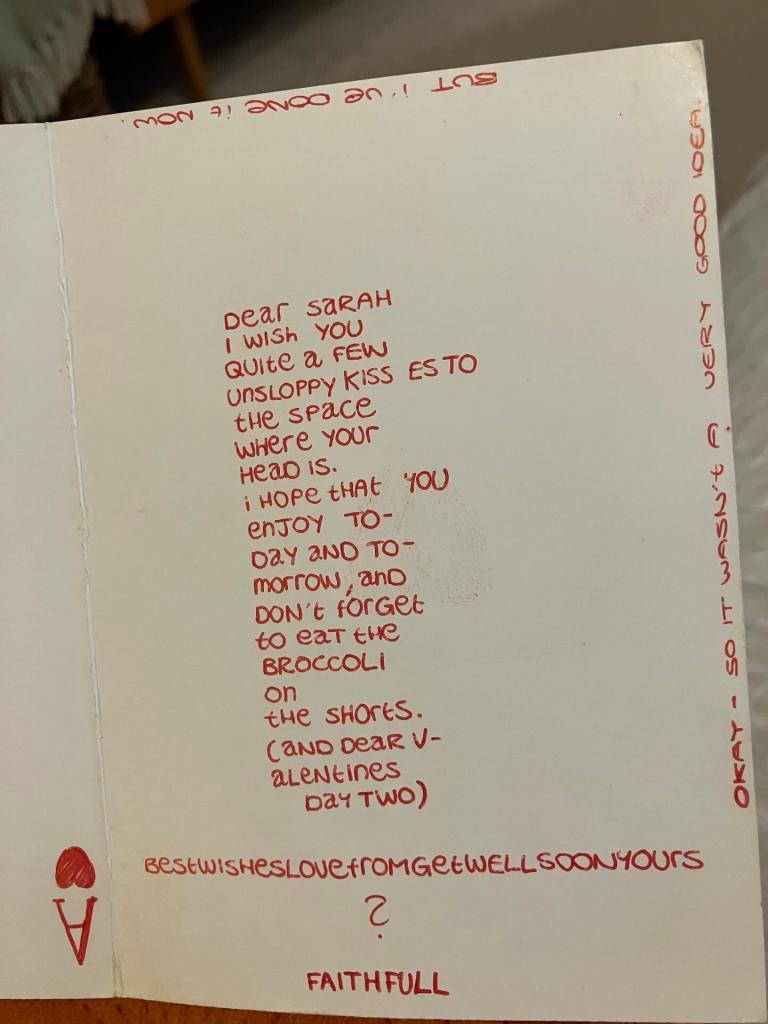
Other strange words and scratchings appeared around the edges of the card, and the copyright information on the back was scratched out, except for the word “HAPPY.”
What could it all mean?
“I kept it all these years because I have never figured out who sent it to me,” Snop wrote in the post. “It intrigued me as I always felt it was in some form of code that I just couldn’t crack.”
For all these years, she’s had no leads or clues. Snop told Upworthy the card must have come from someone at her college, as it was secretly slipped into her bag while she was on campus. Other than that, she didn’t recognize the handwriting or any references to inside jokes with her friends.
And no one ever came forward to claim responsibility.
The challenge
Not to worry—hundreds of amateur Internet puzzlers were more than eager to take on the challenge.
More than 400 users chimed in with observations and attempts to solve the puzzle, taking a multitude of approaches.
Some fed images of the card into AI chatbots like ChatGPT to spot patterns. ChatGPT “identified” an elaborate cipher in the note—a coded message that uses a key, or secret instructions, to encrypt and decrypt information.
“The line ‘Unsloppy kisses to the space where your head is’” was the “key clue,” it said. The AI tool was eventually able to extract a scrambled message from the note, which, when unscrambled, read: “Hi Sarah, I hope you enjoy today and tomorrow. Don’t forget I adore you.”
Adorable, but it doesn’t do much to identify the secret admirer. And for such an elaborate cipher, the hidden message isn’t all that fascinating—hardly worth going to such great lengths to conceal.
Another user chimed in with a much more interesting theory:
“Ok. FAITHFULL could be a columnar cipher key: after writing the letters in a grid under it, if you reorder the columns alphabetically according to the letters in the keyword then reading down the correct vertical column after reordering reveals the hidden name DAVID, and the rest of the letters form LOVE FROM DAVID. Does that make any sense?”
Others took a more human approach, looking for clues in the card, the drawing, and the handwriting itself.
“From the writing, the level of thought that went into it, neatness, I’d be pretty sure this is from a girl,” one user wrote.
Some speculated that, since the card was from Germany, the sender must have been as well, which might help explain the odd phrasing.
A few others didn’t have any codebreaking skills to contribute, but still got a kick out of the mystery.
“So much to unpack… the spacing and arrangement of the letters, the arrow next to the heart, the all one word ‘bestwishes…’, the bordered words, Faithfull … this is zodiac level,” one user marveled.
“Get the swifties on this STAT!!” someone else joked.
Sadly, Snop had to break the news to everyone following the post that she didn’t recall knowing anyone named David or Faith, or anyone who had spent significant time in Germany. For now, at least, the card remains a mystery—but a few dedicated cryptographers are still on the case, with plenty of new leads to pursue.
A fascinating tradition
Secret admirers and coded love letters are a fascinating tradition that dates back hundreds of years.
The Marginalian‘s Maria Popova writes of a gentleman in the 1850s courting a woman with an overprotective father. Knowing his letters would be read first, he brilliantly encoded them to avoid arousing suspicion. Secretly, they contained messages expressing his longing for the daughter:
“The young bachelor cleverly engineered his language so that the letter could be read two ways — line by line, as the unsuspecting father would, which renders the text a contemptuous disavowal of romance, or by skipping over all even-numbered lines and reading only the odds, which transmogrifies the message into a passionate declaration of love.”
In the Victorian era, the placement of a postage stamp on a letter could reveal the sender’s secret intentions. Edwardian Promenade‘s Evangeline Holland writes:
“They say that when a stamp is inverted on the right hand upper corner it means the person written to is to write no more. If the stamp be placed on the left hand upper corner and inverted, then the writer declares his affection for the receiver of the letter. When the stamp is in the centre at the top, it signifies an affirmative answer to a question, or the question, as the case may be; and when it is at the bottom, or opposite this, it is a negative.”
Even Julius Caesar is said to have written secret love notes to his mistress, which she kept concealed in a wooden chest.
When you combine encoded messages with a secret admirer, the titillation is irresistible. Snop’s old Valentine may be a forgotten and slightly strange piece of paper tucked among her belongings, but to the rest of us, it’s a fascinating, multilayered puzzle we can’t help trying to solve.