6 times Ariana Grande awesomely proved she isn’t here for casual sexism.

In recent days, the pop star’s made headlines for all the right reasons. Here are a few more examples.

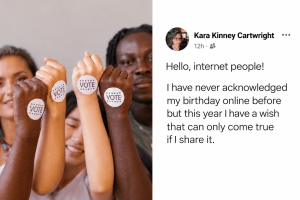
Intercom on wall with "GRL PWR" stickers and a light leak at the bottom.
GRL PWRPhoto credit: Photo by Markus Spiske on Unsplash

Ariana Grande is perhaps best known for her pop vocal prowess, but she’s also a pretty badass feminist.

It’s OK if you hadn’t noticed (I wasn’t especially aware of this, either) as the media has a tendency to focus more on her behavior as it pertains to things like Donutgate (aka the time she said “I hate America“) as opposed to, say, the times she’s shut down body-shamers and music industry sexism.

Below are six times Ariana Grande showed off her feminist bona fides.


1. That time she made it clear that’s she’s not here for body-shamers.

After seeing someone tweet “Got asked if I’d prefer @arielwinter1 or @ArianaGrande lol, it wud DEFINITELY be @arielwinter1 curves are sexy sticks aren’t,” Grande typed up an epic response about body shaming and pitting women against themselves:

“We live in a day and age when people make it IMPOSSIBLE for women, men, anyone to embrace themselves exactly how they are. Diversity is sexy! Loving yourself is sexy! You know what is NOT sexy? Misogyny, objectifying, labeling, comparing and body shaming!!! Talking about people’s bodies as if they’re on display ASKING for your approval/opinion. THEY ARE NOT!!! CELEBRATE YOURSELF. CELEBRATE OTHERS. The things that make us different from one another make us BEAUTIFUL. BODY BOUNDARIES. LOVE LOVE LOVE ONLY.”

Winter, who stars on “Modern Family,” responded, and the patriarchy blew up like the Death Star (OK, not really, but it was a very cool moment).

2. That time she handled ridiculous questions during a recent radio interview by turning the tables on the DJs.

Grande recently appeared on Power 106 Los Angeles to discuss her new single, “Focus.” During the course of the 26-minute interview, there were a few moments worthy of eye-rolls.

The first was when she was given a strange hypothetical question about whether she’d rather go without makeup or her phone for the rest of her life.

The second was when one of the interviewers suggested that certain emojis were “girls’” and certain were “boys.’” She had some thoughts on that, as well.

3. That time she and her mom teamed up to tackle gender equality at the newsstand (or at least highlight it).

Just in case you’re wondering where Grande gets her feminist streak, you can thank her mom Joan.

And I could’ve ended this twitter conversation here, as it illustrates my point well enough, but the next two tweets are too beautiful to leave out:

4. That time back in June, when Grande went on an epic rant about sexism — both in the media and society as a whole.

“I am tired of living in a world where women are mostly referred to as a man’s past, present or future PROPERTY/POSSESSION,” she writes. For more highlights, check out this post over at Bustle.

5. All the times when she’s been all about voicing support for women, especially on International Women’s Day.

You won’t usually see Grande using her social platform (with its tens of millions of followers) to tear into other women. Mostly, you’ll find stuff like this, meant to lift and inspire other women to keep kicking ass. She’s far from perfect, but aren’t we all?

6. She’s not about to let other women bring her down either — even if they’re people she idolizes.

In an interview with The Telegraph, Middler shared her thoughts on the “pornification” of the music industry.

“It’s terrible! It’s always surprising to see someone like Ariana Grande with that silly high voice, a very wholesome voice, slithering around on a couch, looking so ridiculous. I mean, it’s silly beyond belief and I don’t know who’s telling her to do it. I wish they’d stop. But it’s not my business, I’m not her mother. Or her manager. Maybe they tell them that’s what you’ve got to do. Sex sells. Sex has always sold.”

Later, Middler added, “You don’t have to make a whore out of yourself to get ahead. You really don’t.”

Taken aback after getting slammed by one of her idols, Grande responded by tweeting a picture of Middler doing her mermaid routine, captioning it, “Bette was always a feminist who stood for women being able to do whatever the F they wanted without judgement! Not sure where that Bette went, but I want that sexy mermaid back!!! Always a fan no matter what my love.”

Maybe you don’t like her music or you still feel weird about that whole doughnut thing, but at least give her credit for this.

People aren’t perfect, and yes, your favorite will always be problematic. Even so, Ariana Grande deserves some major props for taking a stand on issues affecting her and all women. Way to go, Ariana!


  • A middle school teacher used students breaking their pencils to teach a brillian lesson about respect
    Students kept breaking and losing pencils, so a teacher came up with a genius new policy.Photo credit: Canva
    , ,

    A middle school teacher used students breaking their pencils to teach a brillian lesson about respect

    Some argued that her new classroom pencil policy was rewarding bad behavior. But it worked.

    Today’s teachers have more than their fair share of complaints about Gen Z and Gen Alpha students. Educators say many of them are rude, behind on core skills, inattentive, and unmotivated.

    One teacher just wishes they’d stop breaking all of her pencils. In a recent video on TikTok, Jess, who teaches middle school, shared that her students were losing and destroying their supplies at an alarming rate, forcing her to rethink her classroom pencil policy.

    “My students went through 2,000 pencils in four months,” she says. That’s the fastest rate she’s seen in her seven years of teaching. She says much of it comes down to the kids purposefully breaking and throwing the pencils in class.

    But to make matters worse, these were no ordinary pencils. Jess supplies her classes with Dixon Ticonderoga No. 2 pencils, widely considered the cream of the crop of everyday writing pencils. Jess pays for them each semester out of her own pocket because she believes it’s important for her students to have access to high-quality materials, and we all know the school district isn’t going to pony up. That’s what makes the loss of so many pencils in such a short amount of time so frustrating.

    Teacher Jess came up with a great idea

    “There is a lack of respect for property that isn’t theirs,” she says. Jess then had an interesting choice. She could stop buying and issuing high-quality pencils, but would the kids really learn anything? Ultimately, she came up with a better idea: a clever new classroom pencil policy.

    Starting in the new semester at the beginning of 2026, each of her students would receive one pencil per month. Not only that, but the pencil would be engraved with their name. If they lose their pencil before the month is up, they’re out of luck. Jess even went out of her way to get each kid the color and style of their choice, along with a pencil pouch to make it easier to keep track of their writing tool.

    @inspo_by_jess

    new year, new pencil policy ✏️ the problem has gotten to the point where I’m now engraving students’ names into @Ticonderoga pencils to teach them about respect & accountability✨ Would you try this pencil policy? #teachers #asmr #diy @xtoolofficial

    ♬ original sound – inspo_by_jess

    A few months later, Jess was ready to issue a long-awaited update. Since her first post went up on social media, it has received over eight million views and thousands of comments from fellow teachers and parents cheering her on.

    In short, it worked out far better than she ever could have hoped. Not only did the new policy help her preserve more pencils and save money on supplies, but the kids also began internalizing some amazing lessons.

    Personal property became a point of pride for her students

    For starters, the kids loved the pencils in their chosen color with their name engraved on the side. They were excited to take better care of them and were motivated to avoid losing them and being stuck with whatever cheap loaner was lying around.

    The new policy even began to have an impact on the sense of community in the classroom. Jess was able to teach a few students to use the engraving machine, so now the kids are responsible for making their own new batch of pencils every month.

    She also noticed that students were beginning to help each other out and hold each other accountable. After class, students scoop up loose pencils from the floor and return them to their rightful owners or drop them in the lost-and-found box. A few kids still struggle with throwing and breaking pencils, but the majority of her kids have fully gotten on board.

    Overall, the system is a vast improvement in more ways than one.

    @inspo_by_jess

    update on our new pencil policy ✏️ here’s what happened after engraving students’ names into Dixon Ticonderoga pencils… Would you try this pencil policy? #teachers #asmr #DIY

    ♬ original sound – inspo_by_jess

    Surprisingly, teachers have come up with all kinds of inventive ways to keep students from losing or breaking classroom supplies, especially pencils.

    Classroom pencil policy strategies range from “pencil debt,” a system in which the class works as a group to keep track of all pencils throughout the week, to reward charts, regular check-ins, collateral systems, and more.

    Dedicated educators make a real difference

    It’s amazing that educators would go through so much trouble. Perhaps the more obvious solution would be to just force kids to provide their own supplies if they can’t be trusted to take care of the ones their teachers provide.

    It’s not an exaggeration to say that nearly every teacher at some point is forced to buy needed supplies for the classroom out of their own paycheck. They’re also severely underpaid in most cases, which makes the burden of furnishing the class that much heavier.

    However, the best educators, like Jess, refuse to give up on the younger generations. Instead, they find problems that seem hopeless—like a lack of respect for materials—and creatively turn them into teachable moments. She could have cut them off, expressed her disappointment, and left them feeling dejected. But instead, she crafted a brilliant lesson in responsibility, respect, and community. Her students will carry it with them into their next classrooms and beyond.

  • Social skills expert shares the ‘similarity-attraction effect’ that makes you instantly likable
    A man and a woman laughing together.Photo credit: Canva

    There seem to be two different ways of thinking about who we are attracted to, whether it’s in a romantic or a social relationship. Is it that opposites attract, or do birds of a feather flock together? The evidence overwhelmingly shows that likability has much more to do with what we share with others than with the traits that set us apart.

    In fact, a 2023 study from the University of Colorado Boulder found that historically, romantic couples tend to share between 82% and 89% of the same personality traits.

    “Our findings demonstrate that birds of a feather are indeed more likely to flock together,” said study author Tanya Horwitz, a doctoral candidate in the Department of Psychology and Neuroscience and the Institute for Behavioral Genetics, in a press release.

    friends, two girls, similar girls, look the same, heart,
    Two friends who are similar. Photo credit: Canva

    Knowing that people tend to like those who are similar to them, you should focus on amplifying what you share in common when you meet someone new.

    Vanessa Van Edwards, founder of The Science of People and author of Captivate: The Science of Succeeding with People, shared a three-step process to increase your likability that taps into a psychological phenomenon known as the “similarity-attraction effect.”

    How to be more likable

    “How can we use the similarity-attraction effect to be more likable? Easy. You want to highlight your similarities. Here’s how to do this in an authentic way,” Van Edwards says in her video before sharing her three-step process:

    Step 1: Search for similarities

    “When you first meet someone, you should constantly be on the lookout for similarities. Are you both drinking red wine? Do you both know the host from work? Do you both love Thai food? Orient your first few conversational topics to find mutual likes and dislikes.”

    Step 2: Capitalize on similarities

    “Once you find a similarity, don’t let it pass you by. For example, if they think cilantro tastes like soap—because it does—share in the grossness. Double down on that disgusting little herb by saying, ‘Oh yeah, cilantro is the silent food killer. I’m totally on the same page.’ I’m a big fan of the high five, too. If I hear someone also loves Seinfeld, I’m like, ‘High five.’”

    Step 3: Extend similarities

    “This means using the similarity as a conversational diving board. If you both love watching soccer, ask if they’ve ever played. If they’re big into hiking, ask for their favorite trail and maybe throw out an option to go hike together. This builds on the similarity-attraction effect and creates rapport.”

    hiking, hikers, two people hiking, hiking ger, summit
    Two people hiking together. Photo credit: Canva

    It’s also important that when we meet people, we ask them about their likes and dislikes, because one of the quickest tricks to being likable when you meet someone new is to ask plenty of questions. Harvard University performed a study and found that after you ask someone the first question, ask two follow-ups, and they’ll be much more likely to like you. Studies show that the most likable people like others.

    Now, for a tongue-twister takeaway from this likability story: We like people who are like us, and we also like people who like us. “So get real on what you love, and then highlight that love in other people,” Van Edwards says at the end of her video.

  • Singer who lost both parents in five years moves people to tears with ‘grief is like glitter’ analogy
    A grief-stricken man.Photo credit: Canva
    , , ,

    Singer who lost both parents in five years moves people to tears with ‘grief is like glitter’ analogy

    “It’s lovely at first in small doses, but like grief, you don’t know when it’s coming.”

    Vincint Cannady, who uses they/them pronouns, recently opened up about the grieving process a year after losing their mother. On the podcast Tell Me Something Messy, the musician explains that the loss of their mother came four years after the death of their father. “It is the strangest feeling not having them here,” Cannady says.

    Losing a loved one is an unfortunate part of life that most people will experience. No two people grieve the same, but some things about grief remain consistent for everyone. Grief is not linear, and it can show up unexpectedly. But for viewers of the podcast, Cannady’s analogy about grief moved some to tears.

    grief; grieving; parental loss; loss; grieving process
    Grieving people embracing. Photo credit: Canva

    “Grief is like glitter”

    Admittedly, the grieving child did not create the analogy, but read it somewhere and found it helpful. The singer explains that losing your parents takes away a certain amount of joy that you don’t realize until you experience it.

    “I read something the other day that I thought was really beautiful,” Cannady says. “Grief is like glitter. I don’t know about you, but I hate glitter. It’s lovely at first in small doses, but like grief, you don’t know when it’s coming. You don’t know how much of it is going to be there, but like glitter, glitter gets everywhere.”

    grief; grieving; parental loss; loss; grieving process
    Mourners. Photo credit: Canva

    They go on to explain that, like after coming into contact with glitter, you find grief everywhere. “It comes in doses, and you’re overwhelmed, and you hate it, and you want to get it off, and you don’t know how to, but it’s there.”

    As time passes, the person wearing the glitter showers some of it away, but some still remains. No matter how much you try to rid yourself of it, glitter still shows up. The same goes for grief. No matter how much you try to rid yourself of grief, it still pops up in unexpected places.

    It’s then that Cannady shares something beautiful. After fighting with the sticky, sparkly grief for what feels like an eternity, it’s not as present.

    Grief never fully goes away

    grief; grieving; parental loss; loss; grieving process
    A young man looking troubled. Photo credit: Canva

    “And then days pass, and weeks pass, and months pass,” Cannady tells the podcast host, Brandon Kyle Goodman. “And then someday you’re in your closet, and you pull out a coat or a jacket, and a bit of glitter falls on your hand, and you get sad because you remember what that glitter means. But it’s not as heavy as it was before, and it’s not as messy as it was before.”

    As time passes, glitter is found less often. However, Cannady explains that glitter is part of you now: “Even though it is annoying at times, and sometimes it gets in your eye, but you get it out, and you move on. You remain shiny. It’s just a remembrance of a lot of love.”

    The singer shares advice for those experiencing grief, saying that people should give themselves grace. They encourage others not to focus on how other people feel about how you feel about your grief. Grieving is personal, but talking about it with others is therapeutic, according to Cannady. They share that pouring grief into other things, like work or creativity, can be helpful.

    “You have to find ways to pour your grief into other things,” they advise. “You pour your grief into your work. You pour your grief into life. You pour your grief into your friends and your relationships, and you make sure that they know how much it means to you. Because it’s not just grief, because before it was grief, it was love. It’s still love. It’s just love in absence.”

    When the clip was shared to Instagram, people were moved to tears.

    One person comments, “Whew, and just like that — my glitter is back.”

    “Whew, I think I have a piece of glitter in my eye because…. I lost my father in July and it truly changes you,” someone else writes.

    “I remember I couldn’t say my mom died out loud,” another person shares. “If I did, I would burst into tears. It felt too real!! Saying it out loud almost 2 1/2 years later, it still feels unreal, but it doesn’t hurt as much. I still cry a little while saying it.”

  • People are falling in love with Staples all over again thanks to one employee dubbed the ‘Staples Baddie’
    "Staples Baddie" Kaeden Rowland became an accidental brand ambassador. Photo credit: @blivxx/TikTok
    , ,

    People are falling in love with Staples all over again thanks to one employee dubbed the ‘Staples Baddie’

    Her viral videos showing all the hidden services you can get done are bringing the brand back to life.

    Everyone’s heard of Staples. But now people are actually going there in droves thanks to one employee affectionately known online as the “Staples Baddie.”

    Back in January, Kaeden Rowland, a Staples employee, filmed a brief clip of herself during a work shift. Donning the recognizable red shirt and lanyard, she quipped, “You finna need something printed? I gotchyu.” 

    That single video quickly turned into a mega-viral series. It’s a fun combination of slang-filled humor, nail-clacking ASMR, and genuinely helpful tutorials and insights. The content is breathing new life into the brand and being hailed by fans and experts alike as “marketing genius.”

    A major aspect of Rowland’s shtick is explaining certain lesser-known services you can get at Staples. In one particularly popular video, she quips:

    “It’s come to my attention that y’all don’t really know the full scope of what Staples, like, does. We can make ornaments. We can make mugs, shirts, backpacks, signs, posters, whatever you could need. A banner that’s like eight feet long? Sure. Why not?”

    In another video, she explains the difference between Staples’ direct-mail services. One is for business and can generate a mailing list based on a target demographic. The other is for personal use, like wedding invitations. Though she jokes that either service is too pricey for committing “evil against your ex.

    @blivxx

    Both are more pricey but are worth it depending on your needs

    ♬ original sound – 🦷✨oblivion✨🦷

    Other times, you might catch her letting you know when certain things go on sale: “You’re not getting your shawty a 40% off mug from Staples? And men wonder why women cheat.”

    She also dissects the different personalities of the printers (the Xerox PrimeLink C9200 has “clean girl” vibes, apparently). Finally, she hits a groove showcasing some of her favorite stationery products. At the moment, she’s very into a tiny botanical planner that fits into her small purse.

    @blivxx

    Yall wanted to meet the printers

    ♬ original sound – 🦷✨oblivion✨🦷

    Despite not having any formal marketing training, Rowland has made an undeniable impact. A company struggling to stay competitive now has fresh enthusiasm. Folks are getting their personalized mugs there. They’re switching suppliers. They’re even using Staples to supply their best analog life. The best part is none of this is because of an expensive micro-influencer, but someone who actually works there.

    In a video analyzing the Staples Baddie, marketing analyst and PR expert Katie Omstead said, “Just a scan of the comments on any of these videos will show you that people are thinking about Staples more than ever before.”

    Rowland is just the latest in a growing trend of people who happened to share their creative ideas at just the right time, somehow skyrocketing to full-blown brand collaborations. Think back to Romeo, whose silly Dr Pepper jingle went viral.

    MarketerMilk calls this “human-first media,” where corporations rely on the fact that “people buy things from people they trust, not from businesses.” This can look like companies “leveraging their existing employees to become influencers.”

    This, of course, can also look like corporations trying to recreate something organic, thus squelching its spark. One Staples employee lamented on Reddit that their team is being encouraged to replicate the Staples Baddie moment in their own stores.

    On the bright side, Staples has shared their appreciation for their resident “Baddie.” Not only have they sent a care package Rowland’s way, according to Fast Company, it’s also “exploring opportunities to collaborate and continue supporting her creativity and engagement with the community.”

    We very well might be seeing much more of the Staples Baddie in the future.

  • Pediatric neurologist shares 3 easy and effective journaling techniques to fix mental clutter
    Journaling is a powerful tool for calming the brain.Photo credit: Canva

    Do you feel like your brain is constantly juggling a million things? Like your mind is on overload and you cannot focus? Between the effects of scrolling social media, navigating the 24/7 news cycle, and managing work and family life, your brain can easily feel overwhelmed.

    Even when you have quiet moments of calm, your mind might still feel too cluttered to get your thoughts in order. However, according to pediatric neurologist Dr. Arif Khan, there is an old-school solution to that problem with modern science to back it up: journaling. Khan goes a step further by sharing three specific techniques and the neuroscience behind why they help.

    “In brain scans, something remarkable happens when people write about their feelings,” Khan says in a YouTube video. “The regions for motion and the regions for reasoning begin to synchronize, as if the brain is learning to talk to itself. That is the hidden power of journaling. It’s not just reflection. It’s neurological repair.”

    Khan explains that when you write, your prefrontal cortex—the brain area that helps with planning and analysis—begins to communicate with your amygdala, the brain’s emotional reaction center. He cites a 2021 Stanford University study, which demonstrated that expressive writing can help your brain recover from stress.

    “The mid-cingulate cortex, which usually fires under emotional pressure, becomes calmer and more coordinated,” says Khan. “And when you put emotions into words, the ventrolateral prefrontal cortex turns on, helping to quiet the amygdala. This process is called affect labeling; it allows you to feel without drowning in the feeling.”

    Writing by hand matters, Khan adds.

    A 2023 study in Frontiers in Psychology showed that handwriting activates more areas of the brain than typing,” he says. “When your hand moves with your thoughts, that is, the mind slows down just enough to make sense of itself.”

    Here are three journaling techniques Khan recommends to reduce brain clutter:

    Technique #1: Expressive writing

    Expressive writing, a technique developed by psychologist James Pennebaker, involves writing about something you feel strongly about.

    “Think about something you still carry—a disappointment, a loss, a moment that lingers longer than it should,” Khan says. Then write about it for 15 to 20 minutes.

    “Don’t worry about grammar,” he adds. “Don’t edit. Don’t write for anyone else. Write until you run out of words.”

    A man sits at an outdoor table writing in a journal.
    Expressive writing helps the brain process emotions. Photo credit: Canva

    Khan says this technique is effective because the brain treats emotional suppression as “unfinished work.”

    “Studies show that after expressive writing, the brain’s emotional centers quiet down while cognitive control increases,” he explains. “Your body feels lighter because your mind has stopped trying to contain what it has finally released. You might cry. You might feel tired. You might want to stop halfway. That’s okay. Healing requires a small amount of discomfort before calm returns.”

    Technique #2: Gratitude journaling

    Gratitude journals aren’t new, but Khan explains how and why they work from a neurological point of view.

    Instead of writing about what’s troubling you, write down two or three things you’re grateful for. It could be anything, but stay specific. (Khan gives examples like “the smell of rain,” “a message from a friend that came at just the right time,” or “a meal that made you feel safe.”)

    “Gratitude journaling doesn’t force positivity,” says Khan. “It retrains your attention. Neuroscientists have found that practicing gratitude activates the ventral striatum and the medial prefrontal cortex regions that regulate mood and motivation. When you do this daily, you teach your brain to look for what is stable instead of what is threatening.”

    Khan says gratitude journaling “tunes your nervous system towards balance.” Rather than erasing struggle, it helps you see beyond it.

    Technique #3: Reflective reframing

    Reflective reframing journaling focuses on a specific incident and helps you work through it. Khan says to think of a challenge you’ve had and write about it plainly. No judgment, just write what happened. Then write down:

    1. What it meant.
    2. What it revealed.
    3. What it taught you.
    4. One small action you can take the next time something like that happens.

    “This pattern strengthens the prefrontal regions that regulate emotional reactivity,” Khan says. “It builds the ability to pause and reinterpret before reacting. You learn to step back—not to detach, but to understand. Over time, this practice reshapes resilience itself. You begin to see difficulties not as failures, but as data points for growth. That subtle shift changes how your brain responds to future stress.”

    Journaling rewires the brain over time

    Khan says you don’t have to use all three journaling techniques every day.

    “Think of journaling as mental cross training,” he says. “Use expressive writing when emotions feel heavy. Use gratitude journaling when you feel numb or distant. Use reflective reframing when life feels confusing. Each practice strengthens a different circuit of awareness.”

    Khan says that journaling isn’t just self-expression but self-construction. While it can help in the moment, the real power is the change that happens over weeks or months. “You pause longer before reacting. You remember more clearly. You recover more quickly,” says Khan.

    People in the comments of Khan’s video shared their own experiences with how journaling has impacted their lives:

    “I’ve done all these. I’m 68 now, and I’ve been journaling since I was 13. I have all of these journals. It is all very true and tried out. Today, people ask me how do I live my life so well. This is one of the secrets…..”

    “This is fascinating. When I was about 12, I had a teacher who made us keep journals, and we would write about a given promt for 10 minutes at the start of each class. On the days when we wrote about something negative/stressful, she always told us to just keep writing until every single word we had about the topic had drained out. Sounds like we were actually doing technique #1!”

    “I recently went thru a 12 year relationship breakup. I felt so bad , like no pain I had ever experienced before. After two weeks of this agony I started a journal and wrote whatever came into my mind including my diet. Now, a month and a half later I have stopped daily entries and my anxiety has dropped from 100 pc every day for a month to almost zero. I write as I feel the need. What an amazing insight this video has given me.”

    A girl sits in a window wrapped in a blanket, writing in a journal
    People testify to the old-school power of journaling. Photo credit: Canva

    “I have survived and thrived by doing this kind of journaling since 1996 when my husband left me with our three wonderful children (thank God for them!). I highly recommend writing as often as you can on both good and bad days.”

    “I’m 27. I’ve been journaling since 16/17. I can honestly say it’s gotten me out some pretty dark places. All types a writing, expressing, pain, gratitude, to God, to my future self, it all helps. Writing and journaling are a lost art. I hope more people get in tune with themselves a little more and open up to writing and journaling. It’s a beautiful experience.”

    “I started to write about my life at 75, mainly for my children, grandchildren and future generations. I have to say that getting all the hurt, upset, sorrows and jubilation has given me peace at last.”

    You can follow Dr. Khan’s The Brain Project channel on YouTube for more neuroscience info.

  • In 1982, Jim Henson shared the secret to his success with a young actor. It still touches his heart.
    Jim Henson and the Muppets.Photo credit: JulieLion/Wikimedia Commons

    When people refer to artistic or creative geniuses, we often praise them as rugged individualists who pursued a singular vision. But many times, that story is too simple. In reality, great artistic achievements are made through collective effort. This is especially true in film and television.

    One artistic genius who changed the world by empowering his creative partners and giving them credit was Muppets creator Jim Henson.

    Henson helped create some of the most popular TV shows in the ‘70s and ’80s, including Sesame Street, The Muppet Show, and Fraggle Rock, as well as iconic films such as The Dark Crystal and Labyrinth.

    jim henson, miss piggy, fozzy muppets, sesame street,
    Jim Henson alongside Miss Piggy and Fozzie. Photo credit: Bernard Gotfryd/Wikimedia Commons

    Henson shares the secret to his incredible success

    Actor Alexander Polinsky recently shared rare insight into Henson’s creative process and how much he owed to his collaborators in a TikTok post that received over 650,000 views. Polinsky played Adam Powell on the TV show Charles in Charge from 1987 to 1990 and has done voice acting on shows such as Teen Titans, Teen Titans Go!, and the Ben 10 franchise.

    Polinsky was seven years old in 1982, when Henson’s dark fantasy film The Dark Crystal was in theaters. His mother worked at a gallery hosting an exhibition on the film. Henson was there when young Polinsky was visiting, and his mother pushed him to ask the creator a question:

    “She pushed me in front of him. I was the only kid, besides my two other friends, that were in the whole place that morning. And I said, ‘How did you make this stuff?’ And instead of saying ‘hot glue and learn to sew,’ he said, ‘First, gather a group of people around you that you love and that love you. And give them an idea that has enough empty space in it so that they can take it on and make it their own. And when you get it back, it’s more beautiful than you ever thought possible.’”

    Polinsky ended his video by saying, “So make art with the people that you love.”

    Jim Henson and George Lucas. Photo credit: AP Wirephoto/Wikimedia Commons

    Henson loved to collaborate with people who thought differently

    Steve Whitmire, a Muppet performer who eventually took over as Kermit (Henson’s signature character) after his death, told D23.com that Henson believed in the power of the ensemble. A great example was when The Muppet Show won an Emmy for Outstanding Comedy–Variety or Music Series in 1978.

    “I remember Jim’s Emmy acceptance speech very well because he made eye contact with me,” Whitmire, who was newly hired at the time, said. “I was in the third row, and he was looking at me. He was kind of uncomfortable onstage as himself to some degree, but he said, ‘I just want to let everybody know that this is not about me, it’s about our group and our group dynamic.’”

    “‘Appreciate each other for your differences and not for your similarities’ was a theme that went through all of his work,” the creator’s son, Brian Henson, added. “Clearly, this was a wonderful message that got picked up all around the world. Everyone got it, everywhere.”

    Henson’s belief in providing space for his creative partners shows that he had an astonishing lack of ego—rare in the world of entertainment—and an incredible amount of faith in his collaborators. But it must have been a lot easier for him to keep his faith in those around him because their relationship was based on a power even greater than artistic integrity: love.

  • A linguist from Alabama explains the surprising origin story of the Southern word ‘y’all’
    The history of the word "y'all."Photo credit: Wikimedia Commons

    Head anywhere in the Southern United States, and you are likely to hear one distinct word: “y’all.” “Y’all,” which combines the words “you” and “all,” may be predominantly used in the South—but not for long.

    Paul E. Reed, a linguist at the University of Alabama who studies Southern American English and Appalachian English, told NPR in 2025 that “it’s expanded much more outside of the South” thanks to Americans under 40. (Add it to the list of Gen Z slang.)

    How “y’all” entered the English vernacular is a fascinating tale. Linguist Danny Hieber, PhD, explained the origin story of “y’all” to his TikTok followers—and it stems from a surprising language.

    @linguisticdiscovery

    What do all y’all think about “y’all”? @Landon If you enjoyed this video, you’ll love the Linguistic Discovery newsletter! Deep dives into how language works, language profiles, explainers of terms/concepts in linguistics, reviews, and more! LinguisticDiscovery.com/newsletter (Also available on Substack or Patreon.) #yall #yalldve #South #Southern #English #dialects #grammar #pronouns #linguistics #language#French#LingTok#LearnOnTikTok

    ♬ original sound – Linguistic Discovery – Danny Hieber, PhD

    A linguist explains the ‘y’all’ backstory

    According to Hieber, present-day English doesn’t have a plural form of the word “you” like other languages. In Old English, there were three forms of “you”:

    • Thou (subject)
    • Thee (object)
    • Thine (possessive)

    Hieber goes on to explain that “you” became singular thanks to French. In French, “you” translated to:

    • Tu (singular)
    • Vous (plural + polite)

    “After the Norman Conquest of England in 1066, French had a huge influence on English,” he said. “So English speakers started borrowing that pattern into English and used ‘you’ to politely address one person.”

    He added that over time, this became the default way to address a single person. Along those same lines, the word “be” also followed suit.

    “It used to be that the verb ‘be’ was conjugated like this,” explained Hieber, with the plural use becoming “are.” “That singular verb got pulled along into the singular too, and now the conjugation of ‘be’ looks like this:”

    • I am / we are
    • Thou art / you are
    • He, she, it is / they are

    However, it created a “gap,” and “English speakers have been trying to settle on a ‘you [plural]’ ever since,” said Hieber. Enter: y’all.

    @genteelandbard

    Where and how did the word “Y’all” begin in the southern United States? #genteelandbard #savannah #storytime #historytok #southerncharm

    ♬ Natural Emotions – Muspace Lofi

    The history of ‘y’all’ in the South

    There are many theories as to how y’all infiltrated American English in the 1700s, per NPR. One theory states that it has British origins, where the words “ye” and “aw” were combined and used in the British Isles. From there, Scots-Irish immigrants brought it to Appalachia in the U.S.

    The other theory is that it originated in West Africa, and when enslaved people were brought from there to the South, it began to spread. After the Great Migration, Black Americans brought the term north with them, expanding its use.

    However, the term “you guys” is still commonly used in most Northern states. There are also many regional variations throughout the country, including “yinz” (used in Pittsburgh, Pennsylvania) and “youse” (used in Philadelphia, Pennsylvania).

    Americans respond

    Viewers had lots of opinions on Hieber’s video, including how different regions have termed the plural form of “you”—and their thoughts on y’all:

    “Sorry… y’all is singular all y’all is plural.”

    “In the upper Ohio Valley, we also say things like, ‘All yinz guys,’ a sort of amalgamation of Pittsburgh’s ‘yinz’ (we’re an hour away), and the Midwest ‘you guys.’”

    “From CA but living in the south..I just cannot bring myself to say y’all..feels so unnatural.”

    “Washington born and y’all made it into my vocab.”

  • 7-year-old boy obsessed with UPS asks for a themed birthday party, and his mom delivers big time
    A 7-year-old boy obsessed with UPS gets the birthday party of his dreams. Photo credit: @jenchilla156/TikTok

    Autistic special interests are intense, deeply focused passions or hobbies that provide joy, structure, and anxiety regulation, often serving as a key part of an autistic person’s identity

    For Jenny Grant, her seven-year-old son Sebastian had a special interest in UPS. This naturally meant having a UPS-themed birthday party. 

    Technically, Sebastian only asked his mom for “a chocolate UPS cake,” along with “a million people” for his birthday, as she shared with People. But his mom made up for that latter request by going all out on the decor.

    In a now-viral (and very adorable) TikTok video, we see an array of brown and gold balloons, banners, and other favors with a UPS sticker placed on top, as well as actual UPS packages and a tiny cardboard cutout of a UPS center. Plus the pièce de résistance: a UPS cake. 

    @jenchilla156

    SO to the @UPS store for contributing to their future delivery driver’s birthday party 🙏 #autismacceptance #autismawareness #ups #birthdayparty #autism

    ♬ Chopin Nocturne No. 2 Piano Mono – moshimo sound design

    In her video’s caption, Grant wrote, “Having a ‘normal’ birthday party theme with an autistic son. Level: impossible.” 

    As Grant told People, her local UPS was a major help with her plan. Her own mother went there while procuring decorations, mentioned the themed party they were throwing, and the store gave logos, packaging materials, and even some pens as party favors—all to give the shindig some extra authenticity, free of charge.

    Wild birthday party themes

    The super-cute clip inspired viewers to share how their own kids’ ultra-niche passions led to some pretty wild birthday party themes:

    “My son is obsessed with 20th Century Fox.”

    “My son is obsessed with Home Depot.”

    UPS, UPS near me, autism, autistic special interest, autistic kids
    Home Depot-themed birthday party. Photo credit: @jenchilla156/TikTok

    “My son’s hyperfixation is pool filters. He had a pool filter cake for his birthday.”

    “Mine wanted a broccoli-themed party. Undiagnosed, but we are pretty sure.” 

    “My brother had a coleslaw-themed party a few years ago.”

    “My sister had a Circle K theme for her 10th birthday…the local Circle K gas station sponsored everything for free.”

    How did Sebastian like his UPS party?

    Judging by this video, we’d say he liked it very much.

    How stinking cute was that? His little “ohhhhh my goodness” shoots straight to the heart. And, as Grant pointed out, the way Sebastian’s party blew up online did sort of fulfill his initial request.

    “In a crazy way, his celebration ended up being shared with well over the million people he asked for!” said Grant. 

    One more wholesome chapter

    UPS apparently reached out and offered to arrange a visit with a UPS driver so Sebastian can “see the truck up close.”

    “I haven’t told him yet, but I have my fingers crossed,” Grant told People. “It would absolutely make his year!”

    Sebastian’s UPS party may not have been “normal” by traditional standards, but it was perfect for him. That’s what truly makes a birthday unforgettable.

Pop Culture

In 1982, Jim Henson shared the secret to his success with a young actor. It still touches his heart.

Culture

A linguist from Alabama explains the surprising origin story of the Southern word ‘y’all’

People Skills

Behavioral investigator shares 14 social skills that can help people struggling to make authentic connections

Wholesome

7-year-old boy obsessed with UPS asks for a themed birthday party, and his mom delivers big time