
Saving old text messages from exes can sometimes be an asset when you need to remember exactly why you left them. Alternately, sometimes digital relics from old relationships serve as a good reminder of how much good we have in our lives currently.
At least, they did for the X user May Larsen, who posted screenshots of two text threads with two very different men in 2018.
The conversation on the left shows how an old conversation went down with an emotionally manipulative ex. While the other screenshot is a prime example of what communication in a healthy partnership looks like.
The emotional dynamics of this exchange are full of red flags.The unhealthy "Don’t cheat" Text. Pic cropped from<a href="https://twitter.com/MaycPeterson2/status/1027059199891501057"> Twitter</a> post.
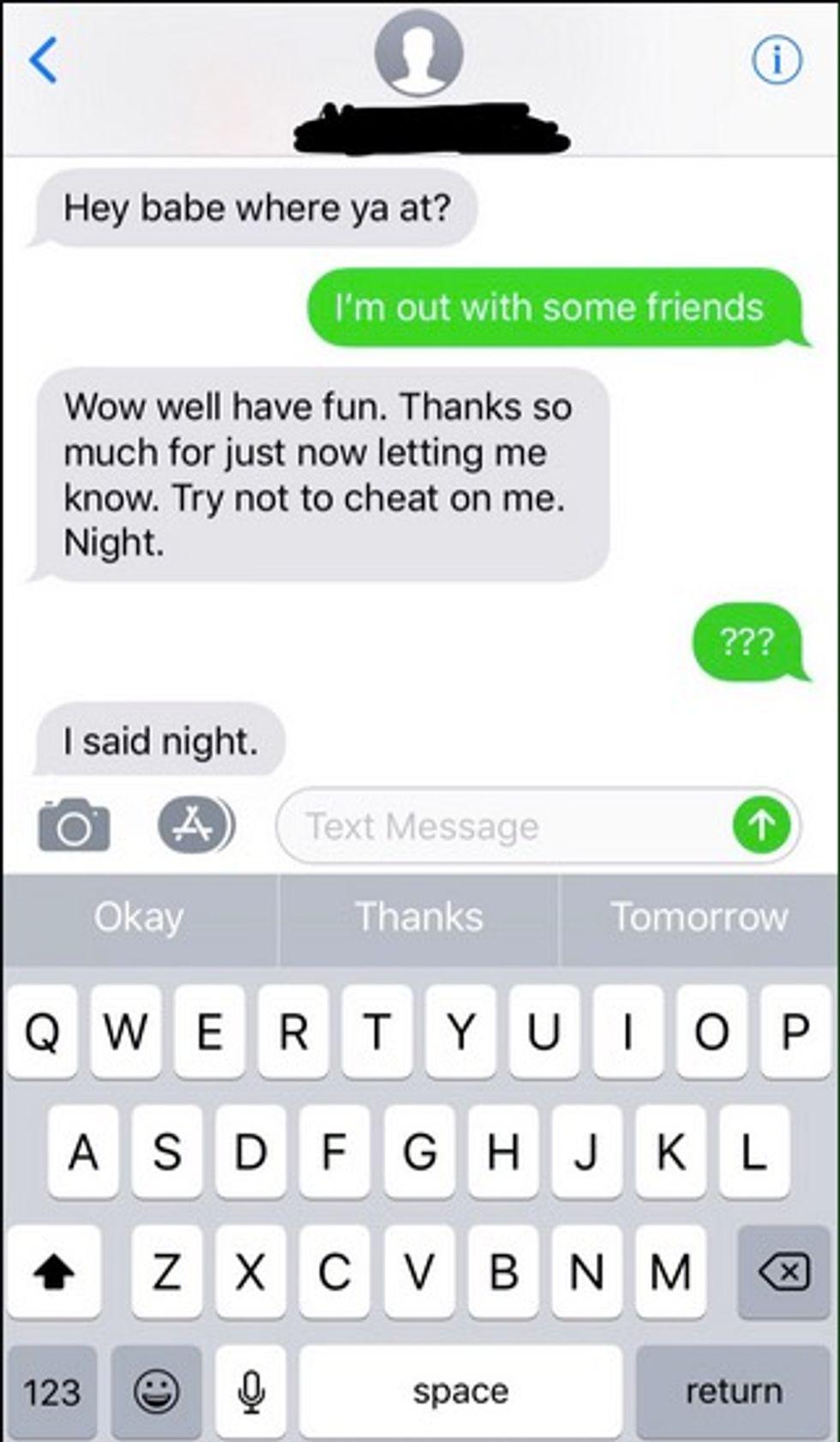
This ex (boyfriend, hookup, whatever he was) went from 0-100 in no time. In fact, the ONLY way this kind of freak out would be excusable would be if they had prior plans she ditched on. Alternately, if he was doing a performance art bit where he embodied Drake’s “0-100 / The Catch Up” via text message. Outside of those possibilities, this type of reaction is nothing short of manipulation and emotional abuse.
The second text message showed how Larsen’s current partner responds to a simple night out:The healthy "Let me know when you’re home safe" Text. Pic cropped from<a href="https://twitter.com/MaycPeterson2/status/1027059199891501057"> Twitter</a> post.
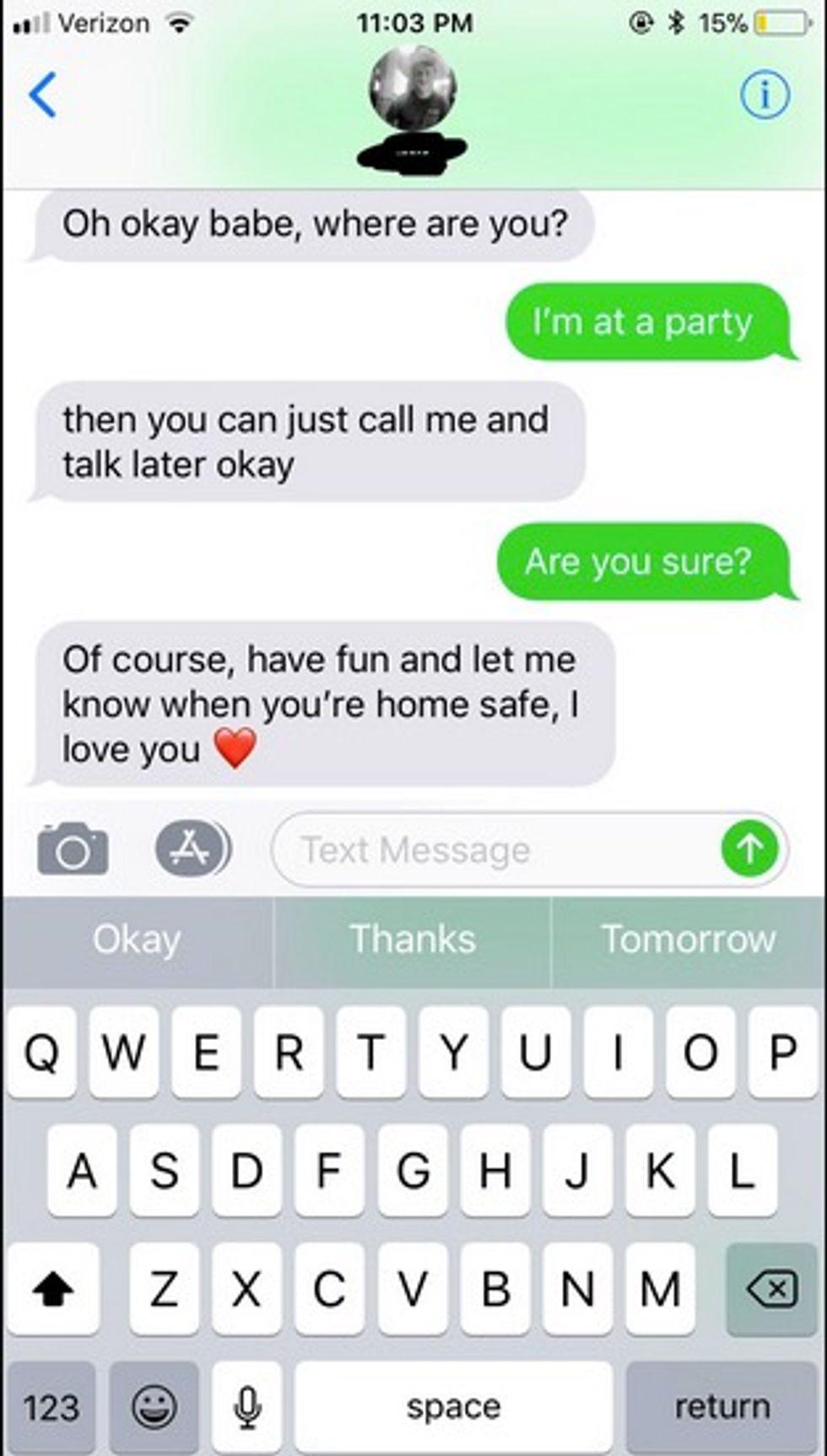
The difference between these responses to a simple night out on the town is night and day. When comparing the two messages, the red flags really pop.
People on X had a LOT of thoughts about the texts.
You’re reminding the one on the left not to cheat. He already has his guard up. The one on the right is just doing the minimum— Samuel (@immasavage3) August 10, 2018
A lot of people assumed the texts were from two guys she’s currently dating.
SO IS EVERYONE IGNORING SHAWTY TALKING TO TWO GUYS AT THE SAME TIME?????— Not Josh (@TheRealJoshMon) August 10, 2018
Meanwhile, others were caught up with the fact that her current dude wears a cowboy hat.
You can tell which one is the man by the cool hat.— Adam Dane (@theseldonplan) August 10, 2018
😂😂🤠YEEHAWW— ❤️🤍👼 łⱤłɆ₮ⱤłⱠⱠłɆ (@IrieTrillVibes) August 10, 2018
Regardless of whether the rest of us are pro cowboy hat (I’m pro if you can pull it off), it seems they’ve got a healthy situation going. Communication is key, in any kind of relationship.
Update: It looks like May and Cowboy Hat got married in 2020. We love a happy ending!
In March 2023, after months of preparation and paperwork, Anita Omary arrived in the United States from her native Afghanistan to build a better life. Once she arrived in Connecticut, however, the experience was anything but easy.
“When I first arrived, everything felt so strange—the weather, the environment, the people,” Omary recalled. Omary had not only left behind her extended family and friends in Afghanistan, she left her career managing child protective cases and supporting refugee communities behind as well. Even more challenging, Anita was five months pregnant at the time, and because her husband was unable to obtain a travel visa, she found herself having to navigate a new language, a different culture, and an unfamiliar country entirely on her own.
“I went through a period of deep disappointment and depression, where I wasn’t able to do much for myself,” Omary said.
Then something incredible happened: Omary met a woman who would become her close friend, offering support that would change her experience as a refugee—and ultimately the trajectory of her entire life.
Understanding the journey
Like Anita Omary, tens of thousands of people come to the United States each year seeking safety from war, political violence, religious persecution, and other threats. Yet escaping danger, unfortunately, is only the first challenge. Once here, immigrant and refugee families must deal with the loss of displacement, while at the same time facing language barriers, adapting to a new culture, and sometimes even facing social stigma and anti-immigrant biases.
Welcoming immigrant and refugee neighbors strengthens the nation and benefits everyone—and according to Anita Omary, small, simple acts of human kindness can make the greatest difference in helping them feel safe, valued, and truly at home.
A warm welcome
Dee and Omary's son, Osman
Anita Omary was receiving prenatal checkups at a woman’s health center in West Haven when she met Dee, a nurse.
“She immediately recognized that I was new, and that I was struggling,” Omary said. “From that moment on, she became my support system.”
Dee started checking in on Omary throughout her pregnancy, both inside the clinic and out.
“She would call me and ask am I okay, am I eating, am I healthy,” Omary said. “She helped me with things I didn’t even realize I needed, like getting an air conditioner for my small, hot room.”
Soon, Dee was helping Omary apply for jobs and taking her on driving lessons every weekend. With her help, Omary landed a job, passed her road test on the first attempt, and even enrolled at the University of New Haven to pursue her master’s degree. Dee and Omary became like family. After Omary’s son, Osman, was born, Dee spent five days in the hospital at her side, bringing her halal food and brushing her hair in the same way Omary’s mother used to. When Omary’s postpartum pain became too great for her to lift Osman’s car seat, Dee accompanied her to his doctor’s appointments and carried the baby for her.
“Her support truly changed my life,” Omary said. “Her motivation, compassion, and support gave me hope. It gave me a sense of stability and confidence. I didn’t feel alone, because of her.”
More than that, the experience gave Omary a new resolve to help other people.
“That experience has deeply shaped the way I give back,” she said. “I want to be that source of encouragement and support for others that my friend was for me.”
Extending the welcome
Omary and Dee at the Martin Luther King, Jr. Vision Awards ceremony at the University of New Haven.
Omary is now flourishing. She currently works as a career development specialist as she continues her Master’s degree. She also, as a member of the Refugee Storytellers Collective, helps advocate for refugee and immigrant families by connecting them with resources—and teaches local communities how to best welcome newcomers.
“Welcoming new families today has many challenges,” Omary said. “One major barrier is access to English classes. Many newcomers, especially those who have just arrived, often put their names on long wait lists and for months there are no available spots.” For women with children, the lack of available childcare makes attending English classes, or working outside the home, especially difficult.
Omary stresses that sometimes small, everyday acts of kindness can make the biggest difference to immigrant and refugee families.
“Welcome is not about big gestures, but about small, consistent acts of care that remind you that you belong,” Omary said. Receiving a compliment on her dress or her son from a stranger in the grocery store was incredibly uplifting during her early days as a newcomer, and Omary remembers how even the smallest gestures of kindness gave her hope that she could thrive and build a new life here.
“I built my new life, but I didn’t do it alone,” Omary said. “Community and kindness were my greatest strengths.”
Are you in? Click here to join the Refugee Advocacy Lab and sign the #WeWillWelcome pledge and complete one small act of welcome in your community. Together, with small, meaningful steps, we can build communities where everyone feels safe.
This article is part of Upworthy’s “The Threads Between U.S.” series that highlights what we have in common thanks to the generous support from the Levi Strauss Foundation, whose grantmaking is committed to creating a culture of belonging.
We all know the feeling: You walk through the front door after a long day, or slam your laptop shut, and the weight of the world slides off your shoulders. Your overworked brain, desperate to relax, entices you to collapse onto the couch and scroll through your phone until it’s time to sleep.
But is this the best way to recharge? By doing nothing? Experts say no.
A fascinating practice on social media called the “personal curriculum” is trending. Championed by Google executive productivity advisor Laura Mae Martin, the concept is simple yet counterintuitive. The idea is to assign yourself “homework”—not to earn a degree, promotion, or extra cash, but for the pure joy of learning. TikTok user Elizabeth Jean also helped popularize the term “personal curriculum,” and posts videos with tips on how to create your own.
Adding tasks to an overflowing to-do list might sound like a recipe for burnout, but Martin suggests that a structured, self-directed learning plan can boost energy, sharpen the mind, and restore a sense of identity.
The unexpected science of “fun homework”
It’s easy to compare our brains to batteries that drain during the day and require total rest to recharge. But cognitive science shows that our minds are more like muscles. To stay healthy, we need new and interesting activities that challenge us.
When we engage in what researchers call “cognitively stimulating activities,” the physical structure of our brains changes. A 2017 report from the Global Council on Brain Health highlighted that keeping the mind active is essential for maintaining brain health as we age. Creative activities like painting, photography, or writing can reduce cortisol levels, lowering stress hormones and creating an emotional regulation loop that leaves you feeling refreshed and ready for the next day.
A systematic review in BMJ Open found a clear link between lifelong learning and a lowered risk of dementia. Researchers explained that challenging the brain with new information builds cognitive reserve, a.k.a. its ability to adapt and remain resistant to damage.
Think of it as investing in your mental future. Each time you tackle a new language lesson or deep-dive into Renaissance art history, you’re strengthening your brain in ways that can last a lifetime.
Redefining what it means to be productive
The word “productivity” can carry heavy connotations. It suggests endless checklists, exhausting efficiency hacks, and squeezing every drop of output from our waking hours. Laura Mae Martin offers a refreshing alternative, defining productivity in simple terms: “Productivity is accomplishing what you intend to do, when you intend to do it.”
This meaning allows us to reclaim our time. It shifts our mindsets from external validation to internal satisfaction.
How to build your syllabus
Let’s put this in practical terms. How do you bring these “nice ideas” into the real world? By creating a “personal curriculum” and treating it with the same respect you would have for a college course. Humans respond well to structure and deadlines. Here’s how to create a syllabus that sticks:
Follow the spark: Genuine curiosity must drive your personal curriculum. If you hated calculus in high school, don’t pick it up again for arbitrary reasons, like trying to feel smart. Look for subjects that make you lose track of time. Identifying every tree in your neighborhood could be one, or mastering the perfect sourdough loaf.
Diversify your materials: Learning exists everywhere, not solely in dense textbooks. Keep required texts engaging and fun, mixing in podcasts, workshops, flashcards, and documentaries. If you are learning a new language, listen to an album in that language. If you’re studying paleontology, visit a local natural history museum.
Set the scene: Get yourself in the zone with a little learning mise en place. Find a specific chair and reserve it for reading, or flipping through flashcards. Make a study playlist and fill it with songs to play in the background. When you sit in that chair, or hit play, you are signaling to your brain that it’s time to switch into “student” mode.
The 20–30 minute rule
Don’t spend all your free time on this. Overload is the greatest pitfall with personal curriculums. We get excited, plan to study every night for two hours straight, then find ourselves exhausted and discouraged.
Sustainability lies in the “Goldilocks” rule for time commitment: keep sessions between 20 and 30 minutes.
Simple 20–30 minute blocks fit into even the busiest schedules yet, they’re long enough to achieve a flow state.. Slot one in after dinner or while drinking your morning coffee.
Valerie Craddock, a content creator, shared her November curriculum on TikTok, embracing this method. It included gentle, actionable goals: walk 8,000 steps, practice penmanship three times a week, work out for 30 minutes. By keeping her curriculum low stakes, Craddock set herself up for a winning streak instead of a guilt trip.
Make room for what matters
How do you protect this newfound time? Martin suggests a simple but effective tactic: integrating your personal calendar with your work one.
This gives you a complete view of the week. You might see Tuesday packed with meetings, so you’ll make a mental note to keep that evening free. Thursday looks much lighter, offering the perfect window to pencil in that 30-minute creative writing session.
An approach like this helps you honor the natural ebb and flow of energy, and prevents you from overcommitting on days when you’re already drained. When you schedule “fun homework” with the same seriousness as an All-Hands meeting, you’re sending yourself a powerful message: personal growth is as important as obligations.
Redefining “you”
One of the most rewarding aspects of the personal curriculum is its ability to reshape our sense of self. In a society obsessed with asking, “What do you do for work?” discovering an answer that’s not attached to a paycheck can feel freeing.
When you learn, you transcend the role of parent, employee, or partner—you become a historian, linguist, painter, or botanist.
Buy the notebook, write a syllabus, and enjoy becoming a beginner again. You might discover that a little homework can unlock the key to reconnecting with yourself.
Activewear is a $400 billion industry, with no shortage of brands selling moisture-wicking tops, running shorts, yoga pants, and all manner of athletic clothing designed for exercise. In fact, we’ve become so accustomed to “workout gear” that the idea of exercising without it feels almost wrong.
Enter Deb Voisin, who not only challenges the notion that people need to run in any particular clothing, but runs herself barefoot and in skirts or dresses, like a preschooler—one with a keen understanding of biomechanics, that is.
Voisin says she could “barely walk” due to an injury caused by overstretching, and she hadn’t been able to find a healing method that worked. Not wanting surgery, she studied biomechanics and natural movement and made an interesting discovery about sprinting.
“Once I realized that a sprint is an amplified walking pattern, I knew that if I could learn how to sprint beautifully, I could walk pain-free,” she shares.
To hone her form, she filmed herself sprinting on a curved treadmill. But there was a problem: she hated looking at herself.
“So I wore skirts and played dress up like a little girl,” she says. “It worked!”
Watch:
Voisin tells Upworthy it worked on multiple levels.
“I started wearing skirts because they helped me stop hating looking at myself—and I realized they also make healthy movement visible,” she says. “Aligned movement is wavy and alive, not rigid. Running is timeless and human, and the fabric lets you actually see that flow.”
She says she always hated running, but sprinting in skirts shifted her perspective.
“Once I realized that sprinting is the ultimate expression of a naturally aligned body, I aimed high and shot past pain into ease and power I don’t think I ever felt growing up,” she explains. “Now I help others find their way back to that feeling.”
Voisin also says the comments on her video, which has been viewed more than 4 million times, made her weep.
“I had no idea how healing it would feel to be so openly accepted for something that even people close to me didn’t understand,” she says. “I just knew there was beauty and healing in it.”
Here are some of the viewer comments that made Voisin cry:
“Something about a running, whimsical lady in a skirt and no shoes is so magical.”
“Every time a human loves herself, is a win for all the universe.”
“Who noticed, the more she practices, the more she looks younger just like a little girl happy running and discovering the world that she sees as a beautiful and happy place? Beautiful lady, am glad seeing you running, run run run..”
“You literally look like you aged in reverse in the process! Amazing how healing joy can be for our bodies.”
“Every single shot of you running in a skirt looks like it comes from a movie I’d love to watch.”
“People forget, we often don’t like doing things that are good for us, because we copy how everyone else is doing it. Make it fun for you, do it the way you want to do it. Find those joys in your life. It’s your first time living.”
“I also just love the kick in the face to traditional ‘workout’ clothes. It’s just more consumerism, you don’t need special clothes to workout. Just use what you have!”
“I loved the reel, the fabric movement, the timelapse, the self love, the deep desire to heal, fit body at later ages… all of it made me smile at how we all creatively approach our problems.”
“I’ve been an avid runner in my life, but haven’t run much for a few years now. This brought tears to my eyes, your beauty and grace and commitment. I am inspired to run again, for the sheer joy of it!”
It’s amazing what can happen when you infuse joy into physical activity. Maybe joy for you isn’t running in a skirt and watching it flow in slo-mo, but something else entirely. Whatever joy looks like, leaning into it may help you reclaim the motivation you lost somewhere along the way and empower you to keep your body moving and healthy.
Introverts can have many personality stereotypes. Many people assume they are quiet homebodies who prefer alone time, but not all introverts are the same.
Psychologist Jonathan M. Cheek, along with his colleagues Jennifer Grimes and Julie Norem at Wellesley College, presented findings in a 2011 study identifying four types of introverts: Social, Thinking, Anxious, and Restrained (STAR).
“Many people assume introversion is fixed, but introversion is on a spectrum,” Chloë Bean, a somatic trauma therapist in Los Angeles, told Upworthy.
Essentially, there is no one-size-fits-all type of introvert.
“It can shift depending on life phase, your stress level, burnout, support system, and trauma history,” Bean said. “What looks like ‘being introverted’ is sometimes the nervous system doing it’s job, protecting you especially when you’re feeling overwhelmed or need to connect with yourself more.”
Four types of introverts
In an interview with The Cut, Cheek explained that these introvert “types” are more like “shades,” and that introverts are often a mix of each one. Here’s what you need to know about each type of introvert:
Bean noted that social introverts may be selective about who they connect with. They enjoy spending time with others but need downtime to recover.
“They prefer to stay home with a book or a computer, or to stick to small gatherings with close friends, as opposed to attending large parties with many strangers,” Cheek explained.
How to tell if it’s you:
“You may tend to lose a lot of energy when socializing in large groups even when they’re fun and prefer one-on-one time,” said Bean. “You may feel more regulated with one person at a time, as you can feel overstimulated with more than one person at a time.”
Thinking introverts
Thinking introverts are internally rich, deep, and active but appear quiet on the outside, Bean noted. They spend a lot of time reflecting, imagining, creating, or analyzing.
“You’re capable of getting lost in an internal fantasy world,” Cheek said. “But it’s not in a neurotic way, it’s in an imaginative and creative way.”
How to tell if it’s you:
“You feel energized and excited by ideas but you feel exhausted when there is constant feedback and stimulation externally,” Bean explained. “You need time to be with your thoughts to come to your conclusion so staying with your inner voice and process is supportive because you can get easily distracted by others’ thoughts and opinions.”
Bean said that anxious introverts deal with anxiety and avoidance driven by fear, as the body anticipates rejection or not being accepted socially.
How to tell if it’s you:
“You might replay conversations, dread upcoming plans and cancel them when the tension and anxiety gets too strong,” Bean shared. “This is often less about your personality and more about your nervous system feeling dysregulated by thoughts about socializing.”
Restrained introverts
Restrained introverts are highly observant, take time to warm up to others, and are cautious about who they spend their energy with, Bean explained.
How to tell if it’s you:
“It might take you some time to feel like you can trust others and feel safe enough to speak up,” Bean said. “You might also avoid being put on the spot or being the center of attention.”
Editor’s Note: This story discusses suicide. If you are having thoughts about taking your own life, or know of anyone who is in need of help, the 988 Suicide & Crisis Lifeline is a United States-based suicide prevention network of over 200+ crisis centers that provides 24/7 service via a toll-free hotline with the number 9-8-8. It is available to anyone in suicidal crisis or emotional distress.
Mental illnesses like depression don’t discriminate. It can hit anyone, and not everyone survives their fight with the condition. Ben West, a man from the United Kingdom, has intimate familiarity with what happens when someone loses their battle with depression. He lost his younger brother, Sam, to suicide eight years ago.
In an effort to help with his own grieving process and connect with those who may feel alone, he created a website. The video launching the site Reasons to Staywent viral due to its touching story and noble mission. It’s a website that allows people from across the world to leave letters of encouragement to people who may be contemplating suicide. The hope is that someone needing a reason to stay one more day will find their reason in one of those letters.
Comfort in a hug: a shared moment of empathy and support. Photo credit: Canva
The website is simple: it displays the latest letter on the home page, offers sign ups for letters to go directly to your email in the form of a newsletter, and shares places to seek help. If someone wants to read a different letter, all they need to do is refresh the page.
“This letter was written by someone in the world that cares. It was delivered to you at random when you opened this page,” the Reasons to Stay website explains.
The creation of this website was strictly an act of compassion for fellow humans, but recently, West received an email revealing that his site saved a life. The website’s founder wept while sharing the news on his Instagram page, saying, “I got a message today, and I’m not going to share the message, but what I can share is that it worked. It worked for someone. We can be fairly confident that it really worked for someone.”
He admits that the person still has a difficult journey ahead, but celebrates that they get to continue on at all. “Like I said before, social media, it can be such a bad place, but how amazing that it can be used for something like this. Like, that person, maybe it wouldn’t reach them if it didn’t go viral, so thank you so much, everyone, for sharing and getting involved in this over the last couple of weeks. What a special thing. What an amazing thing. It worked.”
According to the Centers for Disease Control, “One person dies by suicide an average of every 11 minutes. Over 49,000 people lost their lives to suicide in 2022. Every year, millions of Americans think about, plan, or attempt suicide.”
In August 2025, JAMA Network released an article urging people to consider human connection as a form of suicide prevention. The authors of the article share that there’s power in human connection, writing, “At a time when individuals experiencing suicidality often feel unseen, unheard, and burdensome, structured follow-up sends a clear message: you matter. You are not forgotten.”
Reasons to Stay is putting human connection at the forefront in hopes of saving lives. People are moved by his selfless gesture, with some sharing their own stories of survival. One person shares, “From someone who tried to, this is essential. Wish I had that back then. Will definitely use your site if those thoughts ever come back to me. I’m so proud of you, and so is Sam. We’re safer now.”
Woman seated against brick wall, covering ears with hands. Photo credit: Canva
Another writes, “My dad took his own life. I wish he could’ve had a website like this to go to. I am sobbing happy tears to know that someone’s life was saved, and I’m also so incredibly sorry for your loss. I understand the ache— but you made something beautiful for your brother.”
“You may or may not be familiar with David Kessler’s “The sixth stage of grief,” but in that book he suggests that the 6th stage is: finding meaning. You’ve created meaning by saving others. Sam’s spirit and legacy lives on through you and his life and death now means, not just something to you, but something to many others around the world. What an absolutely beautiful and healing way to honour Sam, and what a gift this is to the world. Thank you Sam. Thank you Ben. So special. So powerful,” someone else kindly shares.
The benefits of getting a good night’s sleep are too vast to name. Sleep is as essential for our brains as food and water are for our bodies. If you’re not getting enough, sleeping better has been shown to elevate your mood, improve your memory, and even boost your physical health. And then there’s the obvious: when you don’tsleep well, you’ll have less energy and generally perform worse on tasks that require any kind of effort or thought.
However, we’re all human, and, sometimes, humans sleep terribly. Your infant might wake you up, or a car alarm might go off outside, interrupting your regularly-scheduled REM. It’s not always our fault when we don’t sleep well, but there might be an interesting way to fix it.
A study from 2014 may have demonstrated the existence of something called “placebo sleep,” or tricking your brain into believing you slept better than you did.
The placebo effect, of course, has been studied relentlessly over the years and has shown that the human body can do amazing, almost impossible things, when the brain gets on board. The classic example is when symptoms of disease get measurably better after a patient takes a “fake” pill. Another study out of Harvard showed that people who were told their jobs qualified as exercise showed improved health and fitness markers compared to people who did the same job. Placebos even work when the person knows they’re taking a placebo. It’s called an “honest placebo” and is considered a legitimate, ethical treatment method for many ailments.
The researchers in 2014 wanted to find out if the placebo effect could also apply to sleep. So, they lectured a group of participants about the importance of REM sleep and how it can effect cognitive functioning. The participants were then split into two groups and monitored overnight while they slept. The next morning, one group was told they achieved 28.7% REM sleep, which is terrific, and the other group was told they only spent 16.2% of their sleep time in REM, which is below average. The numbers, however, were complete fiction.
Stunningly, the participants who believed they achieved top quality sleep performed better the next day on a series of arithmetic and word association tests compared to the other groups.
In their conclusion, the authors wrote, “These findings supported the hypothesis that mindset can influence cognitive states in both positive and negative directions, suggesting a means of controlling one’s health and cognition.”
According to Smithsonian Magazine, follow up experiments confirmed the findings.
The key to feeling great and performing as if you had a great night’s sleep may lie in simply believing that you did.
There are a lot of ways to “placebo your sleep” in order to generate that belief. For starters, you can adopt a new routine or technique or even supplement in order to prime your brain.
John Cline Ph.D. asserts for Psychology Today that the popularity of sleeping aids like melatonin may be tied less to the fact that they work, and more to the fact that people believe they work. But you don’t need to take any supplements or medications. Having a slow evening wind down with a book and an herbal tea, trying a new sleeping position, or practicing some measured breathing might work just as well. Or, rather, they might work precisely because you believe they will.
You could take the concept a step further and alter your morning routine on nights you know for a fact you didn’t sleep well. Perhaps it’s by using a new coffee brand, doing some stretches before getting out of bed, or meditating before starting your day. Anything that you truly believe might help make you more alert and focused may just work.
One viral social media sleep trend capitalizes on this research perfectly. Researchers have shown that forcing your mouth into a smile has been shown to improve your mood. Turns out, similarly, you may be able to get sleepy by pretending to be super tired. Psychologist Erica Terblanche calls it the “alpha bridge,” and it involves gently closing your eyes, fluttering them open just a tad, and then closing them again as you relax and breath. It simulates the feeling of “nodding off” and is said to create the alpha brainwaves that transition your brain from wakefulness to sleep. It’s another clever way of tricking your own brain.
It sounds cheesy, but the power of mindset and positive thinking is truly tremendous. Our beliefs and thought patterns can greatly influence our body, our behavior, and our mood. Sometimes, our mindset can even be stronger than actual reality. Now we have the data to prove that it applies to our precious sleep, too.
When people in the healthcare world experience people dying on a regular basis, they begin to see patterns as to when patients will pass away. Hospice workers say that when people are in their final days, they begin to see the people they’ve loved in the past surrounding their hospital bed. They will share many of the same regrets and have frequent hallucinations.
Kirstie Robb, a TikToker who has worked as an ICU nurse for the past four years, has noticed a trend in people who are about to pass away. She says that when she hears a specific phrase from those who are brought in, regardless of the reason, they will be gone very soon: “Every single person who passes away says the same thing,” she explained in her TikTok. “They say…’Can you please tell my family I love them? I don’t feel good. I know I’m gonna die.’”
Somehow, people know when they are ready to die
Death is such a mysterious process that Robb can’t believe that so many people she’s seen know when the moment is upon them. We’re never trained to sense our death. Why is it that these people have such a clear understanding that it is upon them? Robb says it is due to an internal, spiritual shift that defies medical understanding. “You guys, people know when they’re gonna die,” she says.
“There’s a shift that happens that’s spiritual, that nobody can explain, right? Their vitals may be stable. Their condition may be the exact same way it was when they came in. There’s nothing inherently dangerous,” she continued. “Yet in every single circumstance, no matter what brought them in initially, no matter how many hours it is from the last time that they said that, they always die. Always.”
Lessons from being among the dying
Robb’s experience with the dying led her to remind everyone how important our lives are and to focus on what truly matters, rather than chasing material possessions. “Life is not meant to be an endless pursuit of things. Life is meant to be enjoyed. Life is meant to be appreciated. Life is meant to be explored. Why are you actually here?” Robb asks.
There is no research-based reason for this shift that occurs in people when they know they are going to pass. But David Casarett, M.D., explained his experience with it in Psychology Today.
“What they tell me is that they feel—something. Something different, or changing, or new. One young man dying of a sarcoma told me he felt free. Another middle-aged woman dying of liver cancer said she felt like she was falling out of a plane. Both had been correct to sense something amiss, and both died within the hour,” Dr. Casarett wrote. “I don’t know how we could possibly foresee our own deaths. I’m not saying it’s impossible; it’s just beyond my power to explain.”
While there is a lot of mystery surrounding death, Robb and Dr. Casarett’s experience with it shows that those who are ready to pass away seem to be at peace and are accepting of their final journey home, wherever that may be. It should give all of us a feeling of relief that our final hours may be the most peaceful we ever experienced.
We all know the feeling. You walk through the front door after a long day, or slam your laptop shut, and the weight of the world slides off your shoulders. Your overworked brain, desperate to relax, entices you to collapse onto the couch and scroll through your phone until it’s time to sleep.
But is this the best way to recharge? By doing nothing? Experts say no.
A fascinating trend on social media is trending, called the “personal curriculum.” Championed by Google executive productivity advisor Laura Mae Martin, the concept is simple yet counterintuitive. The idea is to assign yourself “homework”—not to earn a degree, promotion, or extra cash, but for the pure joy of learning. TikTok user Elizabeth Jean also helped popularize the term “personal curriculum,” and posts videos with tips on how to create your own.
Adding tasks to an overflowing to-do list might sound like a recipe for burnout, but Martin suggests that a structured, self-directed learning plan can boost energy, sharpen the mind, and restore a sense of identity.
The unexpected science of “fun homework”
It’s easy to compare our brains to batteries that drain during the day and require total rest to recharge. But cognitive science shows that our minds are more like muscles. To stay healthy, we need new and interesting activities that challenge us.
When we engage in what researchers call “cognitively stimulating activities,” the physical structure of our brains changes. A 2017 report from the Global Council on Brain Health highlighted that keeping the mind active is essential for maintaining brain health as we age. Creative activities like painting, photography, or writing can reduce cortisol levels and lower stress hormones, creating an emotional regulation loop that leaves you feeling refreshed and ready for the next day.
A systematic review in BMJ Open found a clear link between lifelong learning and a lowered risk of dementia. Researchers explained that challenging the brain with new information builds cognitive reserve, a.k.a. its ability to adapt and remain resistant to damage.
Think of it as investing in your mental future. Each time you tackle a new language lesson or deep-dive into Renaissance art history, you’re strengthening your brain in ways that can last a lifetime.
Redefining what it means to be productive
The word “productivity” can carry heavy connotations. It suggests endless checklists, exhausting efficiency hacks, and squeezing every drop of output from our waking hours. Laura Mae Martin offers a refreshing alternative, defining productivity in simple terms: productivity is accomplishing what you intend to do, when you intend to do it.
This meaning allows us to reclaim our time. It shifts our mindsets from external validation to internal satisfaction.
How to build your syllabus
Let’s put this in practical terms. How do you bring these “nice ideas” into the real world? By creating a “personal curriculum” and treating it with the same respect you would have for a college course. Humans respond well to structure and deadlines. Here’s how to create a syllabus that sticks:
Follow the spark: Genuine curiosity must drive your personal curriculum. If you hated calculus in high school, don’t pick it up again for arbitrary reasons, like trying to feel smart. Look for subjects that make you lose track of time. Identifying every tree in your neighborhood could be one, or mastering the perfect sourdough loaf.
Diversify your materials: Learning exists everywhere, not solely in dense textbooks. Keep required texts engaging and fun, mixing in podcasts, workshops, flashcards, and documentaries. If you are learning a new language, listen to an album in that language. If you’re studying paleontology, visit a local natural history museum.
Set the scene: Get yourself in the zone with a little learning mise en place. Find a specific chair and reserve it for reading, or flipping through flashcards. Make a study playlist and fill it with songs to play in the background. When you sit in that chair, or hit play, you are signaling to your brain that it’s time to switch into “student” mode.
The 20–30 minute rule
Don’t spend all your free time on this. Overload is the greatest pitfall with personal curriculums. We get excited, plan to study every night for two hours straight, then find ourselves exhausted and discouraged.
Sustainability lies in the “Goldilocks” rule for time commitment: keep sessions between 20 and 30 minutes.
Simple 20–30 minute blocks fit into even the busiest schedules. Slot one in after dinner or while drinking your morning coffee. Yet, they’re long enough to achieve a flow state.
Valerie Craddock, a content creator, shared her November curriculum on TikTok, embracing this method. It included gentle, actionable goals: walk 8,000 steps, practice penmanship three times a week, work out for 30 minutes. By keeping her curriculum low stakes, Craddock set herself up for a winning streak instead of a guilt trip.
Make room for what matters
How do you protect this newfound time? Martin suggests a simple but effective tactic: integrating your personal calendar with your work one.
This gives you a complete view of the week. You might see Tuesday packed with meetings, so you’ll make a mental note to keep that evening free. Thursday looks much lighter, offering the perfect window to pencil in that 30-minute creative writing session.
An approach like this helps you honor the natural ebb and flow of energy, and prevents you from overcommitting on days when you’re already drained. When you schedule “fun homework” with the same seriousness as an All-Hands meeting, you’re sending yourself a powerful message: personal growth is as important as obligations.
Redefining “you”
One of the most rewarding aspects of the personal curriculum is its ability to reshape our sense of self. In a society obsessed with asking, “What do you do for work?” discovering an answer that’s not attached to a paycheck can feel freeing.
When you learn, you transcend the role of parent, employee, or partner—you become a historian, linguist, painter, or botanist.
Buy the notebook, write a syllabus, and enjoy becoming a beginner again. You might discover that a little homework can unlock the key to reconnecting with yourself.
It’s 2:00 a.m., and you simply can’t get your mind to shut down. You’ve tried counting sheep, but they just keep crash-landing into meadows, making the insomnia even worse. Maybe you’ve tried every trick in the book, from over-the-counter sleep aids to lavender-scented pillows. Well, there’s one more trick to try, and some people swear by it.
It’s called the “Infinity Tracing Technique,” and it’s actually quite simple. Simply put your finger in the air and imagine tracing the infinity symbol (the number eight sideways) for a couple of minutes. This easy technique can instantly help calm an overactive mind.
Dr. Joe Whittington explains the idea in layman’s terms in a TikTok video. “You ever lay in bed at night overthinking all the embarrassing things you’ve done since childhood?” he asks. “Same. So I’m gonna teach you a technique that might help you calm your overactive brain.”
He breaks down exactly how to do it:
“What you do is you take your finger, put it in the air, and you trace the infinity symbol slowly and methodically. Not like you’re casting spells. And as you’re tracing this infinity symbol, you’re gonna just follow it with your eyes. Only your eyes. What this does is it activates your vestibular center, which is involved with your balance and eye movements. When your vestibular system gets activated, it can help calm racing thoughts. Sort of like distracting a toddler with a shiny object, except for the toddler is your overactive brain.”
It’s helpful to the brain in other ways, too. “It’s a technique often used in therapy and neuroscience to help you stop doomscrolling your regrets,” he adds.
Whittington is likely referring to a therapy technique called EMDR, which uses similar methods involving eye movement. EMDR stands for Eye Movement Desensitization and Reprocessing, and it’s used to help people process complex trauma.
“During EMDR therapy, the client attends to emotionally disturbing material in brief sequential doses while simultaneously focusing on an external stimulus. Therapist-directed lateral eye movements are the most commonly used external stimulus, but a variety of other stimuli, including hand-tapping and audio stimulation, are often used.”
Similarly, the Infinity Tracing Technique pairs eye movements with specific brain activity to help calm the mind and redirect focus. This technique has recently become popular due to therapists and influencers sharing it online.
Sarah Jackson offers additional insight in her Instagram Reel, where she demonstrates the process using a capped blue marker to “write” in the air. She explains that “Figure-8 tracking,” as she calls it, activates not only the vestibular system but also the ocular system.
“Eye muscles connect directly to the brainstem — the part of the brain that governs survival functions,” she writes. “Tracking a moving object sends rhythmic signals, saying: I’m balanced, I’m oriented, I’m safe.”
“The vestibular system regulates balance and spatial orientation. Its connection to the brainstem helps calm the nervous system. Smooth, predictable movement supports groundedness, signaling safety. Cross-lateral movement integrates both hemispheres, aiding emotional processing and shifting focus from internal preoccupation to external grounding.”
Many followers of both social media accounts say they’ve benefited from the technique. One TikToker jokes, “So I don’t need to try to remember my junior high school locker combo?”
On the Instagram Reel, one commenter notes that the technique works: “This is great and so effective! I’m always looking for quick wins like this on those days where you can’t tell where the time goes.”