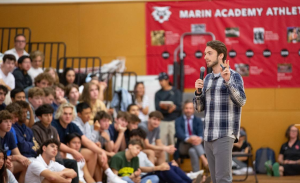




Two heroic teachers refuse to let a pandemic stop them from reaching underserved youth in their communities
Now more than ever, teachers are America's unsung heroes. They are taking on the overwhelming task of not only educating our children but finding creative and effective ways to do it in an unpredictable virtual learning environment.
Lily Read and Justin Bernard, two Massachusetts educators from one of the most diverse public high schools in the U.S. (over 25 different languages are spoken in the student body!), feel ready to meet the challenges of this unprecedented school year. Their goal: find ways to make virtual education "as joyful as possible" to help support teenagers during quarantine.
"Our school is very economically, racially, and linguistically diverse," said Read, "which means meeting the needs for all those students is incredibly complex." That wide range of diversity means that they spend a lot of time in professional development, preparing to meet students where they are. This summer, educators in their district spent weeks learning everything from how to provide emotional and social support via virtual platforms, to meeting 504 plans and Individual Educational Plans for disabled students virtually, to mastering the various online programs necessary for instruction.
Bernard, now in his fifth year of teaching, also coaches the high school football team. Prior to the pandemic, there were clear expectations for student athletes, with clear goals and incentives to keep their grades up. Now, Bernard is concerned that student athletes will begin to fall through the cracks without the structure of physically going to school each day, and he is on a mission to do everything he can to keep that from happening.
Trump's anti-racism training prohibition is already having stupid real-world consequences
Two weeks ago (which frankly feels like a lifetime ago), President Trump issued an executive order banning most popular diversity and anti-racism training programs from being used by federal workers and federal contractors. And the order, which bans programming that suggests the "United States is an inherently racist or evil country or that any race or ethnicity is inherently racist or evil"—a dramatic misrepresentation of what racial bias training based on critical race theory actually teaches—is already having some ridiculous real-world consequences.
Actor William Jackson Harper, best known for playing the anxious philosophy professor Chidi Anagonye on "The Good Place," shared a story on Twitter that illustrates one of the many problems with the order. Harper, who works with the charity Arts in the Armed Forces ran into problems with a group of military personnel watching and discussing the movie "Malcolm X" together.
Long Thread: So I’ve had a rather disturbing experience this past week. I agreed to a virtual event with one of th… https://t.co/ieXhyjBWvS— William Jackson Harper (@William Jackson Harper)1601941397.0
The thread reads:
"So I've had a rather disturbing experience this past week. I agreed to a virtual event with one of the charities I'm involved with, Arts In The Armed Forces (AITAF). As the son of a Marine I have a deep respect for those who serve in our military.
The event was an all-academy virtual screening of a movie I selected, that cadets would watch on their own, which culminated in a Talkback/ Q&A session via zoom. I thought this was a great idea.
- If you're wondering why people always seem to be talking about ... ›
- Kindergarten teacher gently explaining racism to her students is a ... ›
- What's it like for a Black man to train white folks to be anti-racist ... ›
Two heroic teachers refuse to let a pandemic stop them from reaching underserved youth in their communities
Now more than ever, teachers are America's unsung heroes. They are taking on the overwhelming task of not only educating our children but finding creative and effective ways to do it in an unpredictable virtual learning environment.
Lily Read and Justin Bernard, two Massachusetts educators from one of the most diverse public high schools in the U.S. (over 25 different languages are spoken in the student body!), feel ready to meet the challenges of this unprecedented school year. Their goal: find ways to make virtual education "as joyful as possible" to help support teenagers during quarantine.
"Our school is very economically, racially, and linguistically diverse," said Read, "which means meeting the needs for all those students is incredibly complex." That wide range of diversity means that they spend a lot of time in professional development, preparing to meet students where they are. This summer, educators in their district spent weeks learning everything from how to provide emotional and social support via virtual platforms, to meeting 504 plans and Individual Educational Plans for disabled students virtually, to mastering the various online programs necessary for instruction.
Bernard, now in his fifth year of teaching, also coaches the high school football team. Prior to the pandemic, there were clear expectations for student athletes, with clear goals and incentives to keep their grades up. Now, Bernard is concerned that student athletes will begin to fall through the cracks without the structure of physically going to school each day, and he is on a mission to do everything he can to keep that from happening.
People familiar with stuttering explain why Biden's debate performance was extraordinary
As I watched the presidential debate—in horror, like most—I perused Twitter at the same time to see if others were as appalled as I was. About an hour into the blazing tire fire, one tweet stood out to me so much I took a screenshot of it.
Because Biden has spoken publicly about trying to manage his stutter, I feel comfortable noting, as another person… https://t.co/xmoPA4BSg0— Nathan Heller (@Nathan Heller)1601431092.0
Biden has shared publicly his struggles with stuttering, which he's dealt with since childhood. In 2011, he wrote an article for People magazine detailing his experiences.
"I never had professional therapy," he wrote, "but a couple of nuns taught me to put a cadence to my speaking, and that's why I spent so much time reading poetry – Emerson and Yeats. But even in my small, boys' prep school, I got nailed in Latin class with the nickname Joe Impedimenta. You get so desperate, you're so embarrassed."
- This star singer is often mistaken for drunk — but the truth is so much ... ›
- Her Voice Is Unpredictable, But She's Not Embarrassed. Neither Is ... ›
- Boy reveals how Joe Biden helped him overcome his stutter in ... ›
- Parents are struggling to explain the presidential debate to their children - Upworthy ›
Ship captain has some fun with sexist troll after his grammatically challenged attack
When most people hear the name captain, they immediately assume the person being referred to is a man. Kate McCue, the first American woman to command a mega cruise ship, has shattered that stereotype.
In 2015, she became captain of Celerity Cruise Lines "Celebrity Equinox" a 122,000-ton, 1041-foot ship, and last year, she was named the captain of the "Celebrity Edge" a billion-dollar ship designed by women.
The first thing you hear when arriving on her ship is, "This is Captain Kate, but you can call me Captain because it took me 19 years to earn this title."
"People don't have a tendency to call men captains by their first name," she told the New York Times.
- Indigenous woman dies in Canadian hospital after filming racist ... ›
- 5 Minutes Of What The Media Actually Does To Women - Upworthy ›
- 5-year-old girl dressed up as 28 iconic women for Black History Month ›
- Unmarried women with no kids are the happiest population ... ›