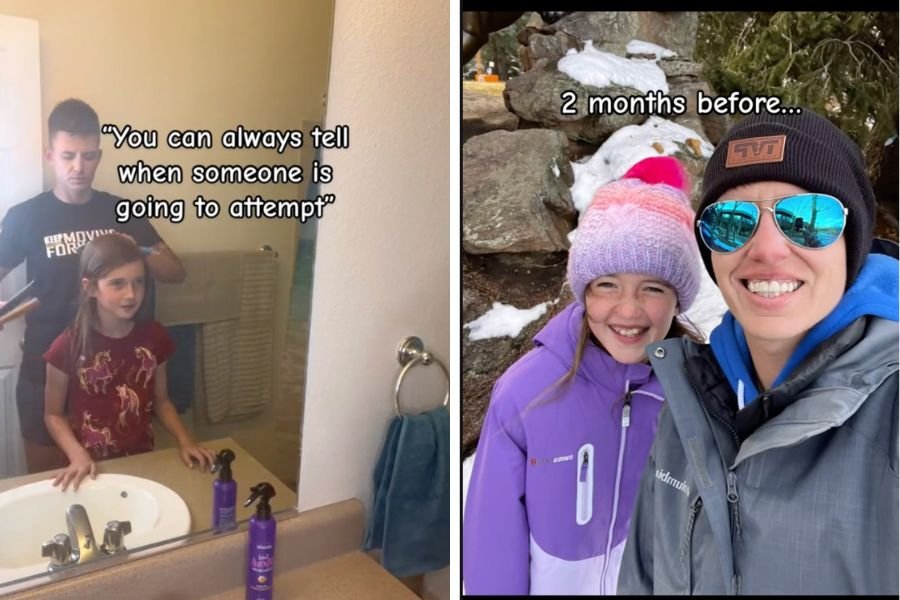
Woman shows moments leading up to her suicide attempt as a jarring reminder to everyone
Reach out to check on your people.

Woman's video before her suicide attempt is a reminder to everyone.
Editor's Note: This story discusses suicide. If you are having thoughts about taking your own life or know of anyone who is in need of help, the 988 Suicide & Crisis Lifeline is a United States-based suicide prevention network of over 200+ crisis centers that provides 24/7 service via a toll-free hotline with the number 9-8-8. It is available to anyone in suicidal crisis or emotional distress.
Not all depression looks the same. Sometimes people don't even realize they're depressed for a long time while others go to great lengths to appear okay to the outside world. People who have functional depression—who still go to work, spend time with friends and look to be enjoying life—may not seem depressed to those closest to them.
This kind of masking can be done for many reasons, but a lot of times, it's because they don't want other people to worry about them. But this could mean suicidal thoughts go unnoticed by loved ones. When people appear happy or as if they're handling everything well, others are much less likely to check in on them.
When Brie Johnson uploaded a video with a quote that reads, "You can always tell when someone is going to attempt," the happy videos and pictures that followed contrasted the reality of her attempting suicide.
Johnson, who's a staff sergeant in the Air Force and mother of one, posted the short video in March with the caption, "Check up on your loved ones. It's not always obvious." This is a sentiment that has been expressed by people repeatedly with a widely shared graphic that reminds people to check on their strong friends—the sentiment being that when people appear to be handling things well, no one checks in to make sure they're actually doing okay.
Johnson's video is a harsh reminder that not every smiling face is conveying joy. Sometimes smiles and laughter are just a mask. So how are people supposed to know when someone is truly struggling when their outward behaviors seem to show everything is fine?
@itsbriej Check up on your loved ones. It’s not always obvious #fyp #SeeHerGreatness #mentalhealth #mentalhealthmatters #recovery #survivor #awareness #love #miltok #foryou
Knowing when to reach out can be tricky, but there can be subtle signs that may easily be missed. Social media posts may change subtly, like broadly asking for prayers frequently when they haven't been in the habit of doing that. Some people may post memes that are either sad or borderline dark humor when those may be out of the ordinary. There could be a lack of care around how much alcohol or drugs they're taking.
Someone who's normally outgoing canceling plans more frequently than usual. Making jokes about death or suicide when it's not a normal conversation for them. A friend who's struggling may ask you about your final plans so they can bring up theirs without raising alarms.
These are all things that can be easily overlooked if you don't know what to look for. But one of the best indicators that you need to reach out is any change, no matter how subtle, that makes you ask the question, "I wonder what's going on with them?" So many times we ignore the tiny alarm bells that go off in our bellies because we're on the lookout for the bigger, louder alarm bells. The tiny alarms are just as important. Now how do you reach out?
Several years ago, I noticed a subtle change in a friend's social media statuses that activated my tiny alarm bells. After waiting about a week or so to see if things went back to normal, I reached out. Never having spoken to this person outside of the comments section in our online running community, I wasn't sure how she would respond. But I sent a message that said something along the lines of, "I just wanted to do a check in with you. I noticed a change in your posts and I wanted you to know that I'm here if you need to talk."
They responded that there were struggling with something pretty big that no one knew about. We spoke on the phone for a couple of hours with me mostly listening. They thanked me about a year later for seeing them when they felt no one else did.
Reaching out doesn't have to be complicated, so try not to overthink it. A lot of times all it takes is genuinely asking how someone is doing and informing them that you want the real answer, not something surface. Then, just listen without judgment and without unsolicited advice or commentary. Ask them what they need and follow through. Human connection, along with the reminder that you matter, can go a long way.
This article was written by Jacalyn Wetzel, Licensed Clinical Social Worker and practicing therapist.

- Simple things you can do to help someone who may be thinking about suicide ›
- 'Smiling depression' can make suicide hard to predict. Here's what you can do. ›
- Renowned psychiatrist debunks the biggest myths about suicide in a candid Reddit AMA ›
- A woman was about to jump off a bridge until Jon Bon Jovi saved her life. - Upworthy ›
- Gardener has saved 50 people from suicide attempts in river - Upworthy ›
- Man who created 'Reasons to Stay' website after brother's death tearfully shares success story - Upworthy ›


a man sitting at a desk with his head on his arms Photo by
Can a warm cup of tea help you sleep better? If you believe it, then yes. Photo by 
A woman is getting angry at her coworker.via
A man with tape over his mouth.via
A husband is angry with his wife. via 
Three women sit on a blanket in the park. 
Two women engaging in a pleasant conversation inside a coffee shop
Two men engaging in a peaceful disagreement.
Resurfaced video of French skier's groin incident has people giving the announcer a gold medal
"The boys took a beating on that one."
Downhill skiing is a sport rife with injuries, but not usually this kind.
A good commentator can make all the difference when watching sports, even when an event goes smoothly. But it's when something goes wrong that great announcers rise to the top. There's no better example of a great announcer in a surprise moment than when French skier Yannick Bertrand took a gate to the groin in a 2007 super-G race.
Competitive skiers fly down runs at incredible speeds, often exceeding 60 mph. Hitting something hard at that speed would definitely hurt, but hitting something hard with a particularly sensitive part of your body would be excruciating. So when Bertrand slammed right into a gate family-jewels-first, his high-pitched scream was unsurprising. What was surprising was the perfect commentary that immediately followed.
This is a clip you really just have to see and hear to fully appreciate:
- YouTube youtu.be
It's unclear who the announcer is, even after multiple Google inquiries, which is unfortunate because that gentleman deserves a medal. The commentary gets better with each repeated viewing, with highlights like:
"The gate the groin for Yannick Bertrand, and you could hear it. And if you're a man, you could feel it."
"Oh, the Frenchman. Oh-ho, monsieurrrrrr."
"The boys took a beating on that one."
"That guy needs a hug."
"Those are the moments that change your life if you're a man, I tell you what."
"When you crash through a gate, when you do it at high rate of speed, it's gonna hurt and it's going to leave a mark in most cases. And in this particular case, not the area where you want to leave a mark."
Imagine watching a man take a hit to the privates at 60 mph and having to make impromptu commentary straddling the line between professionalism and acknowledging the universal reality of what just happened. There are certain things you can't say on network television that you might feel compelled to say. There's a visceral element to this scenario that could easily be taken too far in the commentary, and the inherent humor element could be seen as insensitive and offensive if not handled just right.
The announcer nailed it. 10/10. No notes.
The clip frequently resurfaces during the Winter Olympic Games, though the incident didn't happen during an Olympic event. Yannick Bertrand was competing at the FIS World Cup super-G race in Kvitfjell, Norway in 2007, when the unfortunate accident occurred. Bertrand had competed at the Turin Olympics the year before, however, coming in 24th in the downhill and super-G events.
As painful as the gate to the groin clearly as, Bertrand did not appear to suffer any damage that kept him from the sport. In fact, he continued competing in international downhill and super-G races until 2014.
According to a 2018 study, Alpine skiing is a notoriously dangerous sport with a reported injury rate of 36.7 per 100 World Cup athletes per season. Of course, it's the knees and not the coin purse that are the most common casualty of ski racing, which we saw clearly in U.S. skier Lindsey Vonn's harrowing experiences at the 2026 Olympics. Vonn was competing with a torn ACL and ended up being helicoptered off of the mountain after an ugly crash that did additional damage to her legs, requiring multiple surgeries (though what caused the crash was reportedly unrelated to her ACL tear). Still, she says she has no regrets.
As Bertrand's return to the slopes shows, the risk of injury doesn't stop those who live for the thrill of victory, even when the agony of defeat hits them right in the rocks.