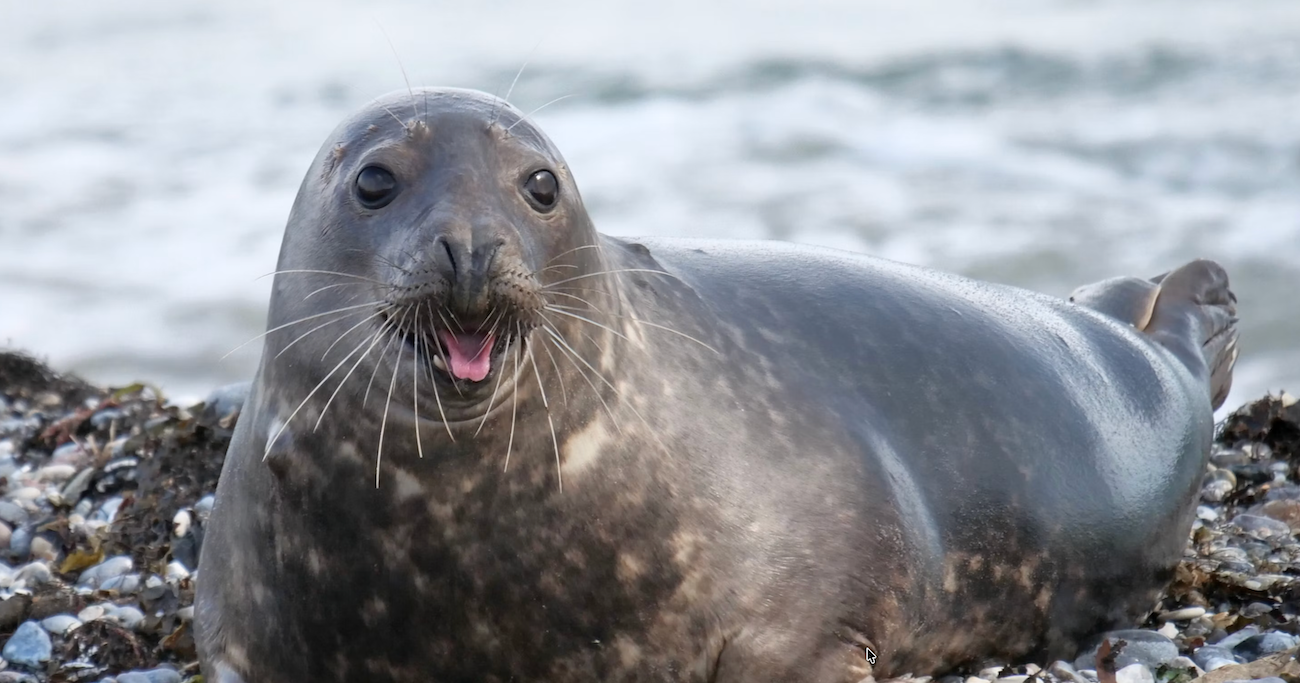
In 1971, a Maine fisherman named George Swallow discovered an orphaned harbor seal pup at Bethel Point. Swallow took him home, named him Hoover, and kept him alive.
During the critical early weeks of the seal’s development, Swallow hand-fed him with a bottle and spoke to him constantly. As Hoover grew too large to safely keep as a domestic pet, Swallow gave him to the New England Aquarium in Boston in 1976.
For years, Hoover behaved like a standard harbor seal. Then, five years after arriving at the aquarium, he did something pretty unprecedented: he began speaking English.
Acoustic experts who analyzed Hoover’s vocalizations confirmed his speech was remarkably human. He successfully modulated vowels and consonants to articulate phrases such as “Hello there,” “Come over here,” and “Get out of here.”
And not only did he mimick human speech, he also spoke with a thick, gravelly Maine accent, directly copying the exact voice of the fisherman who raised him.
Researchers wondered why he waited five years to start using his vocabulary. They determined that Hoover started talking when he sexually matured. He primarily used his English phrases during the breeding season to attract female seals, using the words like other male seals use their breeding calls.
Dr. Tecumseh Fitch, a specialist in language evolution at the University of Vienna, told IFL Science that the delay looks like how birds learn songs: “This time delay is reminiscent of bird song learning: young birds learn the song in the nest but don’t begin singing themselves until they mature.”
Hoover died in 1985, at age 14. He’s still the most studied case of vocal mimicry in a marine mammal.