Stephanie Brander had a ravine full of vines she was never going to beat on her own. So she hired sheep.
Brander, who lives in Northern Virginia, first saw the flock working a July 4 parade in Fairfax City and booked them for her yard. When the trailer arrived, she kept her kids home from school to watch. “It was two hours, and they got more done than I could have in a week,” she told NBC4 Washington. “That’s pretty awesome. And they were fun to watch.”
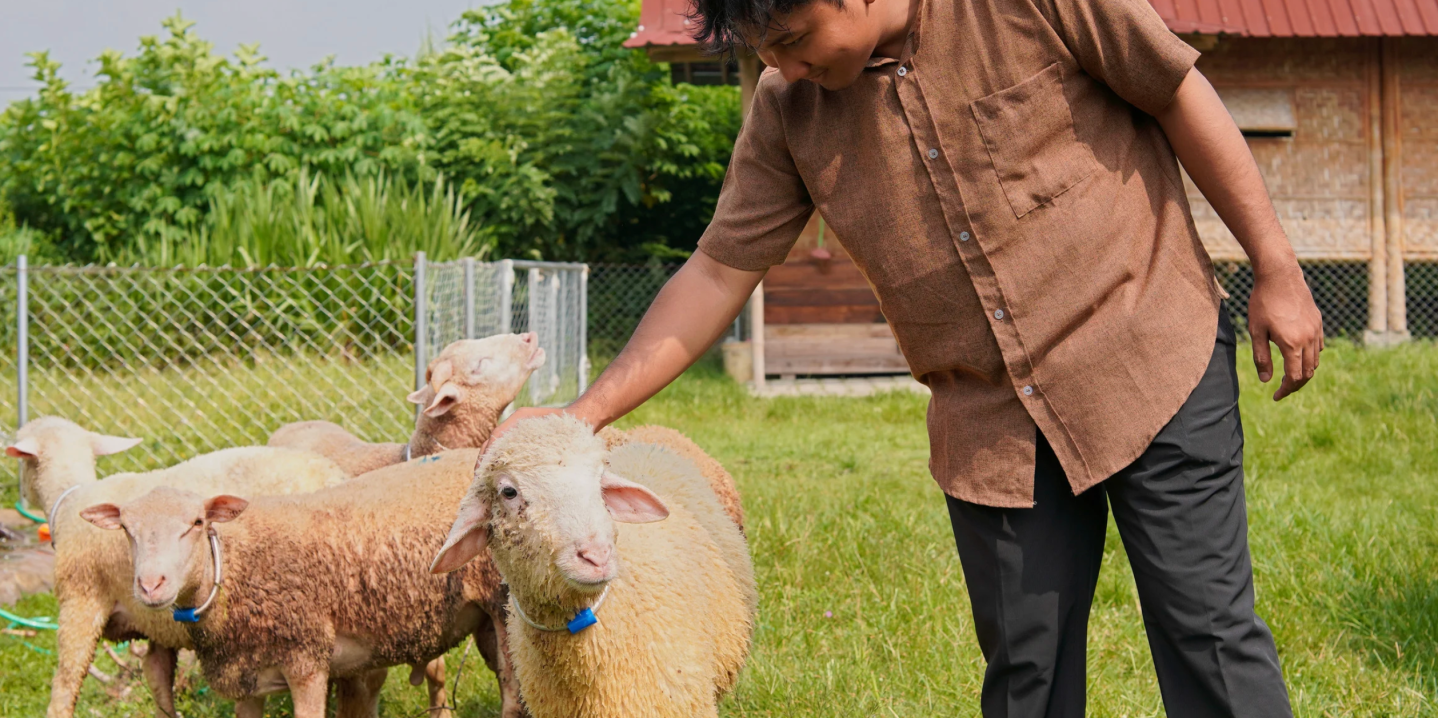
The sheep belong to Lamb Mowers, a licensed Fairfax County landscaping business run by Cory Suter, whose customers call him Shepherd Cory. The flock is made up of Babydoll Southdowns, an heirloom breed that tops out around knee height and looks, accurately, like a walking teddy bear. “These sheep are an heirloom breed that is people-friendly and easy to control,” Suter said. “So, for a suburban environment, they are ideal.”
The business started by accident. Suter brought his first three Babydolls up from Illinois in his wife’s Prius in 2016, a trip he says the car never fully recovered from, and put them to work clearing poison ivy, wisteria, and multiflora rose around his farm south of Fairfax. They were good enough at it that he started renting them out.
A two-hour session starts at $195 on weekdays, $295 on weekends, and brings anywhere from three to fifteen sheep. They eat what most homeowners pay chemicals to kill: poison ivy, kudzu, knotweed, Japanese honeysuckle, the stuff in the corners of the yard nobody wants to deal with. What comes out the other end is fertilizer, which Suter notes improves the soil’s water-holding capacity. Suter handles anything the sheep can’t reach.
There are conditions. He won’t bring the flock to a yard treated with pesticides in the past six months. He’d rather you didn’t mow first. And it helps if you actually have a weed problem, because the sheep are there to eat. If a sheep doesn’t want to get in the trailer, that’s the end of it. “I never force them to come,” he said.
The flock has names, assigned by Suter’s two young sons, which is how a working animal ends up being called Monster Truck. There’s also Elf, Sunny, and Clover. The matriarch is Cinnamon, seven years old and over 130 pounds. On properties larger than two acres, county rules let the sheep stay the night, a job Suter calls a sheepover.
They also do parties. Preschools, community groups, Girl Scout events, birthdays, jobs where the weeds are secondary to the fact that fifteen small sheep have arrived. “We bring joy everywhere we go,” Suter said. “Our sheep are just really friendly, sweet animals that like to say hi to people and are just kind of lower your blood pressure when you get to be near them.”
Margaret Bain, whose church in Vienna hired the flock to clear land, put the competitive advantage plainly. “We could have hired laborers,” she said, “but the sheep were more cute than anybody we could have brought.”