In March 2023, after months of preparation and paperwork, Anita Omary arrived in the United States from her native Afghanistan to build a better life. Once she arrived in Connecticut, however, the experience was anything but easy.
“When I first arrived, everything felt so strange—the weather, the environment, the people,” Omary recalled. Omary had not only left behind her extended family and friends in Afghanistan, she left her career managing child protective cases and supporting refugee communities behind as well. Even more challenging, Anita was five months pregnant at the time, and because her husband was unable to obtain a travel visa, she found herself having to navigate a new language, a different culture, and an unfamiliar country entirely on her own.
“I went through a period of deep disappointment and depression, where I wasn’t able to do much for myself,” Omary said.
Then something incredible happened: Omary met a woman who would become her close friend, offering support that would change her experience as a refugee—and ultimately the trajectory of her entire life.
Understanding the journey
Like Anita Omary, tens of thousands of people come to the United States each year seeking safety from war, political violence, religious persecution, and other threats. Yet escaping danger, unfortunately, is only the first challenge. Once here, immigrant and refugee families must deal with the loss of displacement, while at the same time facing language barriers, adapting to a new culture, and sometimes even facing social stigma and anti-immigrant biases.
Welcoming immigrant and refugee neighbors strengthens the nation and benefits everyone—and according to Anita Omary, small, simple acts of human kindness can make the greatest difference in helping them feel safe, valued, and truly at home.
A warm welcome
Dee and Omary's son, Osman
Anita Omary was receiving prenatal checkups at a woman’s health center in West Haven when she met Dee, a nurse.
“She immediately recognized that I was new, and that I was struggling,” Omary said. “From that moment on, she became my support system.”
Dee started checking in on Omary throughout her pregnancy, both inside the clinic and out.
“She would call me and ask am I okay, am I eating, am I healthy,” Omary said. “She helped me with things I didn’t even realize I needed, like getting an air conditioner for my small, hot room.”
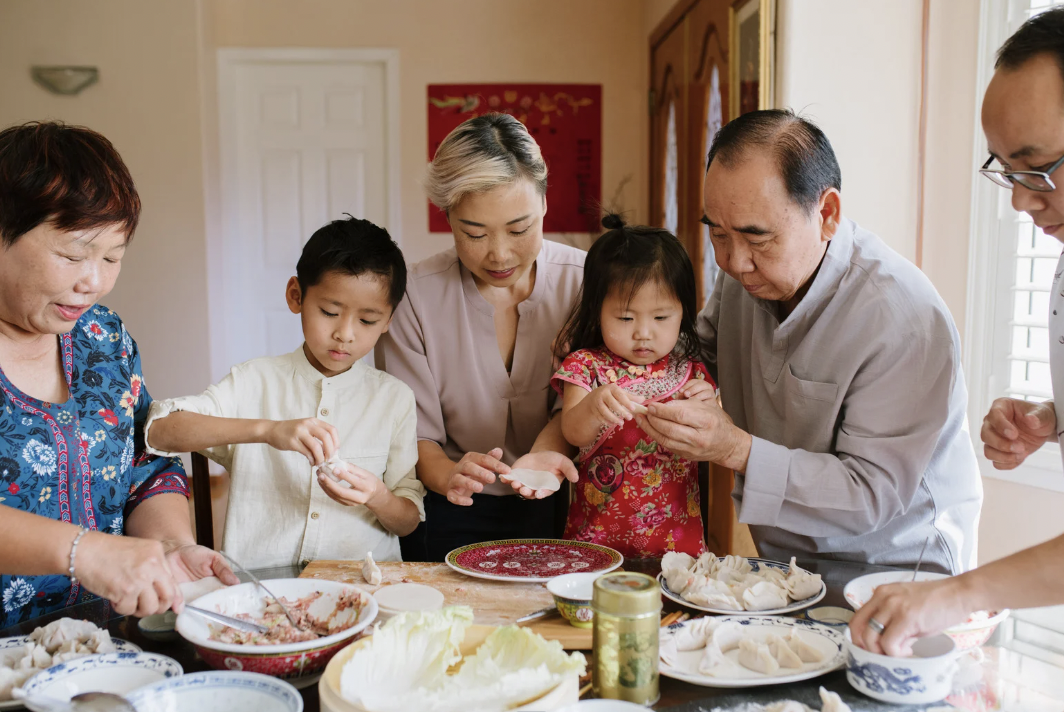
Soon, Dee was helping Omary apply for jobs and taking her on driving lessons every weekend. With her help, Omary landed a job, passed her road test on the first attempt, and even enrolled at the University of New Haven to pursue her master’s degree. Dee and Omary became like family. After Omary’s son, Osman, was born, Dee spent five days in the hospital at her side, bringing her halal food and brushing her hair in the same way Omary’s mother used to. When Omary’s postpartum pain became too great for her to lift Osman’s car seat, Dee accompanied her to his doctor’s appointments and carried the baby for her.
“Her support truly changed my life,” Omary said. “Her motivation, compassion, and support gave me hope. It gave me a sense of stability and confidence. I didn’t feel alone, because of her.”
More than that, the experience gave Omary a new resolve to help other people.
“That experience has deeply shaped the way I give back,” she said. “I want to be that source of encouragement and support for others that my friend was for me.”
Extending the welcome
Omary and Dee at the Martin Luther King, Jr. Vision Awards ceremony at the University of New Haven.
Omary is now flourishing. She currently works as a career development specialist as she continues her Master’s degree. She also, as a member of the Refugee Storytellers Collective, helps advocate for refugee and immigrant families by connecting them with resources—and teaches local communities how to best welcome newcomers.
“Welcoming new families today has many challenges,” Omary said. “One major barrier is access to English classes. Many newcomers, especially those who have just arrived, often put their names on long wait lists and for months there are no available spots.” For women with children, the lack of available childcare makes attending English classes, or working outside the home, especially difficult.
Omary stresses that sometimes small, everyday acts of kindness can make the biggest difference to immigrant and refugee families.
“Welcome is not about big gestures, but about small, consistent acts of care that remind you that you belong,” Omary said. Receiving a compliment on her dress or her son from a stranger in the grocery store was incredibly uplifting during her early days as a newcomer, and Omary remembers how even the smallest gestures of kindness gave her hope that she could thrive and build a new life here.
“I built my new life, but I didn’t do it alone,” Omary said. “Community and kindness were my greatest strengths.”
Are you in? Click here to join the Refugee Advocacy Lab and sign the #WeWillWelcome pledge and complete one small act of welcome in your community. Together, with small, meaningful steps, we can build communities where everyone feels safe.
This article is part of Upworthy’s “The Threads Between U.S.” series that highlights what we have in common thanks to the generous support from the Levi Strauss Foundation, whose grantmaking is committed to creating a culture of belonging.
This article dives into timeboxing, and why it’s such an effective technique—and why it remains underused by the general public. By the end, you will have the tools to incorporate timeboxing into your daily routine.
What is timeboxing?
It’s simple. Timeboxing is a time management technique in which you set a specific, fixed time limit for a single task. You then commit to focusing on it exclusively during that period. It’s like setting up a personal one-on-one with your to-do list. When the allocated time is up, you stop and move on to the next scheduled task. What if you’re not done? Too bad. You move on to the next task, regardless of whether the previous one is fully finished.
Think of it as setting healthy boundaries for yourself and your work. By enforcing this strict, self-imposed deadline, you naturally eliminate distractions and sharpen your focus. You channel all your energy into completing the task within that set timeframe. It turns a vague goal like “work on the report” into a specific action like “spend the next 45 minutes writing the introduction to the report.” Genius.
Why does it work?
The secret to timeboxing lies in its simplicity. By allocating a fixed period to a specific task, you avoid open-ended to-do lists. No vague goals to “get it done today.” You’re left with clear, defined work.
The origins of timeboxing date back to the mid-1900s. In November 1955, British naval historian Cyril Northcote Parkinson published a satirical essay in The Economist with a now-famous observation: “Work expands so as to fill the time available for its completion.” The illustration that accompanied it was a drawing of a woman focused on a single task—sending a postcard—who spent the entire day doing it.
Parkinson’s Law gives us a sharp, accurate insight into human behavior. Photo credit: Canva
This concept, known as Parkinson’s Law, is a sharp, accurate insight into human behavior. Give a task with no clear deadline, and it will expand to fill all available time.
This structured approach to time management soon became a core element of Agile software development methods like Scrum. Instead of letting projects drag on indefinitely, developers began using fixed-length “sprints”—in essence, timeboxes—to complete specific chunks of work. This shift brought predictability and focus to what was often a chaotic process.
While timeboxing originated in software engineering, its power wasn’t limited to coding. The practice has since been widely adopted for personal productivity, and it’s supported by fascinating science that explains why it works so well across so many tasks.
What the research says
A significant 2021 meta-analysis published in PLOS ONE examined 158 studies involving 53,957 participants to determine whether structured time management is effective. The results even caught the researchers off guard.
They found that time management increased life satisfaction by 72%, whereas job satisfaction rose by only 19%. Researchers also discovered that “time management may primarily enhance wellbeing rather than boost performance.” What does that mean? Essentially, the main advantage of managing your time well is not just higher productivity, but a more fulfilling and meaningful life.
The psychological reasoning behind timeboxing is even more important. Research by psychologist Roy Baumeister shows that decision-making is a limited resource that gets used up. Every moment you spend wondering “what should I work on next?” uses up the same mental energy you need for your most important work. Timeboxing removes those small, repetitive decisions completely. Your past self, during the planning stage, decides for you, so your current self can just focus on doing the work.
Then there’s the cost of distraction. Gloria Mark’s research at the University of California, Irvine, found that it takes an average of 23 minutes and 15 seconds to fully regain focus after being interrupted. Timeboxing creates protected windows where interruptions are explicitly blocked, preserving the deep focus that makes real progress possible.
How timeboxing flips the traditional approach
Most people organize their work—and life—around to-do lists. The issue with these lists, as Zao-Sanders points out in his HBR article, is that they lack a system for when tasks should be done or how long they should take. Tasks often remain on lists forever, growing and shrinking, getting delayed, mainly because there’s no sensible limit.
Timeboxing moves tasks from the list to your calendar. Each task is assigned a specific start time, an end time, and a clear goal. Your calendar becomes more than just a schedule: it offers a full view of how your time is really used. It becomes a record of what you’ve achieved and a tool for understanding how long things truly take.
This shift matters beyond just personal productivity. When your timeboxed calendar is visible to colleagues, it becomes a tool for coordination. Teams can plan around each other’s focus periods. Shared visibility decreases the constant flow of “quick questions” that disrupt the workday.
The people who already live by it
Some of the most demanding schedules in the world operate on timeboxing principles. Both Bill Gates and Elon Musk reportedly divide their days into five-minute blocks: a hyper-detailed version of the same core practice. Jack Dorsey, former CEO of Twitter and Square, used a broader approach called “day theming,” dedicating each day of the week entirely to a specific business function. Author Cal Newport has estimated that “a 40-hour time-blocked work week produces the same amount of output as a 60+ hour work week pursued without structure.”
These are not coincidences. Each of these approaches follows the same basic idea: when something has a place, attention goes there.
How to get started
You don’t need a sophisticated app or a complete calendar overhaul to start timeboxing. The core method has seven steps:
List your tasks. Write down everything that needs to be done—big projects, small administrative items, emails, and all of it.
Set clear goals for each task. Specify what “done” looks like. “Work on the report” is too vague. “Complete the executive summary section” gives you a clear target.
Estimate the time, then add a buffer. Most people consistently underestimate how long tasks take (psychologists call this the planning fallacy). Add a 25–50% buffer to your initial estimates.
Schedule blocks of time on your calendar. Assign particular start and end times to each task. Think of these blocks as scheduled meetings.
Work without interruptions. When a timebox starts, close unrelated tabs, mute notifications, and focus solely on the task at hand.
Stop when the time is up. This discipline keeps the system working. If a task isn’t finished, evaluate how many more timeboxes you’ll need and reschedule — don’t let it spill over into the next block.
Review and adjust. At day’s end, evaluate how your estimates aligned with reality. This data sharpens your future planning.
One practical tip: keep your blocks under 90 minutes. Research on cognitive rhythms shows that sustained, high-quality focus has a natural limit. For larger tasks, schedule multiple 60–90-minute sessions throughout the day or week instead of a single marathon session.
Start small, then build
The biggest mistake people make when adopting timeboxing is going all-in right away. Timeboxing your entire week from the start often feels overwhelming—and people give up before it proves useful. Begin with two or three timeboxed tasks each day. Allow yourself a couple of weeks to fine-tune your estimates and develop the habit of focused work before expanding the system.
The key to effective timeboxing is not overwhelming yourself. Photo credit: Canva
If you’re unsure where to start, try this: select your top three tasks for tomorrow, estimate how long each will take, add a buffer, and schedule them on your calendar tonight. That’s all. One week of this practice will reveal more about how you work than months of vague intentions.
The 2021 meta-analysis found that the effects of time management on well-being persisted even when performance improvements were small. That means even imperfect timeboxing—estimations that are off, occasional overruns, days that don’t go as planned—still make a difference in life satisfaction. The structure itself has value, regardless of whether you carry it out perfectly.
Your calendar awaits
Parkinson’s Law has been shaping your schedule for years, whether you realize it or not. Tasks grow, focus scatters, and days slip away between intention and action.
Timeboxing gives that time shape: a start, an end, and a purpose. The research clearly shows that the practice provides benefits beyond the office: reducing stress, increasing life satisfaction, and giving a sense of control over how your days unfold.
Your to-do list will always have more on it than any single day can hold. What timeboxing offers is a way to stop fighting that reality and start working with it, one focused, bounded block at a time.
By 1973, the Bee Gees’ career had hit a low. After a series of hits in the late 1960s and early 1970s, including “To Love Somebody,” “How Can You Mend a Broken Heart,” and “I Started a Joke,” the band was in a rut. Their latest album, Life in a Tin Can, and single “Saw a New Morning” sold poorly, and the band’s popularity declined.
On April 6, 1973, the Gibb brothers (Barry, Robin, and Maurice) appeared on The Midnight Special, a late-night TV show that aired on Saturday mornings at 1 a.m. after The Tonight Show with Johnny Carson. Given the lukewarm reception to their recent releases, the Bee Gees decided to change things up and play a medley of hits from their idols, The Beatles, who had broken up three years before.
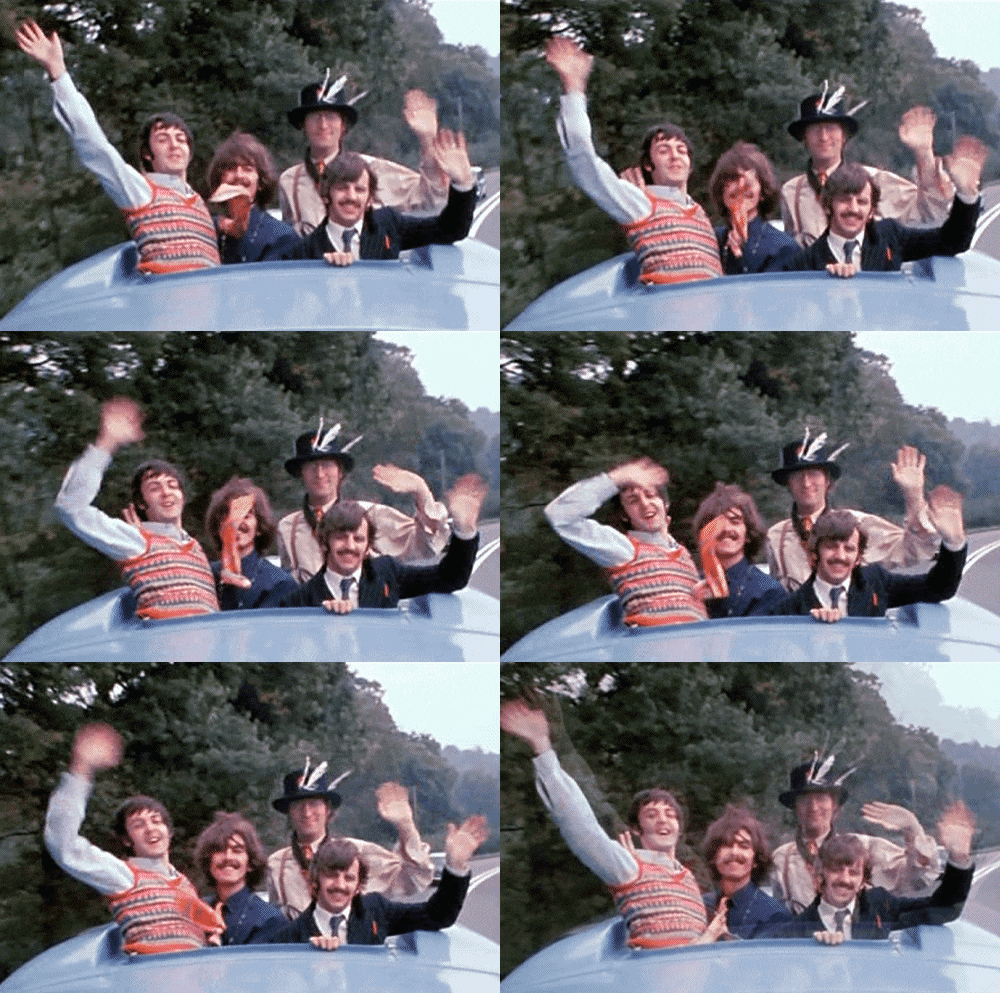
The Beatles were the biggest band on Earth in their heyday. Giphy
The performance, which featured five of the Fab Four’s early hits, including “If I Fell,” “I Need You,” “I’ll Be Back,” “This Boy,” and “She Loves You,” was a stripped-down, acoustic performance that highlighted the Bee Gees’ trademark harmonies.
“When you got brothers singing, it’s like an instrument that no one else can buy. You can’t go buy that sound in a shop. You can’t sing like The Bee Gees because when you got family members singing together, it’s unique,” Noel Gallagher, who sang with his brother Liam in Oasis, said according to Far Out.
A year later, the Bee Gees performed in small clubs, and it looked like their career had hit a dead end. Then, at the urging of their management, the band began to move in a new direction, incorporating soul, rhythm and blues, and a new, underground musical style called disco into their repertoire. Barry also adopted a falsetto singing style popularized by Black singers such as Curtis Mayfield and Marvin Gaye.
This unlikely change for the folksy vocal group catapulted them into the stratosphere and they became the white-satin-clad kings of disco.
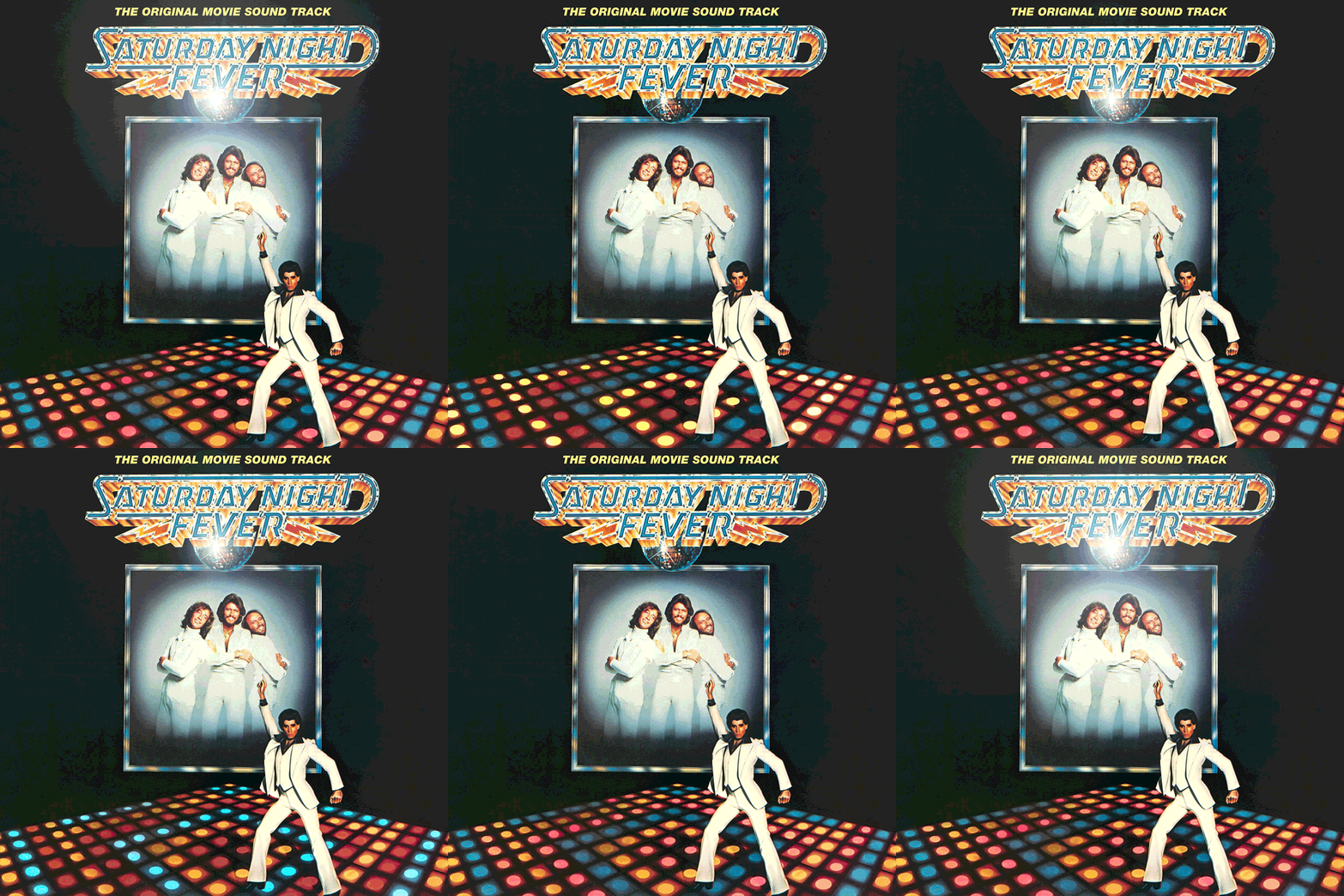
In the late ‘70s, the band had massive hits, including songs featured on the 40-million-selling Saturday Night Fever soundtrack: “Stayin’ Alive,” How Deep is Your Love,” More Than a Woman,” Jive Talkin’,” and “Night Fever.”
In 1978, the band made a significant misstep, starring in a musical based on The Beatles’ music called Sgt. Pepper’s Lonely Hearts Club Band, produced by Robert Stigwood, the man behind Saturday Night Fever and Grease. The film was a colossal bomb, although the soundtrack sold well.
The Beatles’ George Harrison thought the Bee Gees film was about what happens when you become successful and greedy.
“I just feel sorry for Robert Stigwood, the Bee Gees, and Pete Frampton for doing it because they had established themselves in their own right as decent artists,” Harrison said. “And suddenly… it’s like the classic thing of greed. The more you make the more you want to make, until you become so greedy that ultimately you put a foot wrong.”
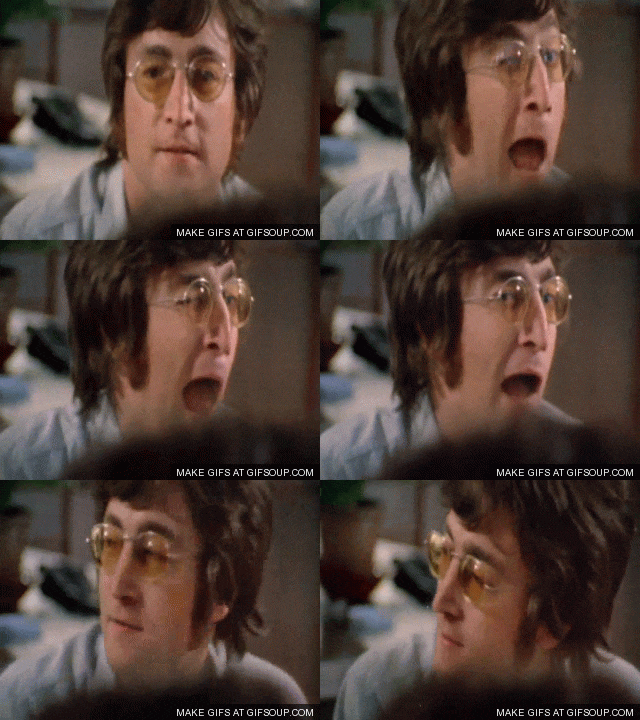
Even though the Bee Gees’ Beatle-themed musical was a flop, former Beatle John Lennon remained a fan of the group. He sang their praises after the public’s growing distaste of disco resulted in a significant backlash.
“Try to tell the kids in the seventies who were screaming to the Bee Gees that their music was just the Beatles redone,” he told Playboy magazine in 1980. “There is nothing wrong with the Bee Gees. They do a damn good job. There was nothing else going on then.”
The Bee Gees historic career ended when Maurice passed away in 2003 at 53. Robin would follow in 2009 at 62. Barry is the final surviving member of the band.
There’s a popular trend where parents often share they are creating “core memories” for their children on social media posts, whether it’s planning an elaborate vacation or creating an extra-special holiday moment. While it’s important for parents to want their kids to have happy childhoods, sometimes it feels presumptuous when they believe they can manufacture a core memory. Especially when a child’s inner world is so different than an adult’s.
The concept of “core memories” was made mainstream in 2015 thanks to Disney’s Inside Out. In it, “core memories” are born from moments and experiences that majorly shape a part of the main character, Riley’s, personality. The experience(s) can be grand or benign; the point is these moments are ultimately forming Riley into the person she is. Seems pretty hard to manufacture such a moment, but parents are certainly trying.
Carol Kim, a mother of three and licensed Marriage and family Therapist, known as Parenting.Resilience on Instagram, recently shared the “5 Things Kids Will Remember from Their Childhood” on her page. The fascinating insight is that none of the entries had to do with extravagant vacations, over-the-top birthday parties, or Christmas gifts that kids could only dream about.
According to Kim, the five things that kids will remember all revolve around their parents’ presence and support. “Notice how creating good memories doesn’t require expensive toys or lavish family trips. Your presence is the most valuable present you can give to your child,” Kim wrote in the post’s caption.
“Taking some time to focus only on your child is very special. Playing games, reading books, or just talking can create strong, happy memories. These moments show your child that you are present with them.”
2. Words of encouragement
“Encouraging words can greatly impact your child during both good times and tough times. Kids often seek approval from their parents and your positive words can be a strong motivator and source of comfort…. It can help kids believe in themselves, giving them the confidence to take on new challenges and keep going when things get tough.”
3. Family traditions
“It creates a feeling of stability and togetherness … Family traditions make children feel like they belong and are part of a larger story, deepening their sense of security and understanding of family identity and values.”
“Seeing and doing kind things leaves a strong impression on children. It shows them the importance of being kind and caring. They remember how good it feels to help others and to see their parents helping too.”
5. Comfort during tough times
“Knowing they can rely on you during tough times makes them feel secure and build trust. … Comforting them when they’re struggling shows them they are loved no matter what, helping them feel emotionally secure and strong.”
Kim’s strategies are all beautiful ways to be present in our children’s lives and to communicate our support. However, these seemingly simple behaviors can be challenging for some parents who are dealing with issues stemming from their pasts.
“If you find barriers to providing these things, it’s important to reflect on why,” Kim writes in the post. “There could be several reasons, such as parenting in isolation (we’re not meant to parent alone), feeling overstimulated, dealing with past trauma, or struggling with mental health. Recognizing these challenges is the first step to addressing them and finding support.”
Alright, that’s it. We’ve finally had enough in this country. In a move that’s long overdue, we’re finally cracking down on… *checks notes*…basic human kindness?
The orders have come straight from the top. Being nice to people who are different than you is now bad. Creating environments that are welcoming and inclusive of everyone? Also bad. What’s most disturbing is just how far these mandates are trickling down—all the way into our schools.
A 6th grade teacher in Idaho was recently told by school administrators to remove a controversial sign from her classroom. She refused.
An angry elementary school teacher sits in class Canva
Earlier this spring, world civilization teacher Sarah Inama at Lewis and Clark Middle School was told that one of the posters in her class was inappropriate. The school asked her to remove it.
Initially, she complied, but upon reflection and discussion with her husband, decided that it didn’t feel right. She needed to take a stand. So Inama put the poster back up and left it visible for all to see, even after administrators warned her she could lose her job over the noncompliance.
Finally, among growing outcry and threats of termination, Inama decided to resign rather than remove the poster. She bravely decided to stick up for her controversial beliefs, even though she knew her personal opinion may not be popular.
Just wait until you see the outrageous sign. Here it is:
Seriously, that’s it. The sign reads “Everyone Is Welcome Here” and shows hands of different colors. This is the poster that was deemed not appropriate for the public school environment.
The district’s chief academic officer Marcus Myers clarified that, “The political environment ebbs and flows, and what might be controversial now might not have been controversial three, six, nine months ago.”
Inama’s sign was said to have violated the school’s “content neutral” policy, which prohibits any speech or messaging that might reflect personal opinions, religious beliefs, or political ideologies.
What’s hard to believe is that a sign meant to show kids that they are welcome in Inama’s classroom somehow reflects a “personal belief” that the school won’t tolerate. The sign made no mention of religion or LGBTQ+ identities or political ideologies; and it was still deemed too woke. That’s extremely frightening.
Inama received an outpouring of support from the community, but it wasn’t enough to change the district’s mind. After her resignation, she didn’t hold back, sharing her resignation letter with local news.
“This will be my last year teaching in the West Ada School District, and it saddens me to leave under these circumstances,” Inama’s letter begins.
“I cannot align myself nor be complicit with the exclusionary views and decisions of the administration. It is deeply troubling that the people running this district and school have allowed a welcoming and inclusive message for my students to be considered controversial, political, and, worst of all, an opinion.”
“I hope for the sake of the students in your district that you can remember the core values of public education,” she concludes. “To serve all citizens, foster an inclusive and safe learning environment, and protect your staff and students from discriminatory behavior.”
And now, the education system has lost a talented and passionate teacher because of it. But at least Inama hasn’t gone quietly, and with millions of outraged supporters all over the country and now world, we probably haven’t heard the last of this case.
This article originally appeared last year. It has been updated.
Some people are just naturally good at reading others. They pick up on subtle cues, body language, tone of voice, and facial expressions that go over other people’s heads. They are adept at seeing past other people’s words and cuing into the energy or emotions behind them.
People who are great at reading others have a significant advantage in being creative, building relationships, and building teams. But where does it come from? Why does it seem like some people have an extra social muscle that others just don’t?
Some posit that people who are adept at reading others often come from backgrounds where they grew up with chaotic parents or family members. To preserve themselves, they become keen observers of subtle clues to protect themselves against abusive outbursts.
This makes them excellent students of tone of voice, body language, and emotional states so that they can defend themselves.
To those who aren’t brilliant at reading others, these people’s skills seem mysterious at best. So, a Reddit user posed a question to the AskReddit forum to see what other people have noticed about people who are great at reading others. “What’s a sign that someone is dangerously good at reading people?” they asked. They received over 1,300 replies, and we compiled the best.
Here are 13 signs that someone is “dangerously good” at reading people.
1. You immediately overshare
“You feel comfortable talking to them and you find yourself sharing things with them you don’t typically share.”
2. They’re hard to read
“They themselves are typically hard to read.”
“Or better yet people think they are reading you and know you but all they know is what you want them to think they know.”
“Observe the person. It helps if you’re naturally empathetic. You can tell when they’re being sincere or when there’s motivation. You can hear it in their voice when they’re nervous, jealous, or uncomfortable. You can see it in their face. You can feel when their energy pauses, dips, or spikes. The key is to be neutral yourself. If you’re not invested in the outcome of the interaction at all, you can read others better.”
“My mom is the one who tipped me off to this. She said it was the key to learning about our lives when we were preteens and teens. She said she was careful not to ever react in big ways to anything we said, especially if it was negative, because if she did we would be more likely to stop providing info. If she acted neutral, we’d keep talking.”
4. They had unpredictable parents
“Some people who grew up with unpredictable parents become hyper-observant of micro-expressions. When coupled with empathy and a good memory, they can ask good questions at the right time, or pick up on unspoken emotions (or intentions/danger). This can be a blessing and a curse.”
“This is exactly how I got good at reading people. If I found myself unable to predict what my father was going to do next, there’s a good chance bad things happen to me. It’s born out of necessity.”
5. They know you before you open your mouth
“They clock your mood or thoughts before you’ve even said anything. They would ask really specific questions. Not nosy, just oddly on point. Also, watch how fast they adjust. You’re all fired up, and they’re calm and grounding.”
6. They’re accurate
“When they say something about you that you’ve never told anyone, but it’s scarily accurate… like ?? How do you know that, that’s when you know they’re built different.”
“People who are highly intuitive, very observant and understands people dynamics usually at the expense of knowing themselves well at times.”
“OH MY GOD. This. This this this. This is exactly my wife who is by far the best people person I’ve ever seen…and she’s terrible at understanding herself or solving her own problems.”
8. They understand receptivity
“Children and animals like and trust them. They are constantly aware of the receptivity levels of others.”
“When they ask lots of questions to people, especially when they’re based off observations.
You usually don’t ___ and i see now you’re ___, is everything alright?
Since you’ve been dating your partner, I’ve noticed _____. What’s up?
I’ve noticed when you feel like ____ you usually do _____, and you’ve been doing ____ lots recently, how come?
NEVER in a way which sounds or is judgemental, is always evidence based, and as a result people are often willing to open up and elaborate more without fear of being judged. My friends do this and I try so hard to learn from them.”
10. They don’t show it
“One of the biggest signs that someone is exceptionally skilled at reading people is that they don’t show it. People who are truly skilled observers mask their awareness and let others underestimate them while they quietly collect insight. They downplay their intuition and pretend to guess poorly. Also, they ask or say things that are psychologically strategic.”
11. You don’t know them, but they know you
“You feel super close to them, very comfortable sharing anything with them and consider them a close friend. In retrospect, you realize you know next to nothing about them beyond the surface.”
12. They can make friends with anyone
“I had a friend who was insanely good at reading people. He once told me ‘if I want you to be my friend, you will.’ I believed it too. He could be friends with anyone.”
“That’s kinda creepy ngl, smacks of the Machiavellian type more than the empathetic type.”
It’s getting harder to distinguish adult drinks from kids’ drinks these days. In recent years, adult beverage makers have created new versions of traditionally “soft“ drinks and made them “hard,” whether it’s seltzer, kombucha, soda, lemonade, or juice boxes. So, it’s easy to be fooled when reaching into the back of the fridge for a kids’ drink and finding a Cutwater 11% ABV Lemon Drop Martini instead.
Recently, the South Fulton Police Department in Georgia shared a post about a Cutwater Lemon Drop Martini can in a lunch box. For the uninitiated, Cutwater drinks have double, and sometimes triple, the alcohol content of the average can of beer. With sweet flavors like Tiki Rum Mai Tai, Strawberry Margarita, and Rum Mojito, some mistake them for kids’ drinks.
To call attention to the problem, the South Fulton Police Department posted a pretty hilarious warning on Facebook, urging parents to watch what their kids bring to school:
“Say Twin…
Before you send them babies off to school… CHECK. THE. LUNCHBOX.
That is NOT Capri Sun. That is NOT Apple Juice. That is a whole ‘Parent had a long night’ starter pack.
Now little Johnny done pulled up to 3rd period talking about: ‘Who want fruit snacks?’ knowing good and well he got a Lemon Drop Martini in the zipper pocket.
TIGHTEN UP TWIN!
We know mornings can be hectic… But your child shouldn’t be the only one in the cafeteria with a beverage that requires an ID.
If it says 12% ABV… it does NOT belong next to a PB&J.
Check the lunchbox before the school resource officers gotta do inventory at recess.”
‘Say Twin’ has become a local catchphrase
The department’s use of “Say Twin” in its messaging has been a hit with locals. “‘Hey twin!’ It’s a term of endearment that’s here that has just taken off, especially in Atlanta,” South Fulton Mayor Carmalitha Gumbs told Atlanta News First. “It’s bringing light to real issues that we’re facing in our community. We’re meeting residents where they are, so they can actually get it.”
Coming Soon! Cutwater Lemon Drop Martini 🍋 🍸🤩
A perfect balance of their award winning vodka, tart lemon juice and a splash of sweetness ✨ pic.twitter.com/DcC60GLWMP
After the story went viral, media outlets began poking around and asking South Fulton schools about the incident to find out where it happened. However, it didn’t. After the initial post, the South Fulton Police Department admitted the story wasn’t true.
It posted a clarification in the comments:
“Important: This did NOT happen in the City of South Fulton or in Fulton County Schools.
We’re sharing this because media outlets have started contacting local schools asking where it happened, and we don’t want any confusion in our community.
The real takeaway here is awareness. Across the country, there’s growing concern about alcoholic drinks being packaged to look like non-alcoholic ones and even being placed near them in stores, which can lead to honest mix-ups.
Friendly reminder to:
Double-check lunchboxes and backpacks
Keep alcohol stored safely and out of reach
Talk with kids about only drinking what a trusted adult gives them
We appreciate y’all helping us spread awareness and keep our community safe “
Was the update a clever backtrack after getting caught creating a fake story? Or was the original post a playful way to educate parents about a real problem the department never expected to be taken seriously? That’s for the people of South Fulton to decide.
The post inspired some hilarious comments
Even though the story was later proven false, the comments on the post are still pretty hilarious.
“Idk about y’all, but those 12% ABV be hitting pretty hard with that Smuckers Uncrustable on a hot summer’s day on the lake,” one person wrote.
“That kid was trying to get a little turnt at school today,” another added.
Some folks in the comments thought the drink may have been for the kid’s teacher. One joked, “… it was really sent for the teacher as a peace offering.”
Kids mistaking adult beverages for soft drinks is a real problem
A teacher in the San Antonio, Texas, area made a big mistake last summer, proving South Fulton’s warning wasn’t entirely unwarranted. The educator accidentally handed out Hard Mountain Dew drinks to students on the last day of seventh grade. One child went to the hospital after ingesting a Hard Mountain Dew Baja Blast Pineapple. The student drank nearly half a can and felt disoriented while at school.
“He says it tasted a little different,” Aaron Corso, the boy’s father, shared with KENS 5 News. “But he didn’t think too much of it. Because he doesn’t drink too much soda. He hardly drinks soda at all.”
This story from Texas and the warning out of Georgia are reminders to parents everywhere to be mindful of where they store alcoholic beverages, especially those that resemble soft drinks.
Sometimes, it feels like everyone we cross paths with is in their own little world—always in a hurry, always glued to a device. It can feel almost impossible to strike up a conversation with a stranger, even if you have no ulterior motive (like flirting).
Conversational anxiety, or, more broadly, social anxiety, affects about 12-14% of adults and is far more common among young people. These disorders often involve negative thought patterns like “I’m bad at meeting people” or “People dislike chatting with me.” Those thoughts undoubtedly make it harder.
But even people without social anxiety may want to talk to strangers. They simply do not have a good strategy for doing so.
Dating coach Adele Bloch recently took to social media to share a tried-and-true blueprint for striking up harmless, low-stakes conversations with strangers. The key is choosing the where and the how.
Bloch helps her clients find love and relationships, but she also takes on the challenge of helping people connect platonically in a disconnected world. In a recent post on X, she lays out her roadmap for “the art of talking to strangers in public.”
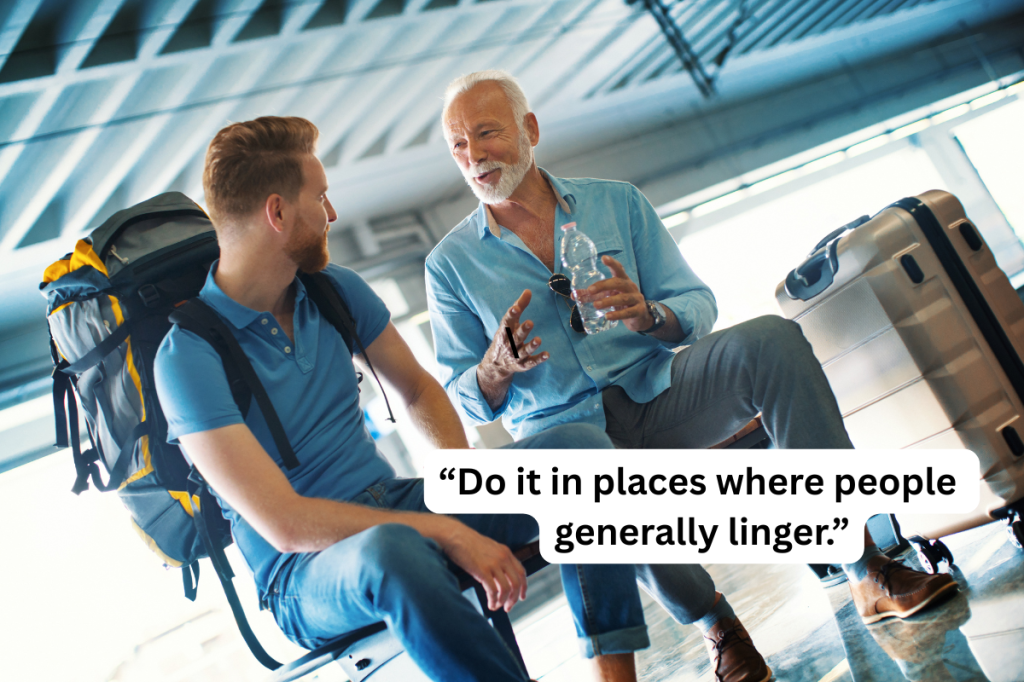
For starters, Bloch explains, the where is critical. People usually aren’t in a chatting mood when they’re engaged in a task or on their way somewhere. That’s why talking to people at the gym can be tricky; you risk coming off as rude by interrupting someone in the middle of something.
“Do it in places where people generally linger,” she suggests. Places like standing in line at a coffee shop or after a group workout class, when people take a few minutes to gather their things before leaving.
The next piece is the tough one: what to say.
“My favorite intro lines are almost as though you’re letting them into your inner monologue,” she writes. Nothing too clever or scripted, less a conversation starter and more like thinking out loud in their general direction. She suggests asking them to help you make a decision on the menu, or even just making a casual observation. A non-physical compliment can work, too.
From there, you’re off and running, she says. In the full post, however, Bloch offers a few more tips on what to do next.
the art of talking to strangers in public:
– do it in places where people generally linger. this can be in line, at coffee shops, after a yoga class, etc. there needs to be an element of slowness so you can easily strike up a convo – wouldn't recommend starting with 'hi' – that… https://t.co/uxywglz46W
The post received over half a million views on X and thousands of likes and comments. Bloch had clearly struck a nerve around a common problem many people share.
Commenters had a lot of thoughts about what impromptu conversations with strangers have meant to them:
“The stakes are so low but the potential for spontaneous great conversation is so high! can’t think of many situations where i regretted taking the initiative”
“I started doing this, significantly helped me get out of my social isolation. Moved to a city and knew nobody Now I have events and hangouts to go to!!”
“Small spontaneous conversations are underrated because they slowly rebuild a sense of community we didn’t even realize we were missing”
Research is clear on the benefits of pleasant human interactions. Yes, even for introverts.
“A growing body of research has found that talking with strangers can contribute to our well-being,” writes Gillian Sandstrom, a senior lecturer in the psychology of kindness at the University of Sussex.
Sandstrom references a study carried out on commuters in Chicago who were asked to talk to someone on their regular train ride. Overwhelmingly, participants who chatted with a stranger were in a better mood afterward. These small micro-connections make us happier and help us feel less alone. We also learn new things about the world by talking to unexpected people.
However, many people are naturally resistant to talking to folks they don’t know. Those same Chicago commuters, before the experiment, predicted they’d feel uncomfortable striking up conversations and would prefer to sit in silence.
Sandstrom writes that these barriers are driven by fear:
“There are endless things to worry about: What if I don’t like my conversation partner? More importantly, what if they don’t like me, or what if I’m bothering them? What if we run out of things to say? What if I want to end the conversation, but can’t figure out how to?”
Maybe not all, but most of these fears end up being unfounded. That’s the true beauty of Bloch’s viral post.
“You’ll start to realize that people are EXCITED to talk to you! Strangers aren’t as scary as they seem!” she writes. “And you’ll start living a life thats more open and fun!”
You’re having a great week. No mishaps, no drama, no unexpected bills. “I’m on top of the world!” you shout out loud. Then, suddenly, your hand shoots out to the nearest wooden surface. Your knuckles rap on it a few times, and you didn’t even think about it. What was that?
Sixty percent of Americans “knock on wood,” according to a 2015 60 Minutes/Vanity Fair poll. Most do it almost automatically. But where does the habit come from?
It’s compulsory. Many don’t think before they knock on wood. Photo credit: Canva
It seems like everyone has a different answer. Ask a group of people, and you’ll get a mix of shrugs, half-remembered myths, and a few confident answers based on a big pile of nothing.
The honest truth: nobody knows for sure. What we do have, however, are a few compelling theories, a paper trail leading back to the 19th century, and fascinating science that explains why we keep doing it—even when we don’t believe in it.
“Knock on wood” or “Touch wood?” Depends on where you live
In the United States, we knock. In the United Kingdom, they touch. Both phrases describe rapping knuckles on wood after saying something hopeful—and they mean the same thing: don’t tempt fate.
Ever heard someone in Britain say “Touch wood!” after hoping for good luck? It’s the UK equivalent of “knock on wood” in other countries. People say it (and sometimes literally touch a wooden object) to avoid jinxing something they want to happen. For example: “The weather’s been perfect all week, touch wood it stays like this for the weekend.” “I’ve never had a speeding ticket, touch wood.” It’s one of those little British superstitions you’ll hear everywhere, from pubs to workplaces. #Johnsenglishpage#learnenglish#learnenglishwithus#englishtutor#englishlessons#englishtips#naturalenglish#englishlanguage#englishlearning#studiareinglese
What do all these diverse customs have in common, and what do they reveal about human nature?
The ancient tree spirit theory (and why scholars don’t like it)
The most romantic explanation traces the phrase “knock on wood” back to pre-Christian pagan traditions. This theory suggests that ancient Celtic and Indo-European cultures believed trees were inhabited by spirits or minor gods, especially oak, ash, and hazel. Knocking on a tree trunk could awaken those spirits to ask for protection, show gratitude for good luck, or drive away malevolent forces lurking in the woods.
It’s a beautiful story. Sacred groves existed across ancient Europe, serving as meeting places between people and the divine. The Druids worshipped the oak. The Scandinavians based their entire cosmology on the ash tree, Yggdrasil. The Germanic Norns—three fate-weaving goddesses—directed destiny through the World Tree itself.
But there’s a problem. As folklorists Jacqueline Simpson and Steve Roud note in A Dictionary of English Folklore, there’s no direct evidence linking these ancient traditions to the modern “knock on wood” superstition. More than a thousand years passed between Europe’s Christianization and the first recorded mention of touching wood. This long interval suggests the practice wasn’t passed down continuously.
🌿 D R Y A D S 🌿 We have all knocked on wood to ward off bad luck, or to prevent something we said from becoming true. But where does this superstition come from? Well the most widely accepted explanation dates back to ancient pagan cultures such as the Celts, who believed that tree spirits known as Dryads resided in trees. A Dryad is a tree spirit, an elf-like tree entity whose life force was connected to the tree. The Celtic people revered trees, and saw them as powerful living beings who played a large role in Celtic culture. Each tree has its own magic, wisdom and sacred meaning. ✨ It was thought that knocking on wood was a way to rouse the tree spirit and ask it for protection, to ward off bad luck, or to show gratitude for good luck. Druids, witches and wise women carried small carved pieces of certain trees around with them which are said to host a resident Dryad, creating a moveable protection token. These would have been in the shapes of wands or staffs. Ordinary folk also would have also carried these, however they might not have been carved for the same ritualistic purpose, but for straightforward protection. 🌿 To create your own talisman you must first go to a sacred space such as an old grove, leyline, sacred spring or site, and find a tree just as the setting or rising sun strikes light upon its trunk. 🌿 From there connect with the tree, ask it for its protection and inform the Dryad of your intentions, as arrogantly cutting off a branch without first asking will anger the spirit. 🌿 From there you can transform your piece of Livewood into a wand, staff, or Ogham stave. You can add pieces on to it such as precious gems, stones, feathers, leather etc. If you have followed the ritual correctly you will end up with a powerful protection token which can be used in meditations, divinations and rituals. . . . . #Dryads#treespirits#treewisdom#treelore#celticfolklore#celtictraditions#celticotherworld#celticgods#celticgoddesses#celticmythology#paganism#paganculture#paganworship#natureworship#pagantraditions#naturegods#naturegoddess#sacredspace#sacredearth#sacredplace
The earliest known written reference to “touch wood” as a superstitious practice appears in Ballads in the Cumberland Dialect, published in 1805 by R. Anderson. Folklorists connect it to a game called “Tiggy Touchwood,” a form of tag in which players were safe from being caught as long as they touched something wooden, such as a door, a fence, or a tree. Touching wood meant you were protected.
“Given that the game was concerned with ‘protection,’ and was well known to adults and children, it is almost certainly the origin of our superstitious practice of saying, ‘touch wood.’ The claim that it goes back to tree spirits is complete nonsense.”
Religious and historical theories
Although the game theory has the strongest evidence, it’s worth knowing the other stories in circulation.
Could the reason why we “knock on wood” come from religious backgrounds? Photo credit: Canva
The Christian Cross Theory suggests that knocking on wood invokes the protective power of Christ’s crucifixion. While religious relics like the True Cross were cherished for their supposed protective powers, this theory mainly explains how the custom may have been reinterpreted through a Christian lens rather than its original genesis. Scholars point to the lack of medieval records linking this idea to superstition, suggesting it is likely a later adaptation tied to seeking divine protection.
The Jewish Persecution Theory, another proposed origin, links wood-knocking to coded signals allegedly used by Jewish communities to signal safe passage during the Spanish Inquisition. While this theory points to another possible protective motivation for the ritual, it’s difficult to verify and appears less frequently in academic literature. Its inclusion illustrates the wide range of narratives people have constructed to make sense of the custom.
The Miners and Sailors Theory points to a more practical foundation: knocking on wooden beams to test their stability, which by extension may have led to a superstition about safety. Similarly, sailors knocked on deck wood for good fortune at sea. Together, these theories suggest how everyday safety rituals could evolve into superstition—even when direct documentation is limited.
Why our brains keep doing it anyway
This is where the science gets truly fascinating. Even people who recognize the habit as irrational still engage in it. And there’s a solid reason why—one that has nothing to do with tree spirits or sacred crosses.
Jane Risen, a behavioral science professor at the University of Chicago, has spent years exploring this very contradiction. In a 2016 article in Psychological Review, she found that individuals can recognize a belief as irrational in real time yet still choose not to challenge it—a phenomenon she terms “acquiescence.” As she explained:
“We see people maintaining these beliefs that they themselves acknowledge are irrational. They’ll say, ‘I know it’s crazy, but I’m going to do this.’ We have [these beliefs] because they’re the output of pretty basic cognitive processes.”
Two systems drive human thinking. The fast, intuitive one makes judgments before the slower, more deliberate system can catch up. As Risen explained, “Detecting an error in your intuitive belief doesn’t necessarily lead you to correcting it. It seems that some intuitions are just very difficult to shake.”
But that’s not all. Researchers at the University of Chicago Booth School of Business published a 2013 study in the Journal of Experimental Psychology finding that the physical motion of knocking on wood is just as important as the saying itself.
There are psychological aspects to why we knock on wood. Photo credit: Canva
Here’s what the study found: participants who knocked downward—pushing force away from themselves—felt a bad outcome was less likely than those who knocked upward or simply held an object. The study suggests this outward physical motion creates a feeling of pushing bad luck away. Rituals like spitting or throwing salt may work the same way.
There’s an emotional payoff, too. “These beliefs and behaviors actually do end up regulating your emotions,” Risen told Discover magazine. “When you knock on wood, you may worry about this less.”
Jacqueline Woolley, a psychologist at the University of Texas at Austin, found that superstitious beliefs are most prevalent around ages five and six, before skepticism begins to develop. Meanwhile, Nadia Brashier, a researcher at Harvard University, observed that adults around age 70 tend to be less superstitious than those around age 19, as accumulated life experience typically reshapes the brain’s understanding of cause and effect.
The meaning behind the knock
Here’s what the research and folklore actually agree on: the phrase “knock on wood” is almost certainly not thousands of years old. Its documented history dates back to the 19th century, likely rooted in a children’s game of tag. The pagan, Christian, and persecution theories make for interesting stories, but none have the same weight of supporting evidence.
What holds up the tradition is psychology. Whether the gesture started with a game of Tiggy Touchwood, a fragment of the True Cross, or a coded knock on a synagogue door, it endures today because of how the human brain functions. We’re wired to seek some control over what we cannot control. A small physical act—touching something solid, directing force away from the body—provides that sense of comfort, even if only for a moment.
The next time your hand reaches for the nearest table after saying something hopeful, you don’t need to feel embarrassed. You’re doing something humans have practiced across cultures for at least two centuries, probably longer. Call it a habit, call it superstition, call it a small act of hope. Whatever you call it, the impulse remains the same: to hold on, just for a moment, to the good things in front of you.



















 CHECK. THE. LUNCHBOX.

 “
“