upworthy
Add Upworthy to your Google News feed.
Google News Button
Joy

People over 30 are sharing their biggest regrets so we can all learn from them

Here are 13 of the most powerful responses.

regrets, regrets over 30, people pleaser

A woman realizes that she has some pretty big regrets in life.

After the age of 30, people begin to judge the decisions they’ve made in the past based on their newfound perspective on life. This is a time when many of us pause and take stock of where we are versus where we imagined we'd be. As careers, relationships and personal aspirations begin to unfold, so do the realizations of things we may have done wrong. But it's also time for a type of self-reflection that can empower us to make more informed decisions in the future.

There probably isn’t one person alive over the age of 30 who doesn’t have at least one major regret. The key is to use that regret to your advantage by learning from it and not making the same mistake twice.

Regrets can also be helpful to others as a warning of some of the pitfalls in life to avoid.


A Redditor who goes by noThefakedevesh recently posed a question to the AskReddit subforum: “People above 30, what's your biggest regret in life?” The question was a great excuse for people to share their regrets and how they overcame the mistakes they made in the past. The list of regrets is also a wonderful way for younger people to avoid things that will give them regrets later in life.

One of the most powerful themes repeated in the post was people’s regret for caring too much about other people’s opinions and trying to be people-pleasers. Many people also regretted not taking more risks in life, especially when they were younger.

Here are 13 of the most powerful regrets people 30 and over shared on Reddit.

1. Not being healthy

"Not taking my own health seriously." — Outlasndishness3310

"I always think of the line from 'Peggy Sue Got Married' where she asks her grandfather if he could go back and do things differently, what would he change and he says, 'I'd have taken better care of my teeth.'" — TrustAvidity

2. Fear of judgement

"The amount of time I spent anxious about being judged." — BastardWing

"When I learned to let go, it was amazing. You can't control other people's opinions. You only get to control yourself and your own attitude. What other people think of me really doesn't have much effect on my life and it's easy enough to not interact with folks who judge me." — tmp_advent_of_code

"'Never take criticism from people you wouldn't go to for advice' has helped me with this many times." — RemainingEye

3. Fear of failure

"Not putting myself out there due to fear of failure. Failing should be celebrated and encouraged as a tool to learn and grow and improve." — TheWinderousWizard

4. Not exercising

"My biggest regret is not getting into exercise earlier. I thought people only exercised to lose weight and I was convinced I was just meant to be overweight. In my 30s I discovered running and volleyball and now I’m fitter in my 40s than I was in my 20s. I wish I’d realised how much fun I could be having." — NeitherGur5003

"One of the most useful tools for me recently has been reframing exercise as movement. The word 'exercise' has a punishing connotation to me - it's a tool used to cudgel  'lazy' people. 'Movement,' however, is joyful and free-flowing. Movement can be running, lifting weights, dancing, yoga, stretching, scrubbing your bathroom, walking your dog, goofing off with your nieces and nephews, parkour, bike riding - whatever. Celebrating movement gets me to appreciate the power of my body and the pleasure of mobility. It helps me to focus on a healthier relationship with my body that emphasizes the long-term ability to inhabit and utilize this great, useful, electrified meat sack that requires nourishment and ongoing maintenance. Anyway, hope that helps you too." — BarnacledSeaWitch

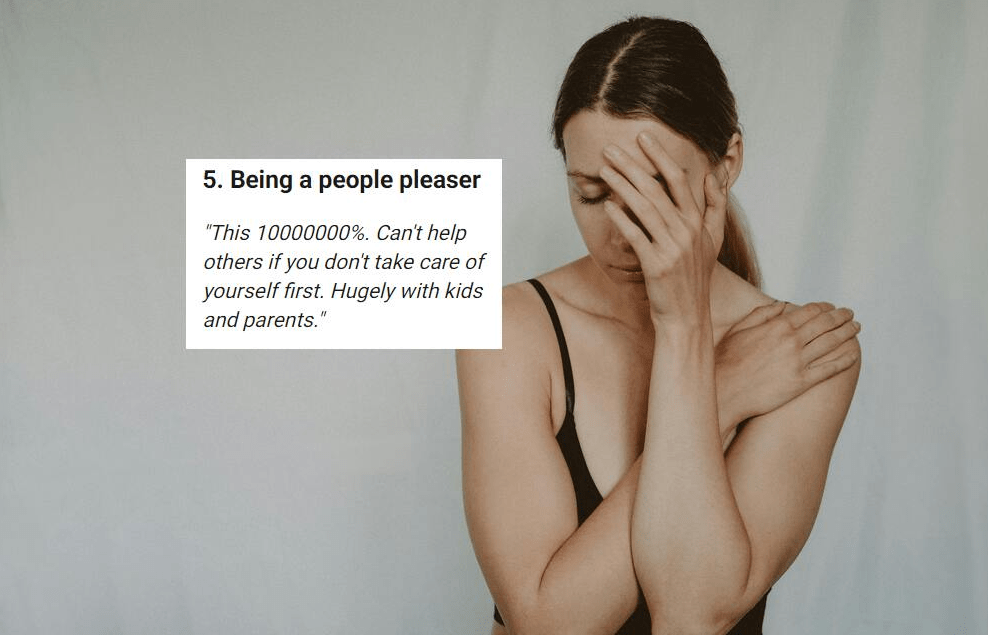
5. Being a people pleaser

"This 10000000%. Can't help others if you don't take care of yourself first. Hugely with kids and parents. Parents are ineffective if they ignore their spouses and put all their energy into everything else and nothing into themselves and each other." — Slickpoison

6. Should have invested earlier

"Yes to investing. I'm close to retiring and don't have anywhere close to the amount that I'd like. I used to make fun of my brother for his frugality but it turns out I was the foolish one." — Scurtrberau

"Rule of 72- at 8% growth you’d see your money double in 9 years. Waiting a decade means you miss out on doubling that money. What’s worse is that you have a certain set number of doubling periods before retirement- 22-31, 31-40, 40-49, 49-58, 58-67 - 5 doubling periods. $1 put in at 22 is worth 25 = $32 at retirement." — Burnbabyburn11

7. Paid too much attention to parents

"I listened to my parents too much when I was younger." — Distressed_Finish

"My mother was never going to understand me or love me unconditionally, or see me as anything other than something to possess and control, and I wish I could have realized it and freed myself from her sooner." — FloraFly

8. Waiting too long to get sober

"I'm in my 40s now and pretty much drank my way through my 20s and early 30s. I got into the lifestyle of drinking with friends every day after work, then a big session Friday night and it was the norm for me, I pitied people who just went straight home from work. Now thinking of all the money I spent, the health implications, the general setting my life back by 15 years, I think I was the one that was pitiable." — Dave80

"Same. I was a casual/social drinker my entire 20s and early 30s, and I wish I was not. Life without alcohol is so much better." — Barhanita

9. Put more effort into friendships

"I wish I didn't let friendships die so easily. I'm 36 and you'd be surprised how fast you can go a decade without talking to someone you once saw every day." — NutellaBanabaBread

10. Missed opportunities with women

"Took me far too long to realise if I had just taken my shot, I most likely would have succeeded with a few of my crushes. But I am happy were I am now, but man some of those missed opportunities..." — Zeebie_

11. Smoking

"Wish I never would have touched a cigarette." — BlueStarSpecial

"This for sure, I smoked for 25 years, maybe 15 a day. At today's prices in the UK that amounts to around £82k or just over $100k." — Dave80

12. Self-loathing

"I regret the amount of time I spent hating my body. The self-loathing I had with my appearance consumed me, and now when I look back at photos of me in my twenties I just wish I could have seen how skinny I was." — Wetsummer486

13. Being a loyal employee

"Being loyal to a company and expecting to be rewarded later." — Pinkpujita

"Been job hopping every 2-3 years. New projects, more motivation, learning new stuff, most of the time with increased salary." — fr6nco

True

Food banks are a community staple for millions of Americans. Not only do they provide nutritional assistance to low-income families, they’re also often one of the few places where people can get non-food essentials like diapers, toiletries, paper towels, clothing and more. For the 44 million people in the United States facing food insecurity, pantries can literally be a lifeline.

But that lifeline is at risk. Food pantries rely on donations, both from individuals and government programs, to stay stocked. Rising poverty levels and budget cuts mean that food pantries sometimes can’t meet the demands of their communities—and as a result, families go without.


No person should struggle for basic needs—which is why Land O’Lakes is teaming up with Clove in the name of comfort ahead of the 2025 holiday season.

Comfort, meet comfort.

A partnership between a farmer-owned cooperative and a modern footwear brand might seem like an unusual pairing. But the reality is that both organizations provide things that are enjoyable and much needed for American families.

You might be surprised to learn, for example, that dairy is one of the most requested but least-donated items at food banks around the nation. From a nutritional lens, dairy is a source of high-quality protein that provides 3 of 4 nutrients—calcium, potassium and vitamin D—that low-income households are at risk of missing from their diets.

But on a larger scale, dairy provides comfort. Items like butter, milk and cream are in high demand, particularly around the end of the year since so many families use these items for baking holiday treats. And while shoes can be stylish gifts, they’re also a basic necessity for hardworking frontline workers who provide care for others and spend hours on their feet. In fact, 96 million people in the U.S. spend their work shift standing.

"We are so excited to collaborate with Clove Shoes and take a moment to celebrate the color of the moment, but also our everyday favorite, butter yellow," said Heather Anfang, president of Land O'Lakes Dairy Foods. "As a company who shares our values of community, hard work and comfort, we are thrilled for the launch of their shoe but also for our shared donation to those in need in an important area for our two brands in Philadelphia."

Meaningful giving when people need it most

Together, the organizations have donated dozens of sneakers and more than 3,750 pounds of butter to Philabundance, one of the largest food banks in Philadelphia and part of Feeding America’s nationwide network of food banks, pantries, and meal programs. As they team up to donate needed supplies, they’re also helping families feel nourished—inside and out—ahead of the cold winter months.

"As a Philadelphia-based brand, we’re proud to give back to the community we call home—nourishing our city and supporting those who care every day," shares Jordyn Amoroso, Co-founder and CBO. Clove has also gifted 88 shoes to the students enrolled at Philabundance Community Kitchen: a free, life-changing workforce development program run by Philabundance.

At a time when so many are stretched thin and families are moving into the holiday season facing food insecurity, collaborations like these can provide an unexpected value—a chance to revitalize local communities, to nourish families, and show how comfort can take many different forms.

Learn more about this unexpected partnership here.

Health

12 photos of women before and after an orgasm shines a new light on women's sexual wellness

"We hope that everyone viewing this project will feel more confident about their bodies and sexuality."

Imagine if this kind of joy had a bigger place in the world.

You might recall Marcos Alberti's mega-viral "3 Glasses" project from 2016, in which he photographed people after they had consumed one, two, and then three glasses of wine. The series was impactful in part because it showed the physical transformation that comes from being relaxed after some wine. That, and it touched on a common curiosity. Haven’t we all wondered if we look as different as we feel after getting a little tipsy? (Spoiler alert: the answer is yes.)

Using a very similar format to “3 Glasses,” as well as the elements of lightheartedness, novelty, and rawness that made it so special, Alberti utilizes his photography to delve into a topic much less discussed: women’s sexual wellness.


The concept is simple: photograph women before, during, and after an orgasm. You can see why he calls this the “O” project.

Despite the subject matter, Alberti assures viewers that the intention wasn’t to be explicit, or even erotic, for that matter. The 20+ women who participated, of varying ethnicities and varying levels of sexually liberated versus conservative countries of origin, were completely covered below the waist while using personal massagers.

“The underlying message: all women deserve to be in control of their sexuality, no matter their background. Women should be free to be empowered by–and have a little fun with–their sexuality,” Alberti wrote on his website.

Similarly, Fan Yang, Global Brand Manager of Smile Makers (a sexual wellbeing brand that partnered with Alberti for this project) noted that the goal was to break through stigma and show female pleasure in a positive, healthy light. The hope is that not only society normalizes female pleasure, but that women themselves connect to their sexuality without “shame and secrecy.”

Given that all the women who participated were “in awe” seeing themselves “glowing and radiant” in their final photo, as Yang put it, it feels safe to say mission: accomplished.

Take a look:

marcos alberti, 3 glaas, big o, orgasm, sexual wellness, womens sexual wellness, personal massager, female pleasure An O Project participant. marcosalberti.com


marcos alberti, 3 glaas, big o, orgasm, sexual wellness, womens sexual wellness, personal massager, female pleasure An O Project participant. marcosalberti.com


marcos alberti, 3 glaas, big o, orgasm, sexual wellness, womens sexual wellness, personal massager, female pleasure An O Project participant. marcosalberti.com


marcos alberti, 3 glaas, big o, orgasm, sexual wellness, womens sexual wellness, personal massager, female pleasure An O Project participant. marcosalberti.com


marcos alberti, 3 glaas, big o, orgasm, sexual wellness, womens sexual wellness, personal massager, female pleasure An O Project participant. marcosalberti.com


marcos alberti, 3 glaas, big o, orgasm, sexual wellness, womens sexual wellness, personal massager, female pleasure An O Project participant. marcosalberti.com

marcos alberti, 3 glaas, big o, orgasm, sexual wellness, womens sexual wellness, personal massager, female pleasure An O Project participant. marcosalberti.com

marcos alberti, 3 glaas, big o, orgasm, sexual wellness, womens sexual wellness, personal massager, female pleasure An O Project participant. marcosalberti.com


marcos alberti, 3 glaas, big o, orgasm, sexual wellness, womens sexual wellness, personal massager, female pleasure An O Project participant. marcosalberti.com

marcos alberti, 3 glaas, big o, orgasm, sexual wellness, womens sexual wellness, personal massager, female pleasure An O Project participant. marcosalberti.com

In a video posted to YouTube, we get a behind-the-scenes look at Alberti’s process. Welcoming the models in, setting up his camera behind a curtain for privacy, talking them through the process, making them feel safe and comfortable, etc.

We also get to see the “awe” that Yang spoke of. It’s palpable.

“Initially, I was still apprehensive… [with] a lot of worry. And this one [referring to the final image] is like “Ha! Life is beautiful!” one woman shared, grinning ear-to-ear.

- YouTube www.youtube.com

We can talk ad nauseam about how women’s pleasure shouldn’t be a taboo subject, about how it’s a natural, vital part of her overall wellbeing, how it can lead to better mood, heart health, immune function, sleep, intimacy, self-esteem…yadda, yadda yadda…but there’s nothing like actually witnessing its semi-miraculous powers firsthand. It’s one of the things that make photography so powerful. We feel something raw and honest on a visceral level, so that we can THEN talk about it with empathy and understanding. It’s clear that Alberti knows this on a deep level and is using that knowledge for something truly good.

Be sure to follow Alberti (@marcos_alberti ) on Instagram to keep up-to-date with all his work.


Photo Credit: https://www.canva.com/photos

A Westie dog. A piano.

Meet Bradford. He's only 13 years old, and yet his grasp of music is savant-level distinguished. He is drawn to the most complex piano chords, particularly loving jazz of all kinds. He's extremely close to his family and especially supportive of his mom and her musical talents.

I might have buried the lede here—Bradford is actually a gorgeous, tiny dog.


For years, classically trained jazz singer and pianist Kara Baldus-Mehrmann (who often simply uses the last name Baldus) has been sharing clips of herself playing piano with Bradford on her lap in her home in the St. Louis area. A Westie mix, Bradford listens intently—his eyes closed tight, swaying to the songs when he's particularly moved. Sometimes when he's so deeply into the notes, he bounces along with them and buries his face into Baldus's chest.


Many agree that the duo are the perfect antidote to doom-scrolling. On Instagram alone, Baldus has over half a million followers who enjoy her thousands of posts.

But just recently, she went extra viral when the pair appeared on ABC News, where anchor Danny New describes Bradford as the "world's greatest 'vibe-ologist.'" Baldus explains, "He seems to react in real time to certain elements of the music, which is just wild." When asked, "How would you explain the squinting?" Baldus, while holding Bradford lovingly in her arms, answers, "Oh my gosh. The squinting is when he really just starts to feel the music."

Kara Baldus-Mehrmann and her dog Bradford groove to the music. www.youtube.com, ABC News

She further explains it all began during the 2020 pandemic, when she and her husband were home most of the time. "He would just stay there during my lessons, sit on my lap, and he would sit there for hours and hours." They then cut to a clip (which they mention was the first ever posted) of Bradford resting his tiny head on the piano while Baldus lightly played. He was so moved by the music, "he couldn't even lift his chin," New gleefully reports.

It's also noted, "For the record, Bradford is not the first to love a good piano nap. I brought you a story back in June about a cat in Croatia named Zlatko, who simply cannot stay awake when his parents start playing."

Cat in Croatia really enjoys the piano. www.youtube.com, WQAD News 8

ABC News also points out that celebrities have begun to take notice of Bradford's grooving. "Five-time Grammy Award winner SZA commenting in all caps, 'I LOVE BRADFORD.'" (Adding to that, Pixar Studios, Questlove, and many other famous accounts have loved and commented on the coolness of this super soulful canine.)

The news report also points out that Bradford still loves running in the park, but on especially anxious days, "like say in a half-hour TV interview…" They leave us hanging, while showing Baldus ask Bradford if he's doing alright. She then begins to play and he immediately settles into her groove. New leaves us with the knowledge that while "jazz does appear to be Bradford's favorite, he does react well to pop and soothing classical music, as well."

As one might imagine, the comments over the years are incredibly warm and supportive. One writes, "My heart bursts when I watch Bradford. He is such a beautiful soul." Another notices how much love Bradford has for his mom. "My goodness how he looks at you. This is what the world needs — thanks for sharing your beautiful relationship."

The link between dogs and music has been studied in great depth. I can personally attest that my hound dog mutt is especially partial to Americana folk music, particularly when the harmonica kicks in.

In a piece for Mental Floss, staff writer CaLea Johnson shares that yes, dogs do indeed respond to music, writing, "Researchers from the Sydney School of Veterinary Science examined nine studies of the effect of music on dogs in 2020. Their findings, published in the journal Animals, indicated that the classical genre soothed canines, as the pups exhibited calmer behaviors (i.e., lying down, resting, sitting, etc.) while the music played."

There are even playlists meant especially for anxious dogs with separation anxiety. (These don't usually include hard rock or metal, however.)

As for Bradford, whether it's being close to his "person" or just genuinely loving jazz, he's bringing delight to the world in a time where it's much needed. Groove on, little man.


An angry man in front of the American flag.

America has never been a perfect place, but since the Civil War, it has been one where most people bought into the idea of the country and supported the institutions that keep it running. People may disagree on politics and culture, but when America was threatened, whether it was 9/11 or World War II, people came together to fight for the country they love, even though the reasons may have differed.

However, it’d be naive to say that sentiment is still as strong as it once was. Since The Great Recession, many people have felt that the vibes are off in America, and polls and research back those feelings. Right around 2012, when smartphones became ubiquitous, there was a considerable rise in the number of people who felt that America was on the wrong track and that racism and sexism were considerably worse than they were just a year before. There was also a big spike in mental illness.


So what happened in 2012? Did the world suddenly become drastically worse overnight, or had our perceptions been changed?

woman, dispair, smartphone, bad news, woman in kitchen, upset woman A woman is upset looking at her smartphone.via Canva/Photos

Why does it feel like America is on the decline?

Other developed countries have experienced similar vibe shifts since 2012, but it has hit America the hardest. Economics blogger Noah Smith explains why this feeling of malaise has hit America so hard, and he illustrates it perfectly in a viral Substack piece called “Social media destroyed one of America's key advantages.” Smith is an American blogger and commentator on economics and current events and former assistant professor of behavioral finance at Stony Brook University.

In his Substack post, Smith postulates that the technological change hit America the hardest because it punctured our geographical buffers. “A hippie in Oakland and a redneck in the suburbs of Houston both fundamentally felt that they were part of the same unified nation; that nation looked very different to people in each place,” Smith writes. “Californians thought America was California, and Texans thought America was Texas, and this generally allowed America to function.”

Why did America fundamentally change in 2012?

Here’s an excerpt from Smith’s piece. Please check out the entire piece on the Noahpinion Substack.

Like some kind of forcible hive mind out of science fiction, social media suddenly threw every American in one small room with every other American. Decades of hard work spent running away from each other and creating our ideologically fragmented patchwork of geographies went up in smoke overnight, as geography suddenly ceased to mediate the everyday discussion of politics and culture.

The sudden collapse of geographic sorting in political discussion threw all Americans in the same room with each other — and like the characters in Sartre’s No Exit, they discovered that “Hell is other people.” Conservatives suddenly discovered that a lot of Americans despise Christianity or resent White people over the legacy of discrimination. Liberals suddenly remembered that a lot of their countrymen frown on their lifestyles. Every progressive college kid got to see every piece of right-wing fake news that their grandparents were sharing on Facebook (whereas before, these would have been quietly confined to chain emails). Every conservative in a small town got to see Twitter activists denouncing White people. And so on.


protests, american protest, protest sign, demonstration, mass gathering A group of people protesting in the street.via Ted Eytan/Flickr

It may sound cynical to believe that America was a better place when people were less likely to talk to people with a different worldview. But, given how things have gone in the past 15 years, it’s fair to say that putting every American in a proverbial ring to fight it out just makes everyone feel under attack... and the fight never ends.

The problem with the Like button

Another development around the same time that many believe negatively affected the country was the development of the Like button on Facebook. The button made its debut in 2009, and it, along with the share button, which came in 2010, incentivized people to create content that their audience agreed with, creating echo chambers. The buttons also incentivized people to make outrage-provoking posts and create fake stories to go viral and increase advertising revenue.

maga, trump supporters, trump flags, trump rally, american flags Trump supporters at a rally.via Elvert Barnes/Flickr

The positive takeaway from Smith’s geographical sorting theory is that, quite possibly, many people’s perceptions about life in Amerca are wrong because we’re seeing it through the distorted, funhouse mirror of social media that shows us every bad deed in a country of 330 million people and amplifies the voices of the unscroupulous. By pinpointing the moment that America “went to hell,” as author Jonathan Haidt says, we also have a roadmap to get back to when people had greater faith in America’s institutions and people.

This article originally appeared in June.

This study is for the birds, literally.

Turns out, humans might not be the only species with brand loyalty. According to a new study, birds are just as particular about where they…well, leave their mark.

The study, from Alan’s Factory Outlet, set out to answer a question every car owner has quietly wondered: Do birds actually prefer certain cars to poop on?


After surveying 1,000 drivers, the answer was a resounding yes. And while there are a few caveats to this study, it still makes for some interesting conversation. Maybe not dinner party conversation, but conversation nonetheless.

Perhaps even more importantly—it stumbled on a surprisingly fascinating mix of biology, color theory, and bird behavior.

First off, the findings confirmed that a bird’s ability to “detect ultraviolet (UV) light” and “heightened vision” makes certain car colors stand out more in their environment. In particular, vehicles with “eye-catching” shades like brown, red, and black are often “prime targets” for getting blessed.

Here are the most poop-worthy colors:

  1. Brown
  2. Red
  3. Black
  4. Yellow/Orange
  5. Blue
  6. White
  7. Silver/Gray

As the site Carbuzz mentioned, the caveat to note here is that the results came from self-reporting. Since “bird mess doesn’t show up quite as easily” on lighter colored cars, the results could be skewed due to a bit of cam-poo-flage.

Regardless, the study found that the longer birds hang around a car, no matter the color, the more likely accidents are to happen.

Furthermore, shiny cars and reflective mirrors can also incite some damage since birds often mistake their own reflections for rivals, especially during mating season, and attack them repeatedly.

And when it comes to brands, Ram trucks, Jeeps, and Chevrolets top the list of bird favorites. Teslas and Audis, meanwhile, appear to be in the “less splattered” club (for now).

Most poop-on-able car brands, according to birds:

  1. Ram
  2. Jeep
  3. Chevrolet
  4. Nissan
  5. Dodge
  6. Kia
  7. Tesla
  8. Audi
  9. Ford
  10. Subaru

birds, pigeons, bird poop on car, cars, best cars, clean vehicle car wash, bird studies, keeping car clean Clip from Alfred Hitchcock's 'The Birds' media3.giphy.com

Interestingly, the roundup potentially points to something car folks will appreciate: size does, in fact, matter. As Carbuzz put it, the top choices tended to be pickup trucks, “which are bigger, meaning more surface area to poop on.” Cause who wants a tiny toilet? No one, that’s who.

Lastly, the results might be funny, but the impact isn’t always a laughing matter. The survey noted that nearly one in four Americans spend over $500 each year on car washes and repairs due to bird droppings. Fifty-eight percent even said their car has been pooped on more than once in the same day. That’s enough to make anyone feel personally victimized by nature.

While it might feel like an attack on human dignity, birds aren’t plotting against our paint jobs. They’re simply reacting to a landscape in the only way they know how. They can’t help it if they’re nature’s Jackson Pollocks, and our cars are irresistible canvases.

All you can really do is protect your finish, park under a covered area (not trees though!), and hope for the best. And next time you’re purchasing a new vehicle, consider a boring color.

A woman saying no.

Does telling someone "no" make you uncomfortable? Whether it’s turning someone down for a social engagement, a favor, or shutting down someone’s idea at the workplace? It’s difficult to reject someone’s idea or plan because you don’t want them to feel bad, and you also may feel the need to justify your decision.

What’s worse is when saying no makes us feel so uncomfortable that we get roped into attending social engagements that we don’t want to go to, or following someone’s bad idea at work that you know isn’t going to make a difference.


The good news is that Jefferson Fisher is here to show us how to say no in a kind way, without feeling the need to justify ourselves. Fisher is a personal injury attorney and communications expert who has become massively popular on Instagram—with over 6 million followers—for sharing tips “to help people argue less and talk more.”

What’s the wrong way to tell someone no?

@kencoleman

How to say no while also being kind. #no #kind #clarity

First, Fisher explains where many people get fouled up when telling someone no. They add a "but" to the statement that negates the positive idea they are trying to convey.

“Here's where it goes wrong, where you say thank you. You lead with gratitude first. Say, thank you, but. ‘Oh, I love to, that sounds so wonderful. But I can't,” Fisher explains. “It dismisses it. That puts it down. The word 'but' has a way of deleting what you just said before."

How to tell someone 'no' in a polite way without making excuses

Instead, Fisher said people should “flip it” by starting with the “no” and ending with gratitude. He says the way to say "no" to an invitation is to say, “I can’t. Thank you for inviting me...I’ve heard that’s a great place. Let me know how it is.”

The order in which you deliver the information is crucial if you don’t want to justify yourself. If you end with “I can’t,” people will assume you want to explain yourself and are more likely to ask for one. That can put you in the position of having to give a poorly considered excuse.

Fisher then adds a beautiful nugget of wisdom: you should be direct because “clarity is kind.”

@todayshow

#AmyPoehler says that she loves the #Scandinavian #CommunicationStyle, and #HodaKotb and #SavannahGuthrie agree that being direct is often the best way to go. #TODAYShow

What does 'clarity is kind' mean?

“Clear is kind, unclear is unkind” is a phrase popularized by Brené Brown that means being direct and honest with others—even when it's hard—is more compassionate than being unclear.

“Feeding people half-truths or bulls**t to make them feel better (which is almost always about making ourselves feel more comfortable) is unkind,” Brown writes. “Not getting clear with a colleague about your expectations because it feels too hard, yet holding them accountable or blaming them for not delivering is unkind. Talking about people rather than to them is unkind.”

Fisher’s advice is excellent for anyone who has ever felt bad about saying no to someone. There’s no reason to feel bad about turning down an invitation or being honest with someone at work. You do right by yourself and others when you focus on being clear and kind. Sometimes the kindest thing you can say is “no.”