The longest — and probably largest — proof of our current climate catastrophe ever caught on camera.

It was the largest such event ever filmed.

climate change, environment, global emergency, arctic circle
All GIFs and images via <a href="https://www.youtube.com/watch?v=hC3VTgIPoGU">Exposure Labs</a>.Photo credit: Exposure Labs

Photographer James Balog and his crew were hanging out near a glacier when their camera captured something extraordinary. They were in Greenland, gathering footage from the time-lapse they’d positioned all around the Arctic Circle for the last several years.

They were also there to shoot scenes for a documentary. And while they were hoping to capture some cool moments on camera, no one expected a huge chunk of a glacier to snap clean off and slide into the ocean right in front of their eyes.
science, calving, glaciers
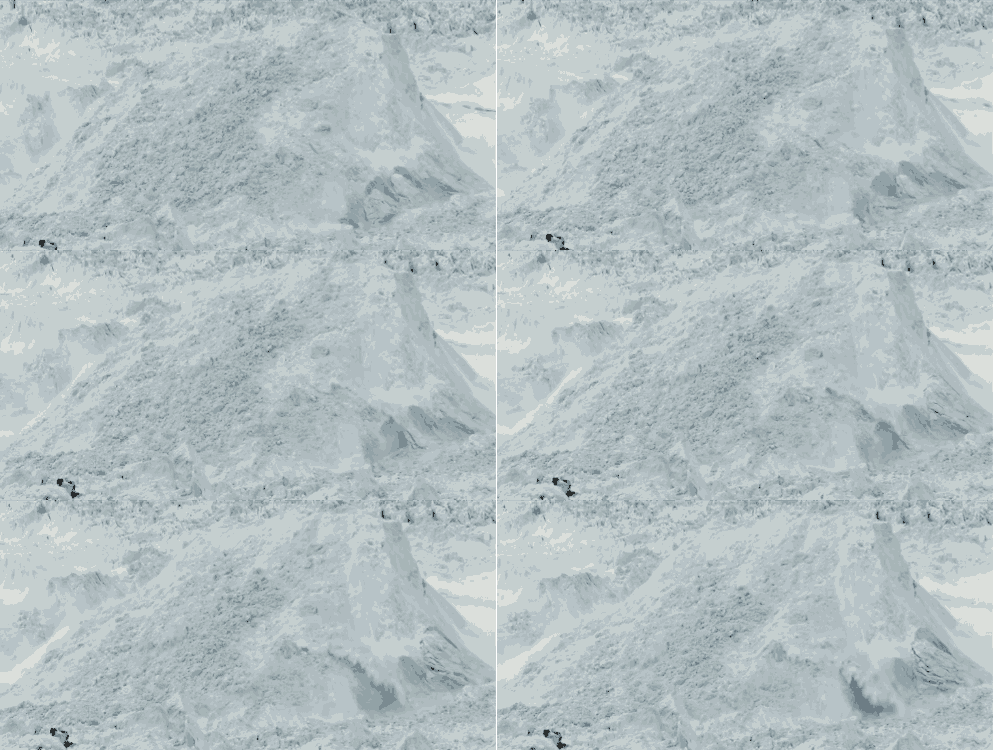
A glacier falls into the sea. <a href="https://assets.rebelmouse.io/eyJhbGciOiJIUzI1NiIsInR5cCI6IkpXVCJ9.eyJpbWFnZSI6Imh0dHBzOi8vYXNzZXRzLnJibC5tcy8xOTQ5OTk4MS9vcmlnaW4uZ2lmIiwiZXhwaXJlc19hdCI6MTY0Mzc1NTc3OH0.FAySffHTIynGNOXPuRAokuqF7bGD_M20bj7y8AC8fW0/img.gif?width=980">assets.rebelmouse.io</a>
ocean swells, sea level, erosion, going green
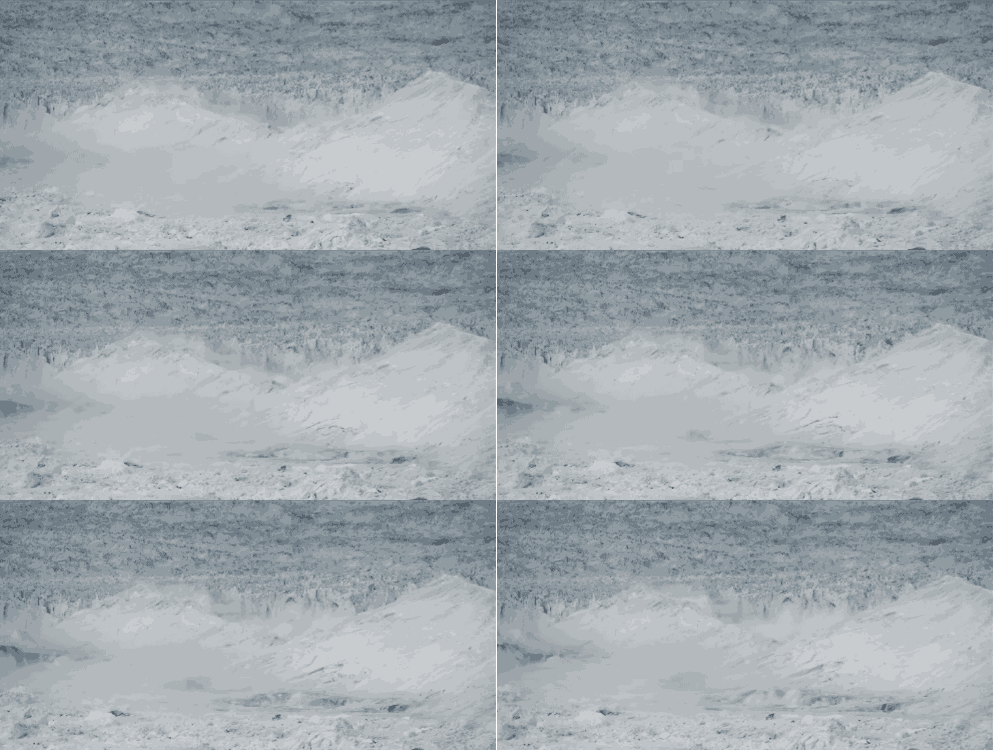
Massive swells created by large chunks of glacier falling away. <a href="https://assets.rebelmouse.io/eyJhbGciOiJIUzI1NiIsInR5cCI6IkpXVCJ9.eyJpbWFnZSI6Imh0dHBzOi8vYXNzZXRzLnJibC5tcy8xOTQ5OTk4Mi9vcmlnaW4uZ2lmIiwiZXhwaXJlc19hdCI6MTY5MjAyNjg2Nn0.4uD3PHudZc7Wf9XMIQ8DG2nEfELR8JK4_6G14Ph2Ok8/img.gif?width=980">assets.rebelmouse.io</a>

It was the largest such event ever filmed.

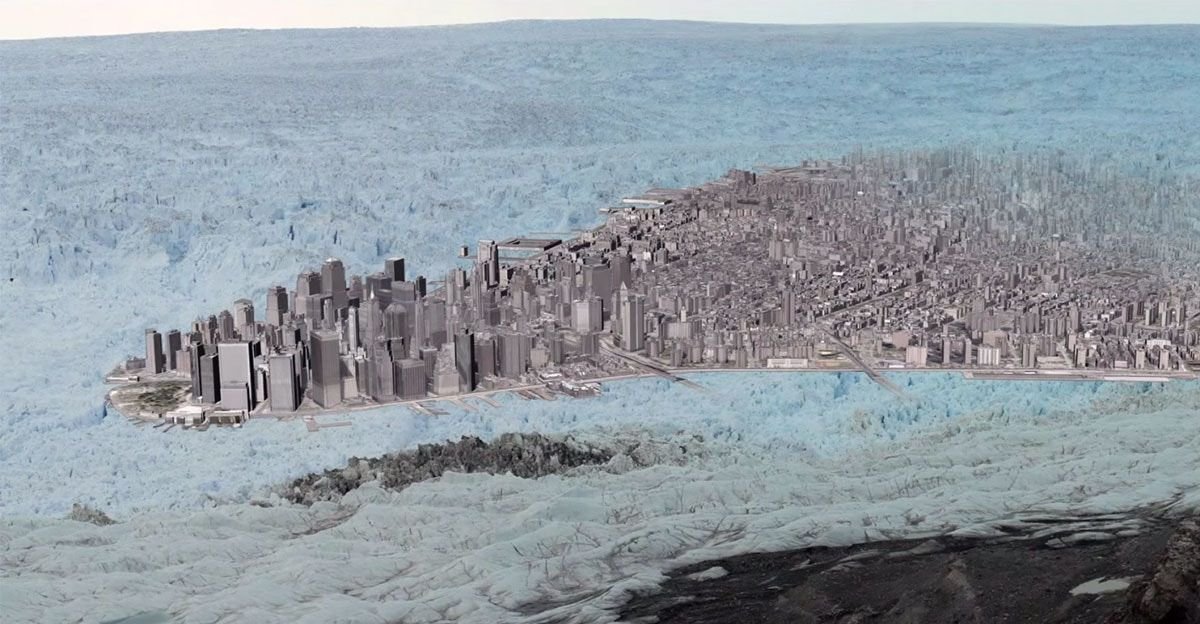
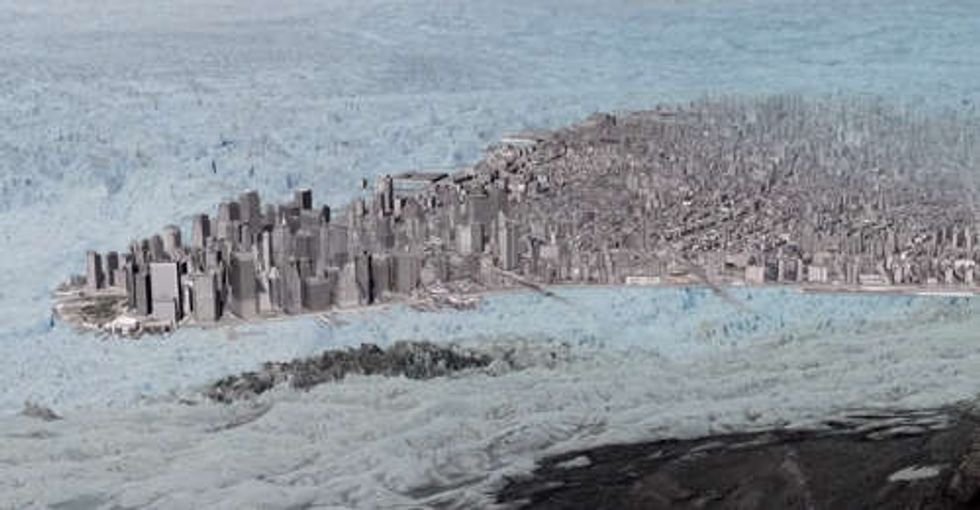
For nearly an hour and 15 minutes, Balog and his crew stood by and watched as a piece of ice the size of lower Manhattan — but with ice-equivalent buildings that were two to three times taller than that — simply melted away.
geological catastrophe, earth, glacier melt
A representation demonstrating the massive size of ice that broke off into the sea. <a href="https://assets.rebelmouse.io/eyJhbGciOiJIUzI1NiIsInR5cCI6IkpXVCJ9.eyJpbWFnZSI6Imh0dHBzOi8vYXNzZXRzLnJibC5tcy8xOTQ5OTk4My9vcmlnaW4uanBnIiwiZXhwaXJlc19hdCI6MTY0NTc3MDU2MH0.A3vkySOxfkoGCsFu1LKsh9_pOWJKzaXWAUUeMp4D_Og/img.jpg?width=980">assets.rebelmouse.io</a>

As far as anyone knows, this was an unprecedented geological catastrophe and they caught the entire thing on tape. It won’t be the last time something like this happens either.

But once upon a time, Balog was openly skeptical about that “global warming” thing.

Balog had a reputation since the early 1980s as a conservationist and environmental photographer. And for nearly 20 years, he’d scoffed at the climate change heralds shouting, “The sky is falling! The sky is falling!”

“I didn’t think that humans were capable of changing the basic physics and chemistry of this entire, huge planet. It didn’t seem probable, it didn’t seem possible,” he explained in the 2012 documentary film “Chasing Ice.”

There was too much margin of error in the computer simulations, too many other pressing problems to address about our beautiful planet. As far as he was concerned, these melodramatic doomsayers were distracting from the real issues.

That was then.
Greenland, Antarctica, glacier calving
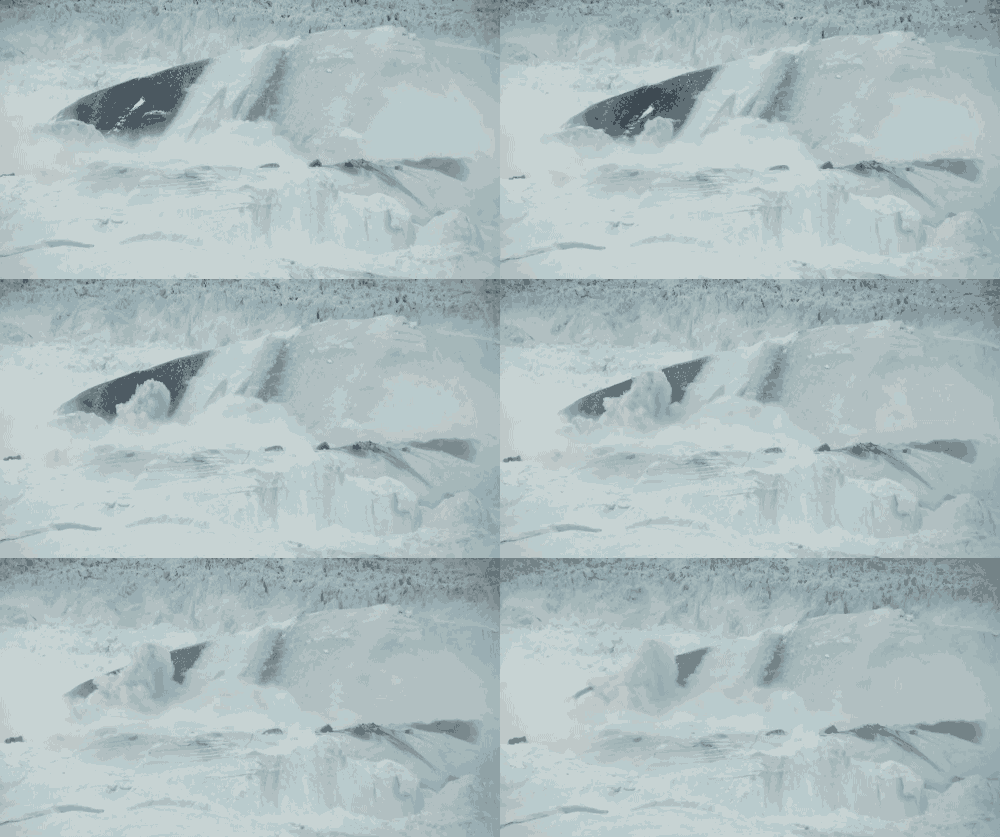
The glacier ice continues to erode away. <a href="https://assets.rebelmouse.io/eyJhbGciOiJIUzI1NiIsInR5cCI6IkpXVCJ9.eyJpbWFnZSI6Imh0dHBzOi8vYXNzZXRzLnJibC5tcy8xOTQ5OTk4NC9vcmlnaW4uZ2lmIiwiZXhwaXJlc19hdCI6MTY1NDM4NDY1OH0.mEoIl6RYtdd5bbRS6MrKIt_ne69YC3yE9QdLD7qN6YA/img.gif?width=980">assets.rebelmouse.io</a>

In fact, it wasn’t until 2005 that Balog became a believer.

He was sent on a photo expedition of the Arctic by National Geographic, and that first northern trip was more than enough to see the damage for himself.

“It was about actual tangible physical evidence that was preserved in the ice cores of Greenland and Antarctica,” he said in a 2012 interview with ThinkProgress. “That was really the smoking gun showing how far outside normal, natural variation the world has become. And that’s when I started to really get the message that this was something consequential and serious and needed to be dealt with.”

Some of that evidence may have been the fact that more Arctic landmass has melted away in the last 20 years than the previous 10,000 years.

Watch the video of the event of the glacier calving below:

This article originally appeared 10 years ago.

  • What will Earth look like if all its land ice melts? These maps show the clear answer.
    A map of the United States post land-ice melt.Photo credit: via Business Insider Science/YouTube.

    Land ice: We got a lot of it. Considering the two largest ice sheets on earth — the one on Antarctica and the one on Greenland — extend more than 6 million square miles combined … yeah, we’re talkin’ a lot of ice. But what if it was all just … gone? Not like gone gone, but melted?

    If all of earth’s land ice melted, it would be nothing short of disastrous. And that’s putting it lightly. This video by Business Insider Science (seen below) depicts exactly what our coastlines would look like if all the land ice melted. And spoiler alert: It isn’t great. Lots of European cities like, Brussels and Venice, would be basically underwater.

    I bring up the topic not just for funsies, of course, but because the maps are real possibilities.

    How? Climate change.

    As we continue to burn fossil fuels for energy and emit carbon into our atmosphere, the planet gets warmer and warmer. And that, ladies and gentlemen, means melted ice.

    A study published this past September by researchers in the U.S., U.K., and Germany found that if we don’t change our ways, there’s definitely enough fossil fuel resources available for us to completely melt the Antarctic ice sheet.

    Basically, the self-inflicted disaster you see above is certainly within the realm of possibility.


    In Africa and the Middle East? Dakar, Accra, Jeddah — gone.


    Millions of people in Asia, in cities like Mumbai, Beijing, and Tokyo, would be uprooted and have to move inland.


    South America would say goodbye to cities like Rio de Janeiro and Buenos Aires.


    And in the U.S., we’d watch places like Houston, San Francisco, and New York City — not to mention the entire state of Florida — slowly disappear into the sea.


    All GIFs via Business Insider Science/YouTube.

    Business Insider based these visuals off National Geographic’s estimation that sea levels will rise 216 feet (!) if all of earth’s land ice melted into our oceans.

    There’s even a tool where you can take a detailed look at how your community could be affected by rising seas, for better or worse.

    Although … looking at these maps, it’s hard to imagine “for better” is a likely outcome for many of us.

    Much of America’s most populated regions would be severely affected by rising sea levels, as you’ll notice exploring the map, created by Alex Tingle using data provided by NASA.

    Take, for instance, the West Coast. (Goodbye, San Fran!)


    Or the East Coast. (See ya, Philly!)


    And the Gulf Coast. (RIP, Bourbon Street!)

    “This would not happen overnight, but the mind-boggling point is that our actions today are changing the face of planet Earth as we know it and will continue to do so for tens of thousands of years to come,” said lead author of the study Ricarda Winkelmann, of the Potsdam Institute for Climate Impact Research.

    If we want to stop this from happening,” she says, “we need to keep coal, gas, and oil in the ground.”

    The good news? Most of our coastlines are still intact! And they can stay that way, too — if we act now.

    World leaders are finally starting to treat climate change like the global crisis that it is — and you can help get the point across to them, too.

    Check out Business Insider’s video below:


    This article originally appeared eleven years ago.

Animals

Woman demonstrates the proper way to burp a turkey, and people have so many questions

Health

People share the home remedies their families swear can fix any ailment

Nature

14 stunning images from the 2026 World Nature Photography Awards

Science

The ancient, brilliant reason we divide days into 60-minute hours and 60-second minutes