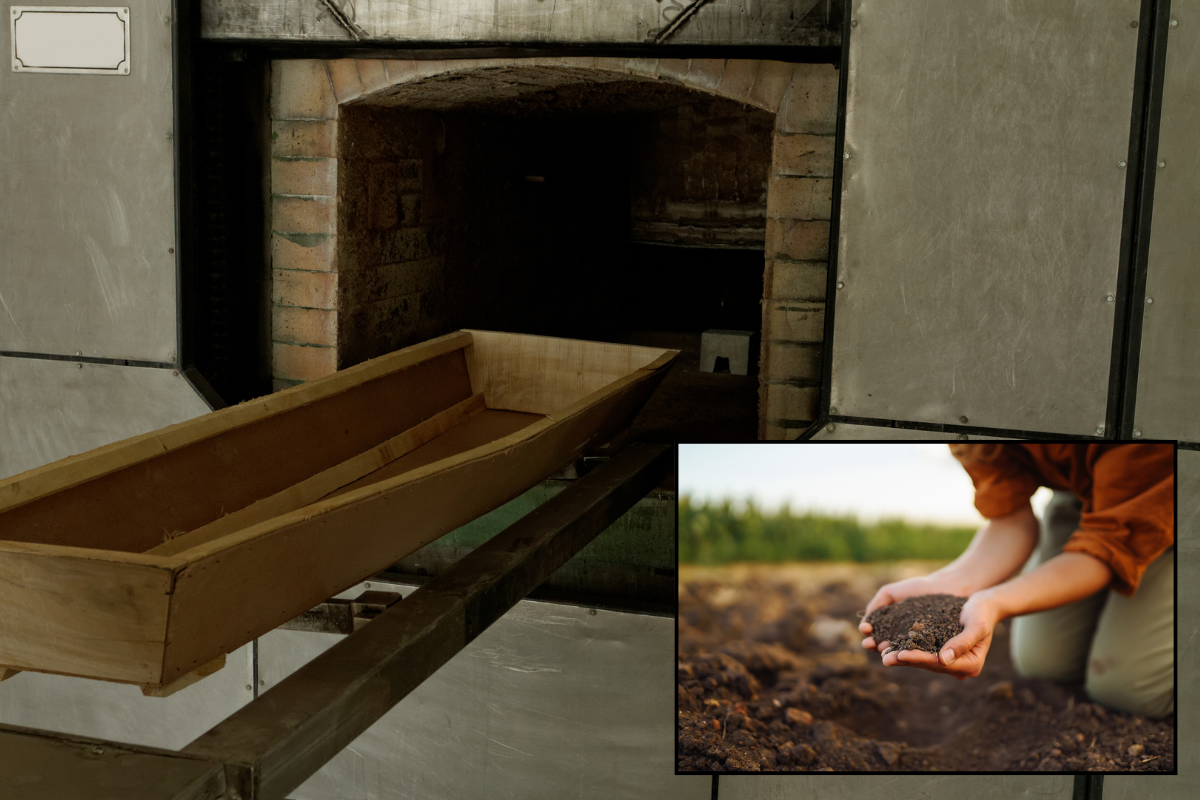
A funeral is no one’s idea of a good time, but there’s more to dislike about traditional burial ceremonies than just the grief. There’s the outrageous, almost predatory, expense—with a funeral in many states costing anywhere from $6-12,000. The use of millions of gallons of embalming fluid annually is bad for vegetation, soil, water quality, and critical ecosystems. Not to mention, coffins that never decay permanently occupy a finite amount of land.
Cremation is sometimes seen as a better option, but it has its drawbacks. The energy consumption, carbon emissions, and toxic pollutants created during the process are far from environmentally friendly.
It’s no wonder that “natural funerals” are rapidly rising in popularity.
USA’s largest ‘human composting’ facility opens on the East Coast
A company called Earth has been a pioneer in the field of “human composting,” which is exactly what it sounds like. Their facilities turn human remains, through a gentle and natural process, into rich and fertile soil.
Families take the soil home and spread it, like ashes, or use it as the foundation of a memorial garden.
Previously, Earth has operated two centers on the West Coast: One in Washington, and the other in Nevada. Their popularity meant that families were often forced to fly the remains of loved ones across the country in order to take part in the ritual.
The company just opened up a new location in Elkridge, Maryland; its first on the East Coast. The brand new facility is also now the largest of its kind in the country.
How human composting works
Unlike traditional morgue work, composting is gentle and natural.
The body is wrapped in a biodegradable shroud and placed in a chamber or vessel. It’s then surrounded by organic materials like mulch, wood chips, plant life, wild flowers, and more. The chamber is kept extremely hot, which helps the process along and kills pathogens, and in around 30 days, all that’s left inside is nutrient-rich soil. Each person transforms into about one cubic yard of soil.
The cost, meanwhile, is roughly on par with that of cremation.
The end product—something lively, organic, and natural; not a steel urn or an enormous casket—is deeply meaningful to the people left behind.
Stephen Spiese of Pennsylvania drove his late wife all the way to Washington to use Earth’s facility there. An emotional Spiese told CBS News, “To be laid in that rich soil, surrounded by wildflowers, I can’t think of a thing she would’ve wanted more than that.”
Human composting has only recently become legal in several states
Processes like the one carried out by Earth have been steadily gaining legal support. Currently, human composting is legal in 14 states including Maryland, Arizona, California, Vermont, and Washington. More are joining the movement every year.
However, human composting is not the only form of green funeral or burial that’s growing in popularity.
More families than ever are making perhaps the simplest choice possible: burying loved ones in simple, untreated wooden caskets or even just a biodegradable shroud. No toxic embalming chemicals or elaborate coffins involved.
It’s another excellent choice for protecting ecosystems and habitats, as well as the cost and environmental footprint of the burial. Some areas even offer “conservation burial grounds,” which are protected nature preserves where natural funerals are allowed.
Lakespur, one such green burial site, writes, “With conservation burial, families and friends are encouraged to get close and participate in the rituals of care around the body. There’s no forklifts stacking containers inside a warehouse, and there’s no flip of a switch for a casket to magically disappear into a grave. No. At Lakespur, people are invited to get close and participate in the process. The person’s body is lowered by hand by the people who loved them. They get to fill in the grave by hand with shovels. They do the hard work because saying goodbye is hard work.”
Fewer and fewer people are choosing traditional funerals with caskets and embalming. It’s projected that by 2040, over 80% of people will choose cremation over a casket burial.
But that’s not accounting for the rise of other, more natural choices.
A recent survey of American funeral preferences found that about 40% of Americans would consider human composting. That’s about the same number of people who are even aware of the concept, which indicates that many people find it appealing once they learn how it works.
With the environment in crisis and green space for permanent graveyards slowly running out, a return to more natural rituals makes sense. But the movement is about much more than that. There’s something undeniably beautiful about our bodies returning to the Earth, in whatever form that takes. It brings comfort and a greater sense of connection to all involved.