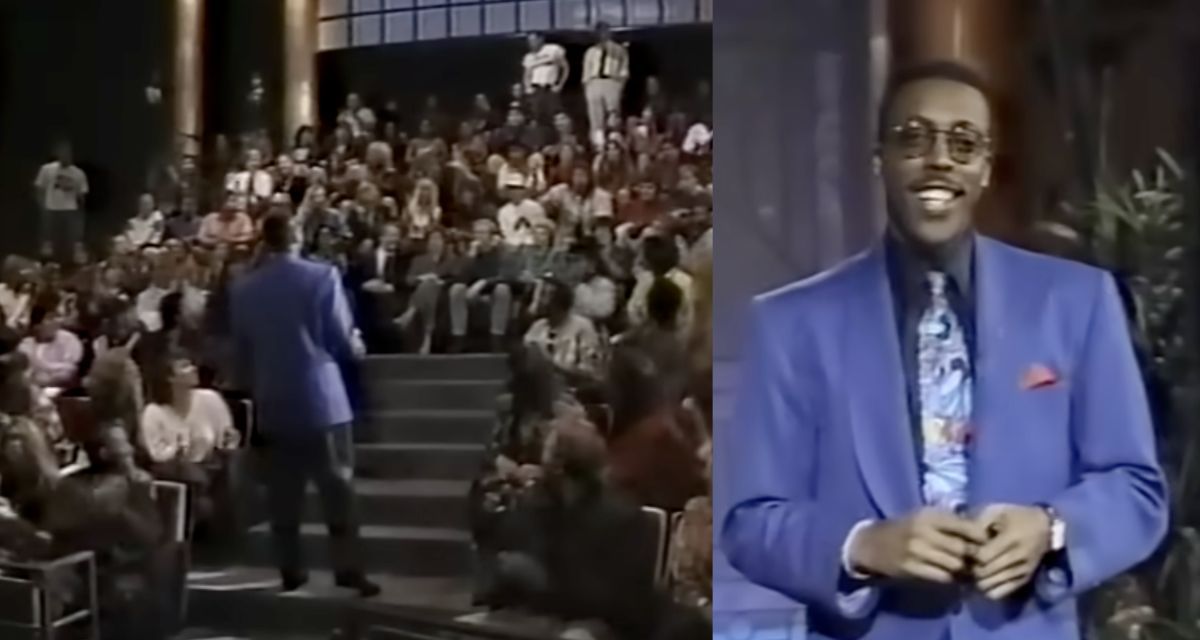
The television talk show circuit of the 1980s rarely courted controversy. That all changed in 1989 with the premiere of The Arsenio Hall Show, which changed late night TV forever. However, a recently unearthed time capsule reveals that Hall himself was sometimes challenged by the new culture he helped usher into the mainstream. During the December 14, 1990 episode of his show, two members of Queer Nation interrupted Hall to challenge him on why he didn’t have more openly gay guests on his show. And how Hall reacted made for one of the most electric, unscripted moments in talk-show history.
Premiering in 1989, The Arsenio Hall Show brought hip-hop, R&B, and a younger, more diverse guest list—and audience—to a genre that had been coasting on the same formula for decades. It was a major sea change before cable, and the internet broke the monoculture. And it broke the rules of what late night had to be forevermore.
A confrontation that put Hall on the spot
As Arsenio concludes his monologue for the live studio audience, two Queer Nation protesters can be heard shouting at Hall to get his attention. The issue? They wanted to know why he wasn’t booking more openly gay celebrity guests.
It was a fair question for the era. The visibility of openly gay and lesbian performers on television was practically nonexistent. And Hall, as the only Black entertainer in late-night, had a proven platform for hosting underrepresented groups across movies, TV, and music.
Rather than ignore the protestors to keep the show moving along, Hall walks into the audience to speak directly to them. He pushes back, arguing that plenty of gay guests had already been on his show. They just weren’t talking publicly about their sexuality. It was 1990, during the height of the AIDS crisis, a period marked by misinformation and stigma against the gay community. The entertainment business was at a breaking point between performers who wanted to be out and proud, and those who did not feel safe doing so. Coming out could literally end a career.
Arsenio doesn’t hold back here. The exchange is both combative and heated. One side was looking for representation. Hall, meanwhile, tried to make it clear that he would never discriminate against having a gay guest on the show, but also that whether or not someone is gay is “none of your damn business!”
Decades later, the reasoning behind his fire came into focus
Years afterward, Hall opened up in an interview with the Logo Network about why the confrontation hit such a nerve. He pointed out that his personal friends had stayed silent about their own identities during this time period. He was more concerned about honoring their privacy than naming names to prove a point. Hall says. “I can give you 20 guests on my show in a month [who were gay], but they weren’t talking about it. Luther Vandross ain’t talking about it. He can’t at that time. Louie Anderson can’t then. Ellen can’t then. Rosie can’t then.” All of these acts had appeared or would appear on The Arsenio Hall Show during its run. In Hall’s mind, the entire clash comes back to protecting people who couldn’t yet protect themselves.
Today, in an era when queer voices are routinely seen and heard on late-night, it’s easy to forget how much was at stake at the time. Hall didn’t have a playbook for this conversation. He just had his own experience navigating an industry that wasn’t built for people like him. And in the heat of that moment, he made the case that visibility without safety isn’t really a choice at all.