upworthy
Add Upworthy to your Google News feed.
Google News Button
Joy

People are helping introverts by sharing their go-to 'small talk' topics

Here are 14 great ideas.

introverts, small talk, conversation starters
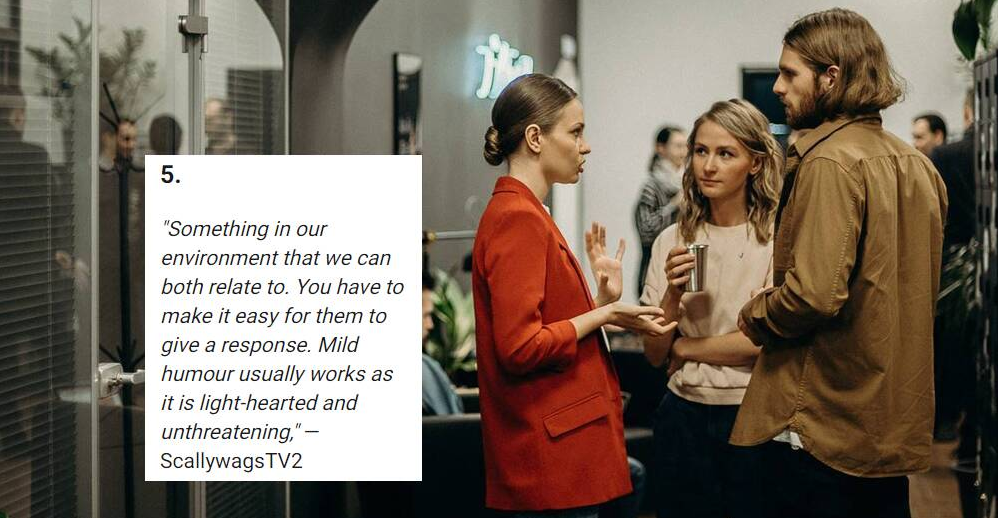
via Pexels

People chatting at a party.

A lot of people feel uncomfortable starting up conversations with strangers in social settings. It’s not that they don’t want to meet people, they’re just not sure what to say.

There's an art to small talk and some people are incredibly at ease starting up a conversation and coming up with things to say. They know how to get things moving without being obvious and seem to do this effortlessly.

A Reddit user named Blugged Bunny asked the online forum “What is your go-to 'small talk' topic with strangers?” and although the question may not have intentionally been to help introverts, there were a lot of great suggestions for people who are uncomfortable making small talk.


It seems the best ideas are questions and statements that are about the current setting and situation. The truly great small talk artists know that the best way into a conversation is to allow the other person to talk about themselves.

It’s also helpful to bring up topics that everyone can speak to whether that’s family, pets, weather, sports or articles of clothing. I once knew a guy who was single and whenever he went out he wore a “Livestrong” bracelet that he got from Lance Armstrong’s cancer charity. He told me that it “Gives women an easy conversation-starter if they want to talk to me. They’ll ask, 'Why are you wearing that? Isn’t Lance Armstrong, a cheater?'" That would begin a great debate over whether Armstrong was such a bad guy, after all he’s done for people with cancer.

Here are 14 of the best go-to small talk topics from the Reddit thread.

1. 

"Make an observation. Literally anything. It helps if it’s something about them like an article of clothing that catches your eye, something they’re doing, anything that you can relate to or are interested in but it doesn’t have to be. It can be something in the environment that is drawing both of your attention. People bullshit about the weather all the time. Once you’ve got something to work with, the key is to ask. ... Let them do the talking. People love talking about themselves. You learn some light-hearted things about the stranger, they feel more comfortable, and you can add bits and bobs of your own experiences in response so they get to know you too. It works in literally any situation. From an elevator ride to a first date. It’s so easy to personalize small talk and it makes it so much less uncomfortable." — arrocknroll.

2. 

"Have you ever tried Ayahuasca?" — KarmicBreath

This comment kicked off a funny response from Sinsaraly:

"Love this. My friend once spent a few hours in a car with poet Allen Ginsberg. The very first thing he said to her was “what drugs do you do?”

3. 

"The weather is a good one. everyone shares it. I'm a guy and i do not give one shit about professional sports or cars and it's like a social disability." — Mr_Mojo_Risin

4. 

Hobbies. "Pretty much everyone has something they're either super passionate about or really rather good at, so a conversation about hobbies pretty much always moves from 'small talk' to 'genuine interest' pretty damn fast." — Trashpanda692

5.

"Something in our environment that we can both relate to. You have to make it easy for them to give a response. Mild humour usually works as it is light-hearted and unthreatening." — ScallywagsTV2

6.

"Usually people love to talk about themselves, so a few questions about them and some follow up questions to their answers usually does it." — I_Can_See_The_Music

7.

"I try to think of random things. Like a favorite animal or star, talking about something in the room. Usually is stupid dad jokes." — UncreativeGlory

8. 

"I try to come up with questions regarding the situations we are in. Like, 'Hey you know any good place around here to get a decent meal?"' — Chromerix

9. 

"Food. People typically love food. I mention I’m new/newer to an area. And ask them what they like, where they eat out. Usually works and people have their choices validated and I always know where to find good local snacks." — TheProfWife

10. 

"If it’s a woman, I’d compliment them on something I like (bag/shoes/makeup/a book they’re reading) and then try to find common ground for there. For men, I’d try something neutral so it doesn’t seem like I’m trying to hit on them. Perhaps weekend plans, work etc." — llovejoy1234

11. 


"Biggest animal you think you could take in a fight." — RizziJoy

12. 

​"I usually bring up home renovations. Especially if the small talk confined us to a space for quite some time. Like a wedding, business conference etc. I can always find people who are not only working on different parts of their homes, but enjoy talking about them. Learned a thing or two along the line as well!" — Calm-Ad

13. 

"Did you ever hear the Tragedy of Darth Plagueis the Wise?" — HowToDoNot

14. 

"F.O.R.D. Family/Occupation/Recreation/Dreams

Family: Do they have kids? If so, people love to talk about their kids. How many, what ages, what grades are they in in school? If they are older (High School/College) what are they studying? Do they play sports/music? If family is not a comfortable subject (you don't feel like asking about spouse and kids and such) then move on to Occupation
Occupation: What do they do for a living? How long? Do they like it? Did they go to school for it? How did they get into it?
Recreation: What do they like to do in their free time? Hobbies? What sports do they like to watch? Do they play any sports? Do they do anything active? Do they do anything artistic or musical?

Dreams: What are they currently looking forward to in life? Is there a big vacation coming up? Are the kids graduating from School? Are they training for a major athletic event (marathon or some other competition)?

This is usually my go-to when making small talk and it's usually enough to get me to some sort of common ground that our conversation can build off organically." — khamylion


This article originally appeared on 5.5.22
From Your Site Articles
Gen Z; Millennials; technology; cell phones; social media; teens and technology; teens social media

Gen Z is the first generation less cognitively capable than their parents. Denmark has the solution.

Nearly every parent hopes their child will be better off than they are: smarter, more secure, and more well-adjusted. Many parents see this as a stamp of successful parenting, but something has changed for children growing up today. While younger generations are known for their empathy, their cognitive capabilities seem to be lagging behind those of previous generations for the first time in history.

Dr. Jared Cooney Horvath, a teacher turned cognitive neuroscientist who focuses on human learning, appeared before Congress to discuss concerns about cognitive development in children. In his address to the members of Congress, he says, "A sad fact that our generation has to face is this: our kids are less cognitively capable than we were at their age. Since we've been standardizing and measuring cognitive development since the late 1800s, every generation has outperformed their parents, and that's exactly what we want. We want sharper kids."


kids, intelligence, sharp kids, generations, education, cognitive abilities Student smiling in a classroom, working on a laptop.Photo credit: Canva

Horvath explains that the reason this happens is that each generation has gone to school longer than the previous generation. Gen Z is no exception to the longer duration of time spent in school, but they're the first ones who aren't meeting this normal increase in cognitive development. According to the cognitive neuroscientist, the decline is due to the introduction of screens in the classroom, which started around 2010.

"Across 80 countries, as Jean was just saying, if you look at the data, once countries adopt digital technology widely in schools, performance goes down significantly. To the point where kids who use computers about five hours per day in school for learning purposes will score over two-thirds of a standard deviation less than kids who rarely or never touch tech at school," Horvath reveals.

In most cases, the decline in performance doesn't result in better strategies. The neuroscientist shares that the standardized testing has been adjusted to accommodate lower expectations and shorter attention spans. This is an approach that educators, scientists, and researchers went to Capitol Hill to express wasn't working. But not every country is taking the approach of lowering standards to meet lowered cognitive ability. Denmark went in the opposite direction when it realized their students were slipping behind.

France24 recently interviewed educators in Denmark following their seemingly novel approach to students struggling with cognitive development. Since the beginning of the 2025/2026 school year, Denmark has not only been having students turn in their cellphones, but they've also taken tablets, laptops, and computers out of the classroom. No more digital learning for the majority of the school day. Danes went old school by bringing back physical textbooks, workbooks, and writing assignments. The results have been undeniable. Even the students can't seem to deny the success of the countrywide shift in educational approach.

"I think the biggest issue has been that, because we kind of got rid of the books and started using screens instead, that we've noticed that a lot of the kids have trouble concentrating, so it's pretty easy to swipe with three fingers over to a different screen and have a video game going, for example, in class," Copenhagen English teacher, Islam Dijab tells France24.

Now, instead of computers being part of every lesson, Denmark uses computers very sparingly and with strict supervision. One student says that it has been nice not having screen time at school because she loves to read and write. But it wasn't just the lack of attention span children were developing, they were also developing low self-esteem and poor mental health due to the amount of time spent on devices.

kids, intelligence, sharp kids, generations, education, cognitive abilities Students focused and ready to learn in the classroom.Photo credit: Canva

The data showing the negative impact of screens on teens' brains has prompted a nationwide change in Denmark that extends outside of the classroom. Afterschool activities are eliminating or extremely limiting electronic use. There is also a national No Phone Day that encourages everyone to put away their devices for the day, and Imran Rashid, a physician and digital health expert, is petitioning parliament to ban social media use for children under the age of 15. The no phone movement in Denmark is a nationwide effort that hopes to right the ship before another generation feels the effects.

ups, ups driver, delivery driver, ups deliveries, cookout, family, food, hospitality, kindness
Relaxed008/YouTube
UPS driver invited to family's cookout.

UPS drivers are always on the grind delivering packages around the clock—even on holidays. And one family took notice of the hard-working UPS driver in their neighborhood who had his nose to the grindstone as they enjoyed a cookout together. Rather than simply let him pass by, they decided to flag him down and extend an invite to join them in a move that proved community and hospitality are still alive and well.

TikToker @1fanto shared a touching video with his followers from Easter weekend where his family invited a UPS driver making rounds in their neighborhood to come to their cookout and 'make a plate.'


"Everybody family around here 😭," he captioned the video. "Everybody invited to the cookout.😂"

@1fanto

Everybody family around here 😭 #easter #cookout #wherethefunction

In the video, the UPS driver is seen standing in the family's driveway, and a group of cookout attendees warmly welcome him to join them. The uncle of @1fanto says to the driver, "You've been working hard all day man, you can go on in there!" He calls out for a woman named Stephanie to "take care of him!"

The UPS driver walks up the driveway, and they encourage him to go inside and get his fill as he enters the garage. After securing a plate of food and a drink, the driver walks back outside to mingle with guests, shaking hands with the uncle who invited him.

"You good?" the uncle asks, and the driver responds, "Yeah I'm good. They hooked me up. Thank you so much. Appreciate y'all for inviting me out." On his way back to his truck, the uncle encourages the driver to invite other workers to stop by as well.

- YouTube www.youtube.com

In a follow up video, @1fanto explained more about how the invite went down. He shares that the UPS driver was driving by the family's house on the Saturday before Easter, and at the time the family was enjoying a big fish fry cookout together. His uncle flagged the driver down, and he pulled over.

He shares that his uncle told the driver, "Go inside and get you a plate!" The driver asked him, "Are you sure?" But he reassured him, adding that the family made sure to ask the driver what he wanted and didn't want on his plate to "make sure he was good and got everything he needed".

"I saw it had a positive impact. That's what my family do. That's not something that we just do for social media," @1fanto shared. "That's something that we do on a regular basis that doesn't just happen when the camera's on. It happens when the camera's off, too. We're all equal. We all bleed the same."

ups, ups truck, united parcel service, ups delivery, ups deliveries, ups driver A UPS truck with package deliveries.Image via Wikipedia

Viewers had lots of positive things to say in the comment section.

"I am a UPS driver and that makes our day. People showing love to us"

"Your family represents the best of America🫶🏼 Your uncle is now all of our uncle."

"Working the holidays suck. But they made that man’s entire day. Love it."

"I love when people are nice for no reason. You’re so real ♥️thank you for being so kind."

"Being a delivery driver is grueling, often thankless work. It's awesome to see a family that remembers those hardworking folks are essential parts of our communities."

This article appeared last year. It has been updated.

Science

Helicopters dump 6,000 logs into rivers in the Pacific Northwest, fixing a decades-old mistake

Forty years ago, restoration workers thought logs were the problem. They were wrong.

river restoration, washington, river fish, restoration, Yakama Nation, indigenous land, indigenoues tribes, salmon, trout, pacific northwest

Restoration workers now see how "critical" wood is to the natural habitat.

For decades, river restoration in the Northwestern United States followed a simple rule: if you saw logs in the water, take them out. Clean streams were seen as healthy streams, fast-moving water was seen as optimal, and wood was treated like a "barrier" to natural processes, particularly those of the local fish.

Now, helicopters are flying thousands of tree trunks back into rivers to undo that thinking.


In central Washington, one of the largest river restoration efforts ever attempted in the region is underway. More than 6,000 logs are being placed along roughly 38 kilometers, or 24 miles, of rivers and streams across the Yakama Reservation and surrounding ceded lands.

Nearly 40 years ago, Scott Nicolai was doing the opposite kind of work, all in the name of restoration.

"(Back then) the fish heads — what I call the fisheries folks — we stood on the banks, and we looked at the stream," Nicolai, a Yakama Nation habitat biologist, told Oregon Public Broadcasting. "If we saw a big log jam, we thought, 'Oh, that's a barrier to fish. We want the stream to flow.'"

river restoration, washington, river fish, restoration, Yakama Nation, indigenous land, indigenoues tribes, salmon, trout, pacific northwest Fish find shelter for spawning in the nooks and crannies of wood. Photo credit: Canva

At the time, logs were removed in an effort to simplify the habitat. However, it soon became clear that wood provided vital "complexity," creating sheltered pockets for salmon and bull trout to spawn and supporting algae that feed aquatic insects. Logs also slow water, spread it across floodplains, and allow it to soak into the groundwater. That water is then slowly released back into streams, helping keep them flowing and cooler during hot, dry periods.

The consequences of removing this "critical part of the system" (in addition to overgrazing, railroad construction, and splash dam logging) were made all too clear over the years as the rivers dried up and wildlife populations declined.

"We're trying to learn from our mistakes and find a better way to manage," said Phil Rigdon, director of the Yakama Nation Department of Natural Resources.

That's why Nicolai is now helping lead a project for the Yakama Nation aimed at rebuilding river complexity by returning logs to their rightful place. Many of these streams are now unreachable by road, which is why helicopters are used. Logs are flown from staging areas and carefully placed at precise drop locations marked with pink and blue flagging tape.

river restoration, washington, river fish, restoration, Yakama Nation, indigenous land, indigenoues tribes, salmon, trout, pacific northwest Many of these streams are now unreachable by road, which is why helicopters are used.Photo credit: Canva

The wood comes from forest-thinning projects led by The Nature Conservancy and includes species such as Douglas fir, grand fir, and cedar. Although some of the timber could have been sold, it is instead being used as river infrastructure.

For tribal leaders, the work carries even deeper meaning. During the helicopter flights, they gathered along the Little Naches River for a ceremony and prayer.

river restoration, washington, river fish, restoration, Yakama Nation, indigenous land, indigenoues tribes, salmon, trout, pacific northwest Tribal leaders gathered by the Little Naches River for a ceremony and prayer.Photo credit: Canva

"It was very simple: to bring what was rightfully part of this land back to us," said former tribal chairman Jerry Meninick.

The aftermath of the original restoration project illustrates how human concepts, such as the belief in the superiority of "cleanliness," can be limited and sometimes cause more harm than good. The miracle of nature, however, is that when left to her own devices, she can heal herself.

parents, parenting, moms, dads, children, kids, family, love, stress, happiness, studies, research

Having kids decreases your quality of life and marital satisfaction, but that doesn't mean you can't be happy.

For decades now, there's been one great question looming over society: Does having kids make you happier?

Most studies show that, perhaps surprisingly, people without children tend to be happier, or have more life satisfaction. When you really think about it, it makes sense why: being child-free eases your finances and allows you more time to pursue friends, romance, hobbies, travel, adventure, and career aspirations. Having children makes your immediate quality of life and marital satisfaction go down temporarily, or in some cases, permanently. In 2024,The Surgeon General even issued an advisory warning that parental stress is a major public health issue.


But there are three factors that might turn the tide. In the right circumstances, the joy and immense satisfaction of raising children can overcome all the associated stressors and lead to incredible happiness. Other studies from around the globe prove that you might just be a happy parent if:

1. Your kids have moved out

empty nest, parents, parenting, moms, dads, children, kids, family, love, stress, happiness, studies, research Empty nesters are happy with a job well done. Canva Photos

A study from Heidelberg University in Germany specifically looked at happiness in people aged 50 and older. What they found makes a lot of sense.

People who have children were happier than those without, but only in the older age group, and only when those grown children no longer lived at home. Drilling down, the research found that when children become a source of "social enjoyment" rather than stress, life satisfaction increases dramatically while symptoms of depression decrease.

You can think of it as finally getting to enjoy the fruits of your hard labor. After spending decades teaching, nurturing, and shaping your children, your twilight years are when you get to really enjoy them as fully-fledged people who enrich your lives. While there's lots of joy and fun and happiness to be found in the younger years, those years are also marred with financial and other stressors which can subdue our overall happiness.

2. You have a lot of money AND good work/life balance


empty nest, parents, parenting, moms, dads, children, kids, family, love, stress, happiness, studies, research, wealth, work life balance Older couple on vacation.Canva Photos

A 2019 study out of Bocconi University in Milan, Italy found that "Parents are happier than non-parents ... as long as parents feel they can handle their work pressures to find work/life balance and they have the financial and other resources they need."

Oh, is that all?

Some estimates say it costs roughly $24,000 per year to raise a child, on average. A family with three kids would need to make about $75,000 just to cover the absolute bare minimum food and childcare costs—yowza! The costs are more when they're young (daycare, childcare, diapers, toys), but it never stops being expensive. Parenting is also extremely time-consuming, requiring several hours per day of childcare and extra housework for most families.

The impossible conundrum that many parents find themselves in is somehow having enough money and enough time to do it all. It's easy to see that if you can somehow solve that puzzling equation, yeah, you'd be a heck of a lot happier. Easier said than done!

3. You don't live in the United States

parents, parenting, moms, dads, children, kids, family, love, stress, happiness, studies, research Parents in Spain, Norway, Sweden, Portugal, and more are enjoying more time off to spend with family.Photo by Mauro Lima on Unsplash

In 2016, The Council on Contemporary Families wanted to look into whether parental discontent was a global phenomenon or not. So, they studied parents and non-parents from 22 different countries to see if they could find any differences in life satisfaction.

The report found that parents in countries like Norway, Hungary, Portugal, Finland, Sweden and Spain were shown to be happier than non-parents.

And yet, according to Time Magazine, "Of the 22 countries the researchers studied, America has the biggest happiness differential between parents and the child-free."

The report specifically cites the high cost of childcare for young children and the limited amount of paid leave Americans receive—and not just parental leave, but simple vacation time. Countries like Spain and Portugal mandate anywhere from 22-30 paid leave days per year, while Americans average about 11. That allows for significantly less time to actually enjoy time with your kids, and has a big impact on our happiness, or lack thereof.

new parents, parents, american parents, america, happiness, study American parents would be happier with more time to spend with their families.Canva Photos

Of course, happiness can be measured in a lot of different ways. Is happiness a blissful feeling of freedom and joy? Or is it a deep satisfaction and sense of purpose in your life? Or maybe a combination of the two?

What the overall body of research seems to show is that there are many different paths to happiness, whether you choose to have children or not. Finding joy and satisfaction in your life as a parent might be considered "hard-mode." There are a lot of obstacles working against you, especially in America, but the research is beginning to give us some clues about how we can get there.

This article originally appeared last year. It has been updated.

Identity

Woman who lost her 'pretty privilege' reveals how it changed her perspective on life

" I instantly felt sad and horrified, because of the cosmic unfairness of life."

smiling, woman, pretty, privilege, looks, attraction, beauty

A smiling blonde woman.

There is something extremely unfair about people born with great genetics who are extremely attractive. Sure, folks can improve their looks after putting in some work at the gym or learning how to present themselves. But many people we consider conventionally good-looking hit the jackpot by simply being born that way.

With little effort, these people have an incredible social advantage in life. They are seen as morally virtuous, receive random favors, are always the center of attention, and are more likely to get raises and promotions at work. The funny thing is that many people with pretty privilege don’t realize the incredible advantage they have until it's gone.


People with pretty privilege get the social advantage that comes with a lot of people wanting to date them. They also have the advantage of the "halo effect," where people take one trait, their attractiveness, and use that to make blanket positive assumptions about their intelligence, kindness, and integrity without much evidence.

What happens when people lose their pretty privilege?

In a since-deleted post, a woman on Reddit shared how she realized the power that comes with pretty privilege when she gained a lot of weight, and the world immediately began treating her differently.

“Whether we want to admit it or not, pretty privilege is a thing. And it’s something that I now realize I had for the majority of my life,” the woman wrote in a viral post. “People were usually very nice to me. I got offered perks like drinks at bars and extra attention when I went out. And I was stared at a lot.”

smiling, woman, pretty, privilege, looks, attraction, beauty An attractive woman at a bar.via Canva/Photos

Things changed for the woman after she had a health condition that required her to take a medication that slowed her metabolism, which resulted in rapid weight gain.

“The fatter I got, the less attention was paid to me," the woman continued. "I didn’t notice it at first, but I began to have to ask for customer service at places instead of being offered, and I started to feel invisible, because no one looked at me. No one. People would walk right by and not even acknowledge my existence. It was strange at first, then incredibly humbling. I thought, well, this is the new normal.”

The power of thin privilege

It’s important to note that being a certain weight doesn’t automatically make you good-looking. People can look good at any weight. However, it would be naive to believe that thin people don’t have an advantage in this world.

thin, fitness, measuting tape, waist, thin woman, A woman measring her waist.via Canva/Photos

The drastic fluctuation in the woman’s weight made her conscious of what other people who don’t have the privilege of being pretty or thin go through in life. It allowed her to have greater compassion for people, regardless of how they look.

“My personality started to change a little," she wrote. "I began being thankful for any small interaction someone had with me, and responded to any small act of kindness with gratefulness. I noticed other not conventionally pretty people, and other overweight people, and made an effort to talk to them and treat them like they mattered. I became a better person. Not that I wasn’t a good person before, but I was now more aware and empathetic to those around me.”

The woman soon went off the medication and, just like that, she lost weight, and people began to treat her as they had before.

Realizing the inequity of pretty privilege

“The first time I noticed it was when I was in a store looking for something, and a handsome male worker came up to me and asked if I needed help. He looked me in the eyes. I felt like I mattered again,” she continued. “Then I instantly felt sad and horrified, because of the cosmic unfairness of life, that how we look really does determine how people treat us, even though it shouldn’t.”

smailing man, ahppy man, good-looking man, man in sweater, man holding chin A good-looking man holding his chin.via Canva/Photos


After the woman lost her privilege, she better understood what other people go through. On one hand, she probably enjoys the privilege, but on the other, she feels that the world is much less fair than she once imagined. At least, in the end, it’s taught her to be more empathetic to everyone she meets.

“And also, when someone looks at me and smiles, no matter who they are, I give them a huge smile back,” she finished her post.

This article originally appeared last year. It has been updated.