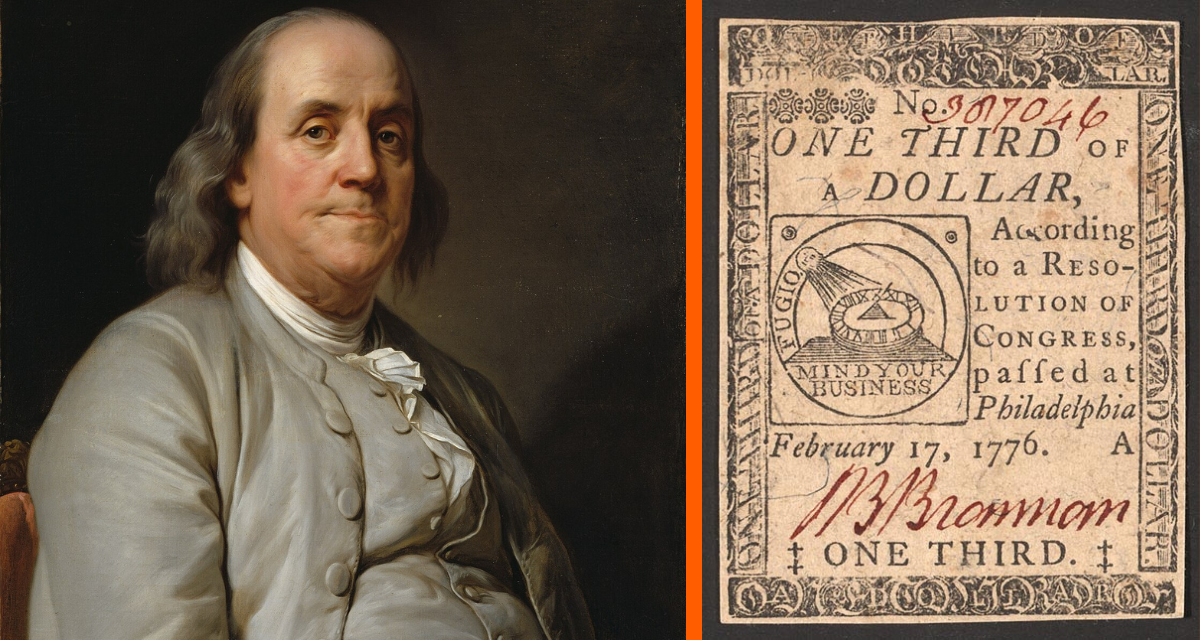
Founding Father Benjamin Franklin lived an incredibly accomplished life. He was a signer of the Declaration of Independence, a scientist, and an inventor.
Interest in Franklin has been renewed following the use of one of his quotes in the finale of Apple TV’s Your Friends & Neighbors. The quote comes from Franklin’s Poor Richard’s Almanack: “Three may keep a secret, if two of them are dead.”
Franklin played a key role in bringing paper money into use in the American colonies. He was also responsible for inventing methods to prevent counterfeit money from circulating.
Benjamin Franklin and paper money
Franklin worked as an independent printer and was first introduced to the art of printing at age 12, according to the Benjamin Franklin Historical Society.
Franklin earned a contract to print paper currency, and in 1730 he became Pennsylvania’s official printer. According to research from the University of Notre Dame, he printed nearly 2.5 million banknotes for the American colonies in his printing shops.
“Benjamin Franklin saw that the Colonies’ financial independence was necessary for their political independence,” Khachatur Manukyan, an associate research professor in the Department of Physics and Astronomy at the University of Notre Dame, explained. “Most of the silver and gold coins brought to the British American colonies were rapidly drained away to pay for manufactured goods imported from abroad, leaving the Colonies without sufficient monetary supply to expand their economy.”
Fighting counterfeiters
Franklin was well aware of the risks of paper money being counterfeited. “To maintain the notes’ dependability, Franklin had to stay a step ahead of counterfeiters,” said Manukyan.
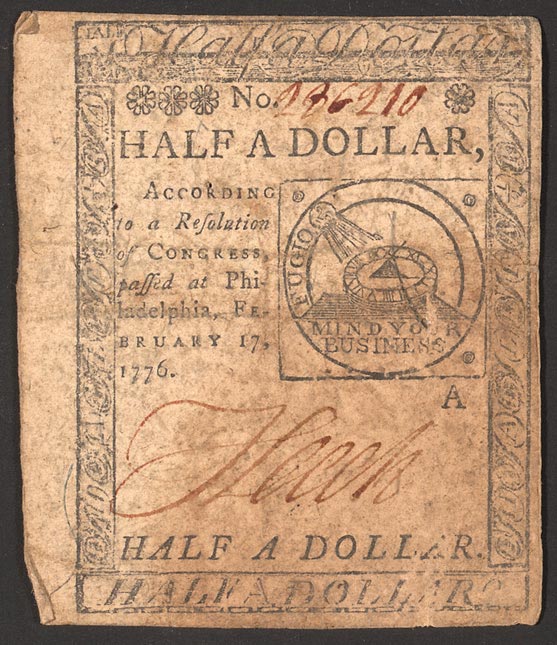
Keen on stopping counterfeiters, Franklin paid close attention to the inks, paper, and fibers used in his bills. According to the Library of Congress, Franklin “devised the use of mica in the paper and leaf imprints as ways to foil counterfeiters.”
One way Franklin fought counterfeiters was by including naturalist Joseph Breintnall’s botanical leaf prints on his bills, according to JSTOR. He also “cleverly utilized security marbled wove papers to safeguard early American paper currency, as well as his own personal checks.”
More ways Franklin stopped counterfeiting
Franklin’s printed currency included three additional security features designed to prevent counterfeiting. First, he used a specific kind of black dye made from graphite on currency. For other printed materials, he used a pigment created by burning vegetable oils called “lampblack.”
Second, Franklin invented a way to incorporate tiny fibers (colored silks) into his paper pulp. Franklin was ahead of his time: researcher Manukyan noted that paper manufacturer Zenas Marshall Crane was alleged to have introduced the method into his own practice in 1844—more than 100 years after Franklin.
Finally, Franklin added a special ingredient to his bills: muscovite crystals (also known as mica). The shiny addition to his paper currency was initially intended to provide greater durability, but Franklin noticed that it also helped deter counterfeiters.