Experts explain exactly how, and when, to tactfully change the subject of a conversation

Should a conversation always be interesting and meaningful for both people?

psychology, social skills, change the subject, small talk, people skills, people pleasing, conversation, small talk tips, social etiquette
How and when to politely change the subject of conversation.Photo credit: Canva

We’re all familiar with the feeling of being “trapped” in a conversation. It might be because the other person won’t stop talking long enough for you to get a word in edgewise. Or maybe the topic of conversation just bores us. Worse, perhaps it makes us uncomfortable, and we can’t figure out a good way to change the subject without coming off as rude.

A massive debate on this topic recently unfolded on X. Some users argued that a good conversation should always be interesting and engaging to all parties, while others maintained that showing genuine interest in what others have to say (even if it doesn’t really interest you) is a key element of socializing.

It’s possible that both sides are right. Experts say changing the subject doesn’t have to be curt or selfish.

In fact, a great conversationalist understands that artfully pivoting is the key to maintaining an interaction that’s enjoyable for both parties. The key is understanding both when it’s time to “smile and nod,” and when and how to steer the conversation in a new direction.

Why it feels scary or hard to change the subject

psychology, social skills, change the subject, small talk, people skills, people pleasing, conversation, small talk tips, social etiquette
Changing the subject can be harder for some people than for others. Photo credit: Canva

Dr. Kelly Gonderman, a clinical director and licensed clinical psychologist at We Conquer Together, tells Upworthy that changing the subject is one of the social skills her clients struggle with most.

“In my clinical work, the inability to redirect a conversation is rarely about rudeness or poor communication. It’s almost always about anxiety, people-pleasing, or a fear of conflict rooted in early relational experiences,” she says. “The nervous system registers social disapproval as threat, which means steering away from a painful or triggering topic can feel physiologically dangerous even when it’s entirely reasonable.”

Unfortunately, people who have difficulty setting boundaries in conversation may also struggle to maintain boundaries in other areas of their lives.

“They’ve learned that their discomfort is less important than keeping others comfortable,” she says.

Experts give tips and scripts for how to tactfully change the subject

One user on X sparked debate when they suggested a rather blunt and direct shifting of gears: “I’m sorry, it’s not really my thing, I don’t understand the importance of this and I can’t contribute to the conversation.”

It’s a fair and reasonable boundary to hold, but it’s likely to alienate or deflate your conversation partner because it’s missing a few key elements of a great pivot.

Amy Arias, senior lecturer of communications studies at the University of Nevada, Reno, tells Upworthy: “The key to changing the subject tactfully is to acknowledge what the person said before redirecting. People mainly want to feel heard, and once that happens, most conversations can move on naturally.”

Here are a few scripts to try out:

  • “That’s a good point. It actually reminds me…”
  • “I hear what you’re saying. Speaking of that…”
  • “That sounds intense. On a lighter note…”

In each of these instances, you’ve acknowledged the speaker and what they were saying in a positive way before attempting to move the conversation into new territory.

@justaskjefferson

or just try, “crazy weather we’re having.” ♬ original sound – Jefferson Fisher

You could also try using humor to deflect the tension around your attempted pivot, with a segue that’s so jarring your conversation partner can’t help but laugh: “Speaking of politics, who’s hungry?”

Arias adds that, no, a good conversation doesn’t always have to be interesting or engaging for both parties all the time. It’s more about reciprocity and making sure each person gets a turn to be heard.

“Good conversation is more about reciprocity and turn-taking than constant fascination,” Arias says. “In healthy conversations, people take turns being the storyteller and the listener, but it’s also okay to redirect when a topic feels draining, awkward, or just not a great fit.”

“Ultimately, changing the subject gracefully is really about reading the room and protecting the flow of the interaction,” she adds. “A thoughtful topic shift isn’t rude, it’s often what keeps conversations comfortable, inclusive, and enjoyable for everyone.”

Why being a great conversationalist goes beyond the script

Gonderman says that, though having a few canned lines up your sleeve can help, being able to confidently redirect a conversation may require deeper work.

“The fix isn’t a script,” she says. “It’s building enough internal safety to trust that your need to redirect is valid.”

That could require something as simple as some breathwork or grounding techniques, or more advanced interventions like therapy to get to the root issues of your social anxiety.

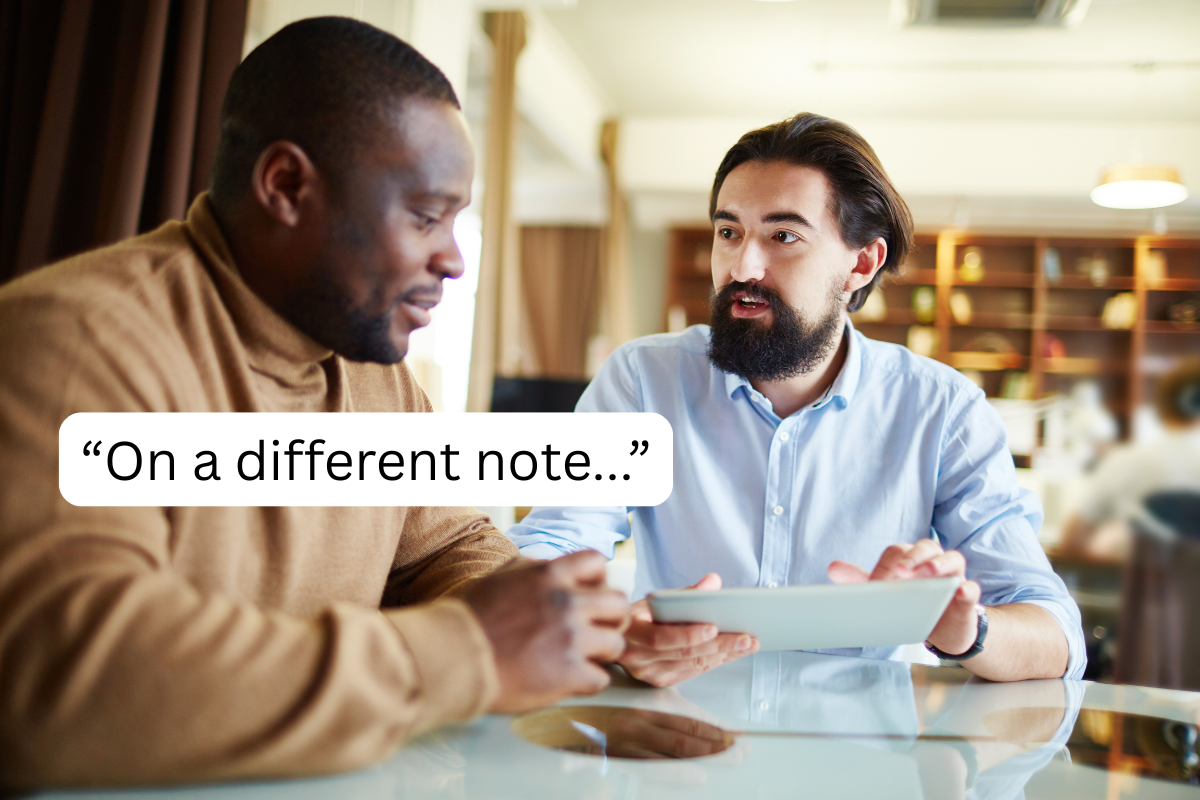
There are a lot of reasons you might not be comfortable continuing a given line of conversation. It could be political, too personal, too taboo, or just plain uninteresting to you. It takes a person who’s quite sure of themselves to use a brief, direct pivot like “I want to shift gears,” “On a different note …,” or even “I’d rather not get into that right now.”

It’s best to acknowledge and make the other person feel heard before pivoting, but some people, well, just won’t take a hint. That’s when more direct methods might be called for.

Human conversations are an incredibly intricate dance. They’re an exchange of information, a building block of relationships, and an emotional back-and-forth all rolled into one. The finer aspects of navigating them tactfully don’t always come naturally to us and sometimes require preparation and practice.

  • The one sign that someone is highly intelligent, according to legendary philosopher Voltaire
    Voltaire and a smart young woman. Photo credit: Wikimedia Commons and Canva
    ,

    The one sign that someone is highly intelligent, according to legendary philosopher Voltaire

    Voltaire was an 18th-century French philosopher, writer, and one of the most important voices of the Enlightenment. His works challenged authoritarianism and championed freedom of religion and speech. His beliefs in civil liberties and individualism inspired American revolutionaries such as Thomas Jefferson and Benjamin Franklin, helping shape the ideals behind the Declaration of Independence. Julian…

    Voltaire was an 18th-century French philosopher, writer, and one of the most important voices of the Enlightenment. His works challenged authoritarianism and championed freedom of religion and speech. His beliefs in civil liberties and individualism inspired American revolutionaries such as Thomas Jefferson and Benjamin Franklin, helping shape the ideals behind the Declaration of Independence.

    Julian de Medeiros, a popular TikToker who also writes about philosophy on Substack, recently shared how Voltaire could tell whether someone was highly intelligent. His observation suggests that sometimes those who don’t speak know far more than those who can’t keep their mouths shut.

    Signs that someone is highly intelligent, according to Voltaire

    “Here’s how you know that someone is smart, like highly intelligent, and this goes back to a simple maxim from the French thinker Voltaire, who wrote, ‘Judge a man not by his answers but by his questions,’” de Medeiros said in a TikTok video

    “What he meant, and I think this is so important, is that the more intelligent someone is, the more they listen. The more they want to learn and grow each and every day. They have an innate curiosity,” he continued. “As Plato put it, ‘An intelligent person speaks when they have something to say, but an unintelligent person speaks because they have nothing to say.’”

    An intelligent person also knows how to ask the right questions to learn as much as possible from the person they are talking to.

    A teacher writing on the blackboard. Photo credit: Canva

    Studies show a deep connection between intelligence and curiosity

    Voltaire’s thoughts on intelligence make a lot of sense. Curious people seek out new information. They ask questions, read books, take things apart, and make connections between ideas that may not be apparent at first. Studies show it starts early: infants seen as curious were more likely to grow up to be intelligent adults. Albert Einstein was a true believer in curiosity. He once said, “I have no special talents. I am only passionately curious,” and was also famous for urging people to “never stop questioning.”

    albert einstein, einstein, intelligence, relativity, smart people
    Albert Einstein. Photo credit: Archivo General de la Nación/Wikimedia Commons

    Adam Bryant, a columnist for The New York Times, interviewed 525 CEOs and found that curiosity was the most important quality:

    “[Curiosity] means trying to understand how things work, and then trying to understand how they can be made to work better. It means being curious about people and their backstories. It means using insights to build deceptively simple frameworks and models in their minds to make sense of their industry—and all the other disruptive forces shaping our world—so they can explain it to others. Then they continue asking questions about those models, and it’s those questions that often lead to breakthrough ideas.”

    Ultimately, curiosity can be seen as a source of fuel and energy for the mind. You can have an incredible brain that’s great at storing and making sense of complex ideas, but without a constant stream of information and input, it’s like a sports car with no driver.

  • Research reveals the trick to being more likable after screwing up in public
    A woman who made a mistake.Photo credit: Canva

    Even the coolest of the cool cannot escape the occasional social faux pas. Whether it’s putting your foot in your mouth at a dinner party, tripping in public and spilling coffee on yourself, or screwing something up at work, we all mess up from time to time. The good news is that every mistake is an opportunity to recover. This begs the question: What’s the best way to react when you’ve made a mistake?

    Historically, people have thought that the best way to respond to a mistake is to express honest embarrassment. Feeling sheepish about your mistake is a great way to show others that you understand social norms and simply fell a bit short on this occasion. You blush, cast your eyes downward, and whisper a small “My bad” or “Sorry about that,” with a shrug of your shoulders.

    mistake, embarrassment, laughing, social psychology, people skills
    A woman facepalms. Photo credit: Canva

    What’s the best way to respond to making a public mistake?

    However, research shows that the best way to recover after screwing up publicly is to laugh at yourself. A new study from the Cornell University SC Johnson School of Business involving 3,000 participants found that laughing at yourself can make you more likable than showing embarrassment.

    “Our findings suggest that people often overestimate how harshly others judge their minor social mistakes,” said study co-author Övül Sezer, PhD, of the Cornell University SC Johnson School of Business, according to Neuroscience News. “For minor, harmless blunders, laughing at yourself can signal social confidence, reduce tension, and communicate that the mistake was accidental.”

    Why is it better to laugh at yourself than to show embarrassment?

    Laughing at yourself shows that you are socially confident and downplays the mistake in others’ eyes. Plus, people who can laugh at themselves are seen as warmer and more competent. The humor serves as a “reset button,” de-escalating the collective feeling of awkwardness.

    mistake, embarrassment, laughing, social psychology, people skills
    A woman falls while ice skating. Photo credit: Canva

    On the other hand, when people appear embarrassed and apologetic after a mistake, others often see their reaction as excessive. This can come across as inauthentic or socially awkward. Often, people exaggerate their level of embarrassment to show that they understand what they did was inappropriate. Ironically, in trying to take the sting out of a cringeworthy moment by appearing embarrassed, they actually end up looking more awkward.

    “What’s interesting is that embarrassment was often perceived as excessive,” Sezer said. “Observers tended to think that actors who displayed embarrassment were feeling more embarrassed than the situation warranted, while laughing signaled that they recognized the mistake was minor.”

    Beyond the social situation itself, feeling embarrassed can be bad for our mental health.

    “Some people can shake off their embarrassment when they make a mistake or violate a social norm,” Psychology Today noted. “Others who fear the disapproval of the group might be consumed by shame.”

    The researchers added an important caveat to their results: If you are going to laugh off an embarrassing moment, it must be harmless. If your actions hurt someone, laughing things off can backfire in a big way, making you appear selfish and uncaring. “What’s important is calibrating the reaction to the seriousness of the mistake,” Sezer said.

    We’re all bound to make a mistake from time to time. The good news is that every mistake presents an opportunity to recover and potentially make ourselves look even better than before. The key is to give your ego a rest and have a big laugh at your own expense. Most likely, people will find you more likable because you had the confidence to let your guard down.

  • 10 signs you’re a quiet introvert in group chats, according to psychology
    Are you an introvert who struggles with group chats? Photo credit: Canva

    You open your phone to a group chat flooded with 47 unread messages. Instantly, anxiety hits. By the time you compose a thoughtful reply, the conversation has rushed three topics ahead. The moment is lost. You close the app, feeling left out.

    If this sounds familiar, you’re not alone. Introverts make up one-third to one-half of the population, but our conversation norms—both online and off—are designed for extroverts.

    Susan Cain, author of the bestselling book Quiet: The Power of Introverts in a World That Can’t Stop Talking, calls this phenomenon the “New Groupthink.” It’s a culture that favors constant collaboration and rapid-fire replies over stillness and deep thought. We live in a world that measures contribution by the number of messages sent, and it’s easy to feel like you’re falling behind when you go silent.

    But what if this isn’t about falling behind? What if silence is just a different way of engaging? If you’ve ever wondered why you go quiet in group chats, consider these 10 signs you might be an introvert.

    1. You process before you share

    While extroverts type as they think, introverts think before they type. When forming their responses, introverts rely more on long-term memory than working memory—the brain’s active workspace where information is juggled and processed in real time. Extroverts might talk through ideas out loud; introverts process information through slower, deeper neural pathways designed for accuracy and nuance.

    texting, group, chats, introverts, psychology
    Unlike their extroverted counterparts, introverts take time to think about their responses before firing off a text. Photo credit: Canva

    As Cain describes in her book, introverts “listen more than they talk, think before they speak, and often feel as if they express themselves better in writing than in conversation.”

    In a group chat setting, this internal processing means you might mentally prepare a response, revise it, overthink the timing (can’t be too quick or too slow, right?), and then decide the conversation has already moved on without you. The perfect response you crafted vanishes before you hit send.

    2. Surface-level banter drains you

    For introverts, not all conversations are created equal. You might find endless small talk, quick memes, and emoji reactions tiresome, and yearn for messages with more substance. That’s because introverts crave depth—a meaningful exchange that explores an idea, a feeling, or a genuine problem.

    @thewadeempire

    How would you react in this situation? I already interact too much with some of my coworkers on a daily basis so please leave me out the group chat. Thanks #groupchat #introverts #workgossip

    ♬ original sound – TheWadeEmpire

    Research published in the Journal of Personality and Social Psychology found that serious conversations are more enjoyable than people expect, yet we consistently underestimate others’ interest in them. For introverts, this inclination toward depth isn’t a personality quirk—it’s a fundamental part of how they communicate.

    3. You observe everything

    If you’re quiet in the group chat, it doesn’t mean you’re not paying attention. Introverts are sharp readers of context: they notice shifts in tone, track emotional undercurrents, and pick up on what’s not being said as much as what is. This ability to observe and accurately synthesize group dynamics is one of the most underappreciated traits in online communication.

    group, chats, introverts, communication, context
    Introverts are sharp readers of context—everything that’s not being said. Photo credit: Canva

    Psychologist Daniel Goleman found that empathy is a core component of emotional intelligence, and that quiet people often exhibit greater empathy because they listen more deeply. So while you may not be contributing messages to the group chat, you’re still playing an active role—picking up on subtle cues, like a shift in someone’s tone.

    4. Group chats drain your social battery

    Group chats require a lot of mental and social energy as you process multiple conversations, competing personalities, shifting group dynamics, and implicit social cues all at once. That’s an enormous cognitive load, especially compared to one-on-one conversations, where your focus can be directed toward a single person without all the noise.

    If you feel overwhelmed, muting the chat might not be a bad idea. You need to manage—and maintain—your energy well.

    5. You refuse to break the silence with noise

    You won’t send a message just to be seen. While some group chat members are happy to drop a fire emoji or send an “lol” to stay visible, introverts tend to hold back unless they have something substantial to contribute. They’re committed to authentic communication.

    introverts, texting, conversation, group, chats
    Introverts are intentional with their messages. Photo credit: Canva

    Blake Griffin Edwards, a licensed marriage and family therapist, explains it this way: “Introverts must think it out before they are able to talk it out very well.”

    As a result, your communication style is built on intention rather than impulse. You may send fewer messages, but when you do, they’re more meaningful.

    6. Group chats can feel overwhelming, even for good writers

    Here’s a paradox many introverts recognize: writing often feels more natural than speaking. Text removes the social pressure of real-time performance, giving you space to choose your words carefully. Yet despite being text-based, group chats can still trigger overstimulation.

    @kisama_

    For the people who always get cut off in group conversations 🗣️ #introvert #publicspeaking #motivation

    ♬ original sound – Ki$ama

    The problem lies with pace. A group chat doesn’t move at the same speed as a thoughtful email chain or a journal entry. It’s fast and unpredictable—like a live conversation—which creates the same timing pressures introverts face in verbal group settings. Hans Eysenck’s foundational theory of introversion suggests that introverts have a higher baseline level of cortical arousal, meaning they reach sensory overload faster than extroverts when external stimulation—like a flood of notifications—keeps escalating.

    7. You tune into how others are feeling

    You’re not just reading the words in a thread—you’re reading between the lines. As an introvert, you probably notice delicate emotional shifts, like a person’s messages becoming shorter, a joke that falls flat, or silence from someone who’s usually chatty. This emotional sensitivity is a strength, but it can also make group chats feel more burdensome than expected.

    emotional, texting, group, chats, introverts
    Emotional sensitivity can feel like a burden in group chats. Photo credit: Canva

    In The Mirror, Katie Oborn observed that introverts “pick up on unspoken emotions and subtle shifts in conversation and tone.” That level of awareness means introverts are often the first to notice when something is off.

    8. You don’t bend to the pressure to perform

    Group chats carry an implicit social pressure: respond quickly, be entertaining, stay visible. For emotionally independent introverts, that pressure can feel crushing. People who resist the pull to perform in group settings often have a strong internal compass about what matters to them and why. They won’t chime in for the sake of it, and they won’t be dragged into drama just because the group demands a response.

    9. Constant notifications break your focus

    For introverts, great thinking often happens when you’re alone. There’s research to support this: studies consistently link solitude to improved emotional regulation, creativity, and decision-making. When a group chat keeps pinging you—interrupting a reading session, the workday, or a quiet moment—it fragments the kind of deep focus and flow state introverts depend on.

    texting, group, chats, messages, interruptions
    A woman looking at her phone, concerned. Photo credit: Canva

    Studies from Microsoft Research confirm that instant message notifications slow task performance and make it more likely you’ll lose your train of thought. For introverts, who need more time to process information, these interruptions can be even more costly. The “ping” of a phone notification can disrupt deep focus.

    10. You engage on your own terms

    Introverts often contribute based on sincerity and trust rather than social obligation. When they do speak up, they usually bring something worth reading.

    Scroll through your messages, and you might notice a pattern—either in yourself or in your introverted friends. Long periods of silence often lead to a single, valuable message that adds meaning to the conversation. That’s what strategic participation looks like: waiting for the right moment, then contributing something meaningful.

    Embracing your strength

    For introverts, hanging back and staying quiet in a group chat isn’t withdrawal. It’s a form of meaningful participation that favors observation, thoughtful processing, and intentional engagement over simply making noise.

    If you recognize these signs in yourself and want to start engaging more on your own terms, these small shifts can help:

    • Try preparing your thoughts before or at the start of a lively group conversation.
    • Remember, writing is your natural way in. A thoughtfully crafted message at the right moment can carry more weight than a dozen impulsive replies.
    • Feel free to set notification boundaries without guilt.
    • When you’re ready to chime in, trust your timing and insight.

    As Susan Cain reminds us, being the loudest in the chat doesn’t mean having the best ideas. The quietest voice may actually be paying the closest attention—and when their words are shared deliberately, they can shift the entire conversation.

  • Job recruiter says people will never get hired if they keep getting this easy interview question wrong
    A career coach warns against relying on AI to answer job interview questions.Photo credit: Canva

    As workers struggle to land good jobs and employers struggle to find ideal candidates in the ever-changing job market, a new trend is emerging. Many applicants are turning to artificial intelligence to give them an edge—with mixed results at best. Because interviews are one of the most stressful parts of the job search, it’s become common for folks to input questions into ChatGPT to find the “perfect” response. However, a former recruiter warns that this is a bad idea, noting that you end up “sounding so fake” when using it.

    Former recruiter turned career coach Madeline Mann showed an example of why ChatGPT shouldn’t be used to answer written interview questions. In a TikTok video, Mann shared a ChatGPT response to the question, “Why did you leave your last role?” ChatGPT replied with the following:

    “I decided to move from independent work to a team environment so I can build deeper lifecycle expertise and learn from a strong mission-driven leadership team.”

    @selfmademillennial

    It is common to use AI to help write your job interview answers, but often they are sounding too verbose and not human. If you are reading your interview answers from a script, you are likely to be rejected in the job interview and not get the job offer. Here is an example of how to sound more normal and like a coworker during a hiring process. Follow for more job interview tips, and job search strategies! #jobsearch #jobsearchtips #jobinterviewtips #jobinterview

    ♬ original sound – Madeline Mann

    Did that sound like something a human would say? Mann argued that ChatGPT used so much professional jargon that it sounded like a robot wrote it (because it did). Mann said that in interviews, it’s best to “sound like a coworker.”

    “If you do not already sound like their coworker, they will have trouble picturing you as their coworker, and they won’t give you the job offer,” said Mann.

    Mann said that a better response would be a quick and simple: “After freelancing for X years, I really missed being on a team.” She said that a reply like that is sincere, direct, and more like how a person would normally speak to a coworker. She added that if you were to use AI for interview responses, you should edit them down and remove any “bungle” to “talk like a person.”

    AI experts and employers weigh in

    Upworthy spoke to AI pros, business leaders, and recruiters about using artificial intelligence for job interviews. The majority arrived at the same conclusion: If you choose to use AI, it can be a useful tool for interview preparation. However, it shouldn’t sub in to do the actual interview for you.

    “AI can be a useful tool for preparing for an interview,” said Megan Sweeney, public relations director at the American Staffing Association. “However, at the end of the day, the interviewer still needs to know you’re capable of doing the job.”

    “If a company requests written interview questions, then using AI as a starting point is fair game in my book,” said Russell Taris, an expert on how managers can best use AI in the workplace. “The key statement, though, is ‘as a starting point.’”

    “Candidates should use AI to organize their thoughts and firm up their language, but the examples and experiences need to be their own,” said Taris. “Managers can now tell right away when someone submits a response straight from ChatGPT without any editing. Smart candidates use AI the way you’d use a good friend who happens to be a great editor.”

    Authenticity is key

    “The problem is being authentic,” said Magical Brands CEO Mark Coffie. “Candidates who prepare and deliver scripted, overly polished answers tend to fail when asked questions spontaneously. You can use AI to outline your ideas but speak and answer questions in your own voice. That’s different from reading something generated. Interviews are a testing of judgment, communication, and problem-solving…Technology cannot substitute for that.”

    “Using AI to pressure test your answers ahead of time can truly benefit candidates,” said Taris. “Run your ‘Why did you leave your last role?’ answer through it and ask it to poke holes, or practice your ‘greatest weakness’ answer until it’s specific and honest. The best answers I hear in interviews aren’t the most polished; they’re the ones where the candidate clearly thought it through beforehand and can go deeper, if needed. AI is one of the best prep tools available right now, and most candidates aren’t taking advantage of it.”

    “Using AI for interview prep is helpful, but you will be the one being evaluated,” concluded Sweeney.

  • Expert shares the simple small talk mistake almost everyone makes—and how to fix it
    A group of friends having a chat.Photo credit: via Canva/Photos
    ,

    Expert shares the simple small talk mistake almost everyone makes—and how to fix it

    “It’s a natural impulse—we want to relate, to show we understand.”

    You might be shocked to learn that many people don’t like making small talk. Surprise, right? They either believe it’s beneath them to talk about mundane subjects or don’t see the benefit of discussing the weather, sports, or television with people they hardly know.

    However, these folks are missing a very valuable form of interaction that can help them with their love lives, friendships, and careers. They also remove themselves from situations where they can elevate small talk to something more valuable and meaningful.

    Jefferson Fisher, a Texas personal injury attorney and communications expert, has become massively popular on Instagram—with nearly 6 million followers—for sharing tips “to help people argue less and talk more.” While promoting his new book, The Next Conversation: Argue Less, Talk More, Fisher discussed the number one problem people have while making small talk.

    What’s the biggest mistake people make during small talk?

    “They unknowingly turn the conversation back to themselves too quickly,” Fisher tells Parade. “It’s a natural impulse—we want to relate, to show we understand. But what often happens is that we hijack the conversation.”

    “For example, someone says, ‘I just got back from a trip to Italy,’ and instead of asking about their experience, we jump in with, ‘Oh, I’ve been to Italy several times, it’s great.’ It’s well-meaning, but it can come across as dismissive,” Fisher said. “Instead, focus on them. Ask open-ended questions like, ‘That’s wonderful, what was your favorite part?’ Small talk isn’t about impressing people, it’s about making them feel seen and heard.”

    Fisher’s advice echoes that of the great Dale Carnegie, author of the 1936 classic How to Win Friends and Influence People. In the book, Carnegie says, “To be interesting, be interested.” Carnegie’s advice is counterintuitive because we are taught to believe that being likable means dominating conversations and entertaining the other person. However, Carnegie thinks that people who are generous listeners tend to make a better first impression.

    How to be more likable

    Researchers at Harvard University found that when you ask someone a question, people will like you more if, after they answer, you ask them two more follow-up questions. So, if you ask, “Where did you go last summer?” And they reply, Italy, you can follow that up with two questions about their favorite city and the restaurant they’ll never forget. Then, you can tell them that you’ve been there, too.

    “We identify a robust and consistent relationship between question-asking and liking,” the study’s authors write. “People who ask more questions, particularly follow-up questions, are better liked by their conversation partners.”

    conversation, small talk, chatting, discussion, communication
    Two people have a conversation. Credit: Fauxels/Pexel

    People will take a shine to you after you ask a few questions because it shows that you are listening and interested in what they say. “Follow-up questions are an easy and effective way to keep the conversation going and show that the asker has paid attention to what their partner has said,” the researchers write.

    While at first, it may take a little practice to ask follow-up questions instead of turning the conversation to your experiences and opinions, it should take some pressure off the need to be interesting. Now, instead of trying to wow people with your stories, all you have to do is listen to theirs, and they’ll like you all the more for it.


    This article originally appeared last year. It has been updated.

  • Body language expert explains how the winner of ‘The Traitors’ spotted liars and how to do it yourself
    Rob Rausch and Vanessa Van Edwards.Photo credit: Peacock on YouTube/Wikimedia Commons

    In the latest season of the popular reality game show The Traitors, Rob Rausch emerged as the winner and the sole surviving Traitor. One reason he won was because he was able to see through the lies of his fellow competitors. A body language expert explained how Rausch was able to read people and win the entire cash prize.

    Vanessa Van Edwards said that Rausch was able to discern who was lying to him and who was telling the truth while showing a clip from the show. In the Traitors clip, Rausch explained his strategy for trying to win the dagger prize through a game that required him to find who had it by asking questions.

    @vvanedwards

    Is Rob Rausch really a human lie detector? A human lie detector reacts! 👀 #robrausch #traitors #liedetector #react #behavioralscience

    ♬ Pick (Blowout, pop-up, adsorption) 2(819462) – Koi

    What is baselining?

    Rausch explained that he was able to be a “human lie detector.” He would ask questions that he already knew the answers to and monitor his competitors’ responses. He would then ask whether the person had the dagger, watching how they responded to determine whether they were lying. After observing competitor Natalie Anderson’s responses, Rausch concluded that she was lying and had the dagger.

    On TikTok, Van Edwards explained that Rausch was using a technique called “baselining.” Baselining involves making mental notes of a person’s baseline behaviors when they are speaking comfortably and truthfully. If you notice a person displaying atypical behavior when answering a question, it could be a sign that they’re lying, uncomfortable, or conveying a specific nonverbal response.

    For example, if a person who doesn’t normally touch others when speaking to them suddenly touches you, that could indicate extra interest. In contrast, if someone who is known for touching people while speaking to them doesn’t touch you, they could be hiding something. In the case of The Traitors, Van Edwards said Rausch interpreted Anderson’s lip purse in response to his question as an indication that she was lying.

    How baselining can help day-to-day life

    Being able to baseline a person’s behavior can be helpful both professionally and personally. Professionals consider it one of the cornerstones of negotiation in business because both sides of a deal are likely withholding information. Much like in a game of poker, business professionals aren’t showing their “full hand” and are looking for “tells” before contracts are signed.

    In terms of home life, baselining a family member can be especially helpful when communicating with children. This isn’t in a business negotiation or interrogation sense, though. Noticing a loved one’s common behaviors when speaking and seeing aberrations could indicate that something is wrong. You could approach them privately to ask if anything is making them feel uncomfortable and offer help. This way, you’re spotting their lies not to confront them, but to let them know they’re seen and that you’re someone they can trust.

    Whatever your reasoning, baselining is a useful skill for reading people. In Rausch’s case, it helped him win hundreds of thousands of dollars.

  • Social skills expert shares the ‘similarity-attraction effect’ that makes you instantly likable
    A man and a woman laughing together.Photo credit: Canva

    There seem to be two different ways of thinking about who we are attracted to, whether it’s in a romantic or a social relationship. Is it that opposites attract, or do birds of a feather flock together? The evidence overwhelmingly shows that likability has much more to do with what we share with others than with the traits that set us apart.

    In fact, a 2023 study from the University of Colorado Boulder found that historically, romantic couples tend to share between 82% and 89% of the same personality traits.

    “Our findings demonstrate that birds of a feather are indeed more likely to flock together,” said study author Tanya Horwitz, a doctoral candidate in the Department of Psychology and Neuroscience and the Institute for Behavioral Genetics, in a press release.

    friends, two girls, similar girls, look the same, heart,
    Two friends who are similar. Photo credit: Canva

    Knowing that people tend to like those who are similar to them, you should focus on amplifying what you share in common when you meet someone new.

    Vanessa Van Edwards, founder of The Science of People and author of Captivate: The Science of Succeeding with People, shared a three-step process to increase your likability that taps into a psychological phenomenon known as the “similarity-attraction effect.”

    How to be more likable

    “How can we use the similarity-attraction effect to be more likable? Easy. You want to highlight your similarities. Here’s how to do this in an authentic way,” Van Edwards says in her video before sharing her three-step process:

    Step 1: Search for similarities

    “When you first meet someone, you should constantly be on the lookout for similarities. Are you both drinking red wine? Do you both know the host from work? Do you both love Thai food? Orient your first few conversational topics to find mutual likes and dislikes.”

    Step 2: Capitalize on similarities

    “Once you find a similarity, don’t let it pass you by. For example, if they think cilantro tastes like soap—because it does—share in the grossness. Double down on that disgusting little herb by saying, ‘Oh yeah, cilantro is the silent food killer. I’m totally on the same page.’ I’m a big fan of the high five, too. If I hear someone also loves Seinfeld, I’m like, ‘High five.’”

    Step 3: Extend similarities

    “This means using the similarity as a conversational diving board. If you both love watching soccer, ask if they’ve ever played. If they’re big into hiking, ask for their favorite trail and maybe throw out an option to go hike together. This builds on the similarity-attraction effect and creates rapport.”

    hiking, hikers, two people hiking, hiking ger, summit
    Two people hiking together. Photo credit: Canva

    It’s also important that when we meet people, we ask them about their likes and dislikes, because one of the quickest tricks to being likable when you meet someone new is to ask plenty of questions. Harvard University performed a study and found that after you ask someone the first question, ask two follow-ups, and they’ll be much more likely to like you. Studies show that the most likable people like others.

    Now, for a tongue-twister takeaway from this likability story: We like people who are like us, and we also like people who like us. “So get real on what you love, and then highlight that love in other people,” Van Edwards says at the end of her video.

  • Behavioral investigator shares 14 social skills that can help people struggling to make authentic connections
    Behavioral researcher shares 14 social skills for more effective communication.Photo credit: Canva

    Building healthy relationships starts with having good social skills. Feeling confident jumping into casual conversations and small talk can take practice—especially for people dealing with social anxiety.

    But mastering social skills at work and with friends can help you better engage with people and connect in an authentic way, avoiding feelings of awkwardness and self-consciousness.

    To help people struggling with their social skills, self-described “recovering awkward person” and behavioral investigator Vanessa Van Edwards shared her best advice in a YouTube video. Van Edwards describes social skills as the “tools we use to communicate, relate, and build relationships.”

    She explains the 14 different types of social skills to help people better understand where their strengths lie and how to capitalize on them to make interactions with others feel natural and effortless.

    “I want you to think of social skills differently,” says Van Edwards. “Not all social skills are created equal. There are 14 different ways we can be likable, authentic, and charismatic.”

    Skill #1: Linchpin

    Van Edwards describes the Linchpin social skill as “the gatherer.”

    “You are the social glue,” she says. “What’s really great about you is that typically you are a bridge.”

    These are the characteristics of a Linchpin:

    • I am the glue that holds my social group together.
    • As a team member, I’m involved in lots of projects, bringing ideas and people together.
    • I am the only person who talks to everyone in my family.

    Skill #2: Conversationalist

    Van Edwards describes the Conversationalist social skill as someone with the “gift of gab” who is good at small talk.

    These are the characteristics of a Conversationalist:

    • You have been told you are a great conversationalist.
    • You are good at both leading and facilitating deep conversations.
    • You speak articulately and can easily express yourself.

    Skill #3: Comedian

    Van Edwards notes that the Comedian is great at presenting, leading meetings, being a host, and “making people feel at ease.”

    These are the characteristics of a Comedian:

    • I am funny.
    • I love to make people laugh.
    • I can always see the bright side of any situation.
    @vvanedwards

    My Secret To Building Social Skills

    ♬ original sound – Vanessa Van Edwards

    Skill #4: Speaker

    “What we don’t realize is that we are speaking all the time,” says Van Edwards—from giving directions to telling a story.

    These are the characteristics of a Speaker:

    • I can captivate an audience.
    • I love being on stage or leading a meeting (even on video!).
    • I love writing speeches, giving toasts, and delivering presentations.

    Skill #5: Influencer

    Van Edwards says the Influencer social skill is especially helpful in business.

    “You have no problem talking about who you are and what you do,” she says, adding that Influencers are good at expressing ideas and getting people to agree with them.

    These are the characteristics of an Influencer:

    • People typically listen to what I have to say.
    • I can be very persuasive.
    • I am good at pitching myself.

    Skill #6: Listener

    Van Edwards notes that this is the social skill she struggles with most, adding that she is highly “neurotic.”

    “I’m always so worried there is going to be an awkward silence,” she says. “So the moment there is any kind of break, I try to hop in and make sure people are okay.”

    To help with this, she took an eight-day “vow of silence,” which she says helped her become a better Listener.

    These are the characteristics of a Listener:

    • People always come to you to vent, complain, or talk about their problems.
    • You tend to listen more than you talk.
    • You are very good at being fully present with people and giving them your full attention.

    Skill #7: Magnet

    “Very few people have this social skill. They’re just attractors,” says Van Edwards. “The moment they walk into a room, people are just drawn to them.”

    These are the characteristics of a Magnet:

    • People usually like you.
    • You are charismatic and authentic.
    • People find you approachable and warm.

    Skill #8: Storyteller

    Van Edwards says that people who are good at storytelling can leverage this skill into toasts, presentations, and speeches.

    These are the characteristics of a Storyteller:

    • I always have a story to share.
    • I save and remember good stories.
    • People always ask me to give toasts or introduce people.

    Skill #9: Nurturer

    “When you are a Nurturer, you cannot help it,” says Van Edwards. “You want to nurture everyone and everything. You’re always worried about others more than yourself.”

    She adds that the danger of this includes “having trouble saying no. You probably have trouble setting boundaries. And you might have difficult or toxic people in your life that you have trouble getting rid of.”

    These are the characteristics of a Storyteller:

    • You love taking care of people.
    • You tend to be a people-pleaser and have trouble saying “no.”
    • You are very empathetic and compassionate.

    Skill #10: Decoder

    “Decoders are sleuths,” says Van Edwards. “You’re super perceptive. You’re typically good at reading between the lines.”

    These are the characteristics of a Decoder:

    • I am very perceptive.
    • I can usually tell what people are thinking and feeling.
    • I am very good at decoding body language.
    @vvanedwards

    How To Use Curiosity To Be More Sociable

    ♬ original sound – Vanessa Van Edwards

    Skill #11: Leader

    “Leaders typically are good at influencing, but they’re even better at seeing an entire team or family or group and taking the pulse of [it] and trying to guide to one direction,” says Van Edwards.

    These are the characteristics of a Leader:

    • I like to empower others.
    • People often come to me for guidance.
    • I am better at giving directions than following them.

    Skill #12: Connector

    “Connectors are good at knowing who should know who, and are very good at building a very robust network that you can rely on,” says Van Edwards.

    These are the characteristics of a Connector:

    • I spend a lot of time and effort networking with others.
    • I am good at building relationships with influential people.
    • I have developed a large network of colleagues and associates whom I can call on for support when I really need to get things done.

    Skill #13: Dreambuilder

    “Dreambuilders are often cheerleader types, so they’re really positive and really optimistic,” says Van Edwards. “You’re really good at encouraging and appreciating people.”

    These are the characteristics of a Dreambuilder:

    • You are great at solving people’s problems.
    • You love to encourage people.
    • You are known as a fixer.

    Skill #14: Chameleon

    “If you are a Chameleon, you are great at adapting yourself,” says Van Edwards. “You’re probably the person who has a little bit of everything [social skills].”

    These are the characteristics of a Chameleon:

    • You can get along with anyone.
    • You are a floater socially or professionally.
    • You have a variety of friends and interests.
Health

People share things they didn’t realize until they lost weight, and it’s eye-opening

Nostalgia

A hundred years ago, everyone wore hats. In 1960, they suddenly stopped. Here’s why.

Education

One simple word makes children 30% more likely to cooperate. It works on adults, too.

Dads

A dad was camping with his kids when a fellow camper slipped him this handwritten note