Motivational speaker Jim Rohn is credited with the idea that each of us is the average of the five people we spend the most time with. The same could be said about the way we raise our kids. Each family has its own values, traditions and way of doing things, but we can’t help adopting certain norms from our neighbors and the culture that surrounds us.
That’s why it’s so fascinating to compare parenting in the United States with parenting in other countries around the world. Here are a few things American parents might be surprised to learn that parents and societies around the globe do differently:
1. No kids menus
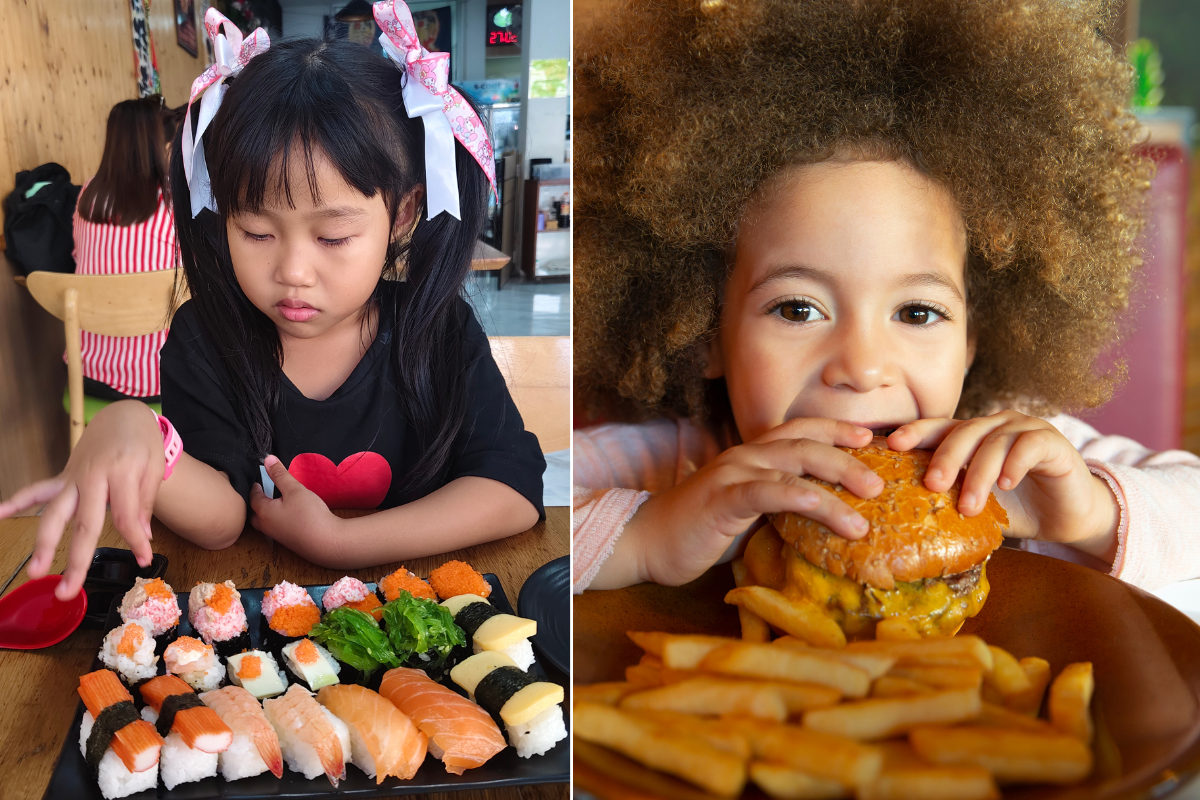
Most American restaurants feature an altered menu for children, usually with simple foods like grilled cheese, chicken nuggets, or cheeseburgers.
In many—perhaps even most—other countries, children are expected to eat smaller portions of what the adults are eating, even if it’s spicy or complex. In countries like Germany, many restaurants offer a menu item called a “robber’s plate,” an empty plate that allows kids to steal bites from their parents.

2. Homeschooling is rare
According to Pew Research, about 3.4% of American children are homeschooled. That’s a relatively small percentage, but accounts for millions of kids. American parents are keen on homeschooling for many reasons, including distrust of the moral instruction in public schools or worries about the “school environment.”
American parents who move abroad are often surprised to find that homeschooling is extremely rare or even illegal in most other countries. Its popularity is growing in the United Kingdom, but even there, only about 100,000 children are currently homeschooled. In places like Germany and the Netherlands, children are required by law to attend school.
3. Some kids are allowed to drink alcohol
The legal drinking age of 21 is strictly enforced in America, with little to no exceptions. What goes on in people’s private homes is anyone’s guess, but legally speaking, the rules are pretty black and white.
In many countries around the world—including Australia, France, Canada, and Ireland—the legal drinking age is 18, and the overall approach to alcohol is far more casual. However, there are numerous exceptions in several of these places. In the U.K., for example, 15-year-olds can have a beer or glass of wine with dinner at a restaurant as long as they’re supervised by an adult. At home, almost anything goes, with the minimum legal drinking age on private premises in the U.K. being five—although doctors strongly advise against this.
4. Postpartum care
In America, it’s common for mothers to leave the hospital about 48 to 96 hours after giving birth, depending on the delivery method and any complications. In the past, new moms would get a single postpartum checkup about six weeks later, although standards have recently changed to encourage earlier support.
Giving birth in other countries around the world can be drastically different. In the U.K., new mothers can be discharged from the hospital as soon as six hours after an uncomplicated birth, which is one of the fastest turnarounds in the world.
In China, however, it’s common for new moms to “sit the month” and take 30 to 40 days of confined rest at home or in a “birth hotel.” South Korea, meanwhile, sends about 85% of new mothers to a joriwon, a specialized postpartum care facility, for about two weeks.
5. Independent kids
In the U.S., kids are spending less time outside. Some estimates say only about 6% of children regularly play outside unsupervised, and around 11% walk or bike to school alone, a number that has fallen dramatically over time.
This is a stark difference from many other cultures around the world, where kids frequently exercise more day-to-day independence. In most European countries, at least 40% of kids walk or bike to school. Japan is famous for children as young as six taking the subway and running errands independently, thanks to high levels of social trust.
“We don’t hover and helicopter kids here like American parents,” a U.S. parent living in Switzerland wrote on Reddit. “Kids walk to school on their own in elementary. They can take public transportation on their own, and parents don’t worry.”
6. Bedtime differences
Americans march to the beat of their own drum in the evening, with kids, on average, going to bed early—and almost always in their own beds.
About 90% of American kids under 10 are in bed by 9 p.m. Bedtimes around the world, however, vary greatly, with countries in Southern Europe like Italy and Spain allowing kids to stay up past 10 or 11 p.m. for late dinners and socializing. In other places, bedtime is much more rigorous. Kids in Germany and New Zealand have some of the earliest bedtimes around.
Co-sleeping is also a major difference. Sharing a bed with your infant is on the rise in America, but it’s still recommended against by the American Academy of Pediatrics. However, the U.S. doesn’t hold a candle to countries in Asia, Africa and Latin America, where more than 70% of young children share a bed with their parents.
7. Bilingual kids
About 20% of kids in the U.S. speak more than one language, usually because someone at home speaks it regularly. In many other countries around the world, learning multiple languages is far more common.
According to Quartz, “Almost every country in Europe requires students as young as six to learn a foreign language, usually English. Even more impressive, over 20 European countries (including France) require students to learn two foreign languages in school for at least one school year.”
America is far from the most monolingual country, however. Places like Hungary, Japan, South Korea, and Brazil place little importance on kids learning English or any other foreign language.
8. Greeting and talking to adults
It’s common in America for kids to be shy around adults or to have their interactions guided and supervised by a parent. In many other countries, kids are taught from a young age to formally greet adults as a show of respect.
“Greeting and talking to adults is taught early on,” wrote one U.S. parent who raised their children in Spain. “My boys always note how awkward some of their US peers are when talking to adults or public speaking. Looking into someone’s eyes when speaking is another thing they noted.”
It’s fascinating to consider alternative approaches to parenting that would seem completely inappropriate in America but tend to work just fine in many other parts of the world. American parents would probably have a hard time letting their six-year-old walk to school independently without drawing suspicion from neighbors or law enforcement. It just goes to show that not every interesting idea can be implemented everywhere, and that our unique cultures shape the way we raise our kids, for better or worse.