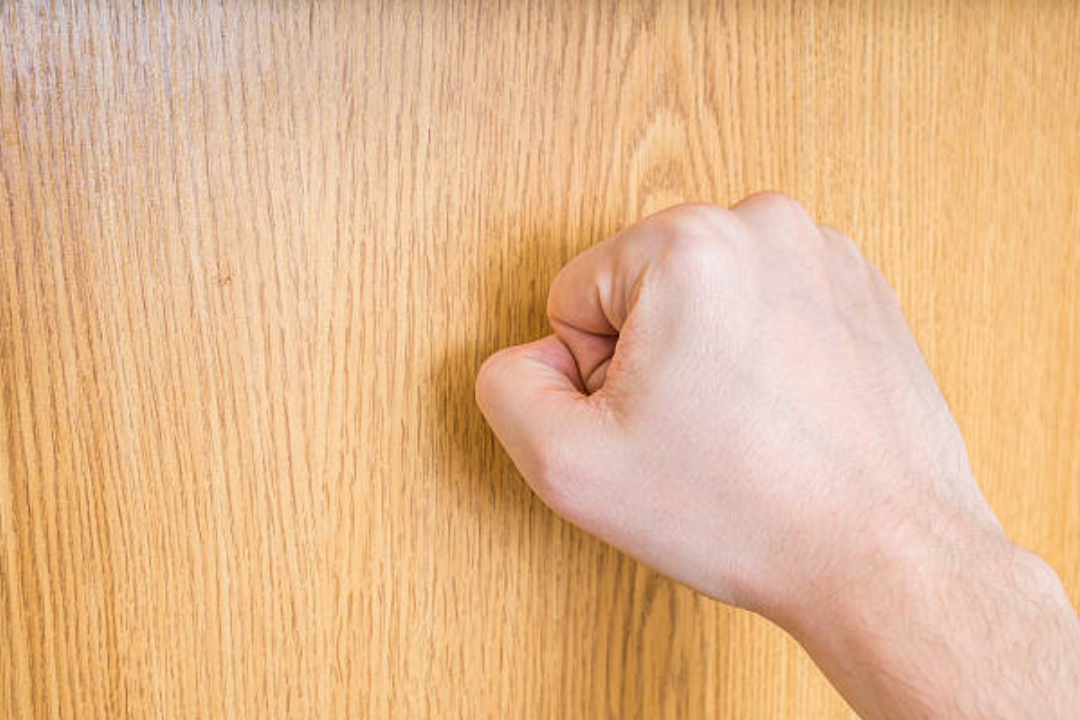
You’re having a great week. No mishaps, no drama, no unexpected bills. “I’m on top of the world!” you shout out loud. Then, suddenly, your hand shoots out to the nearest wooden surface. Your knuckles rap on it a few times, and you didn’t even think about it. What was that?
Sixty percent of Americans “knock on wood,” according to a 2015 60 Minutes/Vanity Fair poll. Most do it almost automatically. But where does the habit come from?
It seems like everyone has a different answer. Ask a group of people, and you’ll get a mix of shrugs, half-remembered myths, and a few confident answers based on a big pile of nothing.
The honest truth: nobody knows for sure. What we do have, however, are a few compelling theories, a paper trail leading back to the 19th century, and fascinating science that explains why we keep doing it—even when we don’t believe in it.
“Knock on wood” or “Touch wood?” Depends on where you live
In the United States, we knock. In the United Kingdom, they touch. Both phrases describe rapping knuckles on wood after saying something hopeful—and they mean the same thing: don’t tempt fate.
Beyond the English-speaking world, the tradition varies. In Turkey, a person pulls their left earlobe and then knocks on wood twice. In Italy and Catalonia, the equivalent phrase is “tocca ferro,” meaning “touch iron.” Sweden has its own version: peppar, peppar, ta i trä, which translates to “pepper, pepper, knock on wood,” and involves throwing pepper over your shoulder for good luck. In Brazil and Portugal, three knocks on wood are necessary—but only on furniture without legs, so most pieces (e.g., standard tables and chairs) don’t qualify.
What do all these diverse customs have in common, and what do they reveal about human nature?
The ancient tree spirit theory (and why scholars don’t like it)
The most romantic explanation traces the phrase “knock on wood” back to pre-Christian pagan traditions. This theory suggests that ancient Celtic and Indo-European cultures believed trees were inhabited by spirits or minor gods, especially oak, ash, and hazel. Knocking on a tree trunk could awaken those spirits to ask for protection, show gratitude for good luck, or drive away malevolent forces lurking in the woods.

It’s a beautiful story. Sacred groves existed across ancient Europe, serving as meeting places between people and the divine. The Druids worshipped the oak. The Scandinavians based their entire cosmology on the ash tree, Yggdrasil. The Germanic Norns—three fate-weaving goddesses—directed destiny through the World Tree itself.
But there’s a problem. As folklorists Jacqueline Simpson and Steve Roud note in A Dictionary of English Folklore, there’s no direct evidence linking these ancient traditions to the modern “knock on wood” superstition. More than a thousand years passed between Europe’s Christianization and the first recorded mention of touching wood. This long interval suggests the practice wasn’t passed down continuously.
The game of tag that may have started everything
So where does the phrase come from? The strongest documented theory points to a Victorian-era children’s game.
The earliest known written reference to “touch wood” as a superstitious practice appears in Ballads in the Cumberland Dialect, published in 1805 by R. Anderson. Folklorists connect it to a game called “Tiggy Touchwood,” a form of tag in which players were safe from being caught as long as they touched something wooden, such as a door, a fence, or a tree. Touching wood meant you were protected.
Roud, a leading folklore scholar, connects the game to the superstition in The Lore of the Playground:
“Given that the game was concerned with ‘protection,’ and was well known to adults and children, it is almost certainly the origin of our superstitious practice of saying, ‘touch wood.’ The claim that it goes back to tree spirits is complete nonsense.”
Religious and historical theories
Although the game theory has the strongest evidence, it’s worth knowing the other stories in circulation.

The Christian Cross Theory suggests that knocking on wood invokes the protective power of Christ’s crucifixion. While religious relics like the True Cross were cherished for their supposed protective powers, this theory mainly explains how the custom may have been reinterpreted through a Christian lens rather than its original genesis. Scholars point to the lack of medieval records linking this idea to superstition, suggesting it is likely a later adaptation tied to seeking divine protection.
The Jewish Persecution Theory, another proposed origin, links wood-knocking to coded signals allegedly used by Jewish communities to signal safe passage during the Spanish Inquisition. While this theory points to another possible protective motivation for the ritual, it’s difficult to verify and appears less frequently in academic literature. Its inclusion illustrates the wide range of narratives people have constructed to make sense of the custom.
The Miners and Sailors Theory points to a more practical foundation: knocking on wooden beams to test their stability, which by extension may have led to a superstition about safety. Similarly, sailors knocked on deck wood for good fortune at sea. Together, these theories suggest how everyday safety rituals could evolve into superstition—even when direct documentation is limited.
Why our brains keep doing it anyway
This is where the science gets truly fascinating. Even people who recognize the habit as irrational still engage in it. And there’s a solid reason why—one that has nothing to do with tree spirits or sacred crosses.
Jane Risen, a behavioral science professor at the University of Chicago, has spent years exploring this very contradiction. In a 2016 article in Psychological Review, she found that individuals can recognize a belief as irrational in real time yet still choose not to challenge it—a phenomenon she terms “acquiescence.” As she explained:
“We see people maintaining these beliefs that they themselves acknowledge are irrational. They’ll say, ‘I know it’s crazy, but I’m going to do this.’ We have [these beliefs] because they’re the output of pretty basic cognitive processes.”
Two systems drive human thinking. The fast, intuitive one makes judgments before the slower, more deliberate system can catch up. As Risen explained, “Detecting an error in your intuitive belief doesn’t necessarily lead you to correcting it. It seems that some intuitions are just very difficult to shake.”
But that’s not all. Researchers at the University of Chicago Booth School of Business published a 2013 study in the Journal of Experimental Psychology finding that the physical motion of knocking on wood is just as important as the saying itself.
Here’s what the study found: participants who knocked downward—pushing force away from themselves—felt a bad outcome was less likely than those who knocked upward or simply held an object. The study suggests this outward physical motion creates a feeling of pushing bad luck away. Rituals like spitting or throwing salt may work the same way.
There’s an emotional payoff, too. “These beliefs and behaviors actually do end up regulating your emotions,” Risen told Discover magazine. “When you knock on wood, you may worry about this less.”
Jacqueline Woolley, a psychologist at the University of Texas at Austin, found that superstitious beliefs are most prevalent around ages five and six, before skepticism begins to develop. Meanwhile, Nadia Brashier, a researcher at Harvard University, observed that adults around age 70 tend to be less superstitious than those around age 19, as accumulated life experience typically reshapes the brain’s understanding of cause and effect.
The meaning behind the knock
Here’s what the research and folklore actually agree on: the phrase “knock on wood” is almost certainly not thousands of years old. Its documented history dates back to the 19th century, likely rooted in a children’s game of tag. The pagan, Christian, and persecution theories make for interesting stories, but none have the same weight of supporting evidence.
What holds up the tradition is psychology. Whether the gesture started with a game of Tiggy Touchwood, a fragment of the True Cross, or a coded knock on a synagogue door, it endures today because of how the human brain functions. We’re wired to seek some control over what we cannot control. A small physical act—touching something solid, directing force away from the body—provides that sense of comfort, even if only for a moment.
The next time your hand reaches for the nearest table after saying something hopeful, you don’t need to feel embarrassed. You’re doing something humans have practiced across cultures for at least two centuries, probably longer. Call it a habit, call it superstition, call it a small act of hope. Whatever you call it, the impulse remains the same: to hold on, just for a moment, to the good things in front of you.