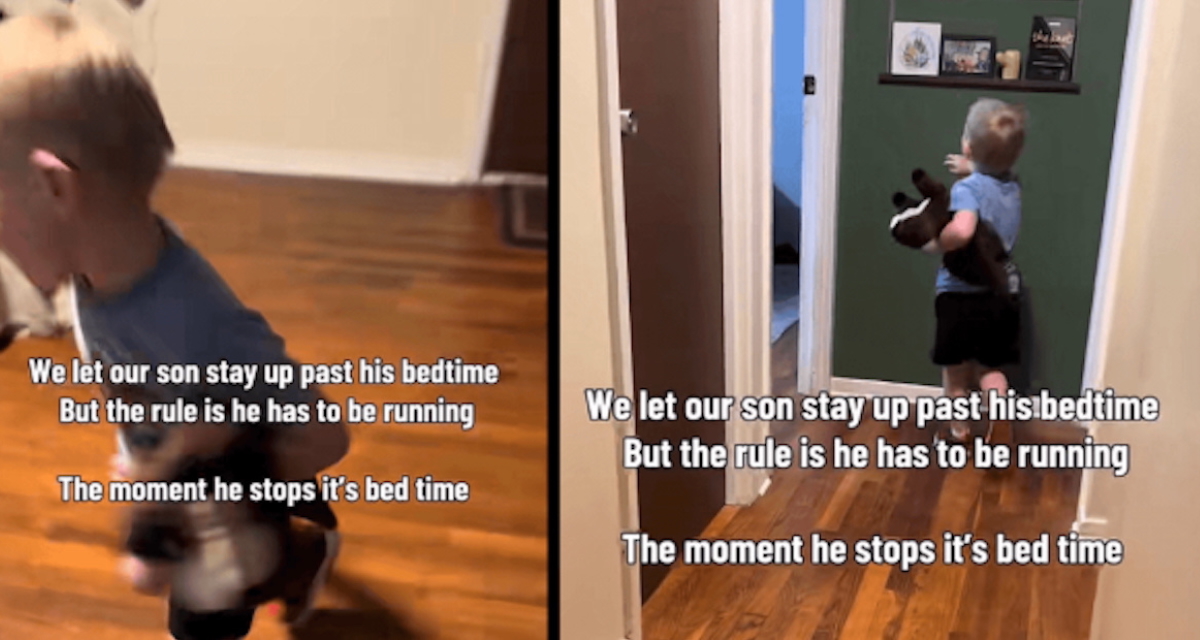
Recently, a TikTok featuring one very determined boy went viral. His parents struck the deal of a lifetime: he could stay up past his bedtime. The only caveat? He had to keep running. The moment he stopped, it was straight to bed. The video shows the little boy sprinting in circles around the room, clinging to those extra minutes of freedom while his parents cheer him on. Three minutes later, he’s wiped. The caption reads, “A win is a win.”
If you’ve ever watched your own kid get this exact second wind, you can probably feel that kid’s energy through the screen. Memories flood in: tiny feet pounding down the hallway, wild giggles, and a voice yelling, “Watch this!” as your toddler launches themselves onto a pile of pillows.
Then, a little voice in your head chimes in: “Fantastic. There goes bedtime.“
But who said that burst of energy before bed is the enemy of sleep? What if it were a crucial part of your child’s nighttime routine? Child‑development and sleep experts agree: under the right conditions, a little active play before bedtime can help some toddlers wind down and sleep more soundly. Let’s unpack what’s going on with those bedtime zoomies—and how to work with them instead of fighting them.
Why toddlers get “jacked up on life” at bedtime
Toddlers collect stress during the day: following rules at daycare; sharing toys they really, really don’t want to; sitting still at dinner; holding in big feelings because you’re not “supposed to” melt down in the grocery store (even though no one wants to buy you that gummy candy you’ve been asking nicely for). By the time evening comes around, all of that unprocessed emotional energy that has been slowly building up is still there in their little bodies.
Active, joyful play gives them a safe pressure valve.
When your toddler is pulling, pushing, jumping, and climbing, their brain releases feel-good endorphins that help them de-stress. Plus, playful contact with parents—wrestling, piggyback rides, being scooped up and spun—boosts oxytocin, the “cuddle hormone” that makes us feel safe and connected. Silly, physical play is essential for toddlers as it helps them move tension through the body and ultimately release it. That’s what’s happening in the viral video as this kid runs laps around the room. “Heavy work” helps many sensory-seeking children feel more regulated and ready for rest.
Think of it as a reset button for an overloaded little nervous system.
The power of active play before bedtime
When you time it right and keep things intentional, a short burst of active play before bed can lead to real, tangible changes. Many “out of nowhere” meltdowns at bedtime aren’t really about their pajamas being itchy or needing “one more story.” They’re the culmination of everything your child has been holding in all day.
That’s why a few minutes of big, silly movement is so essential: it gives that tension a place to go. Laughing, rolling, jumping, and even running laps around their small bedroom is your child’s body saying, “I’m letting go of the day” before heading to bed. They’re practicing turning down the excitement.
Not all play is chaos. Games with start and stop points built in (“run to the wall… now, FREEZE!”), games that take turns, and those that toggle between fast and slow tempos help toddlers learn that their energy comes with emergency brakes.
That’s emotional regulation in disguise. You’re teaching their brain, “We can go big… and then we can come back down.” That same skill shows up later when it’s time to be still, close their eyes, and drift off.
It deepens your connection
Most toddlers just want their parents to be there at bedtime, present and solely focused on them. When you put your phone down and spend even five minutes playing—being the horse and letting them climb on top of you, assuming the role of ‘tickle monster’ or the bridge they crawl under—you add to their sense of connection right before the hardest separation of the day: saying goodnight.
Feeling seen and secure can make bedtime seem less like a painful goodbye and more like a soft landing. Large sleep studies on young children have found that simple, consistent bedtime routines—brushing teeth, reading stories, cuddling, a light jog—are linked with longer, less disruptive sleep and fewer behavioral struggles over time.
It helps their bodies feel ready to rest
In the same way that adults sleep more deeply after a long walk or a workout, toddlers’ bodies respond to movement. A little physical effort equals a calm mind, which sends the clear signal: “Oh, right. We already did our big moves. Now, we can rest.”

For some families, that combination (physical activity and emotional regulation) can lead to faster bedtimes, fewer “one more” negotiations, and restorative sleep. Instead of an emotional 40-minute standoff about “I’m not ready for bed” nonsense (even when their eyes are literally halfway closed), their bedtime routine transforms into an easy cycle: five minutes of running around, a deep breath, one fairytale, and lights off.
How to add energy that doesn’t wreck bedtime
An important note: this is not about letting your child go wild until they crash. It’s a little intentional play that turns into a clear, gentle slide into calm. The viral TikTok provides a wonderful example of that system at play: parents say yes to movement, but it’s contained within the parameters of “bedtime.”
1. Start early
Aim to begin active play about 40–60 minutes before bedtime. Keep the high-energy section brief, ideally about 5 to 15 minutes. Consider running, jumping, and horse play as openers to your bedtime routine, not the grand finale.
2. Choose “heavy work” activities
Many toddlers, especially the endlessly wiggly ones, crave what therapists call “heavy work”: pushing, pulling, climbing, and crashing that give deep input to their muscles and joints. For many sensory‑seeking kids, that kind of play is especially soothing.
- Pull your toddler on a smooth blanket down the hallway like a “train ride.”
- Let them jump from a mini trampoline or low stool into a safe pillow pile.
- Offer piggyback rides and pretend you are different animals (a bouncy kangaroo, a slow turtle, a galloping horse).
Again, the goal isn’t to exhaust them. Their bodies are chock-full of pent-up energy. Laughing and physical activity act as powerful release valves.
3. Build a clear transition
When active play is over, you need a simple ritual that says, “We’re shifting gears now.”
You might:
- Set a simple timer and say, “Two more minutes of big play, then we are heading to the bath.”
- Turn the overhead lights down and switch on a softer lamp.
- Lower your voice and move into the next steady step: bath, pajamas, teeth, stories.
For this portion, it’s wise to repeat the same order and steps on most nights. Their brains start to recognize the pattern: big play leads to a calm routine, which turns into sleep.

4. Stay present, even if you’re tired
No one is asking you to suit up and become a wrestling maniac every night like it’s the WWE. But even when you’re exhausted or “touched out,” you can still provide an anchor.
Set up the pillow pile. Hold the blanket they are pulling. Referee a sibling “pillow tower demolition.” Cheer them on from the floor as they run their own version of that TikTok sprint.
More than any specific game, your attention makes this one of connection, not chaos.
Oh, and never forget that safety is non-negotiable. Before engaging in active play, scan the room for sharp corners or tripping hazards. Skip roughhousing if your child already looks overtired or seems unsteady.
When active play may not be the right fit
For some kids, bedtime rough-and-tumble is simply not the answer. That’s okay. If your toddler is sensitive to noise, sudden movement, and general chaos, high-energy play in the evening might leave their pint-sized nervous system feeling frenetic rather than soothed. Children who are “sensory avoidant” often wind down better with gentler, predictable routines before sleep.
Red flags that the play is too much or too late:
- Their giggles tip into frantic, wild running they cannot seem to stop.
- They are more tearful, not less, once the game ends.
- It consistently pushes bedtime later and later, even with a calm routine afterward.
In cases like these, consider leaning into cozy sensory activities, like deep pressure hugs, slow rocking, or quiet stretches, and keep high-energy play earlier in the day.
Make bedtime more joyful
Sure, bedtime can be stressful, but it can also provide a daily opportunity to reconnect with your child.
A few moments of wild laughter. A blanket ride down the hallway. One last big jump into your arms. These are the moments their bodies will remember when the lights go out. It all provides a sense of “I moved, I let it out, I am safe. They are here.”
For some toddlers, this is exactly the safety that lets their brain finally say, “Okay, I can sleep now.”
If you have a high-energy child, you might try five minutes of play tonight. See what happens. Under the right conditions, those bedtime zoomies might be the precursor of a sweet night’s sleep for both of you.