The Great Depression began in the United States in 1929 and ended in 1939. One silver lining of the Great Depression was the expansion of hobbies.
During the Great Depression, people found affordable ways to find joy amid the heaviness. According to Santa Clara University, “the hobby boom of the Thirties probably represented a real increase in mass participation…there was an important change in the meaning of hobbies as personal activity.”
Even with little money to spend, a number of frugal hobbies came out of the Great Depression. Many are still enjoyed today and just might become your next obsession.
6 frugal Great Depression hobbies
Board games
Sitting with friends and family to play a fun board game was an engaging way for people to spend time together during the Great Depression.
First created in 1904 by Lizzie Magie (who called it The Landlord’s Game), the popular board game Monopoly (as we know it today) was patented in December 1935 by Charles B. Darrow. Other board games created during the Great Depression that we still play today include Scrabble (invented in 1938) and Sorry! (patented in 1934). Other popular games at the time included Go to the Head of the Class and Jury Box.
Jigsaw puzzles
During the 1930s, America had a jigsaw puzzle craze. Cut by hand using a scroll saw, also known as a jigsaw, the puzzle’s popularity also created new jobs. However, that also meant the puzzles weren’t super cheap. But libraries began to rent them out for 5 cents a day or 25 cents a week, according to Bates College. Puzzle clubs and puzzle exchanges also popped up.
Ultimately, production technology improved, making jigsaw puzzles mass-produced and inexpensive. The puzzles came in a variety of styles, often featuring images of idyllic vacation spots or political figures (such as this Franklin D. Roosevelt jigsaw from 1933).
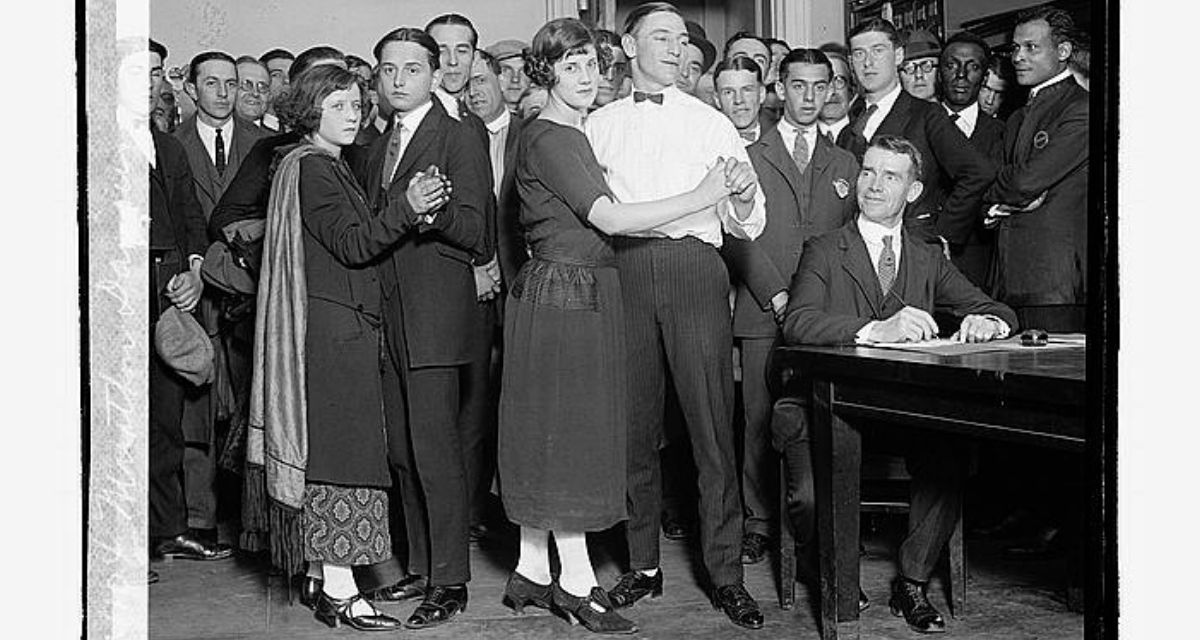
Dance marathons (or marathon dancing)
Dance marathons popped up before the Great Depression began, with the first event documented in New York City in 1923 by dance instructor Alma Cummings, who danced for 27 hours straight. The concept of the dance marathon caught on, and the goal was nonstop dancing for hours on end.
During the Great Depression, dance marathons offered shelter as well as food to many unemployed people. They became promoted events, offering prize money that drew in large crowds of spectators who paid to watch participants.
Promoter Richard Elliott noted that they “came to see ’em suffer, and to see when they were going to fall down. They wanted to see if their favorites were going to make it.”
Walkathons
Dance marathons eventually fell out of favor and were replaced with walkathons. Held at dance halls, walkathon participants paced around dance halls for hours on end.
Like dance marathons, walkathons also drew crowds. “Public dances were also held many evenings simultaneously with the competition, and vaudeville acts sometimes performed during rest periods,” according to the McLean County Museum of History.
In the May 30, 1938, issue of LIFE magazine, they wrote: “People go to a walkathon not to see performers dance, which they don’t, but to see them suffer under the agonies of overwhelming exhaustion.”
Stamp collecting
Although stamp collecting began long before the Great Depression, it was President Franklin D. Roosevelt (he was President from 1933-1945) who was responsible for its resurgence during the Great Depression. According to the Smithsonian National Postal Museum, Roosevelt collected stamps his whole life and looked at his collection daily.
He also “joined stamp clubs, bought stamps from dealers and in auction, and promoted the hobby by association with stamp shows such as the 1936 international exhibition TIPEX in New York City. During the 1930s, he and Postmaster General James A. Farley enthusiastically brainstormed over stamp designs, colors, and themes. Roosevelt actually sketched numerous ideas for stamp designs.”
Bird watching
Another hobby that had a revival during the Great Depression was bird watching, thanks to the popularity of A Field Guide to the Birds by conservationist Roger Tory Peterson, released in 1934.
It sold out in days and went on to become a “classic of ornithological literature” that “was so popular because of its simple approach. Rather than full descriptions of species, it focused on field marks and schematic illustrations by the author, who was also an artist.”