Woman featured in iconic Great Depression photo didn't know she was famous until 40 years later
Florence Owens Thompson later revealed she wished her photo had never been taken.
It's one of the most iconic and haunting photos of all time, up there with the likes of Hindenburg, The Falling Soldier, Burning Monk, Napalm Girl, and many others. It's called simply Migrant Mother, and it paints a better picture of the time in which it was taken than any book or interview possibly could.
Nearly everyone across the globe knows Florence Owens Thompson's face from newspapers, magazines, and history books. The young, destitute mother was the face of The Great Depression, her worried, suntanned face looking absolutely defeated as several of her children took comfort by resting on her thin frame. Thompson put a human face and emotion behind the very real struggle of the era, but she wasn't even aware of her role in helping to bring awareness to the effects of the Great Depression on families.
It turns out that Dorothea Lange, the photographer responsible for capturing the worry-stricken mother in the now-famous photo, told Thompson that the photos wouldn't be published.
Of course, they subsequently were published in the San Francisco News. At the time the photo was taken, Thompson was supposedly only taking respite at the migrant campsite with her seven children after the family car broke down near the campsite. The photo was taken in March 1936 in Nipomo, California when Lange was concluding a month's long photography excursion documenting migrant farm labor.

"Migrant worker" was a term that meant something quite different than it does today. It was primarily used in the 30s to describe poverty-stricken Americans who moved from town to town harvesting the crops for farmers.
The pay was abysmal and not enough to sustain a family, but harvesting was what Thompson knew as she was born and raised in "Indian Territory," (now Oklahoma) on a farm. Her father was Choctaw and her mother was white. After the death of her husband, Thompson supported her children the best way she knew how: working long hours in the field.
"I'd hit that cotton field before daylight and stay out there until it got so dark I couldn't see," Thompson told NBC in 1979 a few years before her death.

When talking about meeting Thompson, Lange wrote in her article titled "The Assignment I'll Never Forget: Migrant Mother," which appeared in Popular Photography, Feb. 1960, "I saw and approached the hungry and desperate mother, as if drawn by a magnet. I do not remember how I explained my presence or my camera to her, but I do remember she asked me no questions. I made five exposures, working closer and closer from the same direction. I did not ask her name or her history. She told me her age, that she was thirty-two. She said that they had been living on frozen vegetables from the surrounding fields, and birds that the children killed."
Lange goes on to surmise that Thompson cooperated because on some level she knew the photos would help, though from Thompson's account she had no idea the photos would make it to print. Without her knowledge, Thompson became known as "The Dustbowl Mona Lisa," which didn't translate into money in the poor family's pocket.
In fact, according to a history buff who goes by @baewatch86 on TikTok, Thompson didn't find out she was famous until 40 years later after a journalist tracked her down in 1978 to ask how she felt about being a famous face of the depression.
@baewatch86 Florence Thompson, American Motherhood. #fyppppppppppppppppppppppp #historytok #americanhistory #migrantmother #thegreatdepression #dorthealange #womenshistory
It turns out Thompson wished her photo had never been taken since she never received any funds for her likeness being used. Baewatch explains, "because Dorothea Lange's work was funded by the federal government this photo was considered public domain and therefore Mrs. Florence and her family are not entitled to the royalties."
While the photo didn't provide direct financial compensation for Thompson, the "virality" of it helped to feed migrant farm workers. "When these photos were published, it immediately caught people's attention. The federal government sent food and other resources to those migrant camps to help the people that were there that were starving, they needed resources and this is the catalyst. This photo was the catalyst to the government intercepting and providing aid to people," Baewatch shares.
- YouTube www.youtube.com
As for Lange, Migrant Mother was not her only influential photograph of the Great Depression. She captured many moving images of farmers who had been devastated by the Dust Bowl and were forced into a migrant lifestyle.
"Broke, baby sick, and car trouble!" is just one of her many incredible photos from the same year, 1937.
She also did tremendous work covering Japanese internment in the 1940s, and was eventually inducted into the International Photography Hall of Fame and Museum and the National Women's Hall of Fame.

Thompson did find some semblance of financial comfort later in life when she married a man named George Thompson, who would be her third husband. In total, she had 10 children. When Thompson's health declined with age, people rallied around to help pay her medical bills citing the importance of the 1936 photo in their own lives. The "Migrant Mother" passed away in 1983, just over a week after her 80th birthday. She was buried in California.
"Florence Leona Thompson, Migrant Mother. A legend of the strength of American motherhood," her gravestone reads.
- WWI vets got the short end of the stick in the Great Depression. This was their answer. ›
- Is the 'cure worse than the disease?' Health stats from the Great Depression show it's not. ›
- 8 Depression-era Thanksgiving meal ideas that still hold up today ›
- 17 Great Depression recipes people still cook today during hard times ›


Animals aren't able to tell us exactly how they are feeling.
Vets often share clues that "it's time."
A little early is better than too late.
Relaxed moment by the window with a thoughtful gaze.
Friendly conversation in a bright office setting.
Understanding the Parent-Teen Connection: A Digital Moment.
Older man talking to younger man.
12 non-threatening leadership strategies for women
We mustn't hurt a man's feelings.
Men and the feels.
Note: This an excerpt is from Sarah Cooper's book, How to Be Successful Without Hurting Men's Feelings.
In this fast-paced business world, female leaders need to make sure they're not perceived as pushy, aggressive, or competent.
One way to do that is to alter your leadership style to account for the fragile male ego.
Should men accept powerful women and not feel threatened by them? Yes. Is that asking too much?
IS IT?
Sorry, I didn't mean to get aggressive there. Anyhoo, here are twelve non-threatening leadership strategies for women.
Encourage.
With permission from Sarah Cooper.
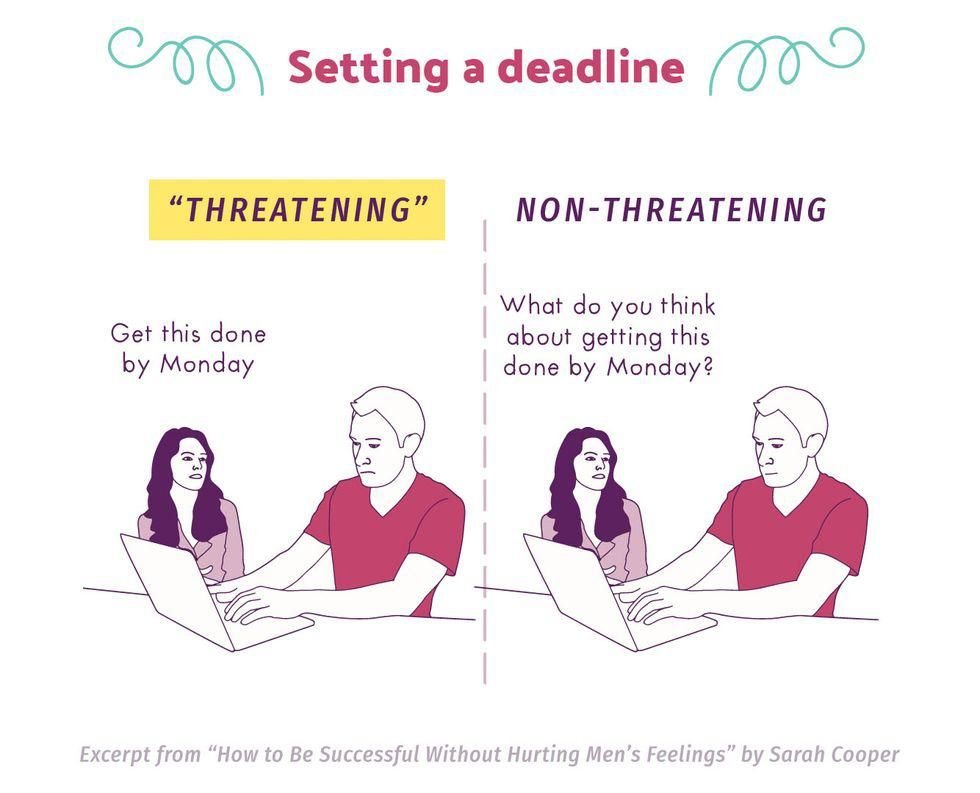
When setting a deadline, ask your coworker what he thinks of doing something, instead of just asking him to get it done. This makes him feel less like you're telling him what to do and more like you care about his opinions.
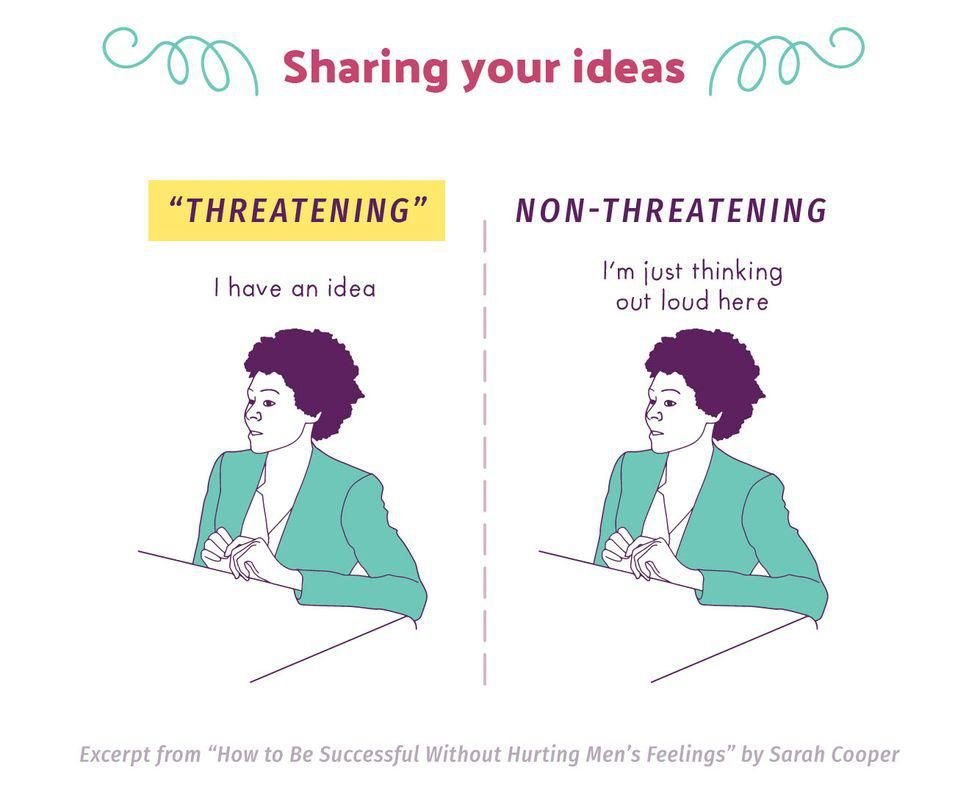
Sharing ideas.
With permission from Sarah Cooper.
When sharing your ideas, overconfidence is a killer. You don't want your male coworkers to think you're getting all uppity. Instead, downplay your ideas as just "thinking out loud," "throwing something out there," or sharing something "dumb," "random," or "crazy."
Email requests.
With permission from Sarah Cooper.
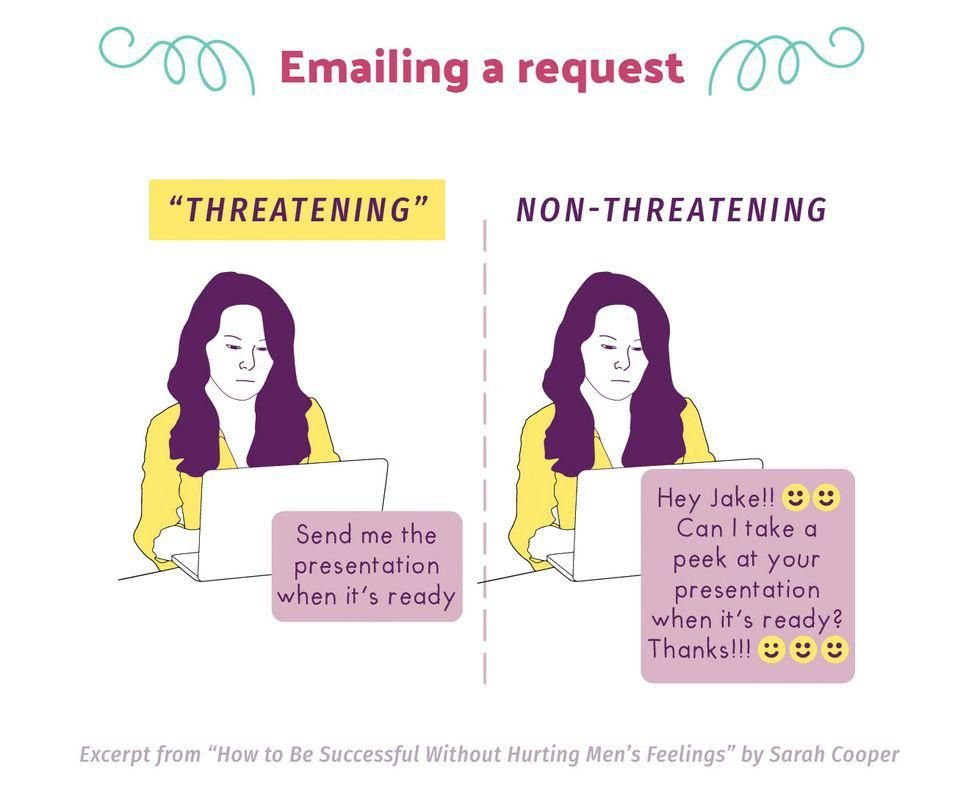
Pepper your emails with exclamation marks and emojis so you don't come across as too clear or direct. Your lack of efficient communication will make you seem more approachable.
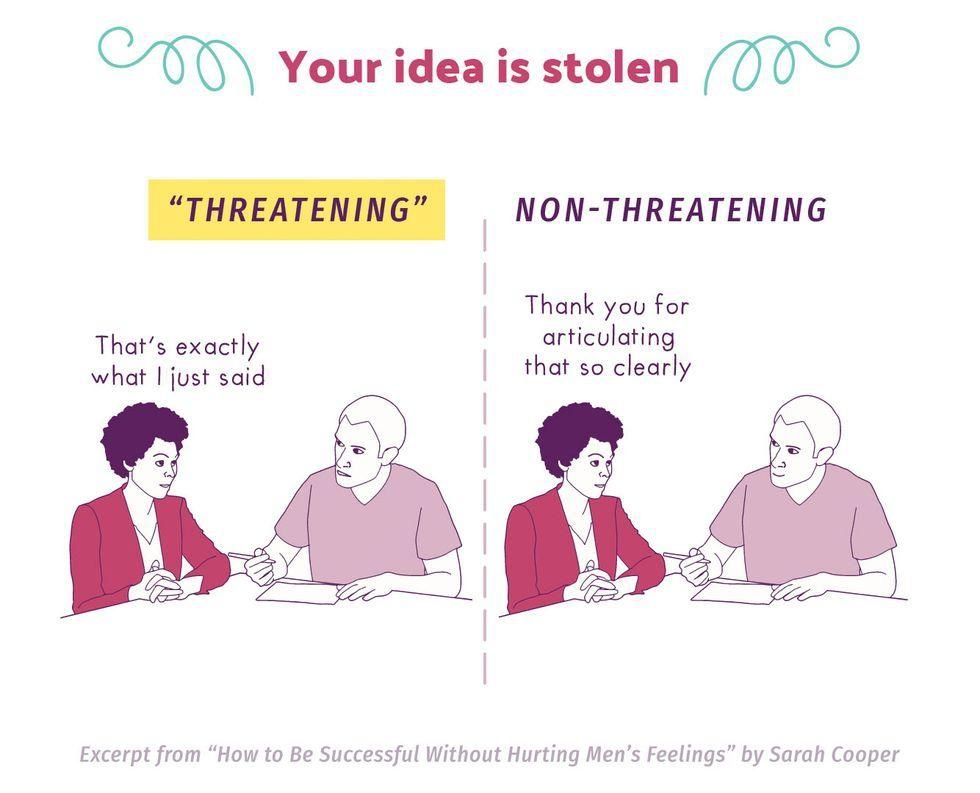
Idea sharing.
With permission from Sarah Cooper.
If a male coworker steals your idea in a meeting, thank him for it. Give him kudos for how he explained your idea so clearly. And let's face it, no one might've ever heard it if he hadn't repeated it.
Sexism.
With permission from Sarah Cooper.
When you hear a sexist comment, the awkward laugh is key. Practice your awkward laugh at home, with your friends and family, and in the mirror. Make sure you sound truly delighted even as your soul is dying inside.

Mansplain.
With permission from Sarah Cooper.
Men love explaining things. But when he's explaining something and you already know that, it might be tempting to say, "I already know that." Instead, have him explain it to you over and over again. It will make him feel useful and will give you some time to think about how to avoid him in the future.

Mistakes.
With permission from Sarah Cooper.
Pointing out a mistake is always risky so it's important to always apologize for noticing the mistake and then make sure that no one thinks you're too sure about it. People will appreciate your "hey what do I know?!" sensibilities.
Promotions.
With permission from Sarah Cooper.
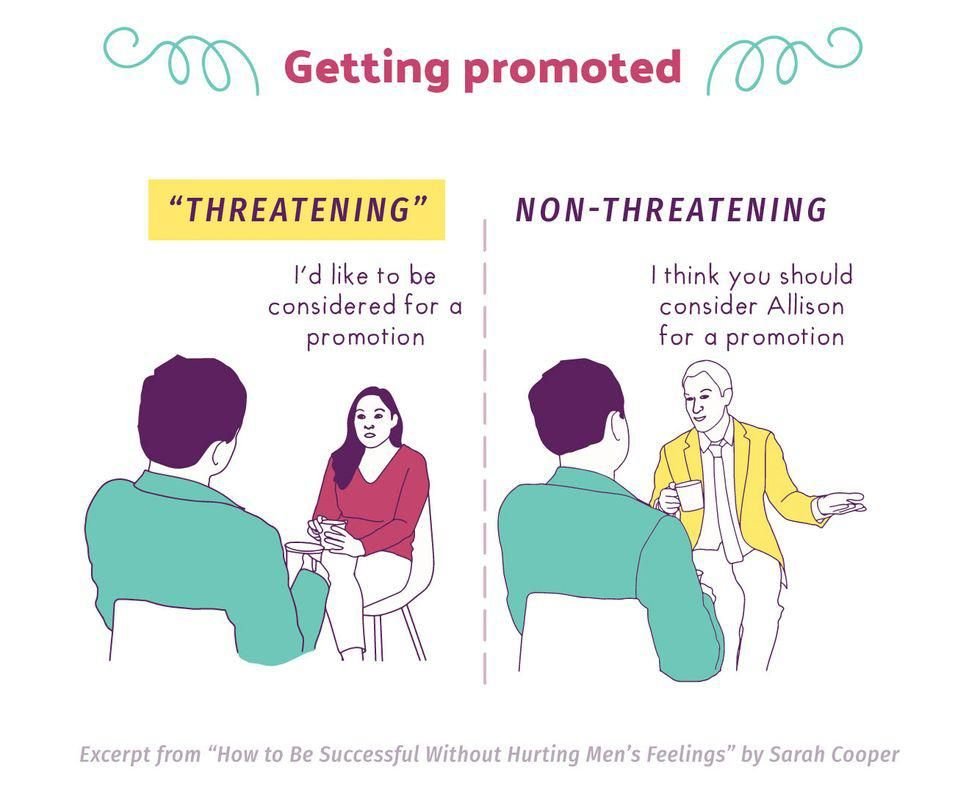
Asking your manager for a promotion could make you seem power- hungry, opportunistic, and transparent. Instead, ask a male coworker to vouch for you. Have your coworker tell your manager you'd be great for the role even though you don't really want it. This will make you more likely to actually get that promotion.
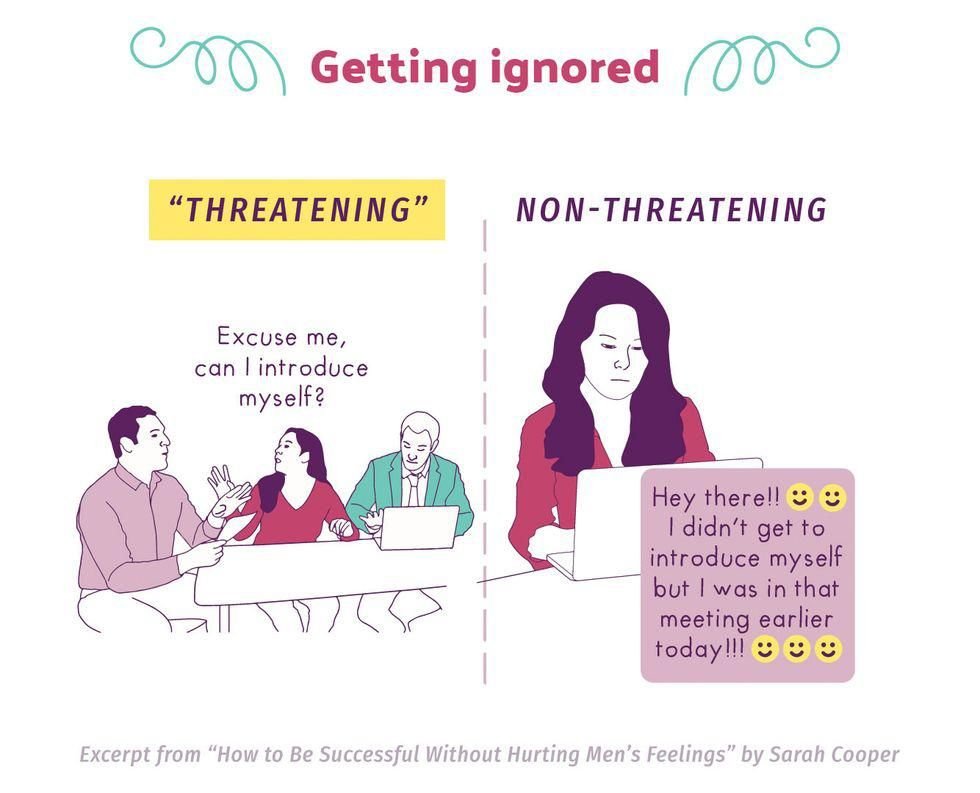
Rude.
With permission from Sarah Cooper.
Sometimes not everyone is properly introduced at the start of a meeting. Don't take it personally even if it happens to you all the time, and certainly don't stop the meeting from moving forward to introduce yourself. Sending a quick note afterward is the best way to introduce yourself without seeming too self-important.
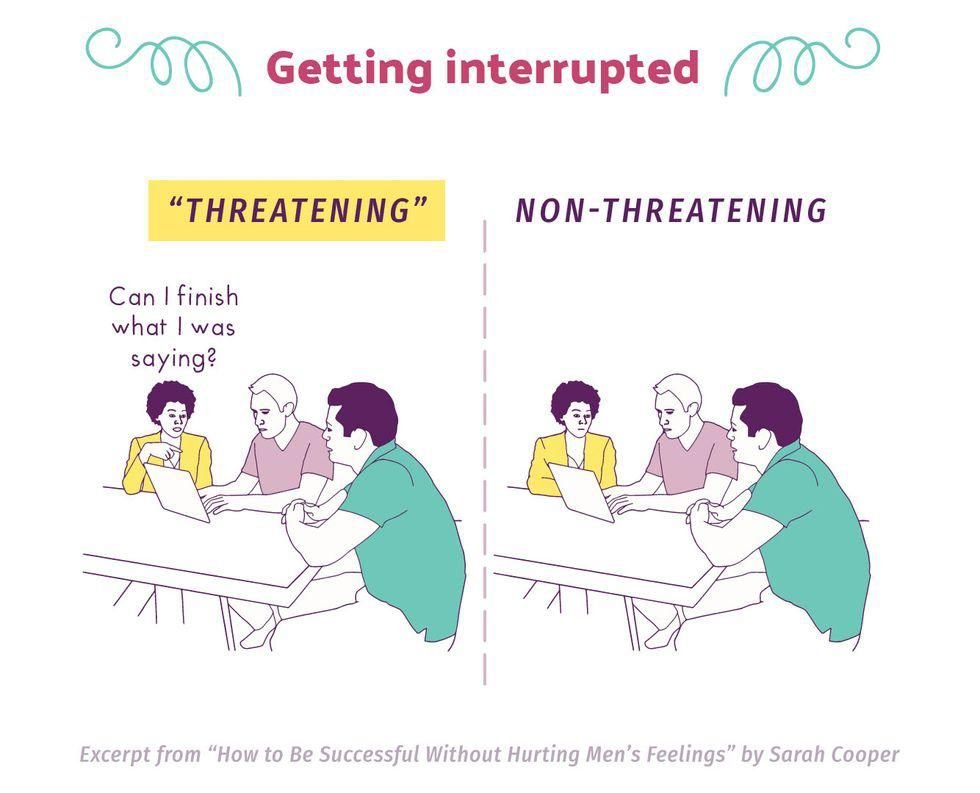
Interruptions.
With permission from Sarah Cooper.
When you get interrupted, you might be tempted to just continue talking or even ask if you can finish what you were saying. This is treacherous territory. Instead, simply stop talking. The path of least resistance is silence.
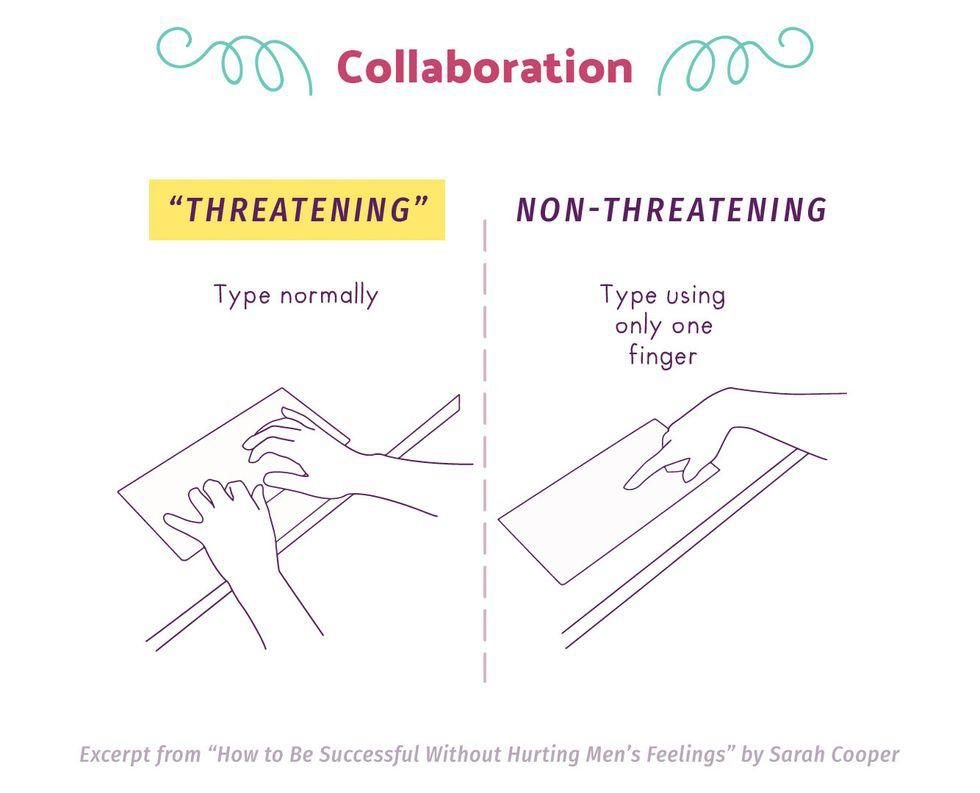
Collaboration.
With permission from Sarah Cooper.
When collaborating with a man, type using only one finger. Skill and speed are very off-putting.

Disagreements.
With permission from Sarah Cooper.
When all else fails, wear a mustache so everyone sees you as more man-like. This will cancel out any need to change your leadership style. In fact, you may even get a quick promotion!

In conclusion...
With permission from Sarah Cooper.
Many women have discovered the secret power of non-threatening leadership. We call it a "secret power" because no one else actually knows about it. We keep our power hidden within ourselves so that it doesn't frighten and intimidate others. That's what makes us the true unsung heroes of the corporate world.
About the Author: Sarah Cooper
Sarah Cooper is a writer, comedian, and author of 100 Tricks to Appear Smart in Meetings. Her new book, How to Be Successful Without Hurting Men's Feelings, is out now.
The comedic book cover.
With permission from Sarah Cooper.
A satirical take on what it's like to be a woman in the workplace, Cooper draws from her experience as a former executive in the world of tech (she's a former Googler and Yahooer). You can get the book here.
This article was originally published on 3.25.19