
Finding a job is already hard enough, and these days, it’s getting harder.
The average job seeker is dealing with a rapid rise in ghost jobs (roles that don’t technically exist), offshoring, and a general flooding of the market. A typical applicant will apply to over 200 individual jobs before landing a new position. And now, AI agents and algorithms are filtering out candidates before human recruiters even lay eyes on their resumes—and a lot of good hires are getting swept away because of so-called “red flags.”
One big red flag AI is trained to look for is a big employment gap.
Woman on LinkedIn eviscerates the ‘resume gap police’
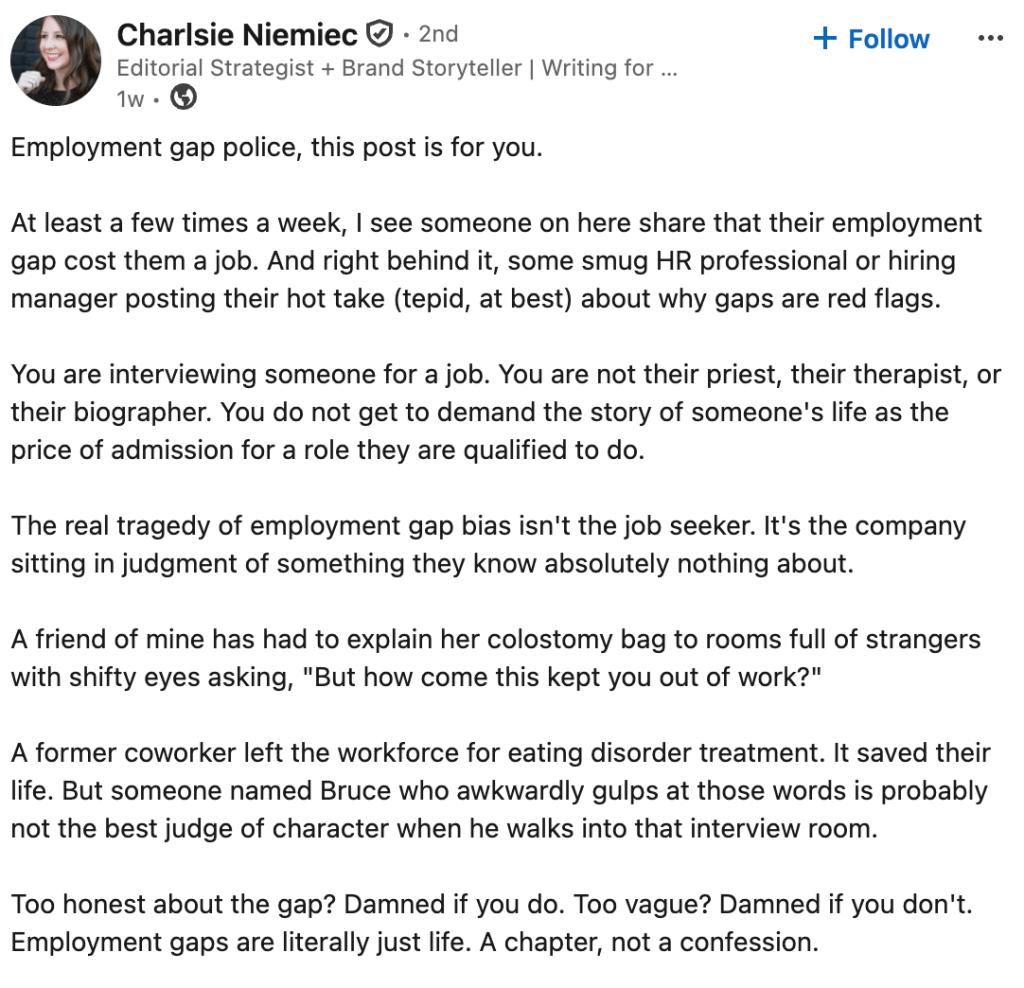
A post on LinkedIn from Charlsie Niemiec, an editorial strategist, is making big waves. In it, Niemiec tackles the epidemic of human recruiters or interviewers—and their AI counterparts—demanding explanations for long gaps in employment.
She calls them the “employment gap police.”
“You are interviewing someone for a job. You are not their priest, their therapist, or their biographer. You do not get to demand the story of someone’s life as the price of admission for a role they are qualified to do,” Niemiec writes.
“The real tragedy of employment gap bias isn’t the job seeker. It’s the company sitting in judgment of something they know absolutely nothing about.”
Niemiec goes on to explain how a friend had to address the sensitive topic of her colostomy bag and how it kept her out of work for a while. Another friend took time off to deal with an eating disorder. Many others—nearly a quarter of all American workers—have taken leave to care for an ill family member. Sometimes that involves a leave of absence from work, other times it means stepping away from their career entirely for a while.
Niemiec argues that candidates should be judged based on their skills and experience
“You need 6 years of project management experience? They have it. You need a content strategist who has led campaigns end-to-end? They have done it,” she writes. “So why the 3rd degree about everything they endured during a gap?”
“Nobody owes you the story of the four months they spent learning how to live without their husband, who died from cancer, or what 12 back-to-back spinal surgeries felt like.”
HR and recruiting practices have made progress toward becoming more human-centered. It’s more understood now that gaps in employment on a resume are common, and usually the result of life-circumstances rather than some kind of character red flag.
However, the comments under Niemiec’s post indicate that the practice has not fully gone away. And AI resume scanners—or Applicant Tracking Systems (ATS)—have made the problem worse.
Too many have been affected by the ‘gap police’
“I don’t mean to denigrate recruiting folks, because I know that most are good people who work hard at a relatively thankless job, but MAN there are some vocal ones on LinkedIn who will DIE on whatever really dumb, esoteric recruiting hill they’ve selected,” wrote one commenter.
“The lack of empathy I’ve continued to see since the pandemic continues to be wild,” shared another.
This commenter shared an anecdote: “Someone asked me about an employment gap on my resume I pointed out that I got 2 certifications during that gap ‘You should put those on your resume’ they told me ‘They are the first section of my resume’ I replied.”
“Moms who took a break for their kids know exactly what you’re talking about here,” wrote someone else.
Too many people find they have to carefully craft and position their answers in order to provide a satisfying explanation.
“Employment gaps are literally just life,” Niemiec says.
In the end, Niemiec implores interviews, HR reps, and recruiters to focus on the job at hand and leave the moral judgments at the door.
“The interview room is not a confessional, and you are not absolution,” she writes.
This is why more and more companies are turning to equitable hiring practices that include blind interviews and screening, more transparent job listings, and even ditching resumes entirely.
In 2026, no company can afford to leave great candidates behind because of an oudated view of supposed “red flags.”