Viral photo of an ailing Jimmy Carter turns into an outburst of gratitude for ex-president

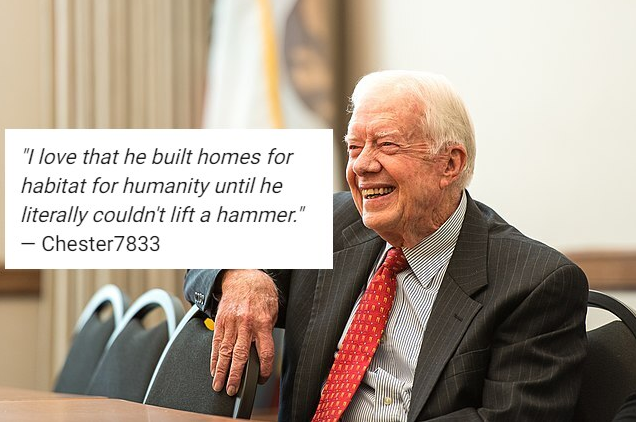
“I love that he built homes for habitat for humanity until he literally couldn’t lift a hammer.”

jimmy carter, jimmy carter hospice, jimmy carter condition
Photo credit: via Commonwealth Club/Wikimedia CommonsFormer president Jimmy Carter at the Commonwealth Club in California.

Former President Jimmy Carter, 99, is known for being a man of tremendous character who rose from a humble Georgia peanut farmer to president of the United States. He was elected in 1976 when America was reeling from the Watergate scandal and turned its eyes to an outsider with integrity.

Carter, a Democrat, served as president from 1977 to 1981, when Republican Ronald Reagan defeated him. After his presidency, he dedicated his life to public service, exemplified by his humanitarian work through the Carter Center, which focused on global health, democracy and human rights.

On Tuesday, March 14, Carter’s grandson, Jason Carter, announced that the former president was “coming to the end” of his life in a statement made at the Carter Center. The 39th president has been under hospice care since February 2023 and in November, he lost his wife, Rosalynn, at the age of 96.


“(My grandfather) is doing OK,” Jason Carter said at a mental health forum at the Carter Center. “He has been in hospice, as you know, for almost a year and a half now, and he really is, I think, coming to the end that, as I’ve said before, there’s a part of this faith journey that is so important to him, and there’s a part of that faith journey that you only can live at the very end and I think he has been there in that space.”

Former president Jimmy Carter
byu/Justin_Godfrey inpics

News of Carter’s decline inspired people on Reddit to share a photo of him taken at his wife’s funeral at Maranatha Baptist Church, on November 29, 2023, in Plains, Georgia. In the photo, the once vibrant man is seen in a wheelchair, looking frail and wearing a suit.

Even though the photo of Carter isn’t flattering, it’s a testament to his stamina that propelled him to serve his community and the world until deep into his 90s. Commenters used the post as an opportunity to lavish their praise on a man who’s often referred to as the greatest ex-president one of the most decent men to ever hold the office.

“Interesting fact: Jimmy Carter has been alive through 40% of the whole US history” — Dacadey

“I love that he built homes for habitat for humanity until he literally couldn’t lift a hammer.” — Chester7833

“A true life of service.” — Faux Real

One commenter noted one of Carter’s greatest achievements was working to eradicate Guinea worm. “His work with the eradication of the guinea worm saves countless lives from unnecessary pain and scarring. And he never asked any recognition for it,” Press465 wrote.

Forty years ago, 3.5 million cases of Guinea worm were reported annually, but thanks to the work of Carter’s team, there were only 13 in 2022. The disease, caused by parasitic worms that can grow up to 3 feet, causes severe skin lesions, debilitating those infected and causing extensive absences from school or work. By establishing educational programs on the risks of infection, primarily spread through contaminated water, Carter’s team helped its eradication in several countries, including the Democratic Republic of Congo.

“I came to the conclusion a while ago that he’s the one president at least in ‘modern’ times that was too good of a person for the office.” — RevengencerAlf

“I find it amazing that when he was beaten for a second term, people were putting down the solar panels he had, putting him down as ineffective (although he did get hostages back) and so on. And today’s voters see him as fantastic. He did everything he was supposed to – put his peanut company in a trust (?) So he had no control of it, chose to negotiate, was forward thinking with technology (solar panels), and he by far has had the best after-presidency career with Habitat for Humanity. He’s just a good, honest guy who has done his best to give back and I find that to be truly remarkable.” — Estrogen


  • Mom is baffled why her Millennial and Gen Z kids refuse to watch TV without subtitles
    Photo credit: via GibsonIsHere/TikTok and Andrea Piacquadio/Pexels The generational caption debate is a big deal.

    Have you ever had trouble catching all of the dialogue in a TV show or movie at home? Not necessarily because you’re hard of hearing, but because you were distracted, the speakers on your television are terrible, the sound mixing is all over the place, or the characters were just talking really fast? If so, you should definitely take a cue from the younger generations.

    If you’re a Gen Xer or older, one surprising habit the younger generations developed is their love of subtitles or closed-captioning while watching TV, during which every word of dialogue appears in crystal clear white text at the bottom of the screen. To older generations, closed-captioning was only for grandparents, the hearing impaired or when watching the news in a restaurant or gym.

    But these days, studies show that Millennials and Gen Z are big fans of captions and regularly turn them on when watching their favorite streaming platforms.

    Subtitles are becoming the new normal

    A recent study found that more than half of Gen Z and Millennials prefer captions on when watching television. It’s believed that their preference for subtitles stems from the ubiquity of captioning on social media sites such as TikTok or Instagram. Think about it, most of us watch videos on their phone without the sound, so younger people in particular are used to and adept at following along this way without missing a beat. It’s comfortable for them.

    This generational change perplexed TikTokker, teacher and Gen X mother, Kelly Gibson.

    “I have three daughters, and they were here. Two of them are young millennials; the other one is an older Gen Z,” Gibson explained in a video that went viral. “All of them were like, ‘Why don’t you have the captions on?’”

    The mother couldn’t believe that her young kids preferred to watch TV like her grandparents. It just did not compute.

    “My Gen X butt was shocked to find out that these young people have decided it’s absolutely OK to watch movies with the captions going the whole time,” she said jokingly.

    Why subtitles? One reason is focus

    Like a good mother, Gibson asked her girls why they preferred to watch TV with captioning, and their reason was straightforward: With subtitles, it’s easier not to lose track of the dialog if people in the room start talking.

    The Today Show talks about the growing popularity of subtitles. – YouTube

    “They get more out of it,” Gibson explained. “If somebody talks to them in the middle of the show, they can still read and get what’s going on even if they can’t hear clearly. Why are young people so much smarter than us?”

    At the end of the video, Gibson asked her followers whether they watch TV with subtitles on or off. “How many of you out there that are Millennials actually do this? And how many of you Gen Xers are so excited that this is potentially an option?” she asked.

    Gibson received over 400,000 views on her video, along with over 8,400 responses to her question. People have a lot of different reasons for preferring to watch TV with captions.

    Happy couple watching TV. Photo credit: Canva Photos

    Here’s what the comments said

    “Millennial here. I have ADHD along with the occasional audio processing issues. I love captions. Also, sometimes I like crunchy movie snacks,” Jessileemorgan wrote.

    “We use the captions because I (GenX) hate the inability of the movie makers to keep sound consistent. Ex: explosions too loud conversation too quiet,” Lara Lytle added.

    “My kids do this and since we can’t figure out how to turn it off when they leave, it’s become a staple. GenX here!” Kelly Piller wrote.

    One user made an astute point: “GenX here. Hubby and I do this! Especially watching British shows…sometimes my American ear doesn’t hear Scottish or Welsh accents well!”

    The interesting takeaway from the debate is that anti-caption people often believe that having writing on the screen distracts them from the movie. They’re too busy reading the bottom of the screen to feel the film’s emotional impact or enjoy the acting and cinematography.

    “Gen X here. I hate the captions. I find I don’t watch the actual scene, I’m just reading the captions,” one user commented.

    However, those who are pro-caption say that it makes the film easier to understand and helps them stay involved with the film when there are distractions.

    Here’s another drawback, or con: The captions often screw up the timing of jokes and punchlines in comedies, which is a huge bummer. Watching a sitcom with the captions on, for example, can be a frustrating experience.

    But here’s a pro! It’s way easier to follow convoluted plot points layered into fast paced dialogue when you can read it and never miss a name or reference.

    Another pro: Turning on subtitles for young kids has been shown to help them to read!

    Con: Even now, live TV closed captioning is still an absolute disaster on many programs, full of errors and inaccuracies. Surprisingly, AI captions have historically lagged behind human accuracy, though the gap is narrowing quickly.

    So are captions and subtitles superior, or a pain? Who’s right? W.hoever’s holding the remote, that’s who.

    This article originally appeared two years ago. It has been updated.

  • Grandpa says grandparents who make unannounced visits are ‘crossing the line’
    Photo credit: @legacyofagrandpa/InstagramWhy that surprise visit might not be the gift you're hoping to bestow.

    It’s a bittersweet situation for many adults. You live close enough to your own parents that grandma and grandpa can help out with the kids from time to time. On the one hand, you’ve got the luxury of a village at your disposal. Holidays are a cinch. Yay. But with that close proximity also comes blurry boundaries, which can take on the form of “surprise” grandparent visits during the most inopportune times.

    Which brings us to the question: should grandparents be able to drop by unannounced in the first place? If you ask grandfather of two Rick Cognata, who regularly posts grandparent related content on his “Legacy Of A Grandpa” Instagram account, you’ll get a pretty definitive answer.

    Should grandparents call before visiting?

    In a video posted in early 2025, Cognata shared why making a call first might be a better move, explaining how well it works for his own kids.

    “I am on my way to my daughter’s house and guess what? I called first,” Cognata began. “I said, ‘Hey, do you mind if I come over? I’m missing them. I just want to pop over. I’ll bring some food, whatever.’”

    While this time Cognata’s daughter gave the okay, in the past she’s also told him “No Dad, today is not a good day.” And offering up this bit of autonomy can make all the difference in a grandparent-parent dynamic. Though Cognata shared that it’s not quite the norm.

    “I see a lot with my friends that this presents a problem with … us grandparents … that just pop over. Like, ‘This is my kid, they live around the corner from me, I will pop over when I want. My parents did it to me and I do it to them.’”

    Navigating grandparent boundaries. –YouTube

     Cognata concluded by saying that of course, the drop in policy will differ from family to family, but in his own observation, “I hear a lot of my friends’ children saying, ‘I wish they would call.’ So that’s all I’m saying … some of us might be crossing that line a little bit.”

    Most of the comments agree

    By and large, folks generally seemed to agree with Cognata’s stance.

    “Totally agree it’s called respect as our children are now adults themselves. ❤️

    “ I ALWAYS make contact first. They are a separate family unit to us and have their own life and routines. This has to be respected ❤️ ❤️ ”

    “Agreed! Your kids are now your friends and they deserve your respect. Not everyone is up for company ( family) at any given time. They need to have their own space and decide when the timing is right. I expect the same from them. It works beautifully that way! ❤️”

    Still, others felt the rule to be unnecessary.

    “It’s sad that family can’t pop over like it was when I grew up. But once an adult child gets married we have to respect how they want to live.”

    “When I was younger and into my early married life, we would pop over to people’s houses all the time. I think it’s a southern thing.”

    setting boundaries, grandparents, grandparent visits, family, parenting, time with family, family dynamics
    Southerners – do people stop by your house all the time? Photo credit: Canva

    Whether or not you totally agree with Cognata’s opinion on this particular topic, it’s easy to see how it brings up a broader shift in how we approach family dynamics. Terms like “boundaries” certainly weren’t as mainstream when we (or our parents) were growing up, and it’s still relatively new territory for everyone. That’s why having open conversations, even online ones, can be pivotal for gaining perspective and possibly finding an approach that’s a win win for everyone.

    By the way, Cognata has all kinds of grandparent-related discussions on his Instagram, which you can find here.

    This article originally appeared two years ago. It has been updated.


  • Dog lost for months in the wilderness recognizes her owner in the most tearful reunion
    Photo credit: Anakin’s Trails Stray and Pet Recovery TeamFamily celebrates the return of their dog.
    ,

    Dog lost for months in the wilderness recognizes her owner in the most tearful reunion

    At first the terrified pup had what’s known as “lost dog syndrome.” Then…pure joy.

    Training a family pet can be hard, especially when you have an active breed that needs a certain level of stimulation. Some dogs are good to go after a few training sessions with a local trainer at a pet supply store, while others may require more personalized training in home. There are even some pet parents who opt to send their dogs to a sleep away training program that requires the dogs to live at a training facility for several months before coming home.

    Many times these programs are expensive and used as a last resort option, when the other training programs aren’t providing the dogs with the skills they need to live safely with their family. This decision to send your fur baby off to a facility for months at a time is not an easy one to make, but with your pets’ best interest in mind, you put your faith in someone who specializes in the care your pup needs, and keep your fingers crossed that it pans out.

    In 2024, one family thought they were doing what was best for their Huskies by sending them to a training facility. It’s unclear what prompted the family’s concern after dropping their four dogs off with their trainer, but after months of looking for their dogs with no luck, they contacted Anakin’s Trails Stray and Pet Recovery Team.

    lost dog, dog rescue, Anakin's Trails Stray and Pet Recovery Team, pet recovery, dogs, pets
    Oakley, the first of the dogs to be found, shortly after being trapped. Photo credit: Anakin’s Trails Stray and Pet Recovery Team

    The dogs, which were from Ohio, where their owner Andrea lives, were entrusted to an unnamed animal training facility in Greenville County, South Carolina. It was suspected that the training facility dumped the dogs in the woods without contacting the family to retrieve their beloved pets. Thankfully, Anakin’s Trails Stray and Pet Recovery Team uses drones and other techniques to help locate lost dogs and give them an idea of where to place their traps, and they were eventually able to help recover the lost pups.

    The first of the Huskies, Oakley, was found and reunited with Andrea after spending a whopping five months surviving in the wilderness. In a clip posted to TikTok, we see that poor Oakley was clearly unsure of the situation when she first spotted her human. It almost appeared that she was afraid of being in trouble. Anakin’s Trails referred to this as “lost dog syndrome.”

    But after a few seconds of uncertainty, the pooch fully recognized her human mom and could not contain her excitement. Understandably—neither could Andrea.

    @anakinstrails

    One of four pet Siberian Huskys that were dumped by a training facility in the southern part of Greenville county farmland , was found by the Anakin’s Trails Stray and Pet Recovery team and reunited with her owner after FIVE months of surviving in the wild on the run ! #anakinstrails#animalrescue#fromthestreettothesofa#fyp#sc#trustthetrap#lostdog#animaltrapping#laurenssc

    ♬ original sound – anakinstrails

    To make things even better, just a few days after Oakley was reunited with her family, her sister Marley was also found.

    Ashley Raymond, Founder and Director of Anakin’s Trails told Upworthy, “We got involved after the owners found out about them being dumped about a month and a half later [after entering the training facility]. For about a month, we hung flyers, set food stations with high quality bait with surveillance cameras, and strategically placed them where we got sightings. Before long, we began getting sightings.”

    @anakinstrails

    Owner reunited with second husky dog (Marley) when she was finally captured by the Anakin’s Trails Stray and Pet Recovery team after surviving in the wild for months with two of her sisters. Marley was captured days after her sister (Oakley) and reunited with her owner . As of now, there is still one sister on the run in the wild that the recovery team is adamantly trying to locate and capture . #anakinstrails #animalrescue #fyp #sc #trustthetrap #animaltrapping #lostdog #dogontherun

    ♬ original sound – Pixar & Dreamworks 🐐

    Things were looking up for the agency after the sightings, but then the region experienced a beast of a hurricane. Hurricane Helene was massive, hitting Florida, Georgia, South Carolina, North Carolina, Tennessee and Virginia making the rescue of these remaining two pets a bit more difficult. The animal recovery organization didn’t give up hope though.

    “Then, the hurricane happened and pushed them 16 miles down the road to another town. We basically had to start from scratch in an entire town, and that’s just what we did. After about 2 weeks of that, we finally nailed down the yard where they kept coming,” Raymond shares. “This time, we set our custom made kennel trap up. After they came once to it, we set it live the very next night. Around 10:30 that evening, Marley and Oakley walked in! Oakley got trapped, Marley ran off. Two nights later, Marley came back and we trapped her. We called the owner and she came down for the reunion for both on 2 different evenings.”

    lost dog rescue, dog reunion, Anakin's Trails, Husky rescue, pet recovery
    The recently-found Nova Jo smiles at the camera. Photo credit: Anakin’s Trails Stray and Pet Recovery Team

    As of October 2024, the third dog, Juno, Marley and Oakley’s sister, is still missing, and their dog mom, Nova Jo, had been found but has still not been reunited with her human, according to Anakin’s Trails.

    “There is a fourth dog. She was dumped with the other three, but she ran up to someone days after being dumped and was picked up,” Raymond said. “SC has a 5 day stray hold unfortunately. So any dog that you find in the state of SC and no one comes forward in 5 days, it’s technically yours. So they are fighting that in court.”

    The work Anakin’s Trails does isn’t easy and since it’s a nonprofit, they rely on donations, which is how they were able to help provide Andrea a hotel room when she came to be reunited with her dog. And how they are able to help many others reunite with the four-legged member of their family.

    If you’d like to donate to Anakin’s Trails Stray and Pet Recovery Team so they can continue their work, you can do so here.

    This article originally appeared two years ago. It has been updated.

  • A toddler kept tapping a woman’s arm on a plane. Her response is a terrific lesson for everyone.
    Photo credit: @Cosmic-Chen/RedditA mom shares screenshots of toddler on plane

    Being locked in a metal box with 150 random people all hurtling through the air at 30,000 feet is quite the social experiment, but one many of us do willingly in this age of air travel. One of the most notable parts of that experiment is that you never know who’s going to sit near you on an airplane. Will you get the quiet reader? The Chatty Cathy? The cougher who doesn’t cover their mouth? The sweet-but-over-perfumed old lady? The parent with a baby who screams from takeoff to landing?

    Flying can feel like a game of roulette, especially when you find yourself sitting near one of the most unpredictable forces on Earth: a toddler. Tiny tots can make for the most delightful trip ever or the most annoying one, but as one couple demonstrates, the difference sometimes comes down to our own attitude.

    A video shared on Reddit reads, “We were on the plane when this baby’s hand kept reaching out and touching my arm from behind…” At first, we see a zoomed-in shot of a woman’s arm next to the window as a little hand reaches around the side of her seat and taps her repeatedly and enthusiastically. Then the camera pans to the woman’s face and the face of the man with her, and their expressions say it all. 

    Clearly, the child is enjoying the feel of the woman’s arm. Tap tap tap, rub rub, squeeze, tap tap. No hesitation, zero sense of decorum, just a totally oblivious toddler sensory experience. A little annoying? Probably. Pure and wholesome and worthy of a laugh? Absolutely.

    This woman could have asked the parent to stop their child from touching her (and she may have eventually). Not everyone finds small children cute and some people have sensory issues of their own that make such encounters more bothersome than it would be for others. But assuming the toddler arm massage was temporary and that the parents saw what was happening and stopped it, the reaction of the couple is a perfect example of finding the joy in life and rolling with the punches.

    As the post reads, “Those small hands are a sign of absolute tenderness,” and people are loving the immediate mirthful reaction the pair had to the wee one’s curious little fingers.

    baby hands, toddler hands, small hands, adult hand, fingers
    An adult touching a toddler’s hand. Photo credit: Canva

    “Nothing cuter than seeing a baby flailing their arms and slapping things because they are happy. They have no control. They just know they’re happy.”

    “The baby slaps ‘yep this is good arm’ tap tap.”

    “My grandma had the softest bat wings in the world. I used to love to touch them. I’m sure she was self conscious about it but I loved them lol.”

    “As a parent I would be horrified to discover my kid was doing this but so relieved that they were such good sports about it. These are the types of people we need on airplanes.”

    “Same, I’m always concerned how my kid behaves on a plane ride (and he freaking loves being on a plane) but I find most people to be such good sports around him. Love when it works out that way. Though I 10/10 would have snatched that hand away soon as I noticed .”

    “The people laughing were so kind! I can imagine some people would lose it if a child did this but they just enjoyed it. “

    “Seriously! Seeing the humor in everyday life says a lot about their temperament. They seem like great folks.”

    Some people shared their own stories of toddlers similarly pawing at perfect strangers. It’s helpful to remember that these little ones have only been on the planet for a hot minute and they barely have anything figured out yet. The nuances of what and whom to touch and not to touch takes a while, as does having the impulse control to not just reach out and feel whatever looks soft or interesting in the moment.

    toddler on plane, airplane, plane window, mom and toddler, curious child, airplane seats
    A toddler looking out of an airplane window. Photo credit: Canva

    “When my sister was a baby, she had an obsession with hair. My mom had her on a plane when she was probably 15 months or so and she was practically vibrating about the young woman seated next to my mom. She had Marida hair – massive red curls down to her waist.

    Mom leaned over to her and said, ‘I am sorry to bother you, but my baby has a hair fetish. She may try to reach over and touch your hair, just let me know if she bothers you. She won’t pull on purpose, she’s just gonna want to touch it.’

    The lady thought it was cute and let my sister hold her hair balled up in her little fists for the whole flight. I think I’ve head this story about 17161626185 times in my life, lol.”

    “Little kids like to just touch stuff to learn more about the world around them, but parents need to be constantly paying attention so their kid doesn’t accidentally harass someone!”

    “A little kid of around that age did this to me at a restaurant once- he walked up to me, rubbed my bare forearm, and then gave me that same mesmerized look and tapped me with his hand a couple times. I didn’t think too much of it (was more puzzled/confused than anything), but his mom had to pick him up and apologized anyway. Kids are funny haha.”

    “Yes this is so adorable. The last time I took a flight with a kid sitting behind me he was kicking my seat for like two hours before I politely turned around and gave a look to his mother and said ‘hey my little friend. I know this flight is long and you wanna get out of this seat but do you mind not kicking my seat anymore?’ Then I gave him a piece of paper and some (like 5 out of my 50) colored pencils and asked him if he could make me a secret drawing and pass it to me quietly and I’d make him one. I’m an artist and I always carry watercolors and colored pencils and sketch books on flights. We ended up passing drawing back and forth for the rest of the remaining 5 hour flight. He didn’t kick my seat again… I suspect it was the poignant look I gave mom. But so he was engaged. Every 20 minutes or so I’d feel a little tap on my arm and a folded up little drawing would appear. I still have them in the pocket of a moleskin somewhere.”

    Here’s to grownups joyfully embracing the reality of co-existing with small children, in all their curious, sensory-driven, hands-on glory.

    This article originally appeared last year. It has been updated.

  • 14 boring habits that can quietly rebuild your life, according to science
    Photo credit: CanvaYou’re not trying to be perfect. You’re trying to become unbreakable.

    Most self-help advice gets one major aspect wrong: the habits that actually change your life aren’t the dramatic ones. They’re not 5 a.m. cold plunges or 75-day fitness challenges. They’re much more subtle, and almost embarrassingly ordinary. But that’s the point.

    Done consistently, the small stuff shapes how you feel, how you show up to the world, and the person you become over time. YouTube user Ideas to Thrive understands this essential truth. In a recent video, “17 Boring Habits That Quietly Rebuilt My Life,” they detail 17 “embarrassingly easy habits that are too small to fail.”

    The ideas are simple: create bite-sized routines that fit seamlessly into your day, and build different versions of those systems for different days, whether good or chaotic. The goal is to stick with these practices, daily or weekly, even on turbulent days when nothing seems to go right. They write:

    “Traditional productivity advice assumes perfect conditions. This system assumes chaos is inevitable and builds protocols for bad days. You’re not trying to be perfect. You’re trying to be unbreakable.”

    Here are 14 deceptively simple habits worth trying, courtesy of Ideas to Thrive:

    Health and wellness

    boring, habits, self, improvement, simple
    Intensity, not length, is important here. Photo credit: Canva

    1. Start with embarrassingly easy workouts

    Jump-starting a healthier lifestyle doesn’t require a gym membership. You don’t need a plan, a new playlist, or special gear. You just need a dedicated block during the day to move: a short walk, five squats while the coffee brews in the morning, or committing to taking the stairs instead of the elevator.

    If this all sounds too small, too trivial to matter, listen to this: In a study tracking nearly 72,000 adults, Harvard Health found that just 15 minutes of vigorous activity per week is associated with an 18% lower risk of dying, while 19 minutes per week was linked to a 40% lower risk of developing heart disease. The takeaway? Even short bursts of intense exercise increase blood flow and improve blood sugar regulation.

    A 10-minute workout done three times a week has been shown to boost endurance by nearly 20%. Importantly, it’s the intensity, not the duration, that drives measurable health benefits. You don’t need an hour per week, just minutes.

    2. Drink water before anything else

    Before your morning coffee, juice, or that special loose-leaf tea your father-in-law got you (thanks, Perry!), drink a glass of water. Then have another about 30 minutes before your first meal.

    You’ll want these glasses to be roughly 500 milliliters full. Why? Your stomach has special nerves that let your brain know when you’re full. Drinking water before a meal can help those nerves send signals earlier. Plus, it’s a simple trick with real benefits. Research published in Clinical Nutrition Research found that pre-meal water improves satiety and can support weight loss. It’s not magic, just biology.

    3. Put your phone in another room at night

    This one’s tricky. What about your morning alarm? (Buy one. It’s good to know the time without constantly checking your phone.) What about that nightly Sudoku game you have to do? (Try a book of puzzles, or the one printed in the newspaper.) The research on this topic is extensive and clear: smartphones in the bedroom disrupt sleep. By removing your phone, you eliminate both the temptation to scroll and the device lighting up with notifications during the night.

    According to the Indian Journal of Medical Research, 87% of Americans sleep with their phones in the bedroom, despite consistent evidence linking the habit to poorer sleep outcomes. A randomized controlled trial found that restricting bedtime phone use improved sleep quality, shortened sleep onset, and enhanced mood. Luckily, the fix isn’t a fancy gadget. It’s as simple as leaving your phone on the kitchen counter.

    4. While you’re at it, write down tomorrow’s one task before bed

    Before you sleep, jot down the single most important thing you need to do the next day. That’s it: one thing. Psychologists call the anxiety caused by unfinished tasks the Zeigarnik Effect, first identified by Russian psychologist Bluma Zeigarnik in 1927. It explains how unfinished tasks stay active in our working memory, using up mental energy and potentially disrupting sleep.

    Writing down a plan to complete them can help ease these restless thoughts, reassuring your brain that it’s okay to let go because a clear plan is in place. Further research shows that having a written plan boosts productivity, as the act of planning helps lighten your mental load.

    The takeaway? Your brain can’t file away a task until it trusts there’s a plan. Give it one sentence tonight.

    5. Take a 10-minute walk after lunch

    That 2 p.m. slump? It’s not just because of the family-style Jersey Mike’s hoagie you wolfed down (no judgment, though it didn’t help). Afternoon sleepiness is real, but a short walk can actually help tremendously.

    Post-meal walking is one of the most well-studied micro-habits in metabolic health. A New Zealand study found that a quick 10-minute walk after each main meal can lower daily blood glucose levels more effectively than a single 30-minute walk taken at any time of day. The Cleveland Clinic notes that even a five-minute walk after eating can have a measurable effect on blood sugar.

    That’s the entire prescription: 10 minutes around the block. How much simpler can it get?

    Productivity and mindset

    boring, habits, self, improvement, simple
    What are you grateful for? Photo credit: Canva

    6. Write three sentences to yourself before bed

    Here’s a gentle, minimal journaling practice: Write three sentences to yourself in a notebook before bed. Answer the following:

    • What are you thinking about?
    • What are you grateful for?
    • What do you want to release before resting?

    Bedtime worry and rumination about incomplete tasks aren’t trivial; they’re significant contributors to difficulty falling asleep. A brief journaling session before bed acts as a form of cognitive off-loading, moving those swirling thoughts from active working memory onto the page and signaling to the brain that they’ve been “handled.”

    A study in the Journal of Experimental Psychology found that taking a few moments to jot down a quick to-do list before bed can help you fall asleep faster. Gratitude journaling, done specifically before bed, has also been shown to improve sleep onset and reduce nighttime disturbances. Your brain wasn’t designed to hold everything. Three sentences are enough to start letting go.

    7. Track your habits with color

    Find a visual tracker that works for you, whether on paper or in a digital app, and assign yourself colors:

    • Green for done
    • Yellow for partially complete
    • Red for skipped

    Yes, it may sound like an elementary school exercise (what’s next, a pizza party for finishing your books?), but there’s real science behind it. Research on digital behavior change interventions shows that visual tools illustrating the gap between current behavior and a goal, such as a green bar for steps completed and a red line for the daily target, can boost motivation through clear, visual feedback. The idea is that color-coded systems tap into these feedback loops, with the brain processing color patterns faster than text or numbers.

    Visual feedback can be powerful. Soon, you’ll start noticing patterns you didn’t even realize were there.

    8. Set aside 20 minutes on Sunday for a quick self-review

    No one’s under fire; this isn’t a productivity audit. You are not in trouble. But a little self-reflection never hurt, did it?

    Without deliberate reflection, it’s easy to stay on autopilot. Reviews create the feedback loop necessary for intentional progress. During these sessions, ask yourself:

    • What went well this week?
    • What didn’t?
    • What does next week look like?
    • Should I adjust my self-improvement expectations?

    Reviewing the week allows you to “bank” wins, process setbacks, and make small, purposeful improvements (a strategy shown to reduce burnout). David Allen, the productivity researcher behind Getting Things Done, notes that the weekly review “will sharpen your intuitive focus on your important projects as you deal with the flood of new input and potential distractions coming at you the rest of the week.”

    By spending 20 minutes looking back each week, you can avoid going 20 weeks in the wrong direction.

    9. Close all your browser tabs at the end of the day

    Every open tab is an unfinished thought. Research from Princeton University and the University of California, Los Angeles shows that visual clutter—digital or physical—overloads the brain and elevates stress. Closing your tabs at the same time each day creates a shutdown ritual that helps separate work from rest, a clear boundary that prevents lingering anxiety during off-hours. This distinction is especially important for those who work from home. Productivity experts also note that fewer digital distractions means fewer choices and less noise, which in turn reduces decision fatigue and increases the likelihood that tasks get done.

    Your browser is not a filing cabinet. Close those tabs. Start fresh tomorrow.

    10. Read 10 pages per day

    That’s it: 10 pages. That’s about 15 minutes of active reading. Do that every day, and you’ll finish between 12 and 18 books a year (unless you’re working your way through the Dune series. Those books are seriously hefty). It’s good for you, too: a landmark study in Personality and Social Psychology Bulletin found that just six minutes of reading can reduce stress levels by up to 68%.

    Ten pages a day is more than just a light reading habit; it’s an insurance policy for your brain’s health.

    Social and emotional life

    boring, habits, self, improvement, simple
    Saying “no” is a deliberate practice. Photo credit: Canva

    11. Say no to one thing per week

    Despite the wisdom in Year of Yes by Shonda Rhimes, treating “no” as a weekly maintenance habit isn’t an act of selfishness; it’s an act of self-preservation. Chronic people-pleasing drains the same mental and emotional resources that support creativity, focus, and recovery. Research consistently shows that excessive stress—the kind caused by overcommitting—is a major trigger for depression, anxiety disorders, and burnout.

    Psychology Today notes that saying no “can create more mental health stability by helping with self-care and building your self-esteem and confidence by setting boundaries.” This is a deliberate practice. Decline at least one request, invitation, or obligation each week that doesn’t align with your priorities. When you set limits on what drains you, you create space for restorative activities.

    12. Send one thoughtful message a week

    Every week, send one intentional message to someone in your life—a text, email, or note that’s personal, specific, and sincere. Social connection is one of the strongest predictors of health and longevity. A landmark study cited by Stanford University’s Center for Compassion and Altruism Research and Education found that a lack of social connection is more harmful to health than obesity, smoking, and high blood pressure.

    A study published in Communication Research, involving 900 participants across five university campuses, found that even a single intentional outreach to a friend or loved one on any given day can significantly improve well-being, reduce stress, enhance connection, and lessen loneliness. Importantly, the research showed that no particular type of message—whether catching up, showing care, joking, or giving a compliment—was more effective than another. The key factor was the act of reaching out with intention.

    Home and money

    boring, habits, self, improvement, simple
    Don’t rely on willpower alone for this one. Photo credit: Canva

    13. Automate your savings

    Don’t rely on willpower alone for this one. Set up an automatic transfer from every paycheck into savings, even if it’s a small percentage.

    Richard Thaler and Shlomo Benartzi’s groundbreaking research found that automated savings programs significantly increase how much people save over time. The reason? It’s far easier to commit to saving money in the future than to cut current spending. Automation removes the friction of decision-making. It turns out the best savings plan is the one that runs without you having to make a single decision.

    14. Do a two-minute tidy every night

    Dishes in the sink. Clothes on the chair. Scattered envelopes on the dining room table. Spend two minutes before bed restoring basic order to your space: reset surfaces, return items to their places, and clear clutter.

    Research conducted by UCLA, involving 32 dual-income families, found that individuals who described their homes as cluttered or full of unfinished projects showed elevated cortisol patterns linked to chronic stress, especially among women.

    Allen’s Getting Things Done methodology helps explain why the two-minute rule works so well. As he explains, any task that can be completed in under two minutes should be done immediately rather than delayed, preventing small messes from building into overwhelming chaos.

    One small step at a time

    None of these habits will change your life overnight. You won’t wake up with a different bank account. Your apartment won’t magically become more organized; you’ll probably still lose focus around 3:33 p.m. each day. But that’s not really how change works, is it? It happens in the small, consistent moments that may not look impressive on paper but add up to real momentum.

    You don’t need to overhaul your entire life. Ideas to Thrive recommends starting with a handful of habits, then slowly adding more. Pick a few and see where they take you.

  • Philosopher Leo Tolstoy was married nearly 50 years. His marriage advice still stands today.
    Photo credit: WikipediaLeo and Sophia Tolstoy were married 48 years.

    Russian writer and philosopher Leo Tolstoy created many literary masterpieces during his lifetime, including Anna Karenina and War and Peace. Works of love and tragedy, Tolstoy’s real life mirrored the full spectrum of the human experience—including in his marriage.

    Tolstoy married his wife Sophia Bers (also ‘Sofia’ and ‘Sofya’, as well as ‘Sonya‘, which is the common Russian diminutive for Sofya), in 1862. He was 34, she was 18. Her father was a successful doctor in Moscow. Their marriage was famously tumultuous, but lasted 48 years.

    Tolstoy shared his insights into marriage, summing up his wisdom in a single sentence that holds true in modern day life:

    What counts in making a happy marriage is not how compatible you are but how you deal with incompatibility.”

    Despite their differences, Tolstoy and his wife put his advice into practice.

    Leo Tolstoy’s marriage

    Tolstoy’s marriage to Sophia began like many: happy. Leah Bendavid-Val, author of Song Without Words: The Photographs and Diaries of Countess Sophia Tolstoy, told NPR that, “They were madly in love when they got married in 1862, and they shared everything, including their diaries. They used their diaries to talk to each other.”

    The couple had 13 children together, with eight making it into adulthood. Sofia was an asset to Tolstoy’s writing.

    “She copied his manuscripts and he listened to her opinions, which was very gratifying to her,” Bendavid-Val said.

    However, their relationship evolved into one described as “love-hate.” Bendavid-Val explained that their relationship was “very emotional, very passionate, and their love was full and passionate and deep and rich—and so was their hatred. And unfortunately, the hatred seems to have won out in the end.”

    @thebritishhistorygirl

    Tolstoy is my favorite author, and his marriage to Sophia complicates his literary career. Sophia always deserved more credit than she got. Her family inspired his characters; her intelligence inspired her husband; and she was often the first pair of eyes to judge some of modern history’s greatest works. #history #femalerage #leotolstoy #russianhistory #historytok #booktok #literarytok #warandpeace #annakarenina #fyp

    ♬ labour – Paris Paloma

    Who was Sophia Tolstoy?

    According to The New York Times, Sophia served as “secretary, copy editor and financial manager” for her husband. In 1869, she copied the manuscript for War and Peace by hand eight times for him.

    A devoted wife, she struggled to meet Tolstoy’s demands and principles. She honestly journaled about her feelings, and many have been translated.

    “All the things that he preaches for the happiness of humanity only complicate life to the point where it becomes harder and harder for me to live,” she wrote in a diary in 1865, per The Guardian. “His vegetarian diet means the complication of preparing two dinners, which means twice the expense and twice the work. His sermons on love and goodness have made him indifferent to his family, and mean the intrusion of all kinds of riff-raff into our family life. And his (purely verbal) renunciation of worldly goods has made him endlessly critical and disapproving of others.”

    Toward the end of his life, an argument over Leo’s will resulted in him leaving their family home called Yasnaya Polyana. Although their relationship had its challenges, the couple did remain married until her husband’s death shortly after he left their home in 1910.

    “They needed each other. Neither of them could have lived as full and rich a life without the other,” Bendavid-Val said.

  • Professor uses two balls and string to show how far the Moon actually is from Earth
    Photo credit: NASAHow far away is the Moon from Earth, really?
    ,

    Professor uses two balls and string to show how far the Moon actually is from Earth

    The physical demonstration showed it’s farther than most of us imagine.

    On April 6, 2026, the Orion spacecraft officially took four astronauts farther from Earth than any human has gone before. While the Artemis II mission did not include a Moon landing, it did involve making a pass around the Moon (in addition to making the world cry over naming a Moon crater after the late wife of one of the astronauts).

    But how far did they go, exactly? We can look at the historic number of miles the Orion flew from Earth—approximately 252,756—but that distance is a little tough for us to visualize. Thankfully, Professor Anu Ojha’s scientific demonstration at The Royal Institution makes it a lot easier.

    The Moon is farther away from Earth than many people imagine

    First, Ojha explained that the distance between the Earth and Moon varies because the Moon’s orbit around the Earth is elliptical. But very roughly speaking, he said, the Moon’s orbital distance from the Earth is equal to 10 circumferences of the Earth.

    He held up an inflatable globe to represent Earth and explained that he had wrapped a piece of string around it 10 times. At the end of the string, he attached a ball that was the correct scale compared to the Earth.

    “It’s about the same size as Australia or Canada or China,” he explained. “About a quarter of the diameter of the Earth.”

    He showed a graphic that depicted the Earth and Moon in proper scale, but with a totally inaccurate distance between them. Then, holding the globe, he asked a student to take the Moon ball at the end of the string and start walking away from him.

    NASA photo of the moon taken from the International Space Station
    Photo from the ISS of the moon “rising” over the Earth’s atmosphere (Photo credit: NASA)

    After the string unwound about six or seven feet, he asked the student to stop. “That’s the sort of visualization we get from this image,” he explained. “But, you know, there’s a lot of string left here.”

    Ojha had the student keep walking, and keep walking, and keep walking until he had fully unwound the string. We can barely see the student as he walked up a flight of stairs into a darkened area of the classroom, but it’s clear the distance between the Earth and Moon is much farther than we are used to picturing it.

    The International Space Station’s location compared to the Moon drives the point home

    After showing how far the Moon—”our nearest naturally occurring neighbor in space”—is from Earth, Ojha put it into even clearer perspective.

    “How far away did I say the international boundary of space was?” he asked the students, who responded, “100 kilometers.”

    “That’s 1 millimeter on this scale,” Ojha said. “International Space Station (ISS) 400km—a finger width. The Moon is a thousand times the distance to the orbit of the International Space Station.”

    But he wasn’t done. He also said that if we go to the next nearest planet, Venus, we are talking about a distance more than 100 times the distance between the Earth and the Moon.

    “So we start to see the challenges that we are facing in directly exploring even our own solar system, let alone the universe,” he said.

    This demonstration also makes it clearer why space missions to the Moon haven’t been a regular occurrence. Many of us had no idea how much further the Moon was than the ISS. They’re not even close to comparable trips.

    Physical science demonstrations for the win

    People appreciated the old-school science lesson:

    “There is no substitute for physical demonstration in a room.”

    “A lot of people just don’t realise the sheer scale of astronomical units, there’s too much ‘space’ out there to wrap their heads around it.”

    “Most people can only understand what they can GRASP. This kind of physical demo is the most efficient.”

    “I used to do that thing with my elementary school students where we go out to the football field and lay down planets showing how far away everything is from the sun. Blew their minds every time.”

    “Everything I learn about space tends to come with the subtext of ‘It’s big. No, not the scale you’re thinking, bigger.’”

    “Crazy how even with such a distance and small mass the Moon can still have such a massive effect on our water (and other such things).”

    Our understanding of the cosmos is always growing and evolving, of course. But the math that tells us the scale of the objects in space has been around a long time and still has the power to boggle our minds. The universe is awesome, literally. Isn’t it wonderful how the awe that space exploration inspires in us is a reminder of everything that makes us human?

  • Emma Thompson’s witty, heartfelt tribute to Alan Rickman is truly one for the ages
    Photo credit: Elena Ternovaja (left), Marie-Lan Nguyen (right) via Wiki Commons(L) Emma Thompson; (R) Alan Rickman
    ,

    Emma Thompson’s witty, heartfelt tribute to Alan Rickman is truly one for the ages

    May we all have a friend who shares our quirks this lovingly and articulately.

    Actor Alan Rickman gave us so many memorable characters, from the terrorist Hans Gruber in Die Hard to the oft ill-tempered antihero Severus Snape in the Harry Potter films, to the unfaithful husband who broke Emma Thompson’s heart in Love Actually.

    Though he was often cast as a villain, Rickman’s distinctive voice and irresistible screen presence made audiences love him. He brought a unique human touch even to his most odious bad guy characters, a quality that makes perfect sense when you hear Thompson, his friend and co-star in seven films, talk about his character in real life.

    In a moving tribute upon the release of his diaries in October 2022, Thompson shared insights into the virtues and quirks that made Rickman “blissfully contradictory.”

    Alan Rickman, actor, autographs, famous, photo
    Alan Rickman signing autographsu00a0at the Brooklyn Academy of Music, January 2011. Photo Credit: Marie-Lan Nguyen via Wikimedia Commons

    Thompson is at the top of her award-winning writer game here, and her words about Alan Rickman are filled with heart, wit, respect, admiration and love. It’s truly a eulogy for the ages.

    Watch (or read the full transcript below): 


    People love Thompson’s tribute to her friend and some have even shared their own stories of their encounters with Alan Rickman:

    “A close friend of mine bumped into him in a theatre in London many years ago. My friend instantly recognised Mr Rickman and from nowhere, instantly found the courage to ask him for his autograph. Having neither pen nor paper for this, he asked Mr Rickman if he would mind waiting a moment whilst he collected the items from somewhere, anywhere! The moment became at least 10 minutes or so, and when my friend ran back to a now empty theatre foyer, he noticed one solitary figure. Mr Rickman had waited patiently for my friend to give him what he asked for.”

    “I was lucky enough to work with him on a film. At lunchtime I joined the line for a meal and as I payed and went to turn to look for a table, someone knocked into me from behind and my drink went flying. I turned and it was Alan, he apologized put his hand on my shoulder and said let me get you another. He came back with a cup of tea and I was so overwhelmed. I was shocked how he was so down to earth and a real gentleman.”

    “I meet him once in Boots and said hello, he realised it was a reflex to recognising a known face. He picked up an item we both were looking at, smiled and said “well hello there are we going to arm wrestle for this?” That deep tone rendered me mute, I realised it was Mr Rickman and instantly denied needing this forgotten thing, apologised for well nothing really, smiled and backed away. He was a giant of a fellow on and off the stage and will be missed.”

    “Everything she said is true. I was fortunate to have dinner with him and his wife and his drama teacher. He was charming and friendly and shared some great ideas about directing, which I use today in my theater group. He is missed by many.”

    Indeed he is.

    Here’s the full transcript of Thompson’s tribute:

    “The most remarkable thing about the first days after Alan died was the number of actors, poets, musicians, playwrights and directors who wanted to express their gratitude for all the help he’d given them. I don’t think I know anyone in this business who has championed more aspiring artists nor unerringly perceived so many great ones before they became great. Quite a number said, latterly, that they’d been too shy to thank him personally. They had found it hard to approach him. And of all the contradictions in my blissfully contradictory friend (hold on, Thompson), this is perhaps the greatest this combination of profoundly nurturing and imperturbably distant.

    He was not, of course, distant. He was alarmingly present at all times the inscrutability was partly a protective shield. If anyone did approach him with anything like gratitude or even just a question, they would be greeted with a depth of sweetness that no one who didn’t know him could even guess at. And he was not, of course, unflappable. I could flap him like nobody’s business and when I did he was fierce with me and it did me no end of good.

    He was generous and challenging, dangerous and comical, sexy and androgynous, virile and peculiar, temperamental and languid, fastidious and casual, the list could go on. I’m sure you can add to it. There was something of the sage about him, and had he had more confidence and been at all corruptible, he could probably have started his own religion.

    His taste in all things from sausages to furnishings appeared to me anyway to be impeccable. His generosity of spirit was unsurpassed and he had so much time for people I used to wonder if he ever slept or ever got time for himself. A word not traditionally associated with Alan is gleeful, but when he was genuinely amused he was absolutely the essence of glee. There would be a holding back as the moment built, and then a sudden leaning forward and a swinging around of the torso as a vast, impish grin flowered, sometimes accompanied by an inarticulate shout of laughter. It was almost as if he was surprised by himself. It was my life’s mission to provide those moments. I remember Imelda Staunton nearly killing him by telling him a story about my mother and an unfortunate incident with some hashish—it’s a really good story, I won’t tell it now—I’ve never seen him laugh more before or since. It was a bit like watching someone tickling the Sphinx.

    One Christmas Eve party I had a sprig of mistletoe hanging up at home, and I was loitering under it and turned to find Alan bearing down on me. I lifted up my chin hopefully. He smiled and approached. I puckered. He leaned in under the mistletoe and a sudden change came over his face. His eyes started to glitter and his nostrils to quiver. He lifted up a hand, reached in, and pulled a longish hair out of my chin. ‘Ow!’ I said. ‘That’s an incipient beard,’ he said, handing me the hair and walking off.

    That was the thing about Alan—you never knew if you were going to be kissed or unsettled, but you couldn’t wait to see what would come next. And the trouble with death is that there is no next. There’s only what was, and for that, I am profoundly and heartbrokenly grateful. So the last thing we did together was change a plug on a standard lamp in his hospital room. The task went the same way as everything we have ever done together. I had a go. He told me to try something else. I tried. It didn’t work, so he had a go. I got impatient. I took it from him. I tried it again. It still wasn’t right. We both got slightly irritable, then he patiently took it all apart again and got the right lead into the right hole. I screwed it in with a screwdriver. We complained about how fiddly it was, and then we had a cup of tea. Took us at least half an hour, this thing, and he said after, ‘Well it’s a good thing I decided not to become an electrician.’

    I’m still heartbroken that Alan’s gone, but these diaries bring back so much of what I remember of him. There is that sweetness I mentioned, his generosity, his champion of others, his fierce, critical eye, his intelligence, his humor. He was the ultimate ally in life, art, and politics. I trusted him absolutely. He was, above all things, a rare and unique human being and we shall not see his like again.”

    Alan Rickman, actor, fans, famous, photo
    Alan Rickman posing for a fan at the Brooklyn Academy of Music, January 2011. Photo credit: Marie-Lan Nguyen via Wikimedia Commons

    This article originally appeared two years ago. It has been updated.

Skills

Philosopher Leo Tolstoy was married nearly 50 years. His marriage advice still stands today.

Science

Professor uses two balls and string to show how far the Moon actually is from Earth

Pop Culture

Emma Thompson’s witty, heartfelt tribute to Alan Rickman is truly one for the ages

Science

A 13-year-old boy has become the first person to be cured of this deadly brain cancer