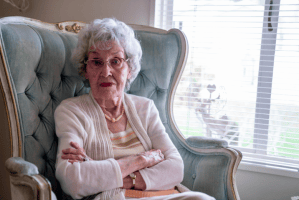
This mom's teaching her kids the most important financial lessons they can learn.
True
Capital One

When Nyna Sorn came to America, her family had nothing. So she's had to spend her life making tough financial decisions.

All photos courtesy of Upworthy.

When Nyna was only five years old, she and her parents escaped the Khmer Rouge — the brutal regime of the Communist Party of Kampuchea (CPK) in Cambodia. The family had lost everything, and that meant that they had to scrimp and save in order to get by in their new country of the United States.


When she grew up, Nyna made a promise to herself: she would work as hard as she could in order to ensure that her children didn't have a childhood like hers. She would do her very best to provide for them in ways that her parents couldn't provide for her. She would make sure that their future was bright and full of possibilities.

"My dream is to see all my children successful," Nyna says.

Nyna's tried to impart her perspectives on money and saving onto her children, but as her kids got older, she's become concerned about their spending habits.

Nyna and her daughter, Macara.

Nyna has been a single mom for the past decade. While her youngest child isn't yet old enough to learn about responsible spending, she's worked hard to teach her older children, who are 15 and 18, how to save money when they can.

However, she worries that they're being swayed by society's proclivity for instant gratification, and becoming too materialistic. She's especially concerned about her daughter Macara who, at 18, will soon be in charge of her own finances.

Nyna and Macara's situations are very different. At 17, Nyna was already a mother. She didn't have any financial support. That's why she feels it's important for Macara to understand the possible impacts of the money decisions she's making now. But while Macara appreciates everything her mother's done for her (including paying for college), she finds it difficult to focus on her finances.

"I don't want to think about it too deep," says Macara. "I don't want to be in the future. I want to be in the present. I don't want to be stressed out."

It's not easy to talk about money, but Nyna knows that being open and honest with her daughter is the only way to help her make smart decisions.

Sometimes Nyna feels like she's being too hard on Macara, but it's only because she wants her to have a bright future.

"I want you to be able to do better than I did," Macara tells her daughter. "I believe in you. I believe that if you wanted to do something, you can do it."

“I'm just trying to help you. I'm trying to pave a path."

These kinds of conversations may be tough, but they're necessary.

By sitting down and talking about money as more than an abstract concept, Nyna's showing her daughter that she's someone she can always talk to about her future, financial or otherwise.

"It's like a signal for me to do something," says Macara. "Can we keep having these conversations?"

"You need something, you can talk to me. I will always support you," Nyna responds.

To learn more and Nyna and Macara Sorn, check out the video below.

Openly discussing money is an important part of raising financially literate childrenThis mother-daughter conversation shows why it's important families talk about money, even if it's not always easy
Posted by Upworthy on Monday, December 3, 2018

Anyone who has gone through the process of disentangling themselves from an addiction knows it's an ongoing, daily battle. It may get easier, and the payoffs may become more apparent, but it's still a decision someone makes each day to stay detached from their substance of choice.

Seeing someone who has a long record of sobriety—especially after a very public struggle—can be motivating and inspiring for others in different stages of their recovery journey. That's part of why actor Rob Lowe's announcement that he's reached 31 years sober is definitely something to celebrate.

"Today I have 31 years drug and alcohol free," Lowe wrote on Twitter. "I want to give thanks to everyone walking this path with me, and welcome anyone thinking about joining us; the free and the happy. And a big hug to my family for putting up with me!! Xoxo"

Keep Reading Show less
Photo by Daniel Schludi on Unsplash
True

The global eradication of smallpox in 1980 is one of international public health's greatest successes. But in 1966, seven years after the World Health Organization announced a plan to rid the world of the disease, smallpox was still widespread. The culprits? A lack of funds, personnel and vaccine supply.

Meanwhile, outbreaks across South America, Africa, and Asia continued, as the highly contagious virus continued to kill three out of every 10 people who caught it, while leaving many survivors disfigured. It took a renewed commitment of resources from wealthy nations to fulfill the promise made in 1959.

Forty-one years later, although we face a different virus, the potential for vast destruction is just as great, and the challenges of funding, personnel and supply are still with us, along with last-mile distribution. Today, while 30% of the U.S. population is fully vaccinated, with numbers rising every day, there is an overwhelming gap between wealthy countries and the rest of the world. It's becoming evident that the impact on the countries getting left behind will eventually boomerang back to affect us all.

Photo by ismail mohamed - SoviLe on Unsplash

The international nonprofit CARE recently released a policy paper that lays out the case for U.S. investment in a worldwide vaccination campaign. Founded 75 years ago, CARE works in over 100 countries and reaches more than 90 million people around the world through multiple humanitarian aid programs. Of note is the organization's worldwide reputation for its unshakeable commitment to the dignity of people; they're known for working hand-in-hand with communities and hold themselves to a high standard of accountability.

"As we enter into our second year of living with COVID-19, it has become painfully clear that the safety of any person depends on the global community's ability to protect every person," says Michelle Nunn, CARE USA's president and CEO. "While wealthy nations have begun inoculating their populations, new devastatingly lethal variants of the virus continue to emerge in countries like India, South Africa and Brazil. If vaccinations don't effectively reach lower-income countries now, the long-term impact of COVID-19 will be catastrophic."

Keep Reading Show less