Shortly after college, I spent a year substitute teaching. My degree was in Secondary Education, so I always worked in middle schools and high schools. But one day, I got a call to sub in a first-grade classroom for two days and thought, “Why not? I love little kids, too.”
Ha ha. While the wee ones were at lunch on the first day, I sat at the teacher’s desk in a daze. I’d only been there a few hours and felt like I had run a marathon. First graders are a lot. Adorable for sure, but their energy, needs, conflicts, lack of attention spans, and propensity for distractions were so much more than I anticipated.
Give first-grade teachers all the money, is what I’m saying. And give even more to Ms. Fernandez, a first-grade teacher who isn’t just wrangling her gaggle of youngsters, but molding them into smart, contributing human beings who know how to communicate.
Can you teach first-graders to engage in actual discourse?
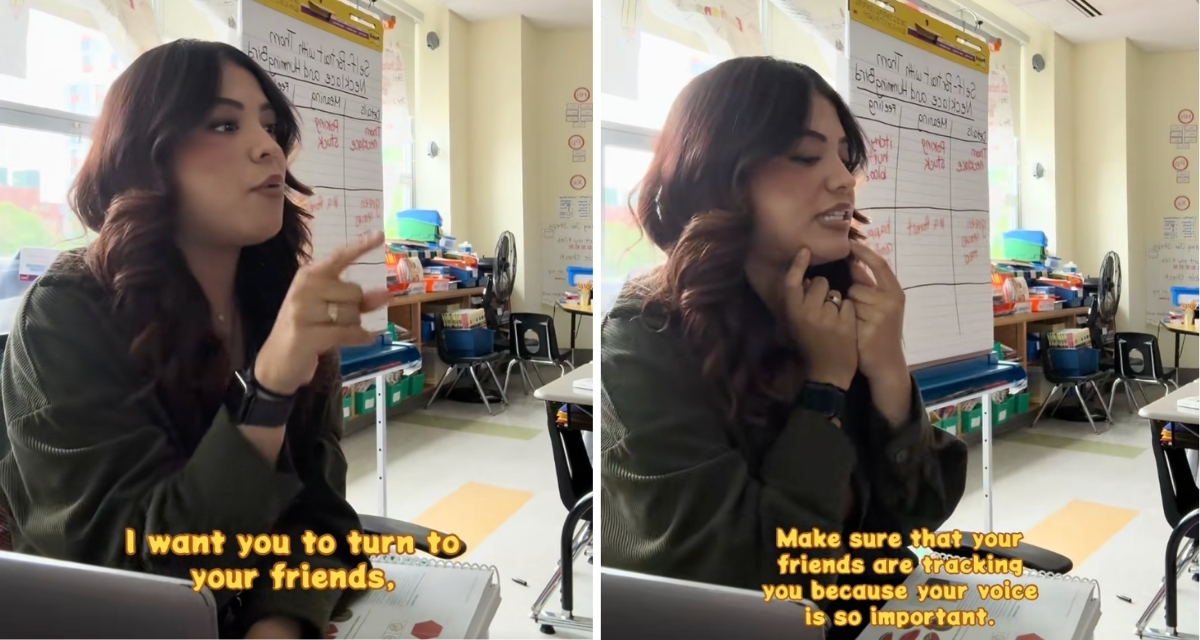
In a video shared on her TikTok, Ms. Fernandez shows how she teaches her students to engage in discourse during a lesson. We’re talking actual discourse, as in an exchange of ideas and discussion about a topic. In this case, the topic is whether watermelon slices are equal or unequal.
As students answer Ms. Fernandez’s questions about the watermelons, she encourages them to either agree, respectfully disagree, or add on to the previous answer. She walks them through the language to use and praises them for communicating like older kids (and adults, but honestly, many grown-ups could use this lesson, too).
Math is the curriculum. The discourse the students are engaging in is a skill Ms. Fernandez purposefully teaches her students, even though she technically doesn’t have to.
What prompted this teacher to focus on communication skills
“One thing I really noticed after COVID and with so much technology is that student voice and discourse started to struggle,” Ms. Fernandez tells Upworthy. “A lot of students forgot how to really talk to each other. They would talk over each other, yell across the room, or struggle with listening when someone had a different opinion.
“Because of that, it became really important to me to intentionally teach my students what respectful conversations look like. I want them to know that it’s okay to have different ideas and opinions and that disagreement does not have to turn into disrespect. We can listen, respond, agree, disagree, and still move forward as a classroom community.
“My goal is always to create a classroom atmosphere where students feel safe sharing their thoughts, engaging in conversations, and learning from each other. Those moments of discourse are about so much more than academics to me. They are life skills and relationship skills too, and seeing my students confidently communicate with each other in that way is one of the most rewarding parts of teaching.”
Ms. Fernandez shared that hearing the students’ live reactions and feedback is her favorite part of the activity, adding, “I really wish I had experiences like this when I was in school.”
Watch stellar teaching in action
What makes good teaching so hard isn’t just the number of skills it requires, which is vast. It’s also the number of skills you’re actually trying to teach kids. Teaching isn’t merely following a curriculum and transferring knowledge, as if kids are empty vessels to be filled. It’s training them to be engaged learners and capable members of society, which requires a whole lot more than reading, writing, and arithmetic.
It’s difficult to teach kids anything if you don’t have their attention. Ms. Fernandez uses various call-and-response chants and hand-clapping methods to get (and keep) her students’ attention. She makes classroom management fun, but she also expects 100% from her students, which is the ideal balance to strike. Running a tight ship while making learning enjoyable is the goal as joyful structure benefits everyone.
Anyone who has spent a day or two in a first-grade classroom knows how impressive it is to manage a group of squirrelly 6-year-olds. Ms. Fernandez has raised the bar in the best way, elevating expectations of her students with examples and encouragement to bring out the best in them.
You can follow Ms. Fernandez on TikTok here.