upworthy
Add Upworthy to your Google News feed.
Google News Button
Democracy

It's easy to be duped by online hoaxes — so we spoke with an expert at spotting fake news.

Being able to tell truth from lies is more important than ever.

fake news, experts, social media, fact checking
Canva

It's getting harder and harder to tell.

True
Firefox

"Fake news" is more than just the phrase the president uses to brush aside stories he doesn't like. It's a real thing, and something we should all be on the lookout for.

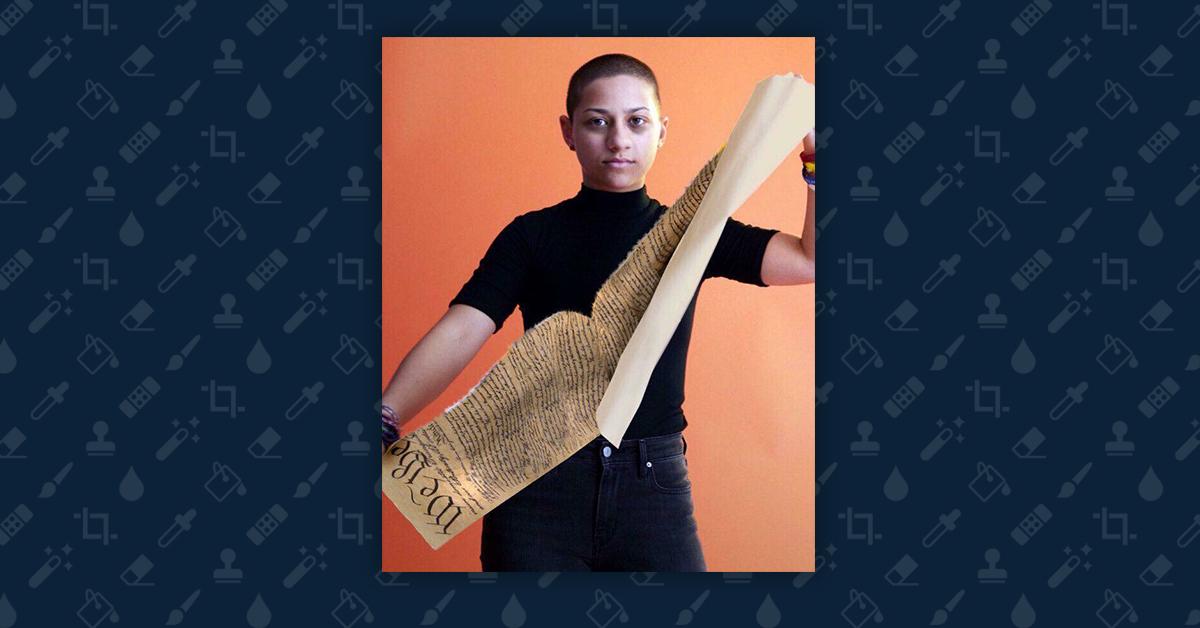
Below is an image of Parkland student Emma González tearing up a copy of the U.S. Constitution that went viral in 2018, sending some corners of social media into a frenzy.


There was one problem, however: It was totally fake.

The actual photo came from a Teen Vogue video shoot featuring her and some of the other Parkland students. In the real clip, González is seen tearing up a paper shooting target.
fake news, Teen Vogue, gun rights, activism

Teen Vogue photo shoot goes viral.

linked image from snopes.com

The fact-check was swift, but a lot of damage was done, as the altered image continued making the rounds.

It's easy to be duped by online hoaxes — so we spoke with someone whose job it was to spot them every day.

At the time of this incident, managing editor Brooke Binkowski wrestled with the importance of truth and figuring out how to stop the spread of hoaxes every day for the highly trusted fact-checking website Snopes.

The site, launched in 1994, began as a collection of fact-checks on some of the internet's early urban legends. Wanted to find out whether or not that story about the killer with a hook for a hand was true? Snopes had you covered. Needed to know whether your favorite brand of bubble gum is filled with spider eggs? The answer was just one click away.

As the site evolved its taken on more serious topics, online hoaxes, and "fake news." Did Donald Trump wade into the waters of a flooded Texas city to save two cats from drowning after Hurricane Harvey? (No.) Did Barack Obama congratulate Vladimir Putin on his 2012 electoral victory? (Yes.)

Snopes is often cited alongside FactCheck.org and PolitiFact as some of the best, most accurate, and bias-free fact-checking websites in the world, even earning it a partnership with Facebook.

Binkowski spoke with Upworthy about how to deal with increasingly sophisticated hoaxes we all encounter online (and gave us a few behind-the-scenes secrets about how the people at Snopes do what they do best).

The following interview has been lightly edited and condensed for clarity.

Why does the truth matter, and what harm is there in sharing fake stories?

The truth matters because without being able to agree on the most basic facts, there is no democracy. Democracy depends on an informed, educated populace in order to survive. To actively suppress curiosity or obscure facts is to actively suppress democratic norms.

When you share fake or misleading stories, first of all, don't beat yourself up about it if you were trying not to! We all fall for it. Some of it is extremely convincing.

I strongly believe that the onus should not be on the individual to sift through all the garbage to find good, vetted news on top of every other thing they have going on in their life, as I hear many suggest — that's why journalism exists. I think people are overall extremely smart and crave information, but without vetted and transparent information, they fall for conspiracy theorizing.

That's what propaganda and disinformation seize on. If you repeat that pattern across a country, it dramatically erodes these democratic norms. Plus, have you ever tried to talk to a really entrenched conspiracy theorist?

So I would be as mindful as you can about the sources of stories and try your best not to share disinformation — and if you do, I would try to be upfront about it and delete it so that it does not spread.

Right now is a crucial time to be mindful, even though I just said the onus shouldn't be on the individual. It shouldn't, but we simply don't have enough working journalists to go around right now, because our industry has been allowed to collapse in the name of executive profit.

Can you walk us through how Snopes fact-checks a story?

We don't have any one specific way that we fact-check a story — there's no real formula for doing so. A lot of what we do is so disappointing when I describe it to people, because it's not magic. It's "just" journalism.

I try to give my writers time and space to do the research that they need to do, although sometimes it's a little difficult when we have "conspiracizing" from all sides. So sometimes, one of us will have to head to the library to pull books or go over to the local university to look through papers on campus.

A lot of the time we do old-fashioned reporting. Our staff is all over the United States and they know their stuff, so I'll take advantage of that and send them out on the field sometimes. We also, of course, know the repeat fake-news and satire offenders, so that makes it easy, because we can save a lot of time just by noting that they have an all-purpose disclaimer buried somewhere on their site. Sometimes we do photo or video forensics and FOIA requests (not that we get a lot of those answered, hahaha).


We try to be as thorough and as transparent with our work as possible, which is why we have a source list at the bottom of each page and maybe describe our methodology in a bit more detail than we should — but that's how we all roll.

Which is also why, on a side note, I find the conspiracy theories about us a bit puzzling. We're really easy to track down online, we list all our sources, and we try to be as open as humanly possible without also being boring about our methodology.

And yet people still think we're part of a grand conspiracy. I'm still waiting for my check from George Soros/the Lizard People/the Clinton Foundation, though. It's been, like, 20 years!

...OK, if you're a conspiracy theorist reading that last sentence, that's a joke. I already got my checks.

No, no, I'm sorry. I just can't stop myself.

Photo via Teen Vogue, illustration by Tatiana Cardenas/Upworthy.

What can regular, everyday people do to avoid hoaxes and "fake news?"

My best tip that I can possible give readers is this: Disinformation and propaganda classically take hold by using emotional appeals. That is why what Cambridge Analytica did should be viewed through that lens.

One of the more sinister things that I have read that they did, in my opinion (among other things I'm sure that no one yet knows), was track people who were highly susceptible to authoritarianism, then flood them with violent imagery that was invisible to everyone else on social media, so that they were always in a state of fear and emotional arousal and highly susceptible to an authoritarian message.

That's the type of person propaganda historically targets anyway — those who feel out of step with society and have strong tendencies toward authoritarianism — but now, groups like Cambridge Analytica are doing it faster and more surgically.

If you're reading, viewing, or listening to a story that's flooding you with high emotion, negative or positive — whether it's fear, rage, schadenfreude, amusement at how gullible everyone else is — check your sources. You are being played. Do a quick search for the story, see if it has been debunked at minimum, and/or look for other sources and perspectives.

One of the most noxious things about disinformation and propaganda is that both weave some truth into their lies, which makes the lies much, much stronger.

Something I like to say about political leanings is that the right assumes it has the moral upper hand and the left assumes it has the intellectual upper hand — both are tremendous weaknesses that are easy to exploit.

Don't let yourself be exploited. Be on guard. Don't assume other people are sheep and don't assume other people are morally bankrupt. Propaganda wants you to assume the worst about your fellow denizens; the people who push it out want the basic fabric of society destroyed.

It wants you hating your lovers, your neighbors, your family members, the guy at the store, the lady at the coffee shop. Propagandists want you distrusting each other, bickering, and unable to agree on the most basic facts — because then they can exploit those cracks further and consolidate power in the process.

Don't let yourself be taken in.

The basic take-aways for the average person? Get your news from trusted sources, confirm it with a second source, check your own confirmation biases, and get familiar with reverse image search tools.

This story originally appeared on 03.30.18

boomer grandparents, boomer grandparent, millennial parents, millennial parent, grandkids
Image via Canva/PeopleImages

Boomer grandparents are excessively gifting their grandkids, and Millennial parents have had enough.

Millennial parents and Boomer grandparents don't always see eye to eye on parenting and grandparenting. Now, Millennial parents are uniting on a nightmare Boomer grandparenting trend that sees them "excessively gifting" their grandkids with tons of both new and old *unwanted* stuff during visits.

Ohio mom Rose Grady (@nps.in.a.pod) shared her "Boomer grandparent" experience in a funny and relatable video. "Just a millennial mom watching her boomer parents bring three full loads of 'treasures' into her home," she wrote in the overlay.


Grady can be seen looking out the window of her home at her Boomer mom and dad carrying bags and boxes up her driveway after several visits. The distressed and contemplative look on Grady's is speaking to plenty of Millennial moms.

@nps.in.a.pod

Today's "treasure" highlight was the mobile that hung in my nursery... #boomerparents #boomers #boomersbelike #millennialsoftiktok #millenialmom #motherdaughter

Grady captioned the video, "Today's 'treasure' highlight was the mobile that hung in my nursery..."

The humorous video resonated with with fellow Millennial parents. "Straight to the trash when they leave," one viewer commented. Another added, "I always say 'if you don’t want it in yours, we don’t want it in ours' 😂."

Even more Millennial parents have shared and discussed their situations with Boomer grandparents buying their kids too much stuff on Reddit. "Both my mother and my MIL love buying and sending toys, books, clothes, etc. I don't want to be ungrateful but we just don't need it and don't have the space. I have brought this up politely in 'we are all out of drawers for that' but it hasn't slowed things down," one explained. "I think part of the issue is that the grandparents live in different cities and vacation a lot. They don't get to see our daughter much so they buy stuff instead."

Another Millennial parent shared, "While the intention is very kind behind these, all the grandparents are very aware that we do not need, nor wish to receive these gifts in such an excessive volume - as it creates a daily struggle to store and accommodate in our home. I struggle to keep on top of tidying as it is, and this is a massive added challenge."

millennial parents, millennial parent, millennial mom, kids room, organize Millennial mom struggles to organize her son's room.Image via Canva/fotostorm

How to talk to Boomer grandparents about gifts

So, why are Boomer grandparents excessively gifting? "Boomer grandparents may be the first grandparent generation to have accumulated the substantial discretionary funds that enables them to spend money on their grandchildren," Sari Goodman, a Certified Parent Educator and founder of Parental Edge, tells Upworthy. "These grandparents probably grew up with grandparents who didn’t have that kind of money and so they may be excited to give their grandchildren the things they didn’t get."

Goodman suggests that Millennial parents first discuss with them the "why" behind the gifting. "What comes before setting a boundary to limit over-the-top gift-giving is delving into the reasons grandparents are buying so much," she explains. "Coming from a place of compassion and understanding makes it possible to come up with mutually beneficial solutions."

- YouTube www.youtube.com

She recommends that Millennial parents sit down with their Boomer parents to learn more. "Did they grow up without many toys and clothes and are fulfilling a dream? Ask them about the values they learned as children (hard work, perseverance, the power of delayed gratification) and how they can pass on these lessons to the grandchildren," she suggests.

She adds that another reason may be that Boomer grandparents live far away and want their grandchildren to feel a connection with them. "Set up a regular FaceTime or Zoom meeting. Rehearse with the kids so they have something to say and suggest a topic for the grandparents," says Goodman. "Or send snail mail. Kids love getting mail. The grandparents can send postcards from where they live and explain some of the special sites."

boomer grandparents, boomer grandparenting, video chat, video call, grandkids Boomer grandparents have a video call with grandkids.Image via Canva/Tima Miroshnichenko

Finally, Goodman adds that for some grandparents, this may be is the only way they know how to show their love. Millennial parents could ask if they would be open to other ideas. "Parents can set up an activity for grandparents and kids to do when they come over—a jigsaw puzzle, art activity, board game, magic tricks," she says. "Arrange for the grandchildren to teach the grandparents something their phones can do or introduce them to an app they might like."

This article originally appeared last September

shoes, cheap shoes, fast fashion, fast fashion brands, sustainable fashion, economy, shrinklfation, money, sustainable shoes

Remember things being built to last?

Unfortunately, most Americans are well aware of shrinkflation, where food companies reduce the sizes of their products while the price remains the same at the grocery store. You see this in fast food restaurants when you pick up a burger and feel like your hand has grown a few inches, and at the supermarket when you buy a box of cookies, it weighs less than it did a few weeks ago. Companies use this strategy when they think you’ll be less likely to notice a dip in quantity than a hike in the price.

We see something similar in the world of retail, particularly fast fashion. Fast fashion offers cheaper garments made from low-quality materials that last about as long as the trend does, so people can throw them away and buy the next hot thing. This can be a real problem because fast fashion harms the environment and leads to exploitative labor practices. And the tough part is—even for the most conscious of consumer, it's hard to escape from.


Here's a prime example of what this looks like in the real world. A few months ago, a TikTokker named Tom (@SideMoneyTom), popular for making videos about consumer products, went viral for a video where he called out shoe manufacturers for dropping their quality while keeping prices high. “So many of you guys want to shoot the messenger, but look, it's not my fault shoes are made out of Styrofoam and oil now,” Tom says in a TikTok with over 528,000 views. “It's literally every shoe you look at now. It's not even just the cheap ones. I can find hundred dollar plus pairs of shoes all day long with glue squeezing out of their Styrofoam cracks.”

@sidemoneytom

Replying to @Oscar Magaña shoes are done #fyp #shoes #foryou

Tom notes that recently, shoes have been made with foam soles instead of rubber. Both have pros and cons. Foam is a little more comfortable, but rubber lasts a lot longer. Rubber shoes keep shape and support over time and are much more durable. Conversely, foam shoes compress over time, losing their support and comfort. When companies sell cheaper shoes that wear out more quickly, they make much more money because you must keep replacing them.

In the video, Tom adds that many companies that used to have shoes made with rubber heels, such as Carhartt and Timberland, have switched to foam. This is an interesting choice for brands that pride themselves on selling durable products.

Cora Harrington, a writer and lingerie expert, says that companies aren't entirely to blame. Americans don’t want to pay higher prices. “People don’t exactly want to pay more for all that stuff,” Harrington told Vox. "So what has to happen if everything is more expensive and the customers still want to pay the same price, something has to be cut and that’s often going to be the quality of the garment.”

“There is an entire generation of consumers at this point that doesn’t actually know what high-quality clothing feels like and looks like,” Harrington continues. “It gets easier, I think, for consumers to just not know any better.”

@sidemoneytom

Replying to @donkles #shoes #fyp #sketchers #nike

Many commenters have noticed the decline in shoe quality and praised Tom for pointing it out. "I am so happy I’m not the only one who is baffled by shoes being made of styrofoam and then being upcharged for them," one commenter wrote. "When shoes started being named some version of 'Air Light Cloud float,' my thought was it was because they went from quality rubber to cheap foam and less materials,” another commenter added.

Tom believes the decline in shoe quality is an example of a more significant trend affecting American consumers' products: quality is decreasing while prices remain the same. “The quality of everything is going to hell, and the prices are going up," Tom concludes his video. "The problem is, so many of us have just become used to it that we keep buying it, and we basically allow them to dumb down the quality of everything. Everything in our lives. These shoes are just the tip of the iceberg. Start thinking about it in your life. What are you gonna allow to be garbage quality?"

This article originally appeared in March. It has been updated.

Pop Culture

In 1969, the Monkees appeared on The Johnny Cash Show and played a stunning, original country song

"Nine Times Blue" is a jaw dropping intersection of craftsmanship and pure talent.

the monkees, nume times blue, monkees live, monkees country, johnny cash show

The Monkees perform on "The Johnny Cash Show."

The great debate about The Monkees is whether they were a real band or just a group of actors thrown together for a TV show. The answer is yes. They were actors cast to play an American version of The Beatles, and many of their early songs were written by big-time professional songwriters such as Tommy Boyce, Bobby Hart, Neil Diamond, Carole King, and Gerry Goffin.

However, The Monkees would pick up their own instruments, play on the 1967 Headquarters album, and perform as a live band on sold-out tours. After a resurgence in the '80s, the band enjoyed a lucrative career as a legacy act, with various members continuing to perform as The Monkees until Michael Nesmith died in 2021. Nesmith, originally a country singer from Dallas, Texas, wrote several of The Monkees' hits, including "Mary, Mary," "Papa Gene's Blues," "The Girl I Knew Somewhere," and "Listen to the Band," and was a driving force in the group being taken seriously as musicians.


By the summer of 1969, The Monkees' TV series was off the air, and the affable Peter Tork had exited the group, citing exhaustion. The remaining three soldiered on, performing on The Johnny Cash Show to promote their latest album, Instant Replay. The band chose to perform "Nine Times Blue," a country song written by Nesmith that he had demoed at the time but wouldn't be released until he recorded it as a solo artist in 1970.

The performance is a wonderful reminder that The Monkees were great comedic actors and accomplished musicians. Davy Jones and Micky Dolenz do a fantastic job singing harmonies on the chorus, while Nesmith plays some nice fills on his Gibson acoustic.

- YouTube www.youtube.com

Later in the show, The Monkees joined Cash for a performance of his 1966 novelty song, "Everybody Loves a Nut," which perfectly suited the band's comedic sensibilities. Two weeks after the release, Cash scored one of his biggest hits with "A Boy Named Sue," recorded live at San Quentin prison.

A few months later, Nesmith left The Monkees to pursue a country-rock career, first with the seminal group The First National Band, which scored a Top 40 hit with "Joanne" from the album Magnetic South.

- YouTube www.youtube.com

Although Nesmith's country-rock albums of the '70s were moderately successful, he was still overshadowed, as a musician, by The Monkees' towering success and subsequent downfall. In the '70s, it wasn't easy for Nesmith to get the respect he was due as a country artist. But in the years leading up to his death in 2021, Nesmith's work was reappraised, and he was seen as a brilliant songwriter who anticipated the rise of alt-country.

The Monkees hold a complicated place in rock 'n' roll history. While some see them as a prefabricated band assembled to cash in on The Beatles' success, others recognize them as talented musicians brought together under bizarre circumstances who forged their own path and created something fresh and innovative, only earning proper respect years later.

stay at home mom, sahm, stay at home dad, sahd, kids, family, marriage, gender roles, good dads, ups driver, ups
via J.R. Minton (used with permission)

A Texas UPS driver has a strong opinion on stay-at-home moms.

J.R. Minton, a 33-year-old UPS driver from the Dallas, Texas, area, recently ruffled some feathers with a viral TikTok video titled “SAHMs Listen up!” that begins with him asking, “I mean, how entitled could you be?” At first, Minton appears to fail to appreciate the enormous amount of emotional, mental, and physical labor that stay-at-home moms provide.

“I truly cannot imagine the amount of arrogance you must have to sit there and complain when you are so privileged to have a person who is willing to provide such a carefree life for you,” Minton continues. “Let’s get real! What do you do all day? Your spouse is taking care of everything so you can take care of one thing. How complicated could it be: all you do is go to work?”


At this point, legions of stay-at-home mothers and those who love them considered trucking themselves to Dallas to find this unappreciative UPS driver. However, it was soon apparent that Minton was referring to himself.

“For 10 hours a day, you get to live the life of a single, childless, carefree man because your wife was willing to take the financial risk of allowing you to be successful in your career while she takes care of everything else,” he continues. “She provides childcare services, home cleaning services, medical services, food services, scheduling services, and a list that goes on and on. And you provide... a paycheck? And you have the nerve to call yourself the provider! What is it going to take for you to realize that, bro, everything you have in your life is because of a stay-at-home mom.”

The commenters on the video breathed sighs of relief and then praised Minton, a father of 4, for publicly appreciating his wife’s work.

"My sleeves were rolled up, earrings were off, hair tied up.... I was so ready...." one commenter joked. "I thought I landed in enemy territory for a min..." another added. "You have just made me realize after all these years that *I* am the freaking provider and that feels amazing,” a stay-at-home mother wrote.

People appreciate Minton’s post because he praised stay-at-home mothers and placed his wife’s work above his, which he characterized as merely bringing home a paycheck. Minton has one job, delivering packages, but as he noted, his wife is an expert in over five different professions. In a world where stay-at-home moms are fighting to be seen as equals to their working spouses, Minton places them on a pedestal and owes his “carefree life” to them.

stay at home mom, sahm, stay at home dad, sahd, kids, family, marriage, gender roles, good dads, ups driver, ups A couple cooking in the kitchen with a cat sitting on the table beside chopped ingredients.Photo credit: Canva

"Married life, with children, is bound to be chaotic," Minton told Upworthy. "It’s bound to have its ups and downs; It’s made me question myself a thousand times. However, the marriage my wife and I share has given me the space to find peace."

Minton may be sharing an opinion we don't hear often enough, but he doesn't think he's the only one who thinks that way. "The last thing I am is rare or unique. There’s nothing special about the way that I feel or the things that I say. I have the same thoughts, feelings, frustrations and problems that any other husband or father might be struggling with," he told Upworthy. "The only difference that might be apparent is how I choose to react to the same situations any other man might encounter."

This post isn’t the first time Minton has pulled the bait and switch on his followers. Last year, he made a video where he appeared to take pride in the fact that he never “helps” his wife with chores.

The twist in this video was that he doesn’t “help” his wife with chores because they are also his responsibility. "Because I do what I am supposed to do as a father and a husband. I cook. I clean. I do the laundry. I take care of the kids. I can't help my wife do those things because they are my job, too,” he reveals.

He then urged men to change their perspectives on how they view stay-at-home moms. “Change the way you speak, change the way you think, and grow the f*** up and be a man," he added.

Minton is an equal partner to his wife because he wants to treat his wife and family differently from how he was raised. “Pretty much everything about my parenting style is in spite of what I saw when I was growing up,” he told Today.com.

It's wonderful to see someone like Minton breaking the generational cycles. What makes it even better is that he wants to teach others to do the same.

This article originally appeared in January 2025.

words, overused words, therapy speak, 2025 slang, filler words, retired phrases, ask reddit, 2026 slang,

No one is gonna miss '6 7.'

It’s pretty customary for humans to collectively latch on to certain words or phrases for a time, only to grow tired of them once the trendiness wears off. That’s by and large how we get generational slang in the first place. One man’s “rad” is another man’s “bussin.” The linguistic circle of life, as it were. `

But the rapidity of social media has certainly seemed to make this turnover move at the speed of light, hasn’t it? It takes a fraction of the time for words to get overused, misused, change meaning, and lose meaning altogether.


That’s probably why when someone on Reddit asked, “What overused word or phrase needs to be retired in 2026?” there was no shortage of passionate answers. From warped psychology terms to nonsensical Gen Alpha brainrot words, people delivered.

Keep scrolling for our favorites.

Sensational journalism words

1. ’Slammed’ by the news.”

2. “Also while we're at it, ‘bombshell,’ ‘destroyed,’ ‘meltdown,’ and ‘disaster.’"

3. “Blasted. Clap back.”

“Those are telltale signs that what you're about to read is heavily biased and was written to evoke emotions instead of giving just the facts so it's basically trash.

Therapy speak

4. “Gaslighting. People love to use this term wrong. It doesn't mean ‘lying,’ it means ‘manipulating somebody into believing they're crazy.’ That involves lying, but they're not the same thing. Also every term invented to get around TikTok censors. ‘Unaliving,’ ‘graped,’etc.”

5. “Calling anyone who does anything slightly annoying a narcissist.”

6. “Similarly, anytime someone feels just a little proud of themselves for something and/or compliments themselves, it's ‘ego.’ Not hating and constantly putting yourself down isn't ego. It's healthy.”

7. “Trauma.You don’t have trauma from the Starbucks barista mispronouncing your name, Djoeffreigh. And if you do, I am not interested in hearing about it.”


Aggressively passive-aggressive phrases


8. "People who use ‘the ick,’ ironically enough, give me the ick. Now I've given it to myself.”

9. “Thank you for your attention to this matter.”

10. “Louder for the people in the back.”

11. “‘Let that sink in.’ ‘Read that again but slowly.’ ‘I don’t know who needs to hear this, but…’”

12. "‘Just saying’ after being very aggressive.”


Social media buzzwords and phrases that have been run into the ground

13. '''Let's normalize this.' please no.”

14. “Tell me you’re Y without saying it.”

15. “I’m begging people to stop saying’"its giving.’"

16. “I’m literally obsessed”

17. “X lives rent free.”

18. “That’s iconic, she’s iconic, they’re iconic.”

19. “Today years old”


Weird, cutesy parenting terms

20. "Boy mom"

21. “I also hate ‘littles."


Words that do not mean what people think they mean

22. “'Underrated'. Sick of seeing ‘OMG! This band/singer/guitarist/drummer is so underrated’ when they're clearly millionaires from the musical success they've enjoyed for years.”

23. “‘My truth.’ I like this one because it lets me know the next words out of their mouth are going to be bullshit.”

24. “According to AI.”


Phrases that kids today use that all us olds hate

25. “The grandkids are slowing down on 6 7 (FINALLY), and I haven’t heard them say ‘sigma’ for a while, so HOPEFULLY those are both going away forever!!

26. “‘Lowkey’ we’ve run it into the ground.”

“The new ‘literally.”

“Omg it's low key every second word my teen says.”

And finally…


Words that have lost their original meaning due to overuse

27. "‘Absolute game changer .’ I do product reviews, and I want to smack people for this one. Everything is a ‘game changer’ or a ‘holy grail.’ Bullshit, it is. That 5 star game changer is usually an overpriced piece of crap lol.”