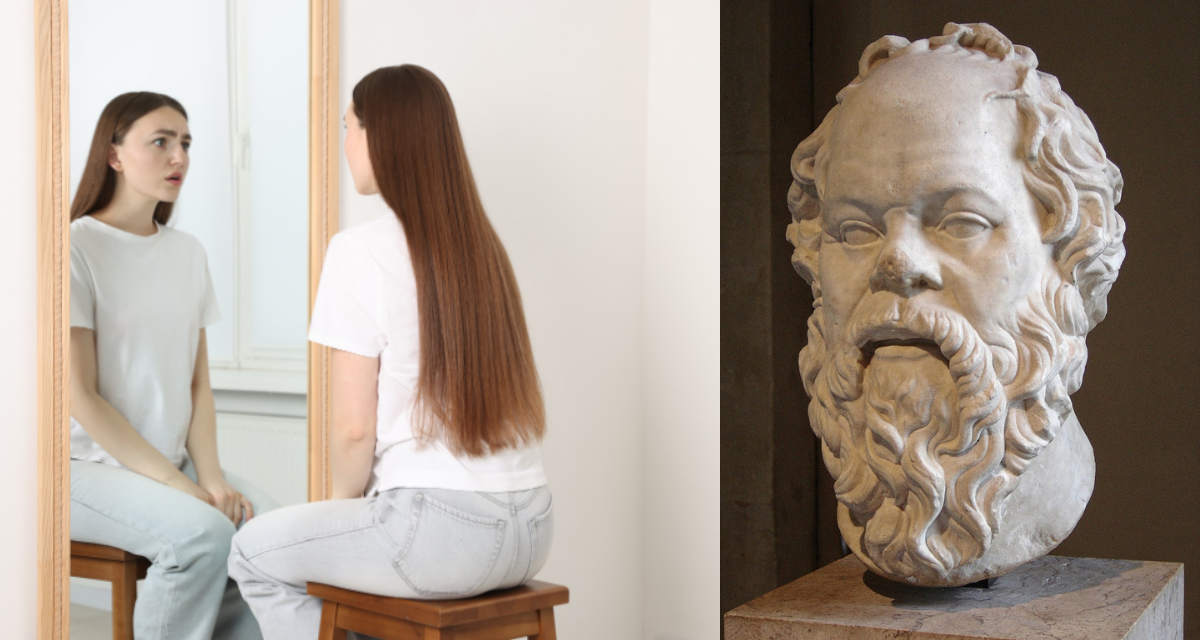
Struggling to find a sense of self is part of the human condition. What makes each person unique and “themself” is a complex topic in psychology and philosophy.
According to the American Psychological Association (APA), identity is defined by two major aspects. The first: “A set of physical, psychological, and interpersonal characteristics that is not wholly shared with any other person.”
And the second: “A range of affiliations (e.g., ethnicity) and social roles. Identity involves a sense of continuity, or the feeling that one is the same person today that one was yesterday or last year (despite physical or other changes).”
The APA adds that it is also “derived from one’s body sensations; one’s body image; and the feeling that one’s memories, goals, values, expectations, and beliefs belong to the self.”
Greek philosopher Socrates addressed the human struggle with self-identity and self-knowledge—”to know thyself”—and he offered a simple sentence to help.
Socrates’ advice on self-identity
According to Socrates, the key to self-knowledge starts in your brain:
“I cannot teach anybody anything. I can only make them think. To find yourself, think for yourself.”
In the book Socrates and Self-Knowledge, author and professor of Philosophy and Classics at The Pennsylvania State University specializing in ancient Greek philosophy, Christopher Moore, theorizes that Socrates based “knowing thyself” on questioning one’s self.
He writes, “a person can be said to have self-knowledge whenever he knows the truth of a statement in which there is reference to himself.”
However, this does note solely require self introspection. Moore argues self-knowledge is actually best achieved with the help of others. “Socrates, at the end of his long speech in Plato’s Phaedrus, urges his friend to dedicate his life single-mindedly to ‘love accompanied by philosophical talk’,” adding that “self-knowledge comes about through conversation with others, and
that self-knowledge is akin to knowledge of others.”
Moore concludes: “Socratic self-knowledge means working on oneself, with others, to become the sort of person who could know himself, and thus be responsible to the world, to others, and to oneself, intellectually, morally, and practically.”
How to tap into your inner-Socrates
In a podcast episode with Yale psychology professor Dr. Laurie Santos, fellow Yale professor and philosopher Tamar Gendler explained how to apply Socrates’ lessons into your personal life to help better understand your self-knowledge. She explains that, according to Socrates, self-knowledge is a paradox.
“To know ourselves is to not know ourselves,” says Gendler. “It is to know that in many ways we do not have direct access to our motivations, that we do not have direct access to what it is that we are actually responding to when we do something. And it’s an endless process of engaging in Socratic self-question.
To tap into that inner-Socrates, she says there is an inner dialogue looks something like this:
“Why do you think that?”
“Is it possible that you think that for a different reason?”
“Is it possible that even though you assume you value that, actually that’s just an old habit that you haven’t questioned?”
“Is it possible that you think you’re responding to a person, and in fact you’re responding to a stereotype about people of that kind?”
Dr. Santos adds that harnessing your inner-Socrates isn’t always comfortable, and involves “intentionally questioning why you think certain things, and why you take certain actions. It also involves admitting that you probably aren’t as smart as you think you are.”