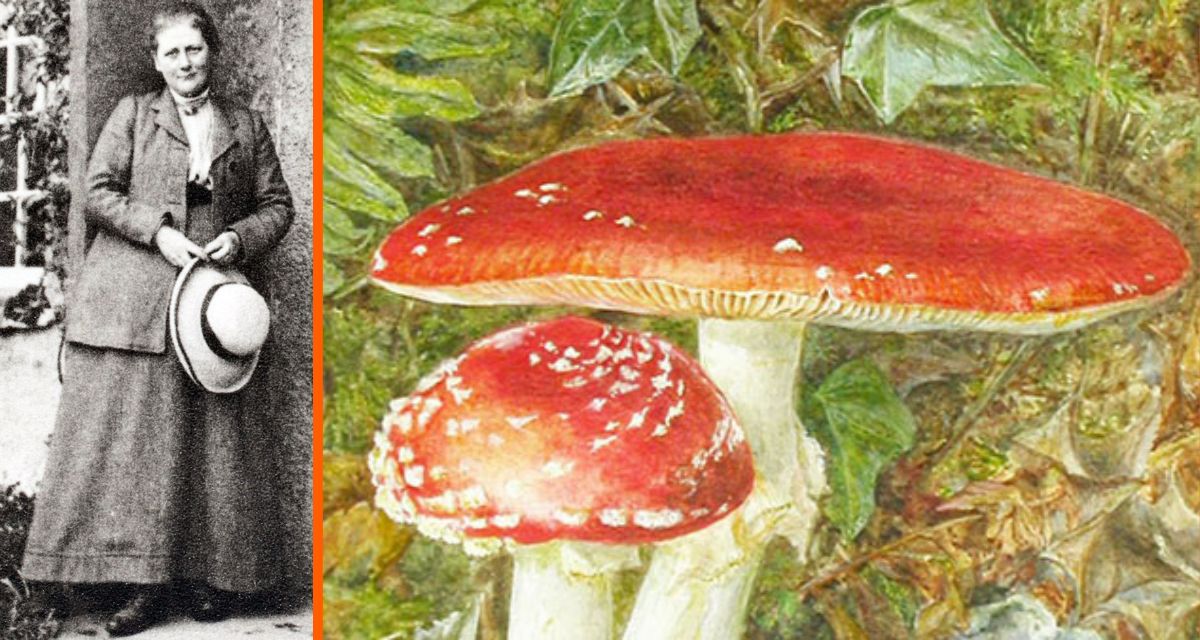
Author Beatrix Potter was born on July 28, 1866. She wrote and illustrated the classic children’s book The Tale of Peter Rabbit.
Her magical storytelling and beautiful artwork have delighted generations since her passing on December 22, 1943. But one of the most surprising facts about her remarkable life is that, besides being a celebrated author and illustrator, she was also a scientist.
Potter studied mushrooms (mycology), and her research was presented to one of London’s most prestigious scientific societies years before The Tale of Peter Rabbit was published in 1902.
Potter’s mushroom research
Potter had a passion for mushrooms and lichens. She began studying them in 1895, according to Art UK. She observed, identified, and cultivated different fungi, developing theories about how spores germinated.
On April 1, 1897, her paper, “On the Germination of the Spores of Agaricineae,” was presented to the Linnean Society of London, founded in 1788 and the world’s oldest active natural history society. Unfortunately, Potter herself was not allowed to present it because women were excluded from membership in the society at the time.
Years later, in a statement from Dr. John Marsden, the society’s executive secretary, he acknowledged the injustice Potter faced, writing, “She was treated scurvily by members of the society. The only consolation is that if she had become a scientist she may never have written her books.”
Potter’s mushroom illustrations
Not only did she observe, study, and theorize about fungi, but she also used her artistic talents to help identify them. Potter became a prolific mushroom illustrator.
Writing about Potter’s growing interest in painting mushrooms, her biographer, Linda Lear, noted that her “interests as an artist and a naturalist had converged on fungi” and that she “was drawn to fungi first by their ephemeral fairy qualities and then by the variety of their shape and color and the challenge they posed to watercolor techniques.”
In total, she created more than 350 illustrations of fungi, including molds, mushrooms, and yeasts.
Potter’s talents were recognized by leading scientists of her day, including George Massee, the keeper of lower cryptogams at the Royal Botanic Gardens, Kew. Massee presented Potter’s paper to the Linnean Society.
Massee praised Potter’s artistic talent, saying he “realized that Beatrix Potter was a wonderful illustrator. She illustrated the fungi precisely, not something that she would have copied out of a book. She illustrated what she saw in nature.”
Another mentor, mycologist Charles McIntosh, encouraged Potter to make her illustrations “include multiple angles of a specimen to give her drawings more of a 360-degree view…which shows the mushroom inside, outside, and even upside down.”
Today, Potter’s mushroom illustrations are still being used. Lear noted that although there was “no evidence that she had any ambition to be recognized by the scientific community as a mycologist, or that she wished for a life devoted to scientific enquiry,” her “watercolours are considered so accurate that modern mycologists refer to them still to identify fungi.”