Natalie San Luis

  • Bridgerton’s Luke Thompson shared his favorite French phrase. We need something like it in English.
    France isn't the only country with a saying like "un ange passe."Photo credit: Canva

    Luke Thompson has achieved heartthrob status as Benedict Bridgerton, the free-spirited, second-born son of the noble family featured in the popular Bridgerton television series. The show’s fourth season focuses on Benedict’s Cinderella-esque love story with a servant named Sophie, played by Yerin Ha.

    In an interview promoting season four, Thompson and Ha read questions from Bridgerton fans. One person asked Thompson, who grew up in France and speaks fluent French, to share his favorite French phrase.

    @etalkctv

    We can’t think of a better French teacher! 🇫🇷 Luke Thompson revealed what his favourite French phrase is and taught Yerin the language of love in the process! Watch the FULL video of Yerin Ha and Luke Thompson texting fans at the link in our bio. 🔗 Part 1 of ‘Bridgerton’ season 4 is streaming NOW on @Netflix. #LukeThompson #YerinHa #Bridgerton #French #BenedictBridgerton @Yerin Ha

    ♬ original sound – etalk

    “My favorite French phrase is probably…Oh! ‘Un ange passe,’” he said.

    Ha asked what it meant, and Thompson helped her decipher it. Un = a/an. Ange = angel. Passe = pass(es). In English, “Un ange passe” means “An angel passes.”

    “What it means is, when you’re having a conversation, or like just in a group, it’s a nice way of expressing awkward silence,” Thompson explained. “But it’s just those moments where like, just, there’s a bit of a lull and no one says anything. And you say, ‘Un ange passe.’”

    “You say, ‘An angel passes,’” Ha said. “That’s really nice.”

    It is nice. And it appears to be a glaring omission from the English language, since people in the comments shared that they have similar phrases for awkward silences in their cultures:

    “OMG we say the same thing in Arabic!”

    “We say the same in Portuguese… ‘passou um anjo’ ☺️”

    “In Spanish we say that, at least in Chile ‘pasó un angel or ‘un angel pasó.’”

    “In Spanish we say the same thing!! México 🇲🇽”

    “In Philippines we have this too! Haha may dumaang anghel 😂”

    “In Malay we said: malaikat lalu.”

    “We have that phrase in Danish too. But it’s more an angel went through the room.”

    “The Dutch also have this, but a reverend walks by instead of the angel 🙈 Angel is much nicer.”

    “We say that too in Nigeria. ‘Ndị muozi na agafe.’”

    It seems that many cultures have handy phrases like this to make a conversational lull feel mystical or magical instead of uncomfortable and awkward. The wording may differ from place to place—apparently, in Russia and Kazakhstan they say, “A cop was born”—but why don’t we have anything even close to it in English?

    When silence falls over a group of English speakers, we just stand there and shift our gaze, feeling the heavy seconds tick by. Occasionally, someone might acknowledge the silence by saying, “Well, this is awkward…” but that only emphasizes the awkwardness.

    The irony here is that English speakers tend to be particularly uncomfortable with silence, at least compared to cultures in which silence is viewed more positively.

    In his research, linguist Haru Yamada found that Americans consider the length of silence in Japanese speakers’ conversations to be “unbearably long.” Unlike many other cultures, we have no sweet, playful saying to slice through the pregnant pause.

    Not all silence is uncomfortable, of course. It becomes awkward when we expect others to speak—or when we are expected to speak—and no one does.

    According to Rebecca Roache, associate professor of philosophy at the University of London, the awkward feeling of silence comes from fear of how it might be interpreted: “Specifically, we worry about one or both of two things: having others misinterpret our silence, and having others correctly interpret our silence.”

    In other words, we might worry that people think we’re boring if we don’t have something to say, which would be a misinterpretation of our silence. Then again, we might worry that people will think we’re nervous, which may be a totally correct interpretation of our silence—but just not the impression we want to give others.

    The beauty of having a standard phrase like “un ange passe” is that it allows everyone to acknowledge that lulls in conversation are a normal, universal phenomenon. It says, “This is so common, we even have a saying for it.” That alone helps lessen the awkwardness. The English language’s lack of such a phrase now feels like a big, gaping hole in our social lives.

    Where did the idea of saying “un ange passe” come from in the first place? According to the Lawless French website:

    “No one seems to know the origin of the expression, whether the angel’s passing is what causes the silence or if she is attracted by the tranquility, but either way, un ange passe is a nice way to break the tension and continue chatting.”

    Can we just start saying “an angel passes” now? Do we need to ask anyone’s permission for this? It appears to be pretty universal, so maybe we English speakers just missed the boat somewhere along the centuries. It feels well past time to remedy that.

  • Woman’s request for ‘life-changing sentences’ is a gold mine of wisdom
    A woman is blown away by wisdom.Photo credit: Canva

    Sometimes, a simple phrase or sentence of sagely advice can have a huge impact on our lives, whether it’s from a religious text, a mental health expert, or an old saying your grandmother lived by.

    Chelsea Anderson, a content creator in Denver, Colorado, loves to collect these pearls of wisdom, so she asked her TikTok followers to share their favorite “life-changing sentences,” and they delivered by the thousands.

    Anderson is a popular figure on Instagram and TikTok for what began as babysitting life hacks, but she’s since graduated to becoming someone who “explains it all,” a playful riff on the 1990s sitcom Clarissa Explains It All.

    “I collect life-changing sentences,” she said in the video. “You know, something that you read and you’re just like, wow, this changes everything. I’m gonna give you some of mine, and then I wanna hear yours.”

    @chelseaexplainsitall

    I will compile the best ones and make another video! #quotes #inspiration

    ♬ original sound – ChelseaExplainsItAll

    Her life-changing sentences of wisdom 

    “Growth can feel like grief when you loved who you were.”

    “The only way to discover all of the talents that you have within you is to give yourself permission to be a beginner.”

    “Don’t worry about disappointing people who do not impress you.”

    Commenters chimed in with over 3,000 of their own life-changing pieces of wisdom

    The most popular piece of wisdom: “Unspoken expectations are premeditated resentments.”

    This quote is commonly attributed to Neil Strauss, author of books including The Game and The Truth. The message is pretty simple: if you expect something from someone and never tell them, the other person has no chance to meet that expectation, which can inevitably lead to resentment.

    A woman at peace. Photo credit: Canva

    Quotes about life choices

    “People only see the choice you made, not the choices you had.”

    “The best time to plant a tree was 20 years ago, the second-best time is now.”

    “Twenty minutes of doing something is more valuable than 20 hours of thinking about doing something.”

    “Birds do not land on branches because they are certain the branch will hold. They land because they trust their wings to carry them if it doesn’t. Trust your wings.”

    “Easy and hard are just familiar and unfamiliar.”

    “You’ll never feel ready. Ready isn’t a feeling, it’s a decision.”

    “I trust the next chapter because I know the author.”

    A woman making a choice. Photo credit: Canva

    Quotes about relationships

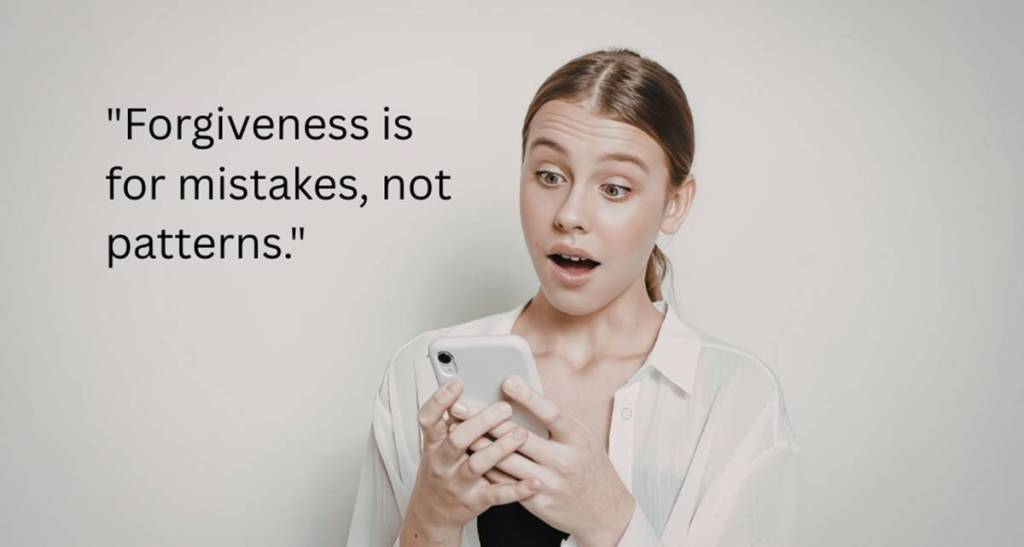
    “Forgiveness is for mistakes, not patterns.”

    There is no clear origin for this phrase, but over the past decade it has become a popular meme. The phrase matters because it’s about setting fair boundaries. We all make mistakes, but when there is a pattern of behavior the other person can’t seem to break, you shouldn’t give your forgiveness so easily. Eventually, it becomes enabling.

    “Over-explaining is a form of begging.”

    “You don’t have to attend every fight you are invited to.”

    “Sometimes the things that break your heart fix your vision.”

    “Never miss anyone who knows how to find you.”

    “Accept people as they are and place them where they belong.”

    “Don’t work harder than the person you’re helping.”

    A woman is unsure about her relationship. Photo credit: Canva

    Quotes about society

    “If you’re not allowed to question it, you’re being controlled by it.“

    This quote offers a way of looking at the authoritarian forces in our lives. Whether it’s the government, the educational system, law enforcement, religion, the media, or even people in your family, when you’re not allowed to be critical or ask questions, those in authority are more interested in controlling you than serving you.

    “Equality can feel like oppression to the ones who have held power.”

    Quotes about mental health

    “You can’t hate yourself into a version of yourself you love.”

    This quote is attributed to Lori Deschene, the founder of Tiny Buddha. She’s also the author of Tiny Buddha’s Gratitude Journal, Tiny Buddha’s Worry Journal, and more. The quote highlights the idea that self-improvement is more likely to come from self-acceptance than from self-criticism.

    “If it doesn’t change my life, then it shouldn’t change my mood.”

    “Avoidance is just prolonged suffering disguised as safety.”

    “People of value don’t go around devaluing others.”

    “You are not the voice in your head, you are the one that hears it.”

    There’s something wonderful about having little pieces of wisdom in your back pocket that you can draw on whenever things get rough. Kudos to Anderson, who asked her audience to share the wisdom many people may really need right now.

  • In 1958, a scientist began filling flasks with air. The samples showed the Earth was ‘breathing.’
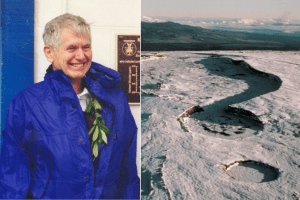
    A scientist pioneered the study of our atmosphere by manually collecting air in glass flasks.Photo credit: Wikimedia Commons
    ,

    In 1958, a scientist began filling flasks with air. The samples showed the Earth was ‘breathing.’

    Charles David Keeling’s painstaking work offered a better understanding of our planet, along with undeniable evidence of climate change.

    One of the longest-running scientific studies of its kind might not sound all that interesting on its surface. For more than 60 years, scientists on the flank of Mauna Loa, an active volcano in Hawaii, have been collecting air. Yes, air.

    The work, while repetitive and tedious at times, is surprisingly among the most important scientific research ever conducted.

    In the early 1900s, a handful of scientists had captured similar air samples from around the globe. An engineer named Guy Stewart Callendar was one of the first to compare these datasets and conclude that the human burning of fossil fuels was causing carbon dioxide levels in the atmosphere to rise.

    However, the datasets weren’t very good. They were collected at different locations around the globe and at different times. In the 1930s, there wasn’t a strong baseline for what Earth’s atmosphere should look like, so the scientific community was skeptical of Callendar’s ideas.

    That’s where scientist Charles David Keeling comes in.

    charles keeling, science, climate change, carbon emissions, fossil fuels, global warming, plants, earth, nature
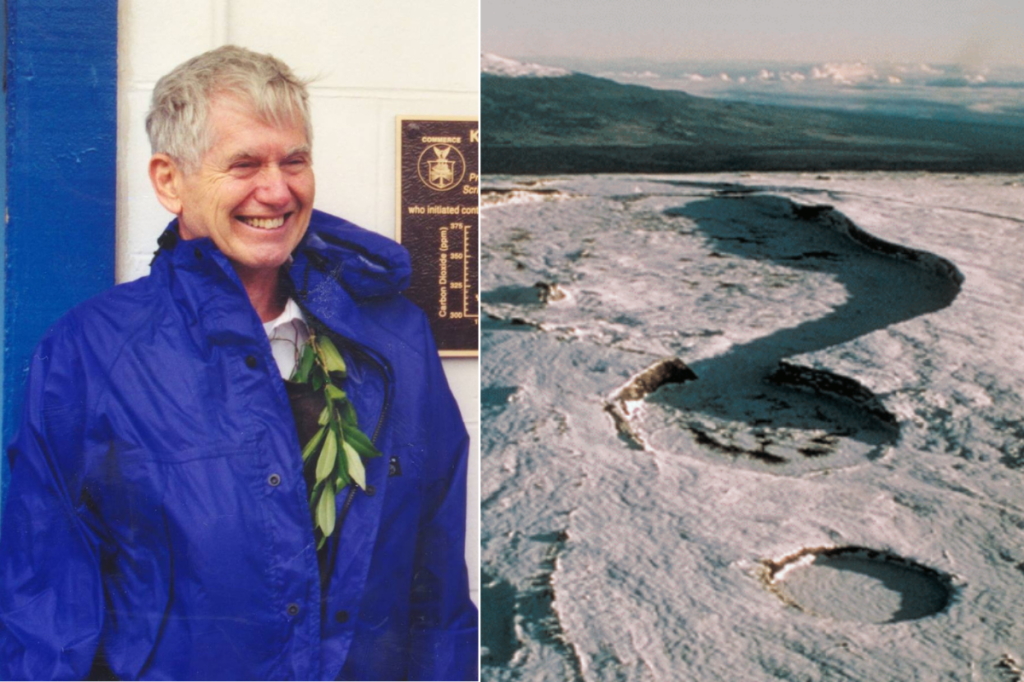
    Charles David Keeling. Photo credit: National Science Foundation/Wikimedia Commons

    In 1958, Keeling had the idea to collect air samples from the same spot every single day. It was radical at the time. His method required stationing a team at the Mauna Loa Observatory, far from cars, factories, and other human emissions, and collecting air samples in simple flasks.

    The entire process doesn’t sound all that scientific. One of the researchers would take a volleyball-shaped glass flask that had all of its air vacuumed out, hold his breath, walk into the wind, and open a valve that allowed air to rush in. Other teams repeated this process at various spots around the world, but the measurements at the Mauna Loa Observatory were where it all began. Despite how it sounds, Keeling was a stickler for precision and helped pioneer more accurate atmospheric measurements than the world had ever seen.

    Once Keeling had enough data, he realized two remarkable things about our planet.

    For starters, the Earth was breathing

    Carbon dioxide (CO2) levels in the atmosphere weren’t exactly steady. Keeling observed that they would rise and fall throughout the day, and even more so in a seasonal pattern.

    According to the University of Illinois Urbana-Champaign:

    “First, Keeling determined that CO2 levels rise and fall during the day, as well as throughout the seasons, based on vegetation growth. Plants feed themselves through photosynthesis, and CO2 is a vital ingredient of that process. With more plants growing in the Northern hemisphere’s summer months, the CO2 levels drop for a time as the plants ‘breathe’ it in.”

    In the winter, as plants die off and begin to decay, they release more CO2 into the air. In the Southern Hemisphere, this pattern is more or less reversed.

    Revealing this simple pattern helped form our understanding of Earth’s CO2 cycle, where carbon flows through the soil, oceans, atmosphere, and living organisms on the planet. This discovery also helps scientists build models that calculate the environmental impact of human behavior.

    Next, baseline CO2 levels were steadily rising every single year

    Soon, a more alarming trend became clear from Keeling’s data. Carbon dioxide levels were rising. He even developed something called the “Keeling Curve,” which is less of a curve and more of a line trending steadily up and to the right, indicating rising carbon dioxide levels.

    The Keeling Curve. Photo credit: Oeneis/Wikimedia Commons

    The Keeling Curve was one of the first undeniable pieces of evidence of human-caused climate change. As carbon dioxide levels rise, the atmosphere traps more heat and steadily warms the planet. This, in turn, leads to melting ice, rising sea levels, and more extreme weather, to name only a few consequences.

    Many scientists consider it one of the most important discoveries of the last century.

    Of course, Keeling was not the sole “founding father” of climate science. There was Callendar, whose hypotheses Keeling’s data eventually helped confirm. There was Irish scientist John Tyndall, who in 1861 discovered how certain gases could trap heat—what we now call the “greenhouse effect.” Fascinatingly, a less-heralded amateur scientist named Eunice Newton Foote demonstrated these ideas several years before Tyndall. And we’d be remiss not to give a shoutout to Jan Baptista van Helmont, a Flemish alchemist who helped identify carbon dioxide as a distinct gas.

    The sample collection at Mauna Loa continues to this day and remains one of the longest continuously running studies in the field. If anything, in recent years the work has only become more important.

  • The little paper emoji on your phone has words on it and people are stunned at what it says
    A screen with variuos emojisPhoto credit: Canva

    Go ahead and pull up the paper emoji on your iPhone. The little white page, the one that looks completely blank from a distance. Now zoom in.

    There’s a letter in there. It’s addressed to someone named Katie. It’s signed by someone named John Appleseed. And it has been sitting inside that emoji, invisible to most people, since iOS 5.

    Instagram user Ella (@el_michelle1) posted a video zooming in on the emoji in December 2025, and it spread rapidly, racking up millions of views from people who could not quite believe they’d been sending that little icon around for years without knowing what was written on it. As LADbible reported in its coverage of the discovery, the reaction split neatly between people who immediately recognized the text and people who absolutely did not.

    Those who recognized it knew it right away. The letter contains the full text of Apple’s “Think Different” campaign, which ran from 1997 to 2002 and became one of the most celebrated advertising moments in the company’s history. It reads, in part: “Here’s to the crazy ones. The misfits. The rebels. The troublemakers. The round pegs in the square holes. The ones who see things differently.” The letter ends: “Take care, John Appleseed.”

    Per Emojipedia, which documents the design details of every emoji across platforms, the text has been embedded in Apple’s paper emoji since the icon was introduced. It’s not just the paper emoji, either. As Creative Bloq noted, the same hidden text shows up in Apple’s notebook, memo, scroll, and clipboard emojis, and the receipt emoji contains a partial reference with the words “misfits,” “square pegs,” and “round holes” listed as line items.

    The name “John Appleseed” is Apple’s longstanding demo persona, used across its software and marketing materials for decades. As for Katie, nobody outside Apple knows for certain. The name varies slightly across emoji versions, appearing as “Kate,” “Katie,” or “Dear Katie” depending on which icon you’re looking at.

    It’s worth noting that Apple isn’t the only platform hiding things in its emoji designs. As Emojipedia documents, Samsung’s version of the clipboard emoji was once addressed “Dear Samsung,” and Facebook’s clipboard features what appears to be a small table of first names and dates, possibly birthdays.

    The response to Ella’s video captured something genuine: the strange pleasure of discovering that something you’ve looked at hundreds of times contained a message you never noticed. “Attention to detail is insane,” one commenter wrote. Another said: “I love when developers leave such tokens of their own in the things they built.” A third simply wanted to know: “Who is Katie?”

    Apple, characteristically, has not said.

    You can follow Ella (@el_michelle1) on Instagram for lifestyle content.

    This article originally appeared earlier this year.

  • Henry Cavill shared a delightful story about a boy’s teacher who refused to believe his uncle was Superman
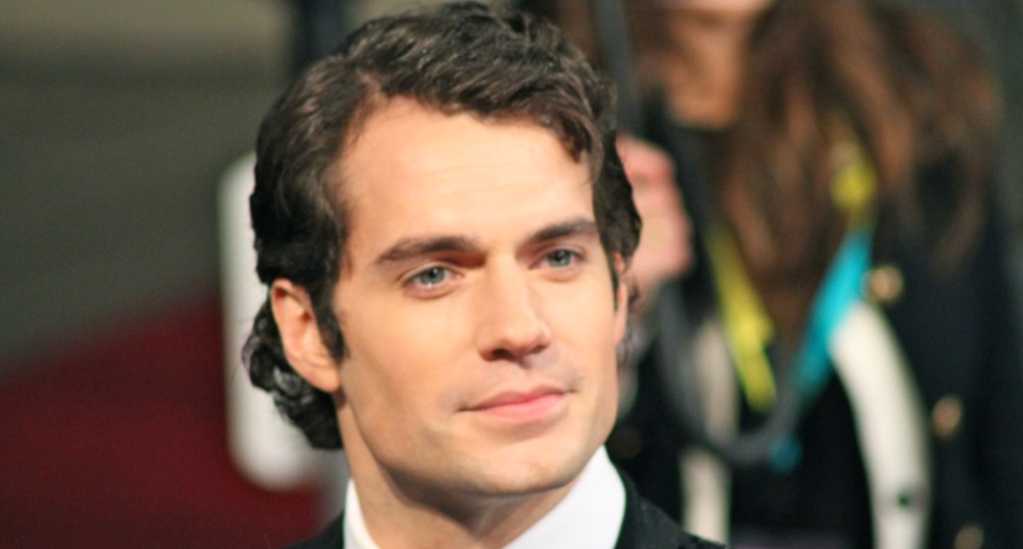
    Henry Cavill February 10, 2013Photo credit: Sean Reynolds via Wikimedia Commons

    When Henry Cavill was cast as Superman in 2011, most people were thrilled. His nephew Thomas was thrilled too, and he wanted everyone to know about it.

    At school, during a “talk about your family” day, Thomas told his class: “My uncle is Superman.” His classmates were stunned. Nobody believed him. His teacher, less than impressed, told him plainly: “Thomas, we don’t lie in school.”

    Thomas did not back down. “My uncle is Superman,” he insisted.

    The teacher, now genuinely concerned, raised the issue with Thomas’s mother when she came to collect him that afternoon. She walked her through the whole incident, explaining that the school did not encourage children to make things up in front of their peers. Thomas’s mother listened patiently, then delivered the news as gently as she could.

    “I hate to tell you this,” she said, “but it’s all true.”

    Cavill told the story on The Tonight Show with Jay Leno in June 2013, and it got so much mileage that he retold it on Live with Kelly and Ryan in 2018. Both times, audiences loved it for the same reason: Thomas never wavered. He knew what he knew, and no amount of adult skepticism was going to change it.

    “My uncle is Superman” is not the kind of claim most teachers are prepared to receive. But from Thomas’s perspective, it was simply a fact about his life, one that happened to be harder to verify than most. As Cavill told the story, there was no drama, no grand reveal. Just a small boy, stubbornly telling the truth, and a mother who had to gently correct a teacher’s assumptions at school pickup.

    The clip from the Live with Kelly and Ryan appearance has amassed over nine million views, with fans delighting in the specifics. “I hope the teacher replied by saying ‘I’m going to need you to prove that,’” one commenter wrote. “If my uncle was Superman I would brag about it every single day,” said another.

    Thomas, for his part, appears to have handled the whole thing with exactly the composure you’d expect from someone whose uncle saves the world for a living.

    This article originally appeared last year.

  • His classmates wouldn’t sign his yearbook. He signed it himself. Then Paul Rudd got involved.
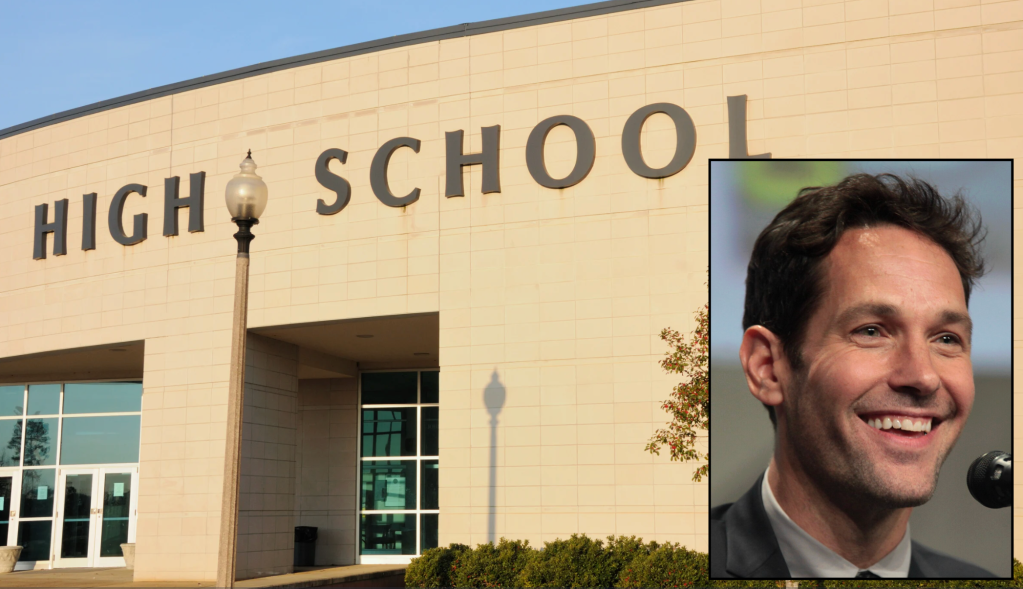
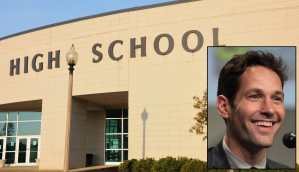
    Photo of a high school; (Inset) Paul Rudd Photo credit: Gage Skidmore via Wikimedia Commons

    When Brody Ridder came home from school on May 24, 2022, his mom took one look at his yearbook and felt her heart crack open. He’d asked all kinds of kids to sign it. Two had. Two teachers had. And then, on one of the pages, in his own handwriting: “Hope you make some more friends. — Brody Ridder.”

    He had signed his own yearbook. And then wished himself better luck next year.

    Cassandra Ridder posted a photo of the page to the school’s private Facebook parent group that night. She didn’t ask Brody first, but as she told the Washington Post, she knew he’d be fine with it. “Brody has always told me he wants to be part of the solution.” Her message to other parents was simple: talk to your kids about kindness. She had no idea what was about to happen.

    Other parents showed the post to their kids. Seventeen-year-old Joanna Cooper got a text from her mom with a screenshot and made a decision on the spot, as she told KDVR. “We’re going to sign his yearbook,” she said, “because no kid deserves to feel like that.” She started texting friends. Meanwhile, Simone Lightfoot, also an 11th grader, was doing the same thing. “When I was younger, I was bullied a lot like him,” she told the Washington Post. “We walked in and we were like, ‘Where’s Brody at? Is Brody Ridder in here?’ And they’re like, ‘Yeah, he’s in the back.’ And we’re like, ‘Brody! We’re here to sign your yearbook, bud.’”

    The older kids didn’t just sign their names. As Goalcast reported in its coverage, they asked Brody about his hobbies, which turned out to include chess and fencing, and gave him a pep talk. Many of them had been in similar situations at his age. Once the upperclassmen started filling pages, the kids in Brody’s own class started getting up from their seats to sign it too. “It was like a domino effect,” Cassandra told Fox News. “It was beautiful.” By the end of the day, Brody had collected more than 100 signatures, paragraphs of encouragement, and a handful of phone numbers.

    “It just made me feel better as a person,” Brody told KDVR. “I don’t know how to explain it. It just makes me feel better on the inside.”

    The story didn’t stay local for long. After Cassandra posted an update to her personal Facebook, it spread widely. Letters started arriving at the Ridders’ P.O. Box from people across the country and around the world, people of all ages who recognized something in Brody’s story. By July, at least 600 letters had arrived, with more still coming, including one dictated by a three-year-old to his mom.

    Among those who reached out was Paul Rudd. According to the Denver Post, Rudd’s sister saw Cassandra’s post and contacted her to say the actor would love to connect with Brody. Rudd FaceTimed him and sent a care package that included a signed Ant-Man helmet and a handwritten note telling Brody that things get better and that many people, Rudd included, thought he was “the coolest kid there is.”

    Cassandra and Brody have since partnered with The UGLI Foundation, an anti-bullying nonprofit, to keep the conversation going, according to the Denver Post. Cooper, the 11th grader who organized the original yearbook visit, said she planned to push for a schoolwide signing event the following year so no student would face an empty book again.

    Brody said he’s not sure all the kids who refused to sign will become his friends. But something shifted. “It made me feel like there’s hope for the school,” Cassandra said, “there’s hope for humanity, and there are a lot of good kids in this world.”

    This article originally appeared two years ago.

  • Wharton researcher discovers money can buy happiness. But these 3 other things matter just as much.
    A psychologist has found the keys to happiness, including moneyPhoto credit: Canva

    There’s no simple answer for how to be happy, but many brilliant individuals have dedicated their lives to finding the answer nonetheless.

    Matt Killingsworth is one of them. A Harvard-educated psychologist and senior fellow at the esteemed Wharton School, Killingsworth has led numerous studies designed to uncover the secret to happiness. In one of his biggest undertakings, he helped design TrackYourHappiness.org, “a large-scale research project that uses smartphones to collect real-time happiness data from people around the world.”

    The findings he’s cultivated over the course of his career are mandatory reading for anyone who wants to maximize the joy they get out of life. Here are just a few takeaways from his body of research:

    1. Money can buy happiness. Really.

    happiness, psychology, research studies, science, brain, behavior, joy, emotions, harvard, wharton school
    Money can buy most people a little more happiness. Photo credit: Canva

    A groundbreaking study conducted in 2010 by Daniel Kahneman and others found that money does not make you happy. Or rather, money increases happiness only up to around $60–$90,000 per year—enough to live comfortably and without many of the hardships associated with poverty. Beyond that point, Kahneman found no additional benefit to earning more money when it came to happiness.

    Killingsworth’s own research disagreed, showing “a linear relationship between happiness and income” with essentially no upper limit.

    The two authors came together to reconcile their findings in a paper titled “Income and emotional well-being: A conflict resolved.” In the end, they determined that the “flattening” effect applies only to the least happy people. Meanwhile, the happiest people continued to get happier as their wealth increased.

    In other words, if you aren’t happy to begin with, more money probably won’t help. But if you’re generally pretty happy, having more resources allows you to maximize your joy in new ways.

    2. Buying things doesn’t move the needle. Buying experiences does.

    It’s hard to say exactly why having more money continues to make most of us happier, but some of Killingsworth’s other research may offer a clue.

    Money makes a lot of problems in our lives go away. But as the old saying suggests, having a lot of money also creates new problems. One thing large amounts of money do allow us to do is buy things that can help us experience joy. Well, not necessarily things.

    happiness, psychology, research studies, science, brain, behavior, joy, emotions, harvard, wharton school
    Experiences make us happier than things. Photo credit: Canva

    In his paper with fellow authors Amit Kumar and Thomas Gilovich, Killingsworth finds: “Spending on doing promotes more moment-to-moment happiness than spending on having. Relative to possessions, experiences elicit greater in-the-moment happiness.”

    The study found that experiences trumped possessions in nearly every category of satisfaction, including anticipation, moment-of-consumption, and remembrance. Vacations, concerts, parties, and adventures are a far better use of your money than cars, clothes, and other material items.

    3. The joy is in the waiting

    Speaking of anticipation, Killingsworth has found that it is sometimes one of the greatest elicitors of happiness.

    In the published paper “Waiting for Merlot,” Killingsworth and his co-authors argue that waiting eagerly is a crucial element of extracting joy from experiences, and reiterate that the happiness we feel while anticipating an experience or event far outweighs the joy we get from waiting for a material possession.

    Happiness expert and New York Times bestselling author Gretchen Rubin agrees. She writes that there are four keys to maximizing how happy an event makes you. The first is anticipation, but savoring the moment, sharing it with others, and reflecting back on it often round out the magic formula.

    “Anticipation is a key stage; by having something to look forward to, no matter what your circumstances, you bring happiness into your life well before the event actually takes place,” she writes. “In fact, sometimes the happiness in anticipation is greater than the happiness actually experienced in the moment—that’s known as ‘rosy prospection.’”

    4. Being present is a happiness superpower

    In “A wandering mind is an unhappy mind,” Killingsworth dropped one of the biggest truth bombs of his career. He and his co-author Daniel Gilbert found “that people are thinking about what is not happening almost as often as they are thinking about what is and … found that doing so typically makes them unhappy.”

    In an essay for the University of California, Berkeley, Killingsworth writes that many of the other factors involved in happiness are relatively superficial: “Yes, people are generally happier if they make more money rather than less, or are married instead of single, but the differences are quite modest.”

    Our ability to stay present in the moment and take joy in our lives—not what’s already happened, or what’s coming next—is incredibly powerful:

    “We found that people are substantially less happy when their minds are wandering than when they’re not, which is unfortunate considering we do it so often. Moreover, the size of this effect is large—how often a person’s mind wanders, and what they think about when it does, is far more predictive of happiness than how much money they make, for example.”

    It’s no wonder so many scientists, philosophers, and researchers have dedicated their careers to understanding the mysteries of happiness. After all, most people simply want to live a happy life, and feeling fulfilled can make us healthier and help us live longer.

    Finding happiness is easier said than done. Killingsworth’s research suggests that being rich and checking things off your bucket list can help in the search, but ultimately the most important part is learning to find joy in the everyday moments.

  • Wedding photographer shares the surprising but ‘surefire’ ways she knows a relationship won’t last
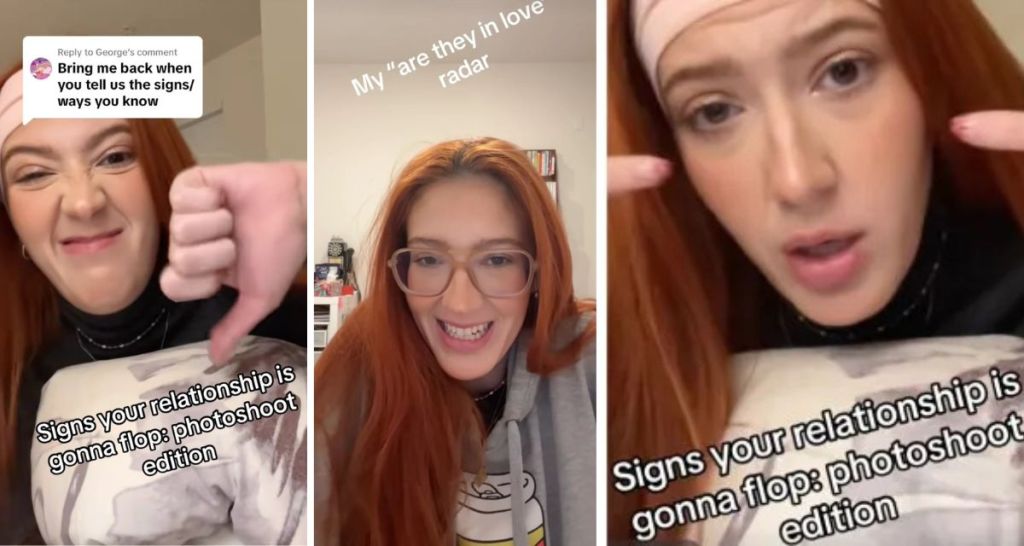
    Wedding photographer Ona Vicente.Photo credit: @onavicente/TikTok

    After years of photographing soon-to-be-married couples, wedding photographer Ona Vicente says she can spot the “surefire” signs a relationship won’t last simply by going off the “vibes” of the photoshoot.

    “You spend enough time with couples, you develop a spidey-sense,” she says in a TikTok video.

    These red flags include: being dressed to go to “two completely different places,” when one spouse refuses to take off a piece of clothing (a coat, for example) for at least one shot, having constant arguments over “small stuff,” making fun of each other “in a mean way,” and getting verbally or physically aggressive.

    What do these “red flags”mean?

    All of these signs point to an unhealthy communication dynamic, which can undermine one of the most important keys to a lasting relationship: healthy communication. After all, Dr. John Gottman, a renowned relationship researcher, has famously said he can predict with over 90% accuracy whether couples will stay together or divorce simply by analyzing their communication patterns.

    @onavicente

    Replying to @George signs I know as an engagement and wedding photographer, that your relationship won’t last #dating #photographer #wlw #weddingphotographer #relationships

    ♬ original sound – Oniii

    As psychotherapist Eliza Davis explains, couples who have healthy communication can “navigate misunderstandings” and high-pressure situations, such as a wedding shoot, because they know how to “repair” after conflict. In one of Vicente’s scenarios, that might look like instantly knowing to apologize and reset the tone after saying something snippy.

    Cheryl Groskopf, an anxiety and trauma therapist, points out that even healthy couples may find themselves acting more hostile toward one another in “emotionally loaded environments.”

    “Stress isn’t personal,” she tells Upworthy. “When people are overwhelmed, the brain shifts into survival mode. The prefrontal cortex, aka the part responsible for patience and thoughtful communication, gets quieter, while the threat-detection system gets louder. That’s why someone might sound sharper than usual or seem short-tempered. It’s often physiology, not intention.”

    How couples can navigate high-stress situations

    That said, couples can help mitigate these tiffs by building in “small regulation moments,” suggests Groskopf.

    “When the schedule is packed, people forget to pause,” she adds. “Even something as simple as stepping aside together for a few breaths, holding hands for a moment, or sharing a quick joke can reset the nervous system. These micropauses help your body move out of stress mode and back toward connection.”

    In a subsequent video, Vicente shares that she’s seen plenty of “green flags” during her shoots as well, like reassuring one another during bouts of awkwardness, expressing the same level of enthusiasm while sharing their love story, being able to laugh with one another, and generally being on the “same page.”

    @onavicente

    Replying to @CatchinupwithCath love radar green flag edition!! #wlw #dating #relationship #greenflag #weddingphotography

    ♬ original sound – Oniii

    Vicente says couples who don’t display these traits shouldn’t consider themselves doomed; she was merely reflecting on patterns she’s witnessed. This is also reflected in how experts assess the health of a relationship—by looking at what patterns emerge. How often do bids for connection get recognized? What is the positivity-to-negativity ratio? Does feedback tend to result in curiosity or contempt?

    Moral of the story

    No two people are perfect, and therefore no relationship is going to be perfect. But what really matters is how the two prioritize their connection with one another throughout all the inevitable twists and turns of life.

Culture

His classmates wouldn’t sign his yearbook. He signed it himself. Then Paul Rudd got involved.

Skills

Wharton researcher discovers money can buy happiness. But these 3 other things matter just as much.

Relationships

Wedding photographer shares the surprising but ‘surefire’ ways she knows a relationship won’t last

Culture

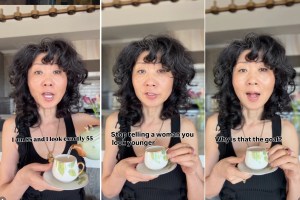
‘I am 55 and I look exactly 55.’ Woman’s viral commentary on aging hits all the right notes.