Tags
More for You
-
The next generation of female leaders has arrived. Here’s how they’re making sure they (and every girl) get a chance to learn.
Malala Fund and their local partners, with support from Pura, help girls find their voice. The result: greater access to education and a better world.
Music, community and joy drive real change
In a small village in Pwani, a district on Tanzania’s coast, a massive dance party is coming to a close. For the past two hours, locals have paraded through the village streets, singing and beating ngombe drums; now, in a large clearing, a woman named Sheilla motions for everyone to sit facing a large projector screen. A film premiere is about to begin.
It’s an unusual way to kick off a film about gender bias, inequality, early marriage, and other barriers that prevent girls from accessing education in Tanzania. But in Pwani and beyond, local organizations supported by Malala Fund and funded by Pura are finding creative, culturally relevant ways like this one to capture people’s interest.
The film ends and Sheilla, the Communications and Partnership Lead for Media for Development and Advocacy (MEDEA), stands in front of the crowd once again, asking the audience to reflect: What did you think about the film? How did it relate to your own experience? What can we learn?
Sheilla explains that, once the community sees the film, “It brings out conversations within themselves, reflective conversations.” The resonance and immediate action create a ripple effect of change.

MEDEA Screening Audience in Tanzania. Captured by James Roh for Pura Across Tanzania, gender-based violence often forces adolescent girls out of the classroom. This and other barriers — including child marriage, poverty, conflict, and discrimination — prevent girls from completing their education around the world.
Sheilla and her team are using film and radio programs to address the challenges girls face in their communities. MEDEA’s ultimate goal is to affirm education as a fundamental right for everyone, and to ensure that every member of a community understands how girls’ education contributes to a stronger whole and how to be an ally for their sisters, daughters, granddaughters, friends, nieces, and girlfriends.
Sheilla’s story is one of many that inspired Heart on Fire, a new fragrance from the Pura x Malala Fund Collection that blends the warm, earthy spices of Tanzania with a playful, joyful twist. Here’s how Pura is using scent as a tool to connect the world and inspire action.
A partnership focused on local impact, on a global mission
Pura, a fragrance company that recognizes education as both freedom and a human right, has partnered with Malala Fund since 2022. In order to defend every girl’s right to access and complete 12 years of education, Malala Fund partners with local organizations in countries where the educational barriers are the greatest. They invest in locally-led solutions because they know that those who are closest to the problems are best equipped to solve and build durable solutions, like MEDEA, which works with communities to challenge discrimination against girls and change beliefs about their education.
But local initiatives can thrive and scale more powerfully with global support, which is why Pura is using their own superpower, the power of scent, to connect people around the world with the women and girls in these local communities.
The Pura x Malala Fund Collection incorporates ingredients naturally found in Tanzania, Nigeria, Pakistan, and Brazil: countries where Malala Fund operates to address systemic education barriers. Eight percent of net revenue from the Pura x Malala Fund Collection will be donated to Malala Fund directly, but beyond financial support, the Collection is also a love letter to each unique community, blending notes like lemon, jasmine, cedarwood, and clove to transport people, ignite their senses, and help them draw inspiration and hope from the global movement for girls’ education. Through scent, people can connect to the courage, joy, and tenacity of girls and local leaders, all while uniting in a shared commitment to education: the belief that supporting girls’ rights in one community benefits all of us, everywhere.
You’ve already met Sheilla. Now see how Naiara and Mama Habiba are building unique solutions to ensure every girl can learn freely and dare to dream.
Naiara Leite is reimagining what’s possible in Brazil
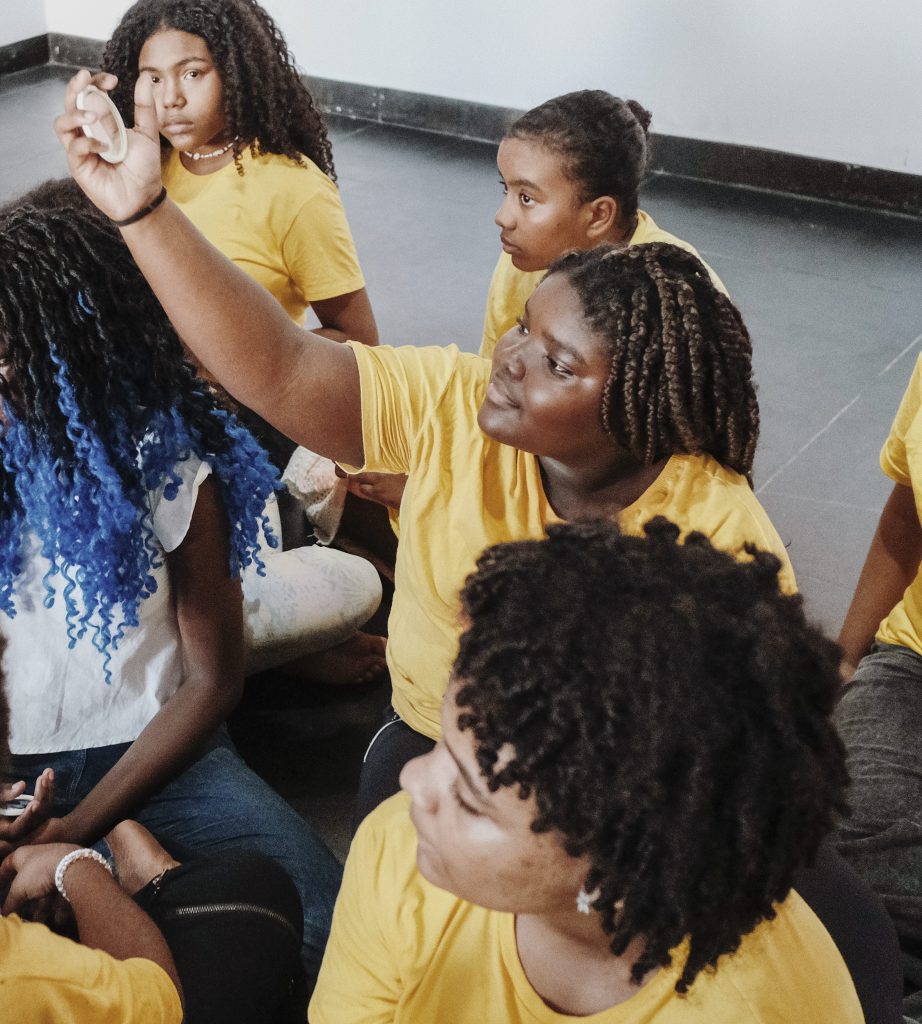
Julia with Odara in Brazil. Captured by Luisa Dorr for Pura In Brazil, where pear trees and coconut plantations cover the Northeastern Coast, girls like ten-year-old Julia experience a different kind of educational barrier than girls in Tanzania. Too often, racial discrimination contributes to high dropout rates among Black, quilombola and Indigenous girls in the country.
“In the logic of Brazilian society, Black people don’t need to study,” says Naiara Leite, Executive Coordinator of Odara, a women-led organization and Malala Fund partner. Bahia, the state where Odara is based, was once one of the largest slave-receiving territories in the Americas, and because of that history, deeply-ingrained, anti-Black prejudice is still widespread. “Our role and the image constructed around us is one of manual labor,” Naiara says.
But education can change that. In 2020, with assistance from a Malala Fund grant, Odara launched its first initiative for improving school completion rates among Black, quilombola, and Indigenous girls: “Ayomidê Odara”. The young girls mentored under the program, including Julia, are known as the Ayomidês. And like the Pura x Malala Fund Collection’s Brazil: Breath of Courage scent, the Ayomidês are fierce, determined, and bursting with energy.
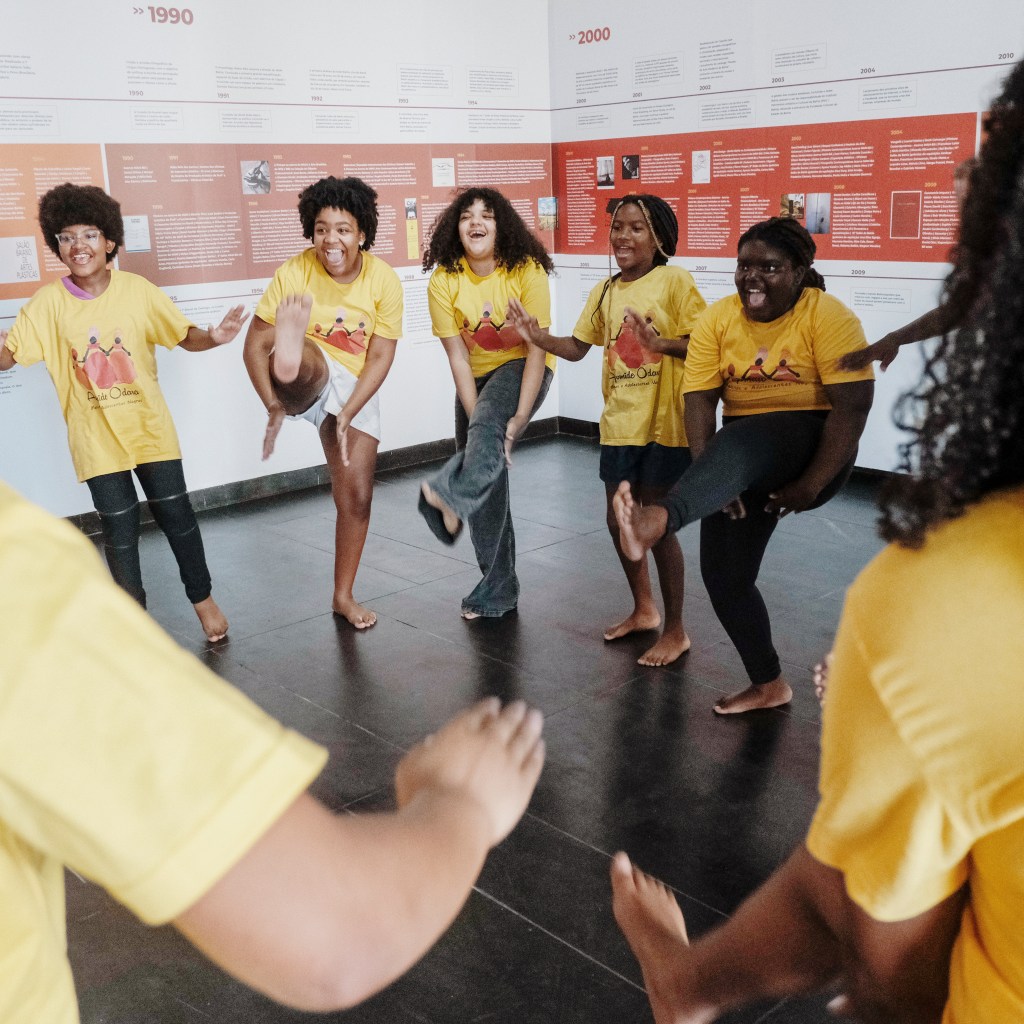
Ayomidês with Odara in Brazil. Captured by Luisa Dorr for Pura Ayomidês take part in weekly educational sessions where they explore subjects like education and ethnic-racial relations. The girls are encouraged to find their own voices by producing Instagram lives, social media videos, and by participating in public panels. Already, the Ayomidês are rewriting the narrative on what’s possible for Afro-Brazilian girls to achieve. One of the earliest Ayomidês, a young woman named Debora, is now a communications intern. Another former Ayomidê, Francine, works at UNICEF, helping train the next generation of adolescent leaders. And Julia has already set her sights on becoming a math teacher or a model.
“These are generations of Black women who did not have access to a school,” Naiara says. “These are generations of Black women robbed daily of their dreams. And we’re telling them that they could be the generation in their family to write a new story.”
Mama Habiba is reframing the conversation in Nigeria

Centre for Girls' Education, Nigeria. Captured by James Roh for Pura In Mama Habiba’s home country of Nigeria, the scents of starfruit, ylang ylang and pineapple, all incorporated into the Pura x Malala Collection’s “Nigeria: Hope for Tomorrow,” can be found throughout the vibrant markets. Like these native scents, Mama Habiba says that the Nigerian girls are also bright and passionate, but too often they are forced to leave school long before their potential fully blooms.
“Some of these schools are very far, and there is an issue of quality, too,” Mama Habiba says. “Most parents find out when their children are in school, the girls are not learning. So why allow them to continue?”
When girls drop out of secondary school, marriage is often the alternative. In Nigeria, one in three girls is married before the age of 18. When this happens, girls are unable to fulfill their potential, and their families and communities lose out on the social, health and economic benefits.
Completing secondary school delays marriage, and according to UNESCO, educated girls become women who raise healthier children, lift their families out of poverty and contribute to more peaceful, resilient communities.
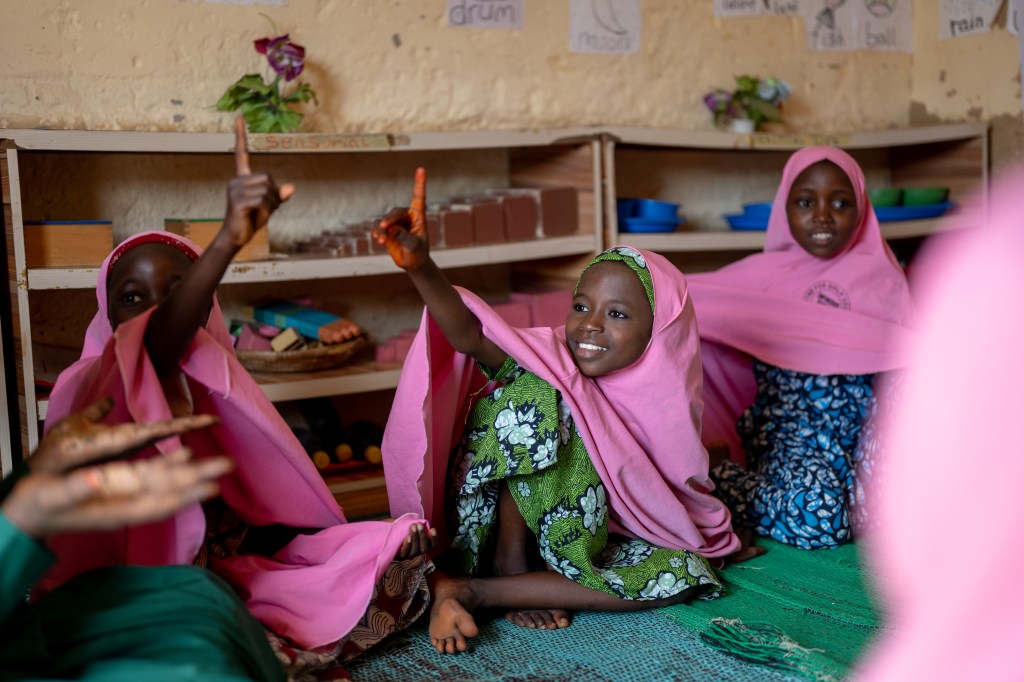
Centre for Girls’ Education, Nigeria. Captured by James Roh for Pura To encourage young girls to stay in school, the Centre for Girls’ Education, a nonprofit in Nigeria founded by Mama Habiba and supported by Malala Fund and Pura, has pioneered an initiative that’s similar to the Ayomidê workshops in Brazil: safe spaces. Here, girls meet regularly to learn literacy, numeracy, and other issues like reproductive health. These safe spaces also provide an opportunity for the girls to role-play and learn to advocate for themselves, develop their self-image, and practice conversations with others about their values, education being one of them. In safe spaces, Mama Habiba says, girls start to understand “who she is, and that she is a girl who has value. She has the right to negotiate with her parents on what she really feels or wants.”
“When girls are educated, they can unlock so many opportunities,” Mama Habiba says. “It will help the economy of the country. It will boost so many opportunities for the country. If they are given the opportunity, I think the sky is not the limit. It is the starting point for every girl.”
From parades, film screenings to safe spaces and educational programs, girls and local leaders are working hard to strengthen the quality, safety and accessibility of education and overcome systemic challenges. They are encouraging courageous behavior and reminding us all that education is freedom.
Experience the Pura x Malala Fund Collection here, and connect with the stories of real girls leading change across the globe.
-
What it means to look at the ground while walking, according to psychology
The answer is surprisingly complex.
So much about a person’s inner world can be revealed without them having to say a single word. Even the smallest gestures can offer clues to their deeper emotions, coping mechanisms, and how they navigate the world.
For instance, you may have noticed people who keep their eyes on the ground while walking. You might even be one of them yourself. Experts suggest that even this tells a psychological story—but not necessarily the one you might be thinking.
Walking with one’s eyes down is commonly associated with shyness, depression, social anxiety, and low self-esteem. There does appear to be some science to support this.
For example, researchers have found that people experiencing social anxiety are more likely to avert others’ gaze, often looking toward the ground rather than making eye contact. Some studies suggest this behavior may stem from a fear of being judged or negatively evaluated, making eye contact feel uncomfortable or even threatening.
At the same time, psychologists caution against making quick assumptions. Human behavior is rarely driven by a single cause, and the same outward action can reflect very different internal states. In fact, looking down while walking can serve multiple purposes, many of which have little to do with anxiety or emotional distress.
Cultural context, for instance, is another important factor. In some cultures, lowering one’s gaze is considered a sign of respect, humility, or politeness, especially when encountering elders or authority figures. What might be interpreted as insecurity in one setting could actually be a learned social norm in another.
There is also a cognitive explanation. Many people use walking as a time to think, process, or problem-solve. Looking down can reduce visual distractions, allowing the brain to focus more fully on internal thoughts. This kind of inward attention may be especially common among creative thinkers or those working through complex ideas.
Another factor is more practical and straightforward: balance and navigation. Researchers at the University of Rochester found that people instinctively spend more time looking at the ground when it’s uneven in an effort to avoid tripping. This behavior is particularly noticeable in unfamiliar environments or places with obstacles where visual attention shifts downward to maintain stability and prevent falls.
Expanding on this, age can also play a role. Older adults, for example, may be more likely to watch their steps carefully to reduce the risk of injury. Similarly, people recovering from injuries or dealing with mobility challenges might rely more on visual cues from the ground.
Lastly, we live in a smartphone-dominated world. Many, if not most, of us regularly look down at our devices while walking. Over time, this habit can carry over even when a phone is not in hand. The posture becomes automatic, shaped by repetition rather than emotion.
Taken together, these perspectives suggest that a downward gaze is not a one-size-fits-all signal. It can reflect anxiety, yes, but it can also point to cultural norms, deep thought, environmental awareness, or simple habit. Like many aspects of human behavior, its meaning depends heavily on context.
-
A dad said he takes his young daughter to the women’s restroom. Then women chimed in.
“I would rather feel awkward or uncomfortable than having my daughter feel uncomfortable.”
It’s one of the all-time classic “girl dad” problems: you’re out with your young daughter and she needs to “go potty.” Do you take her into the men’s room or the women’s room?
Most guys would go to the men’s room without a second thought. But one dad has people wondering if there might be a better way.
Alex Vigilante coaches high-achieving men to “live a more aligned life, be more present, [and be] more whole.” He also shares content about fatherhood and his own life as a dad.
Question goes viral
Recently, Vigilante posed a question to fellow girl dads on Instagram: “When you’re out in public and your daughter has to go to the bathroom, which restroom do you take her to if there’s not a gender-neutral restroom?”
He took his viewers by surprise with his answer: “Today, I took her into the women’s restroom. … I think that is the better route than taking her to the male restroom.”
In the caption to his post, Vigilante outlined his reasoning. One point in particular was especially thought-provoking.
“I would rather feel awkward or uncomfortable than having my daughter feel uncomfortable,” he wrote, adding that he didn’t feel it was appropriate to have his young daughter around grown men using the facilities. Vigilante also noted that he prefers to go in when no women are inside and will openly announce himself so as not to startle anyone.
The now-viral Reel drew more than six million views, and needless to say, a passionate discussion ensued.
Men react
First came the dads who vehemently disagreed and said they would never set foot inside a women’s restroom, even with a toddler girl in tow.
“Men’s restroom, respectfully. Handicap stall. Clorox wipes and Lysol travel size spray in hand. The potential for a misunderstanding isn’t one I’m willing to entertain.”
“Imagine two or three dads in the women’s restroom…no bro, just use the dudes’ and go in the stall with her if she’s a little one, if she’s older, find a better solution. Don’t go in the girls restroom.”
“The world doesn’t revolve around me or my daughter, & it’s not fair for an innocent adult female to walk into me in her safe place.”

Urinals in a men’s bathroom. Photo credit: Canva Women react
Then moms and women at large began to chime in. Their collective response was surprising and heartwarming.
Though not a monolith, of course, a majority of women who responded to Vigilante’s video were strongly in favor of dads bringing their daughters into the women’s room. Many recalled being young and feeling intimidated by the presence of grown men in the men’s room, even with their fathers there.
“Please use the women’s restroom we really don’t mind. We were once little girls who needed protected too.”
“As a woman I support dads bringing their daughters to the woman’s room.”
“Absolutely! I have been in places before and if I see a man bringing his daughter towards the restroom I always offer to announce it in the bathroom and I stand at the entry door and keep everyone informed that comes in until they are finished. It takes a village!”
“I’d rather feel a little uncomfortable and know a child is safe in the women’s restroom than have a little girl in the men’s room where there’s urinals and what not.”
Honest discussion changed the minds of at least a few dads
Several admitted they always “hated” bringing their daughters into the men’s room but didn’t see another way. After the warm response from moms, they were inspired to give it a try.
“I’ve literally never considered this. Dude, thank you for bringing up. My first reaction was that I would never want to make other women afraid or uncomfortable if I was in there with my baby girl. And then I read the comments. WOW. Women are incredible. Sad that we have to even worry about this, but grateful to know my daughter has other women who freely have her back without even knowing her.”
However, the opposing view is also valid, making this a complex issue. It could even become a legal one. While it’s not generally considered illegal for a man to enter a women’s restroom, the situation can become murky if someone feels threatened and raises a complaint.
For his part, Vigilante said he’s never had an issue taking his daughter to the women’s room, but would happily leave if he made anyone uncomfortable.
A better solution?
It seems there should be a better solution by now, and fortunately, there has been incremental progress in this area.
For starters, more men’s rooms have changing tables than in years past. This not only allows dads with babies to avoid going into the women’s room to change them, but also helps rebalance the distribution of childcare labor, which has historically been skewed toward moms.
There’s also a push to “ditch the gap” in public restroom stalls, offering greater privacy for all.
There’s even been a steep rise in the availability of family or gender-neutral bathrooms in public spaces, which helps everyone. In some places, they’re required by law.
There are other solutions as well. For girls old enough to go in alone, many dads choose to stand outside the bathroom, sometimes with the door propped open so they can hear what’s going on and talk to their daughter for comfort.
In the end, it’s an individual choice that requires dads to be mindful of others, as well as their daughter’s comfort level.
“My daughter’s safety comes first…so I feel empowered to keep doing this,” Vigilante wrote in the comments. “I respect the opinion of parent who think otherwise, as they just want their kids to be safe as well.”
-
Madrid art student sews a gorgeous, wearable dress out of hand-picked leaves
It took 40 hours to sew the dress by hand.
Making quality dresses takes an enormous amount of skill. It’s not just about sewing and tailoring, but also about design—knowing which fabrics and colors pop and draw the eye. At their best, dresses bring art and beauty to fashion. But for a fine arts student living in Spain, making a dress incorporated all of those skills, along with a touch of nature.
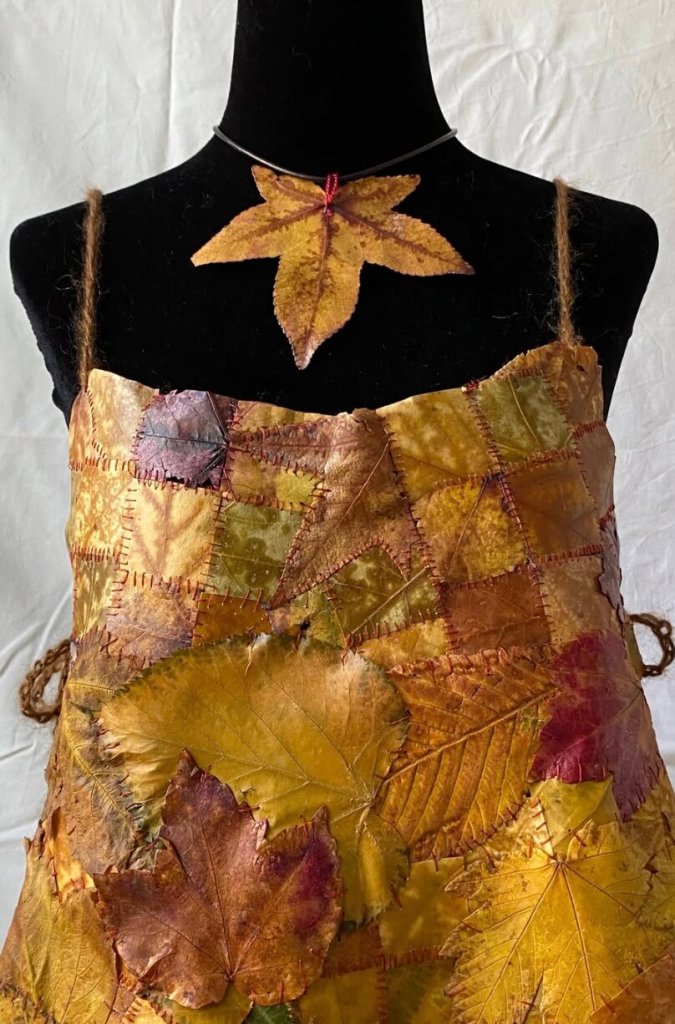
Artist Amanda Meyer successfully sewed a beautiful dress from a variety of hand-picked autumn leaves in vibrant shades of orange, red, and yellow. She then soaked the leaves in glycerin to help preserve them. After drying them with an iron, the leaves became sturdier and easier to manipulate. Meyer cut and sewed the leaves together into a gorgeous patchwork mini dress.
“I wanted to see if it was possible to create a fully organic garment without using the usual materials such as cotton or linen,” Meyer told My Modern Met. “As a young person deeply committed to the environment, my practice focuses on using only recycled and natural resources. I specialize in textile art, creating sculptures and sculpt-like garments.”
Natural fibers of a different kind
It took Meyer around 100 meters of thread and 40 hours of hand sewing to create her leaf dress. While the dress remains fragile and is intended for exhibition, it is also a wearable and successful clothing experiment. However, it was never meant to last.
Screenshot “Many people have asked me if I intend to preserve it,” said Meyer. “The answer is no, I want to see how it passes the test of time. Clothes aren’t meant to last forever.”
The environmental problem of modern fashion
The mixed-media artist draws attention to the troubling fast-fashion industry. Fast fashion offers convenience and style, but it also contributes to environmental issues. According to Boston University, the United States throws out 34 billion pounds of used textiles each year. The lion’s share of them are made from synthetic fibers, which take much longer to decompose than natural ones like cotton.
Fast fashion production also generates more carbon emissions than international flights, according to Business Insider. In the end, it contributes to piles of long-lasting clothing in landfills and increasing levels of air pollution.
Meyer’s artwork and similar movements show how the life cycles of items can be repurposed, whether for creative expression or practical use. An old garment can be transformed into crafts, toys, rugs, or even cleaning rags. If leaves can be used to create beautiful art, a discarded T-shirt can become something more, too.
-
Philosophy expert reveals the character trait that shows someone is highly intelligent
“An intelligent person tries to be a realist.”
Julian de Medeiros, a philosophy expert who’s popular on TikTok and Substack, has built a reputation for sharing some of the world’s most important philosophical ideas about life, love, ethics, and intelligence. Recently, he shared wisdom from Bertrand Russell on the character trait that highly intelligent people tend to have: they see the world as it really is, not as they want it to be.
Russell, a British philosopher and founding figure of the analytic movement in philosophy, won the Nobel Prize in Literature in 1950. His work in logic, epistemology, and mathematics made him one of the most important minds of the 20th century. As they say, it takes one to know one, and if Russell says someone is intelligent, chances are he’s right.
What’s a sign someone is highly intelligent?
“Here’s how you know that someone is intelligent, and this goes back to the philosopher Bertrand Russell, who wrote, ‘You see the world as it is, not as you would like it to be, is the beginning of all wisdom,’” de Medeiros shared on TikTok.
To put it simply, an intelligent person wants to get things right, while an unintelligent person wants to be right. Smart people look at the facts and form their opinions based on reality. Those who aren’t as bright tend to be more dogmatic, trying to see the world in ways that align with their beliefs.

Bertrand Russell. Photo credit: Rijksmuseum/Wikimedia Commons “What [Russell] meant is that an intelligent person tries to be a realist,” de Medeiros continued. “Like, they try to measure, examine, and test their own belief systems against reality. But an unintelligent person tends to be dogmatic. Like they don’t change their mind when confronted with the facts. In fact, you could show them the evidence, and they would simply double down.”
What is the “backfire effect”?
What de Medeiros is referring to is what’s known as the “backfire effect.” It’s a psychological phenomenon in which, when people are presented with credible facts that challenge their beliefs, they may hold on to those beliefs even more strongly than before.
“Once something is added to your collection of beliefs, you protect it from harm,” author David McRaney wrote in You Are Not So Smart. “You do this instinctively and unconsciously when confronted with attitude-inconsistent information. Just as confirmation bias shields you when you actively seek information, the backfire effect defends you when the information seeks you, when it blindsides you.”

Politicians debating. Photo credit: Canva It can sting to change your mind, because it can feel like you’ve invalidated a big part of your sense of self. However, it becomes much easier if you begin to change how you see yourself. Instead of identifying with a specific worldview, you can think of yourself as someone who embraces the truth, no matter how difficult that may be.
“Bertrand Russell believed that true intelligence was when you were open to the possibility that you might be wrong,” de Medeiros said. “When you sought to test your own belief systems and when you had a rational and inquisitive mindset, that is true intelligence. When the facts change, you change.”
-
A man planted tomato seeds from two McDonald’s burgers. Three months later, whoa.
“I expected this tomato to grow,” James Prigioni said, “but I did not expect this.”
In many ways, fast-food restaurants feel like the opposite of a backyard vegetable garden. But one gardener has tied a McDonald’s hamburger directly to a garden harvest in a way that even surprised him.
James Prigioni makes popular gardening videos on YouTube. In one, he wanted to see if he could grow a whole tomato plant by planting the seeds from a tomato on a McDonald’s burger. He picked up a Deluxe Quarter Pounder with cheese, pulled out a tomato slice, and removed two seeds. After rubbing the seeds on a paper towel to remove the protective coating, which can inhibit sprouting, they were ready to plant.
Trying out different seed-planting methods
But like any good scientist, Prigioni wanted to try a different method for testing McDonald’s tomato seeds. So he pulled a slice of tomato from a second Quarter Pounder and, instead of extracting the seeds, planted the entire slice.
With the help of a heat mat and a grow lamp, both sets of seedlings germinated and sprouted in soil-filled red Solo cups in about a week. After they were fully established, Prigioni separated the plants so they could thrive individually before being planted outside.
He planted one of the plants in the ground outside and another in a 5-gallon bucket. He then showed how he culled the lower leaves as they developed blight and used a tomato cage to support the plants as they produced fruit and grew heavier. He also added extra fertilized soil and mulch to the bucket plant.
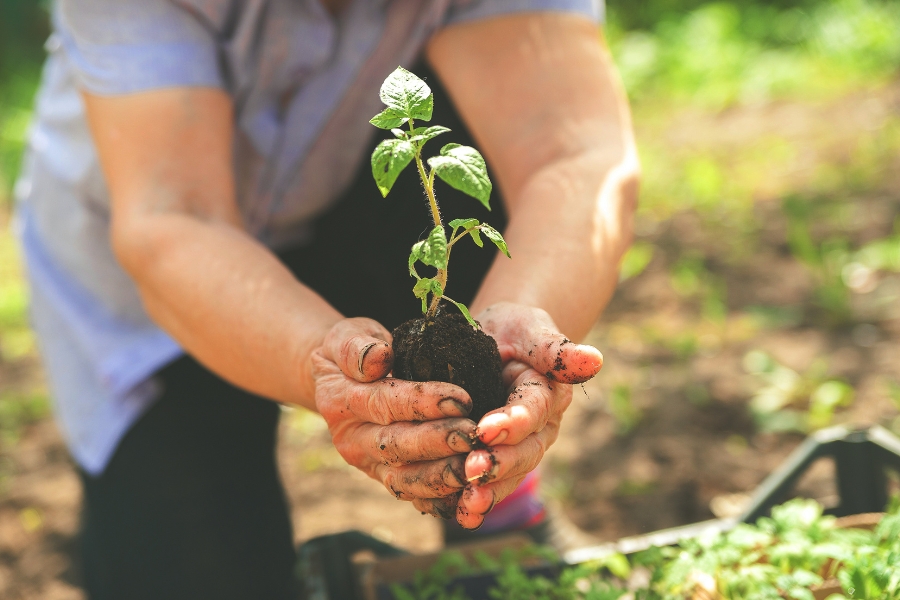
Transplanting a tomato plant outside. Photo credit: Canva The harvest was unexpected
After three months, the plants were producing abundant fruit. The bucket plant didn’t perform as well as the in-ground plant, which Prigioni said was due to insufficient watering during very hot days. The bucket plant also ripened faster, likely due to the stress it had been under. Still, it was an impressive harvest, especially for a plant that started on a McDonald’s burger.
The in-ground McDonald’s plant was even more incredible, with dozens of tomatoes dripping from it.
“I expected this tomato to grow,” Prigioni said, “but I did not expect this.”

Sliced-up tomatoes. Photo credit: Canva The fruit from both plants tasted good and sweet, he said. By the fourth month, the in-ground plant was starting to struggle with its health, but not with its fruit production.
“The plant had so many tomatoes on it that it seemed like it was having a little difficulty ripening that much fruit at one time,” Prigioni said. “I mean, I have had some plants with a lot of tomatoes on them, but never in my life have I seen a single tomato plant with this much fruit on it. I was completely blown away.”
How the McDonald’s tomatoes compared
He said one of his favorite parts of the experiment was seeing what kind of tomatoes would grow from the seeds. He thought it might be a beefsteak variety, but it turned out to be a Roma type. However, he surmised that the McDonald’s tomato was likely a hybrid, based on its ripening characteristics.
Prigioni also shared how the McDonald’s tomato plants compared with his other tomato plants.
“In another area of the garden, I grew Roma tomatoes that I got from Lowe’s, and I planted them at the same time as the McDonald’s tomatoes,” he said. “The harvest from them wasn’t quite as large, but the fruit ripened way more evenly, and I was able to harvest a lot more fresh fruit right off the vine that was ripe.”

There’s nothing like a tomato right off the vine. Photo credit: Canva “Overall, I was shocked with the level of production,” he continued. “And this is probably my favorite experiment that I’ve ever done. I mean, to be able to take a cheeseburger, grab a tomato from it, then grow a tomato plant, and then harvest pounds and pounds of tomatoes from it is just such a unique and refreshing experience.”
Perhaps an unexpected result, but a great way to challenge our assumptions and demonstrate the power of nature, even in the context of fast food.
You can follow The Gardening Channel with James Prigioni on YouTube for more gardening education.
-
Millennial dad of 3 challenges boomer parents over unreasonable holiday expectations
“Yeah, not this time,” he said. “I think for the holidays I’m just gonna stay in and relax.”
The holidays are supposed to be a time for enjoying special moments with family, but often they become a source of stress. Traveling, navigating familial relationships and tensions, talking politics at the dinner table, and handling the all-encompassing issue of “presents” can wear down even the most patient and even-keeled person. It can be especially challenging for parents with young kids who are expected to travel long distances in the name of “family togetherness.”
A TikTok video posted by @carrerasfam is going viral, with over 300,000 views, because so many millennial parents can relate to the frustration of grandparents having unrealistic expectations related to visiting with the kids.
In the satirical video, a husband stages a conversation with his “practically retired” baby boomer dad, in which he explains politely but firmly that he’s not taking his 3 young kids on a 400-mile drive to their house for the holidays.
Carerras Fam is a popular TikTok page about “all things postpartum and mamahood.” Together, the mom and dad share funny skits and slices of their life with three little ones.
The husband opens the conversation with his dad by explaining all the inconveniences of taking 3 young kids on a long road trip. “I know you want us to drive down for the holidays, but it’s kinda ridiculous that you want me to pack my 3 kids with their portable beds with my clothes, their clothes, the formula, everything that goes on with raising 3 kids and having them feel comfortable. Drive down for over four hours just so that we could spend some time in your house?” the husband says while absurdist music plays in the background.
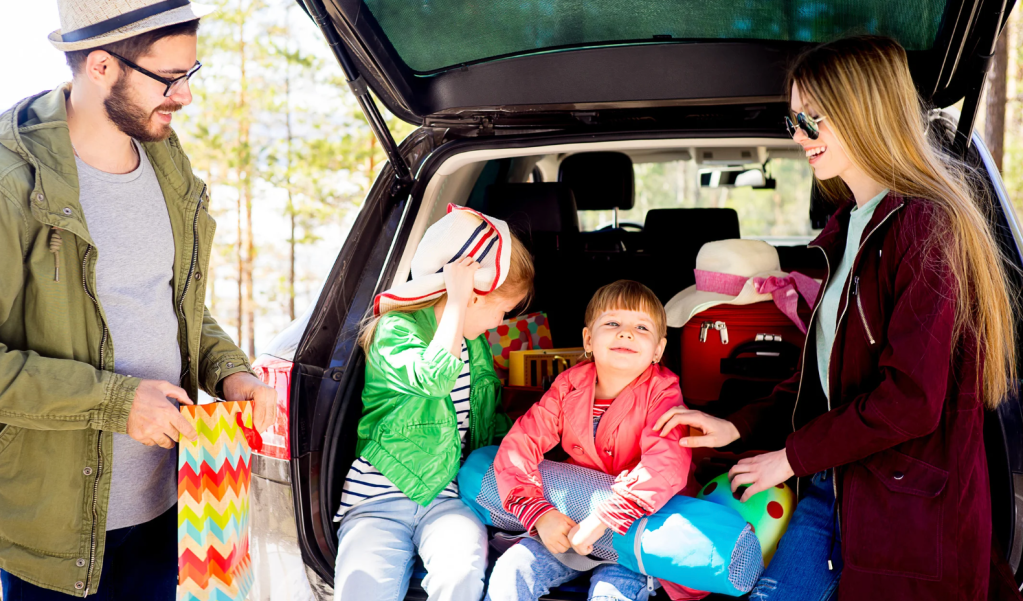
A family prepares for a road trip. Photo credit: Canva It’s obviously inconvenient for the couple to pack up their kids and drive 4 hours, but it’s also unsafe because the house is not baby-proof. “I’m gonna have to run around, make sure that they don’t break any of your stuff, and which you will ‘take care of them,’” the husband continues using sarcastic air quotes. Most parents eventually realize that visiting with the kids does not equate to getting help with them — no, it means chasing them around frantically yourself until it’s time to leave.
The dad brings up another great point: His parents are in good health, so why don’t they drive to their house? “You could visit—you don’t have little kids,” the dad continues. “You don’t have anything going on. Why is it that every time I have to make the effort for you, yet you can’t do the most basic thing for me?”
It’s clear from the phone call that the dad understands that traveling with the kids and staying in a house that isn’t correctly set up for young kids will make the holiday a struggle. Instead of making memories, they’ll most likely be running around bent over trying to save their kids from breaking something or hanging out at Target buying electrical socket plugs and a bottle brush because they left theirs at home. What’s especially frustrating is the pressure and expectations. Parents are often guilted for not wanting to pack up the kids and travel, even though it’s not hard to see why they hate it so much.
The video struck a chord with many millennial parents. Nearly 500,000 people watched the clip, with hundreds and hundreds pouring in to vent their own similar frustrations.
“First holiday with a kid… parents are confused why I won’t drive 9 hours with a 3mnth old for Christmas,” too_many_catz writes.
“The ‘not baby proofed’ part hit my soullllllll. It’s so stressful having to chase your kids around and ask to close doors, move pictures, block stairs, etc. And nobody takes you seriously!” OhHeyItsIndy added.
It’s also expensive for young families to travel. “Add to it they want us to spend money on gas, airfare, etc. when we live paycheck to paycheck and rent while they own homes and live comfortably off a pension,” another user wrote.
“My mom asked me to drive 13 hours with our 2 month old…she doesn’t work and has flight points,” one mom added.
This one hit hard: “They always act like you’re asking the world of them, yet they will willingly go on any other vacation that they choose,” Mackenzie Byrne wrote.
“They can never make the trip for us but they can make them trips to Europe and cruises to the Caribbean,” another user noted.
TX Travel Chick may have hit the nail on the head with her explanation for why boomer parents expect their children to road trip it to their house for the holidays. “Because we are used to following their orders!!! REVOLT,” she wrote.
Ultimately, it would be interesting to learn why boomer parents want to inconvenience their kids when it would be much easier for them to take a trip to see them, especially if they can afford a hotel. One wonders if they are being entitled or if they’ve forgotten how hard it is to travel with young kids. In some cases, it’s a little more complicated — many baby boomer grandparents are still working and have less time and resources than previous generations did to help with the kids.
“Yeah, not this time,” the dad sums up in the video. “I think for the holidays I’m just gonna stay in and relax.”
It’s a hilarious and relatable video, but ultimately, it’s a skit. The power of boomer-grandparent guilt remains undefeated in many households, so the smart money says the Carreras family sucked it up and traveled for the holidays despite their annoyance. Here’s hoping that together, we can eventually break the generational curse when our kids become parents one day.
This article originally appeared last year. It has been updated.
-
We asked people what they enjoy that other people don’t understand. One answer ruled them all.
Surprisingly, research shows that these people are less likely to be neurotic.
Some people have quirky hobbies and interests that others might find odd, so when we asked our Upworthy audience on Facebook, “What’s something that you really enjoy that other people can’t seem to understand?” and over 1,700 people weighed in, it wasn’t too surprising. Some people shared things like housework, cleaning and laundry, which a lot of people see as chores. Others shared different puzzles or forms of art they like doing, and still others shared things like long car rides or grocery shopping.
But what was surprising was the one answer that dominated the list of responses. It came in various wordings, but by far the most common answer to the question was “silent solitude.”

A woman relaxes alone on the couch. Photo credit: Canva Here are a few examples:
“Feeling perfectly content, when I’m all alone.”
“Being home. Alone. In silence.”
“That I enjoy being alone and my soul is at peace in the silence. I don’t need to be around others to feel content, and it takes me days to recharge from being overstimulated after having an eventful day surrounded by others.”
“Enjoying your own company. Being alone isn’t isolating oneself. It’s intentional peace and healthy… especially for deep feelers/thinkers.”
Spending time by ourselves is something some of us relish, while some of us hate being alone. Naturally, this points to the common theory of introversion vs. extraversion, but in some ways, that’s overly simplistic. Even the most peopley people among us can enjoy some quality alone time, and not all introverts see time alone as truly enjoyable. (It might be necessary for an introvert’s well-being, but not necessarily something they truly revel in.)

A man sits quietly by the water. Photo credit: Canva Interestingly, studies have found that people who enjoy being alone are not any more or less extraverted than those who don’t, though they do tend to be less “sociable.” They are also less likely to be neurotic (tense, moody, worrying types) than the general population and more likely to be open-minded. Those characteristics are the opposite of what social norms often tell us about people who want to be alone.
“If our stereotypes about people who like being alone were true, then we should find that they are neurotic and closed-minded. In fact, just the opposite is true,” writes Bella DePaulo, PhD.
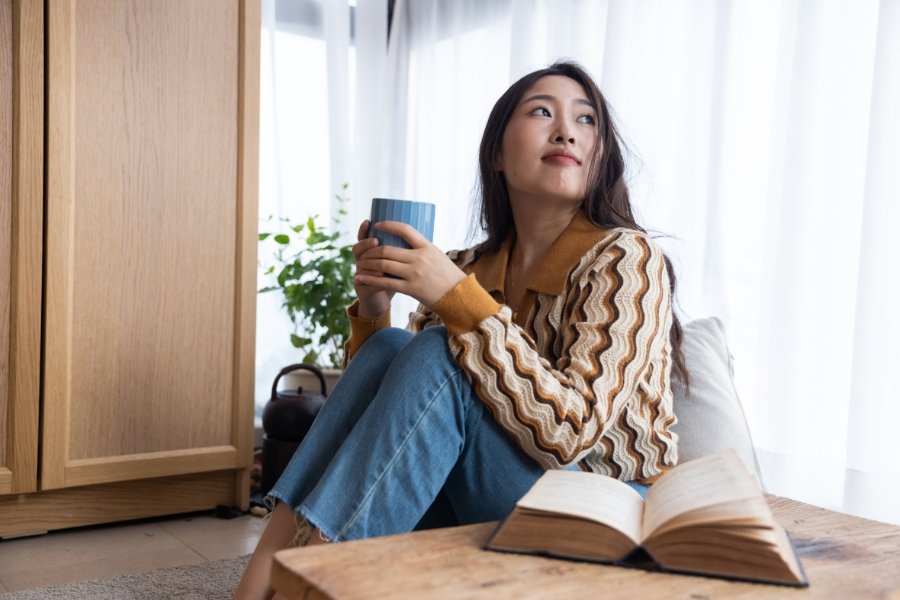
A woman lost in thought with a cup of coffee. Photo credit: Canva There may be lots of reasons some people like to spend time by themselves while others don’t. We are naturally social creatures and need social interaction, but some of us find ourselves overstimulated by being around other people all the time. On the flip side, some people find being alone not just unenjoyable, but extremely uncomfortable, which can be a problem.
“Ideally, we should be comfortable with ourselves, alone or with others,” writes psychologist Tara Well Ph.D.. “If you are uncomfortable being alone, it means you are uncomfortable being with yourself without distraction, engagement, or affirmation from others. This can be a liability in life. If you cannot be alone, you may stay in situations or make life choices that aren’t good for you in the long run, like staying in a job or a relationship, mainly because you can’t tolerate being alone while transitioning to a better situation.”
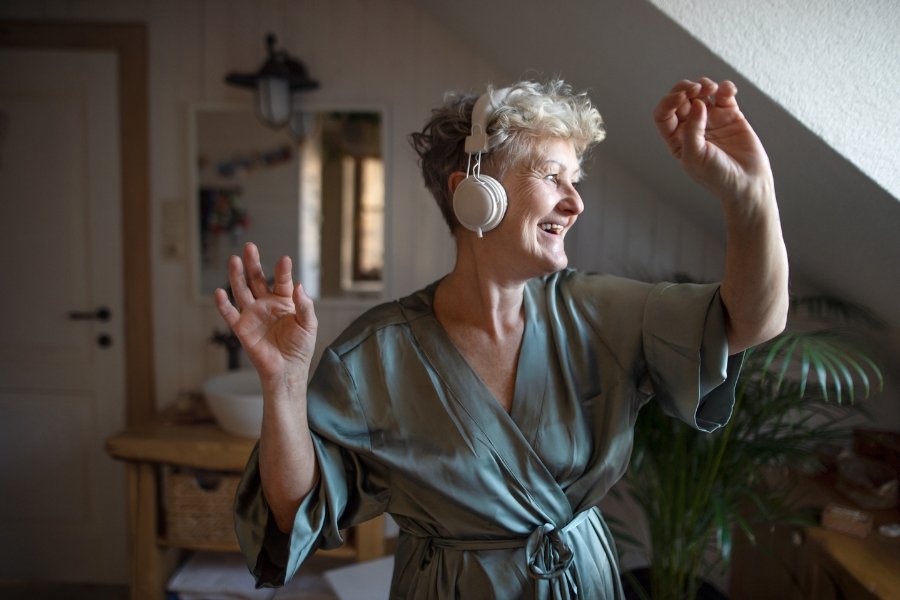
An older woman dances alone while listening to headphones. Photo credit: Canva Dr. Well also points out that people can make the most of their alone time, even if it’s not something they naturally enjoy. One way is to make it purposeful, setting aside a little time daily to write in a journal, meditate, go for a walk or otherwise engage your mind and body in some form of reflection. Another is to pay attention to self-judgments that might make alone time uncomfortable and challenge them with some compassionate confrontation and counteraction with positive thoughts about yourself.
Alone time can be refreshing and rewarding, especially if it’s something you naturally crave. Some people even like to take themselves out on dates or enjoy traveling by themselves. That kind of self-care can be just as important as connecting with others for our overall health and well-being. Being alone doesn’t mean being a loner and it doesn’t mean being lonely. Some of us genuinely like having quality time with ourselves, whether it makes sense to other people or not.
This article originally appeared last year.
-
People share the one thing that makes them laugh without fail. Here are some of the funniest responses.
Sometimes we just need a good laugh.
Arielle Nissenblatt has many questions for her followers on Threads. But one in particular stood out last week, and it led to days of laughter. She asked, quite simply, “Please share exactly one (1) thing that makes you laugh without fail every time.”
Arielle is a podcast strategist, writer, and founder of the EarBuds Podcast Collective.
In less than a week, the question inspired more than 8,000 responses. The Arielle was so pleased that she wrote, “Going through this thread as I fall asleep and am crying laughing snorting. What a joy!”
That’s a lot of funny things. Here are just a handful:
Funny stories
User @loreleiarmstrong shared a hilarious story from a woman named Barbara, who went through quite the ordeal with a brilliantly satisfying ending:

Screenshot Flatulence
More than one Threader mentioned how hilarious they find flatulence. @johnpark quoted writer Emily Heller, who wrote, “If you don’t find farts funny, then you’re a loser because you’re choosing to have less joy in your life but the exact same amount of farts.”
Another commenter agreed with just one word: “Farts.”
This, of course, also included texting mishaps involving, you guessed it, farts:

Screenshot Animals
The daughter of Martin Scorsese, @francesca.scorsese (and yes, she has a blue checkmark, so it’s likely really her), chimed in with “Funny animal videos.” The OP agreed, adding, “Unlikely animals getting along.”
Sweetness
A few people said that simply hearing someone else laugh makes them laugh. @lima_sierra wrote, “Anyone 5 or younger laughing.”
Another user added that “the rubber duckies on a Jeep’s dashboard” always make them happy.
Silly conversations
In one exchange shared by @dolphin_dom, a fun fact quickly goes off the rails:

Screenshot TV moments
@catscoffeebookslove recalled the time Tim Conway played a dentist on The Carol Burnett Show:
@jazaaiekj shared, “Tim Conway talking about the elephant. Cry laughing every single time.”
@cheesee_lizee shared her favorite moment from Parks and Recreation: “The ‘Get on Your Feet’ music scene from Parks and Rec.”
Quite a few people mentioned their favorite Saturday Night Live sketches. One in particular kept popping up, featuring Beavis and Butt-Head lookalikes:
@jodicelesteee wrote that one particular blooper from The Office cracks her up:

Screenshot Memories
One Threader reminded fellow Brits about a guy trying to make limoncello during lockdown:
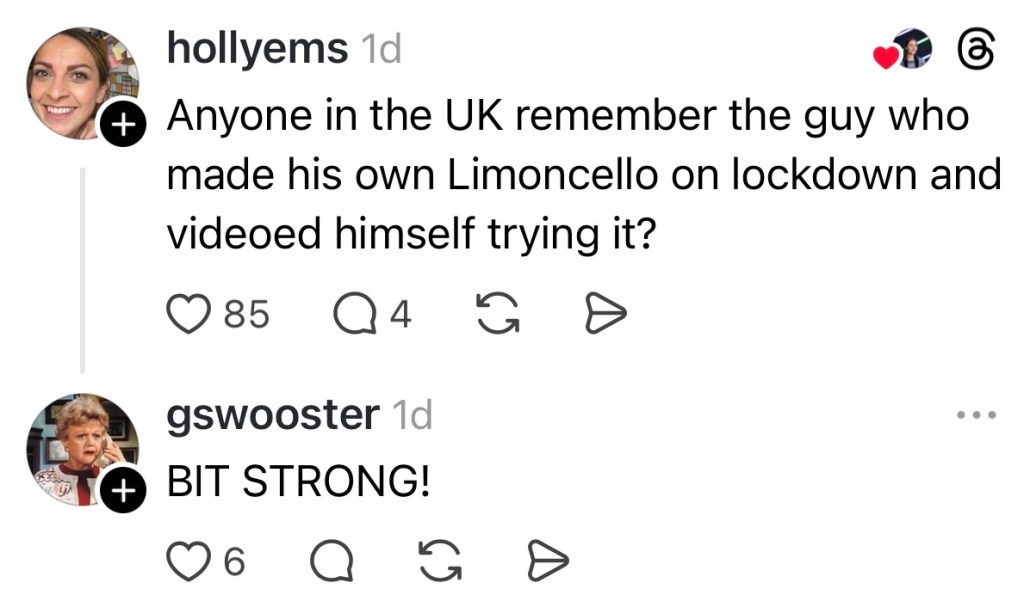
Screenshot Another fun memory? The man whose kids kept interrupting him during a BBC News interview.
@jennknapp reminded readers, “The video of the guy on a zoom call and his toddler marches into his home office, followed by a baby in a walker, and then the mom absolutely driving the struggle bus, trying to remove them with her pants half mast. Hilarious. Every. Single. Time.”
And of course, perhaps the most wonderful moment to come out of a strange time was “lawyer cat.” People from all around the world mentioned the image of a lawyer accidentally using a cat filter during a Zoom hearing. That one is a gift that keeps on giving:

Screenshot












Philosophy expert reveals the character trait that shows someone is highly intelligent

Get stories worth sharing delivered to your inbox.
Advertisement