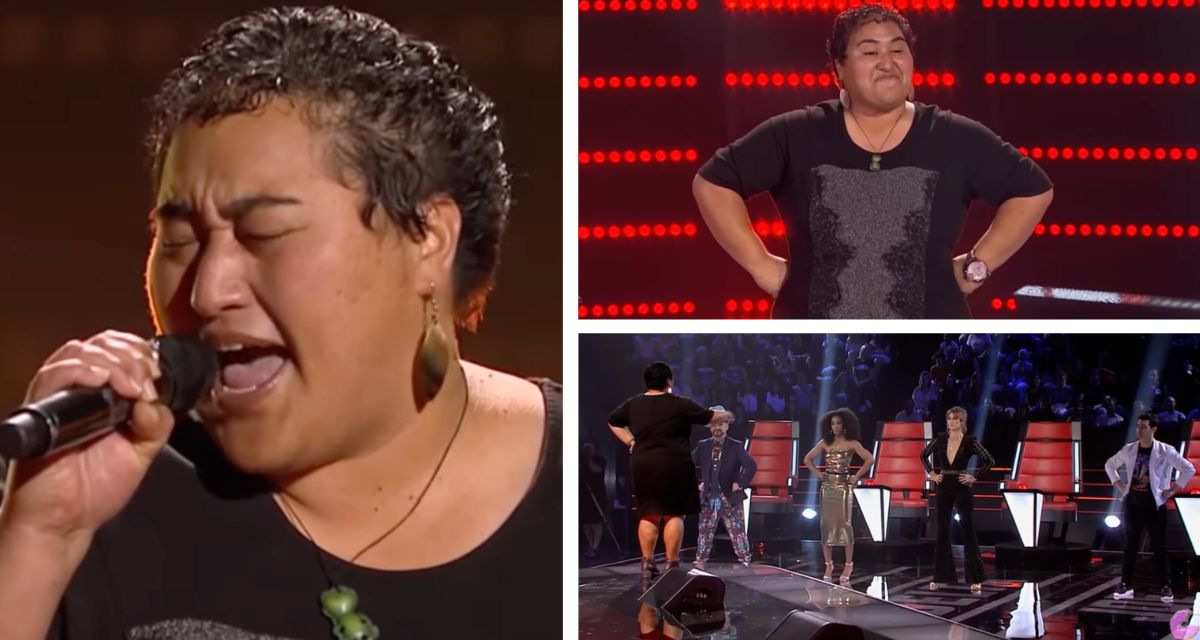
Back in 2017, Māori singer Ora Taukamo, known as “Aunty Ora,” wowed judges on The Voice: Australia with her rendition of Adele’s “One and Only,” somehow making it even more soulful than the original.
It was then that judge Delta Goodrem asked Taukamo what she did outside of singing.
Taukamo answered, “I teach the haka.”
Intrigued, judge Kelly Rowland asked, “Can I learn the haka?” Taukamo giggled while saying, “Sure!” Then, Rowland, Goodrem, and the two other Voice judges, Boy George and Joe Jonas, stepped up on stage for an impromptu lesson.
The group put their hands on their hips, bent their legs into a squat position, and began stomping on their right foot in unison while hitting both hands on their thighs. As their percussion began setting, Taukamo began leading them through a chant.
The moment was cool enough on its own, but made even more heartening by the way it instilled pride among fellow New Zealanders.
“You make me feel proud to be a Kiwi you lovely woman!”
“I aroha ahau ki taua haka. (I loved that haka.) Really nice how the panel joined in. Beautiful voice.”
“Taahua… making Aotearoa proud.”
“Adore you !!! Aroha (Luv) your whanau (family- all of the 5 million) in Aotearoa New Zealand.”
Taukamo would eventually end up going home on the show after singing these showstoppers: “Circle of Life” from The Lion King, “One Moment in Time” by Whitney Houston, a ”Love Me Tender” cover by Norah Jones, “Open Arms” by Journey, “All of Me” by John Legend, “I Believe I Can Fly” by R. Kelly, a “With A Little Help From My Friends” cover by Joe Cocker, “Goodbye Yellow Brick Road” by Elton John, and “Total Eclipse Of The Heart” by Bonnie Tyler.
Aside from her powerhouse vocals and her impressive haka teaching abilities, Taukamo is remembered for her infectiously positive energy, which che clearly infuses into her craft in order to lift others’ spirits up. This can clearly be seen on her Facebook bio, where she writes, “Your voice is a tool to help heal others.🎙️Sing from your heart at all times and just be yourself, most of all be natural.”
That philosophy came through in that brief, joyful exchange on stage.
The haka is more than choreography. It carries history, identity, and connection, and Taukamo shared it in a way that welcomed others while honoring where it comes from. Watching the judges laugh while trying to follow her lead created a sense of togetherness that reached far beyond the studio audience.

Moments like this show how culture can be shared with care and enthusiasm. A few minutes of music and movement turned into something people across the world could feel a part of. Taukamo may not have taken home the top prize, but in this way, her impact was all the more meaningful. She left behind a performance that people still talk about, one that celebrates voice in every sense of the word.