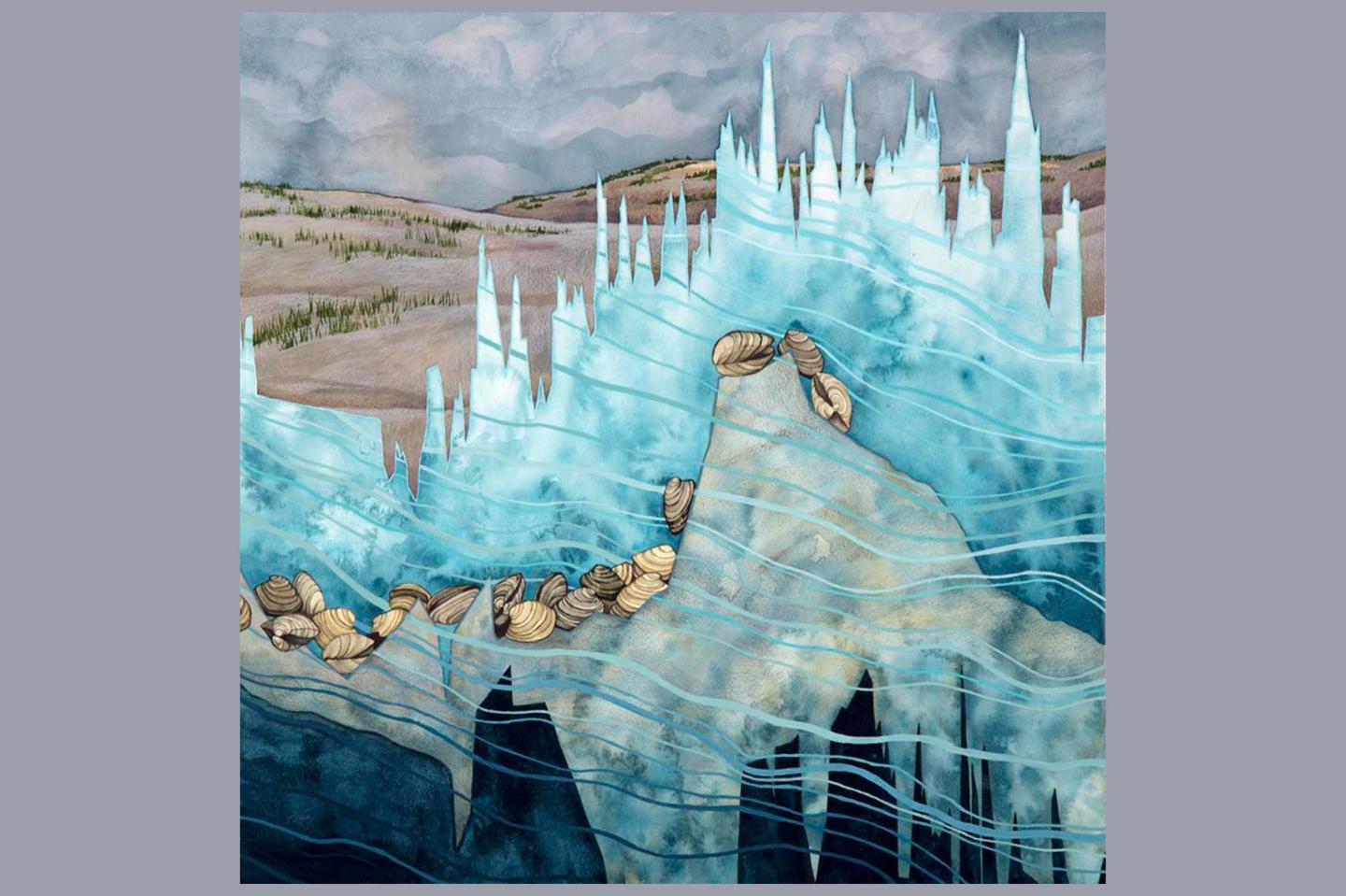
Artist creates stunning watercolor paintings that are scientific charts in disguise
Hard to unsee once you spot it.

Artist Jill Pelto says more than you think in her paintings.
Jill Pelto's world is made up a rich blues, ochres, and a sky that looks like something out of an old mariner's chart.
But when you start to look closer, little details start to pop out. You notice a number here or there. Or a series of points marching down the top of a glacier. Or ... is that an x-axis?
Wait, are all of these charts?! This is data! Wooah!
The artwork, you see, isn't just beautiful. While each piece starts as a simple line graph of mass or temperature, Pelto — a graduate student at the University of Maine — transforms them into something more.
Pelto has spent the past years creating this astounding series of paintings, all based on scientific data.
She was first inspired by a research trip back in 2015.
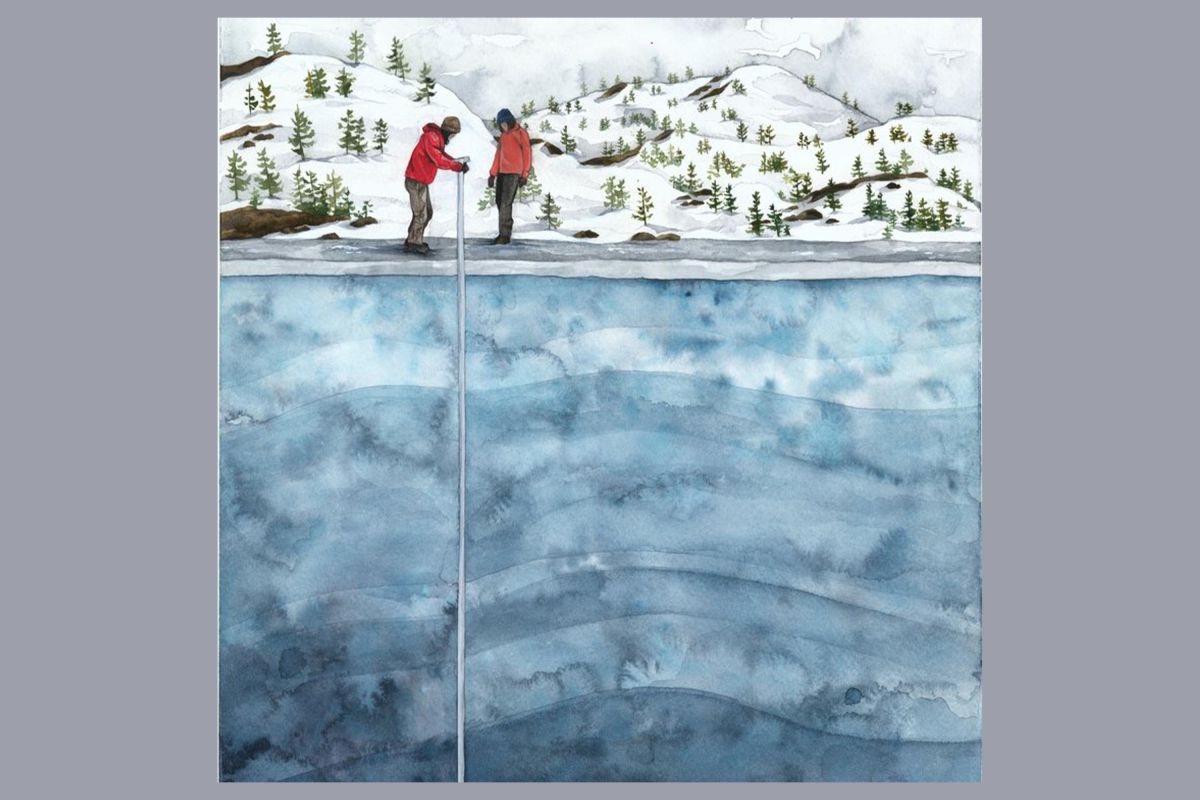
Painting depicts scientist coring ice to reveal climate history.
Image from Jill Pelto, used with permission.
Since she was 16, Pelto's been going on research trips with her father, glaciologist Mauri Pelto. In 2015, she joined her father in the field to study the glaciers in Washington state's North Cascade National Park.
On the trip, Pelto saw how the glaciers, while beautiful, had also lost much of their mass. Inspired, saddened, and packing her watercolors, Pelto decided to try to use her art to communicate what she was seeing.
The mass of glaciers in the North Cascades from 1980 to 2014. Data available here.
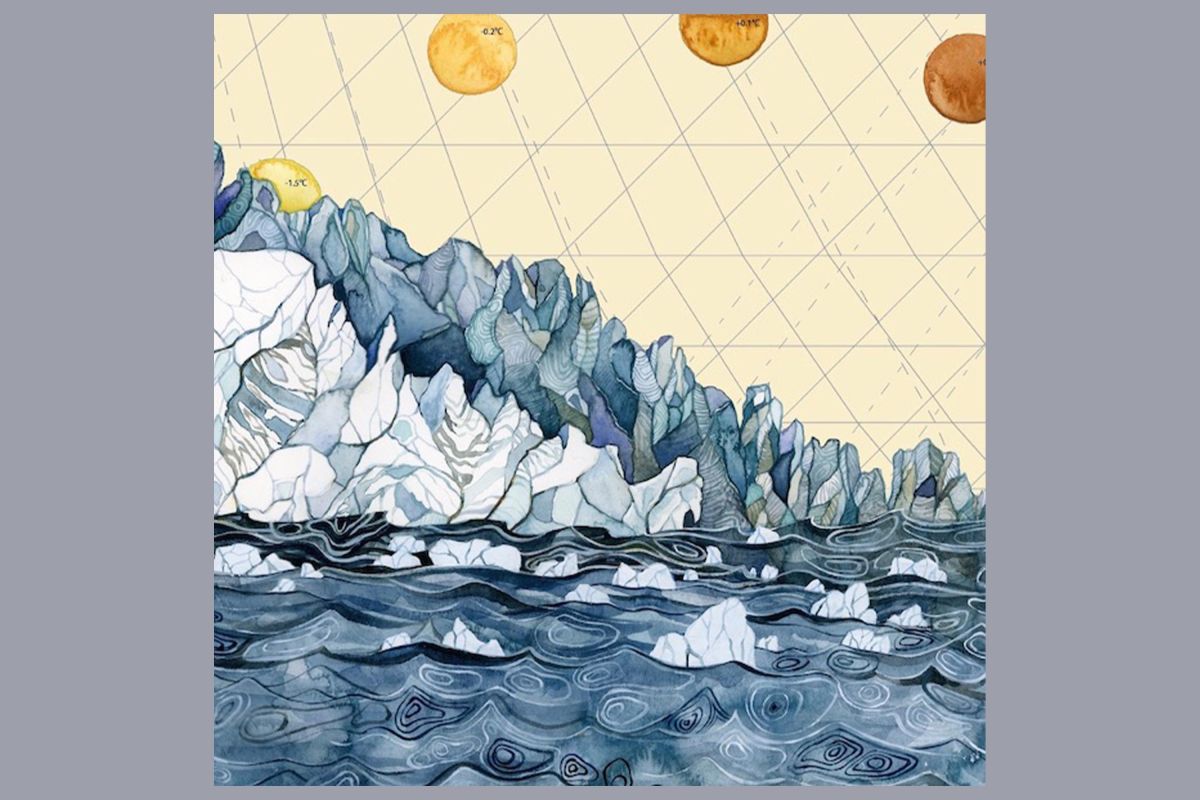
A painting depicting a study in glacial mass.
Image from Jill Pelto, used with permission.
Since then, Pelto has continued the project, turning not just glacial mass but many other variables into brilliant works of art.
Within the deep purples and reds of a forest on fire hides a global temperatures trend.
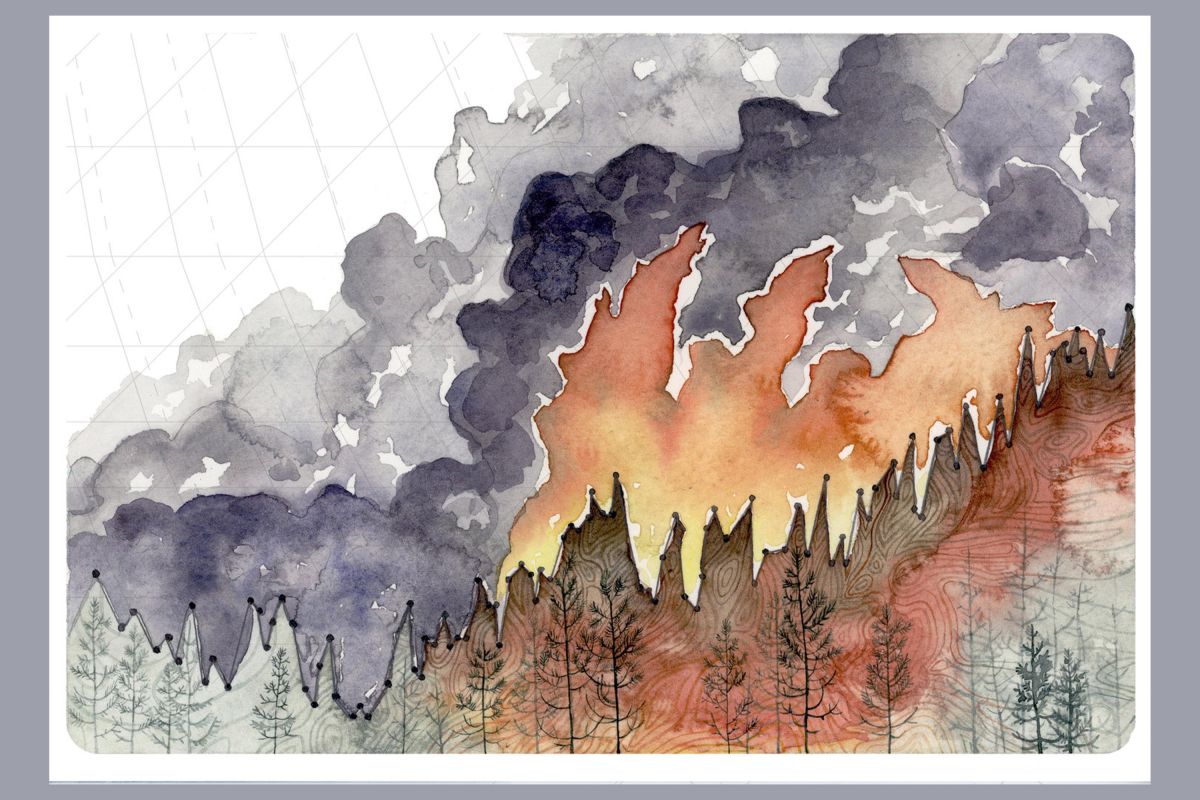
Image from Jill Pelto, used with permission.
Global temperature data, obtained from Climate Central, becomes the backdrop to an incredible forest fire. Rising temperatures and drought conditions could increase the future risk of forest fires.
Aquamarine-colored salmon intertwine with waves made from their population numbers.
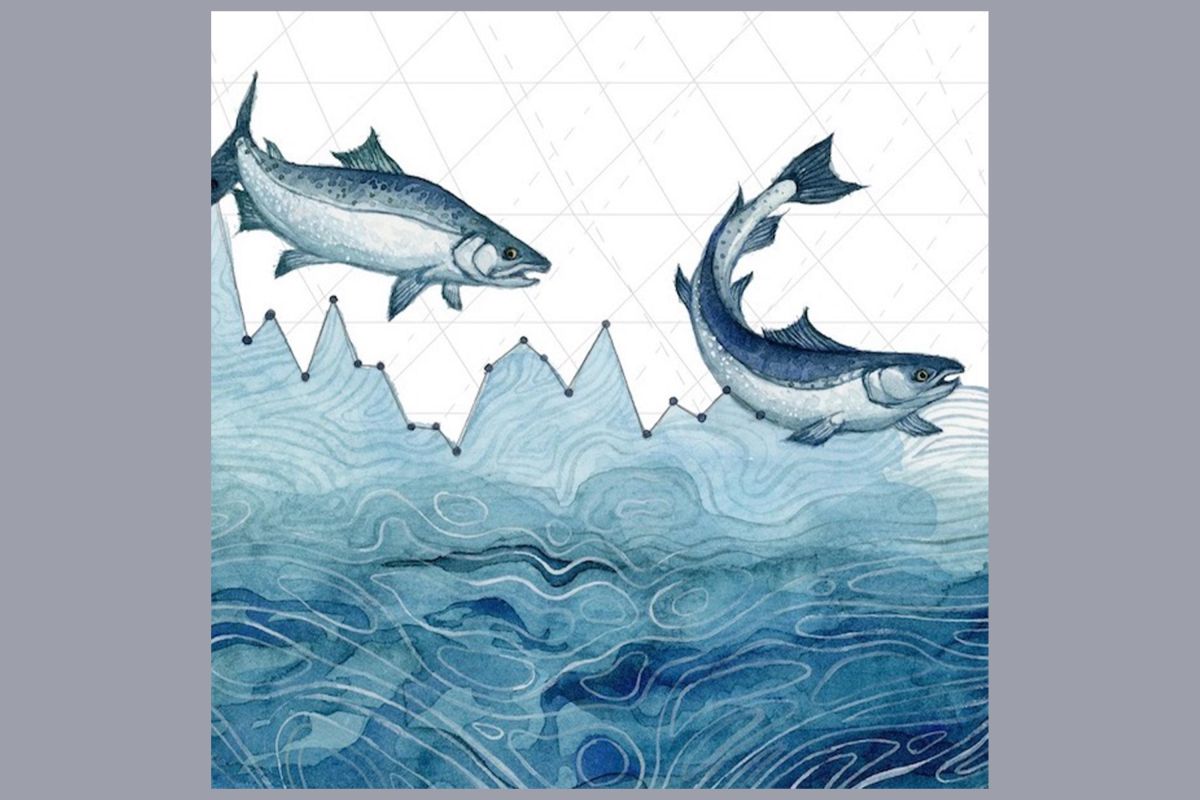
Coho salmon face declining rivers and climate change.
Image from Jill Pelto, used with permission.
Washington state has been hit by a number of droughts in the last few decades. Many rivers run low, affecting the coho salmon that spawn there.
Lifelike Arctic foxes hide amid a line graph that shows dwindling ice sheets.
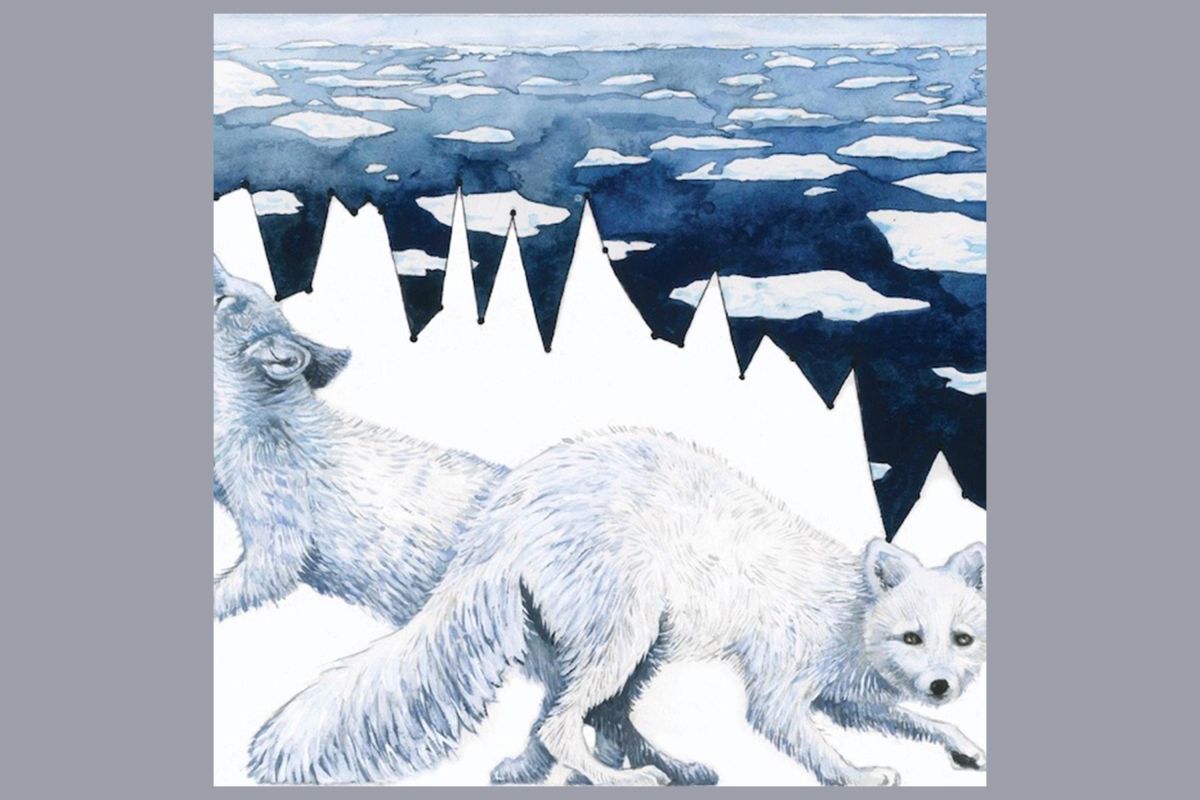
Arctic foxes face warming poles and climate change depicting in artist painting.
Image from Jill Pelto, used with permission.
The graph tracks the loss of Arctic sea ice from 1980 to the present. Arctic foxes are well-equipped to survive the chilly polar weather, but as the poles get warmer, larger species may invade and outcompete them.
This beautiful swaying reef exists in an increasingly acidic ocean.
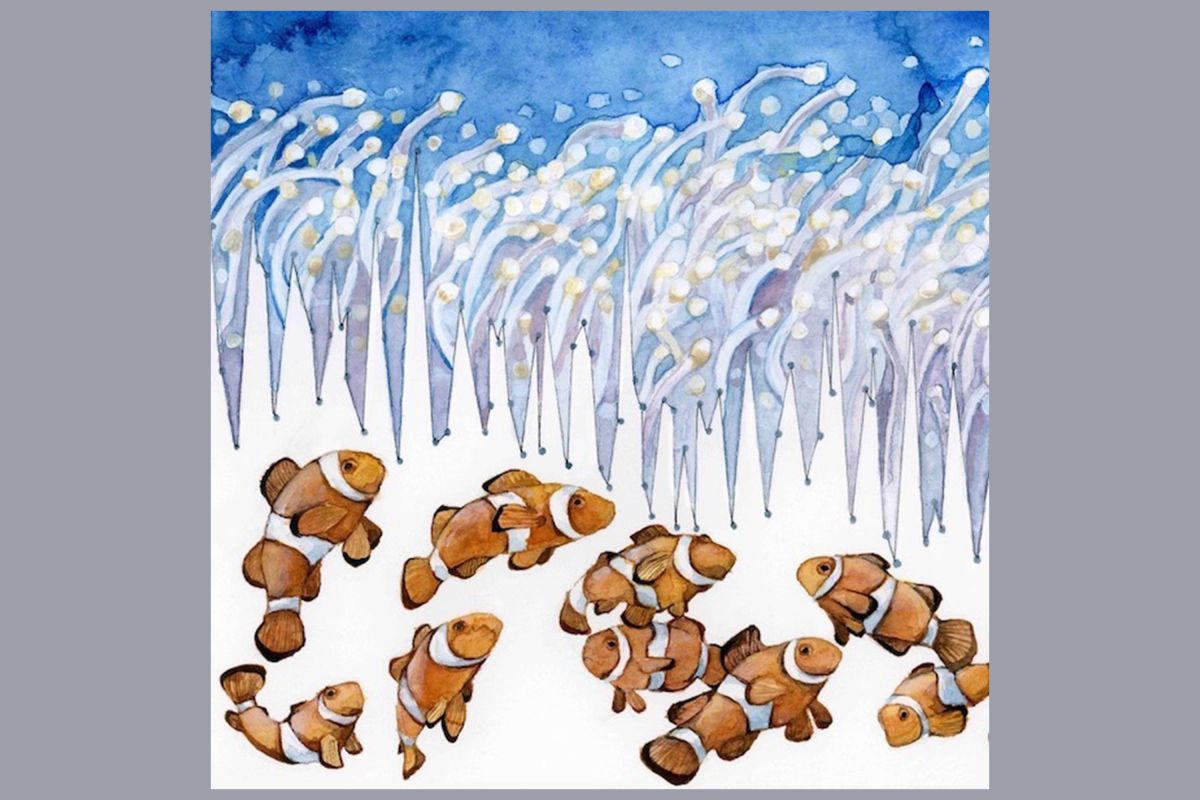
Clown fish swim on a coral reef in a painting showing data of the oceans becoming more acidic.
Image from Jill Pelto, used with permission.
As more carbon dioxide is pumped into the atmosphere, the ocean is slowly becoming more acidic. Many species could be affected, including clownfish.
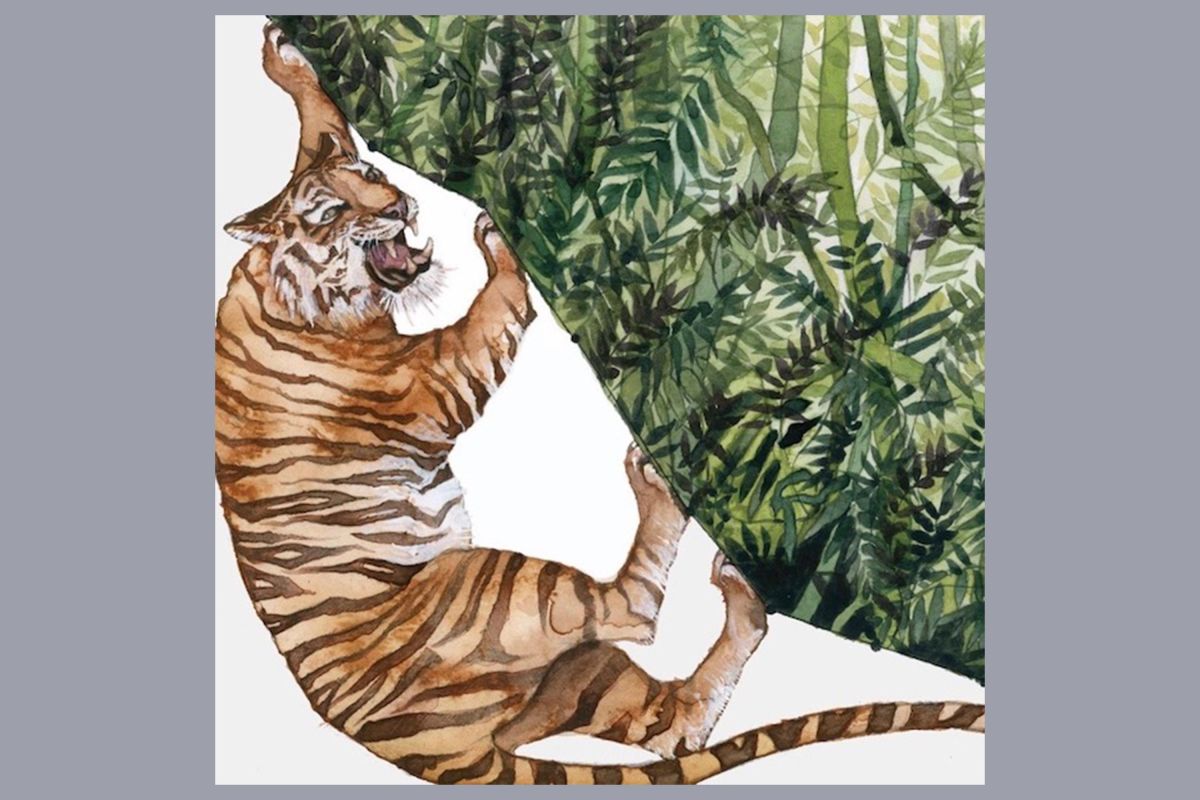
A tiger struggles against it's shrinking jungle habitat.

Painting showing the decline in tiger habitat area.
Image from Jill Pelto, used with permission.
This line graph is based on the decline in tiger habit area from 1970 to 2010.
Here, four different trends combine into a complex, ethereal landscape.
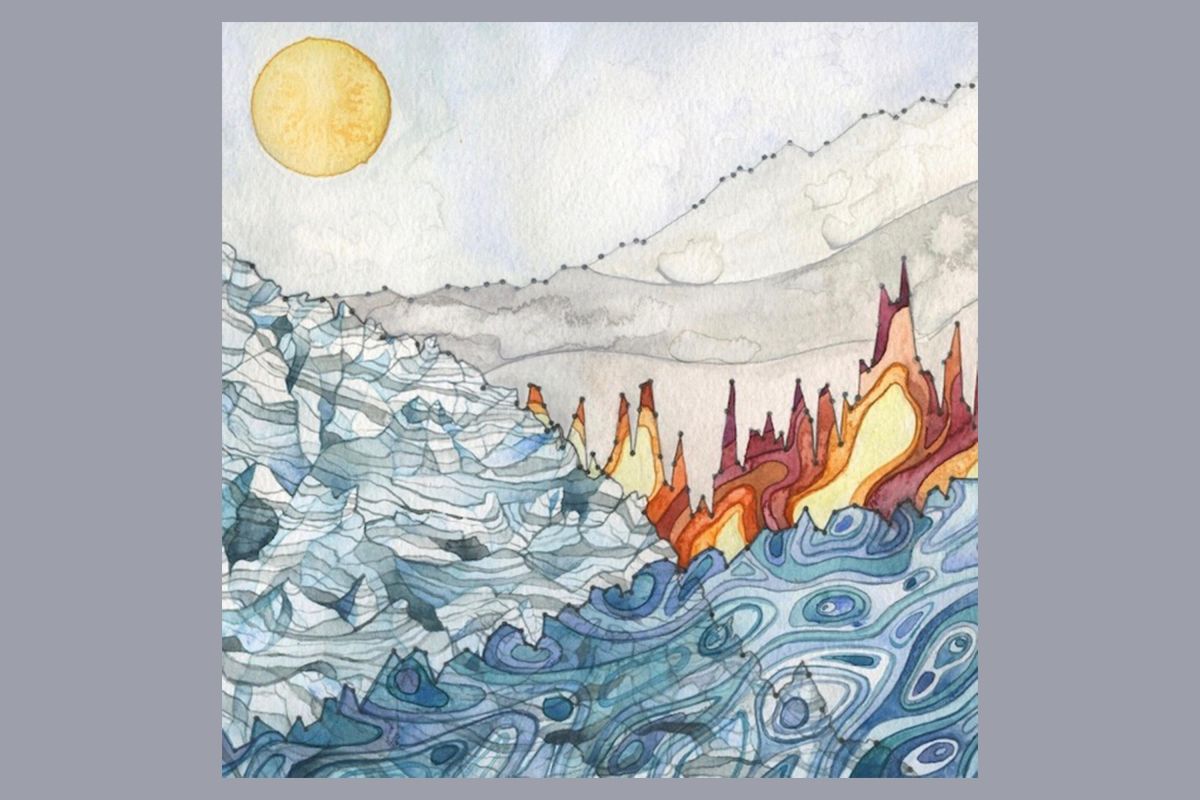
Artist Jill Pelto offers detailed information on climate change in artistic form.
Image from Jill Pelto, used with permission.
In this piece, called "Landscape of Change," Pelto combined data on sea levels, glacial decline, temperatures, and fossil fuel usage.
Pelto plans to continue painting once she completes her master's degree.
Science is an important tool for understanding our changing world, but even the most passionate scientist will admit it can be pretty dry at times. Getting people excited about trend lines or statistical analyses is no easy feat.
But art touches us on an emotional level. We get art. Seeing something that can combine the two disciplines, and hopefully inspire something inside us, is pretty dang cool.
You can see more of Pelto's artwork at her website.
This article originally appeared on 03.03.17



A Generation Jones teenager poses in her room.Image via Wikmedia Commons
An office kitchen.via
An angry man eating spaghetti.via 


An Irish woman went to the doctor for a routine eye exam. She left with bright neon green eyes.
It's not easy seeing green.
Did she get superpowers?
Going to the eye doctor can be a hassle and a pain. It's not just the routine issues and inconveniences that come along when making a doctor appointment, but sometimes the various devices being used to check your eyes' health feel invasive and uncomfortable. But at least at the end of the appointment, most of us don't look like we're turning into The Incredible Hulk. That wasn't the case for one Irish woman.
Photographer Margerita B. Wargola was just going in for a routine eye exam at the hospital but ended up leaving with her eyes a shocking, bright neon green.
At the doctor's office, the nurse practitioner was prepping Wargola for a test with a machine that Wargola had experienced before. Before the test started, Wargola presumed the nurse had dropped some saline into her eyes, as they were feeling dry. After she blinked, everything went yellow.
Wargola and the nurse initially panicked. Neither knew what was going on as Wargola suddenly had yellow vision and radioactive-looking green eyes. After the initial shock, both realized the issue: the nurse forgot to ask Wargola to remove her contact lenses before putting contrast drops in her eyes for the exam. Wargola and the nurse quickly removed the lenses from her eyes and washed them thoroughly with saline. Fortunately, Wargola's eyes were unharmed. Unfortunately, her contacts were permanently stained and she didn't bring a spare pair.
- YouTube youtube.com
Since she has poor vision, Wargola was forced to drive herself home after the eye exam wearing the neon-green contact lenses that make her look like a member of the Green Lantern Corps. She couldn't help but laugh at her predicament and recorded a video explaining it all on social media. Since then, her video has sparked a couple Reddit threads and collected a bunch of comments on Instagram:
“But the REAL question is: do you now have X-Ray vision?”
“You can just say you're a superhero.”
“I would make a few stops on the way home just to freak some people out!”
“I would have lived it up! Grab a coffee, do grocery shopping, walk around a shopping center.”
“This one would pair well with that girl who ate something with turmeric with her invisalign on and walked around Paris smiling at people with seemingly BRIGHT YELLOW TEETH.”
“I would save those for fancy special occasions! WOW!”
“Every time I'd stop I'd turn slowly and stare at the person in the car next to me.”
“Keep them. Tell people what to do. They’ll do your bidding.”
In a follow-up Instagram video, Wargola showed her followers that she was safe at home with normal eyes, showing that the damaged contact lenses were so stained that they turned the saline solution in her contacts case into a bright Gatorade yellow. She wasn't mad at the nurse and, in fact, plans on keeping the lenses to wear on St. Patrick's Day or some other special occasion.
While no harm was done and a good laugh was had, it's still best for doctors, nurses, and patients alike to double-check and ask or tell if contact lenses are being worn before each eye test. If not, there might be more than ultra-green eyes to worry about.