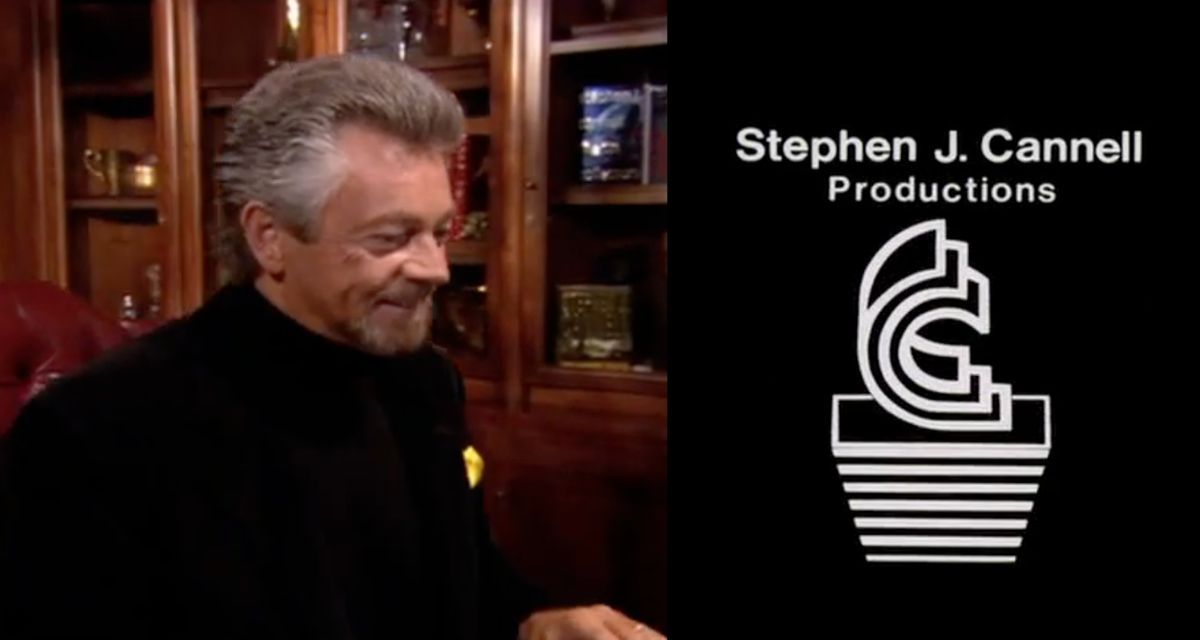
It’s that time of year when millions of kids head back to the classroom to face the familiar anxieties of fitting in and keeping up academically. For any student who feels like the deck is stacked against them, the story of legendary television producer Stephen J. Cannell is proof that academic struggles do not define a person’s future.
Long before he shaped American pop culture on TV, Cannell was just a kid growing up in sunny Pasadena, California. Cannell told the Television Academy Foundation in a 2004 interview that he felt like the “stupidest kid in the class.” He flunked the first grade. Then he flunked the fourth grade. During his formative years, learning differences were poorly understood and often undiagnosed. For reasons Cannell couldn’t articulate, letters and sounds did not align for him. School staff did not intervene or offer him additional support.
It wasn’t a lack of intelligence. Cannell would later learn as an adult that he had severe, undiagnosed dyslexia. Finally, he had answers—or at least a word—to explain why his brain worked differently. He couldn’t use a standard dictionary because he didn’t know the alphabet in sequence. In his writing, Cannell spelled words phonetically to get by. Yet inside his mind was an unstoppable engine of imagination and storytelling that would one day give him a golden ticket to Hollywood.
From failing school to Hollywood success story
Everything changed when he attended the University of Oregon. Cannell’s English professor looked past his terrible spelling and recognized his extraordinary gift for narrative. This teacher saw that his storytelling ability was a rare talent—one that dyslexia shouldn’t hamper or hold back.
That’s when Cannell decided to treat spelling and storytelling as two separate priorities. He was no longer going to let his struggles with mechanics in one arena stop him from expressing his ideas in another. Cannell threw himself into scriptwriting, preferring his IBM Selectric typewriter to computers, which he felt slowed him down.
By his early thirties, he had written his first hit series, The Rockford Files. Starring James Garner, the show reinvigorated the private eye procedural, thanks to Cannell’s thoughtful portrayal of a rare ex-con character imbued with both humanity and empathy.
From there, Cannell became a titan of prime-time television. He created and produced dozens of massive hits that defined ’80s and ’90s pop culture, including The A-Team, 21 Jump Street, The Greatest American Hero, and Hunter. Series like Wiseguy and Profit completely shifted how serialized storytelling worked on network TV, bringing antiheroes and more nuanced villains to the forefront.
The meaning behind that iconic TV logo
Despite managing a television empire, Cannell never saw himself as a Hollywood power player. When publicists suggested he lean into his image, he insisted on remaining, above all else, a writer.
That humility led to one of the most recognizable vanity cards in television history: the iconic end-screen clip of Cannell sitting at his typewriter, pulling out a finished page, and tossing it into the air as it transformed into an animated “C.” Over the years, he reshot the clip, letting audiences watch him age and grow alongside his career.
Cannell passed away in 2010, but his legacy lives on as an enduring lesson that the challenges life puts in your path can help shape who you become. His life reminds us that a child struggling to read a story today might end up the genius who entertains the world tomorrow.