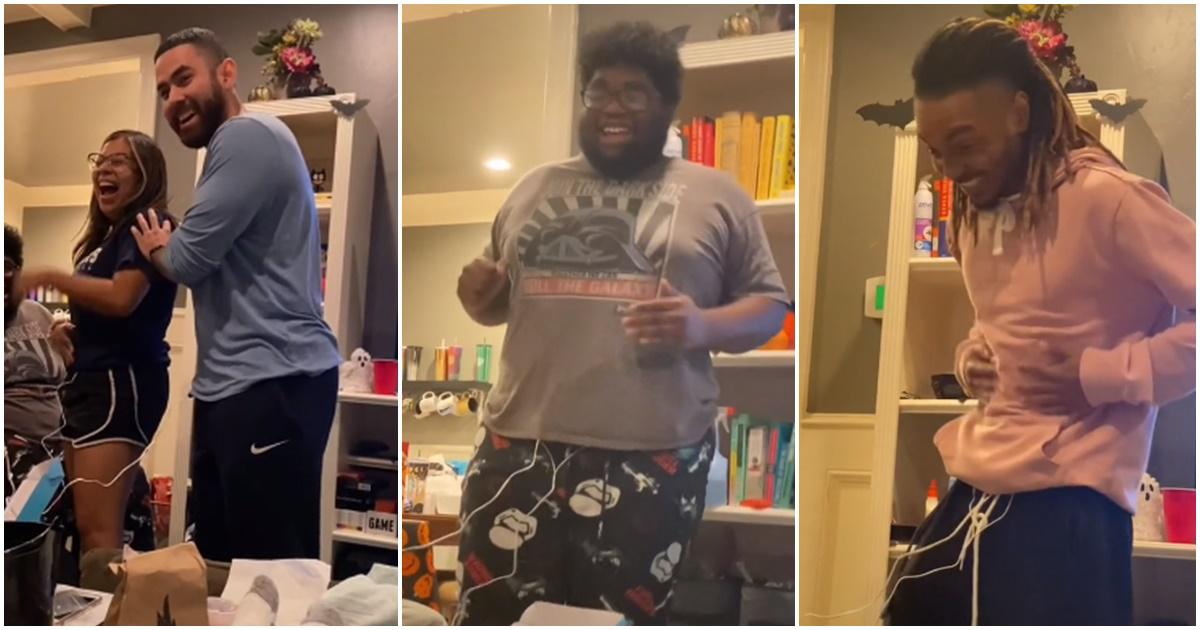
‘Is it supposed to hurt like that?’ Guys try a menstrual cramp simulator and can’t take it

Every guy should go through this.

period pain, men have periods, period simulator
Men try a period simulator.Photo credit: via Benz Trap House/TikTok

Imagine how different the world would be if cis-gendered men had the ability to give birth? Would the state of Texas attempt to ban abortions after six weeks or would they be available on-demand? Would we live in a country without mandatory paid maternity leave? How much more affordable would childcare be? Would there be a tax on period products? How would we treat people experiencing period pain?

A few brave men decided to see what life was like for people who have periods in a funny but enlightening video that’s gone viral on TikTok. In a video posted by Benz Trap House that has over 1.4 million views, a group of guys tried a period simulator to experience what menstrual cramps really feel like. Period simulators are essentially the same as labor simulators. They’re called transcutaneous electrical nerve stimulation (TENS) machines that are designed to relieve pain. But when turned up a notch can create intense, debilitating discomfort.

The group took a semi-scientific approach to the experiment with a woman acting as a control subject. At the beginning of the video, she attaches the simulator to an area near her ovaries and turns it up to ten, the highest setting. In the clip, the group looks impressed as she endures the extreme setting without showing any discomfort.

The men would not do as well.

When the first guy attempted to wear the period simulator he was shocked by the discomfort. “Is it supposed to hurt like that?” the second guy says before erupting in nervous laughter.

The third guy said that he felt the pain all the way down to his knee caps.

At one point in the video, the period simulator is attached to a woman and a man at the same time. When the device is turned on, the guy is in extreme pain while the woman stands still, claiming the feelings created by the machine are “not even as bad as a cramp.”

“Yeah, my cramps hurt worse than this,” she added.

A lot of people who menstruate felt validated after seeing the guys experience their first period.

“‘You feel that in your back, boi?’ every month, friend,” a commenter named Crystal said.

One of the most popular comments was from Candyce, who said: “I’m convinced if men could get pregnant they’d have abortion clinics on every corner and paid maternity leave the whole pregnancy.”

Another commenter, S DeMarco, pointed out that women have to go through an entire day in pain without a break.

“When he said ‘it’s stabbing me what do I do?’ You go to work, clean the house and continue on bb,” she wrote.

Shellz took reality up a notch. “Let’s add headaches. And period poops. And bloating. And the feeling of blood leaving you. And the nausea,” she wrote.

It’s cool that the lighthearted video has gone viral because it’ll give some people newfound respect for the pain that people who have periods go through. Some who watched the video thought that period simulators should be mandatory in sex ed classes.

Imagine how different the world would be if everyone experienced menstrual pain just once in their life?


This article originally appeared four years ago.

  • Wedding photographer shares the surprising but ‘surefire’ ways she knows a relationship won’t last
    Wedding photographer Ona Vicente.Photo credit: @onavicente/TikTok

    After years of photographing soon-to-be-married couples, wedding photographer Ona Vicente says she can spot the “surefire” signs a relationship won’t last simply by going off the “vibes” of the photoshoot.

    “You spend enough time with couples, you develop a spidey-sense,” she says in a TikTok video.

    These red flags include: being dressed to go to “two completely different places,” when one spouse refuses to take off a piece of clothing (a coat, for example) for at least one shot, having constant arguments over “small stuff,” making fun of each other “in a mean way,” and getting verbally or physically aggressive.

    What do these “red flags”mean?

    All of these signs point to an unhealthy communication dynamic, which can undermine one of the most important keys to a lasting relationship: healthy communication. After all, Dr. John Gottman, a renowned relationship researcher, has famously said he can predict with over 90% accuracy whether couples will stay together or divorce simply by analyzing their communication patterns.

    @onavicente

    Replying to @George signs I know as an engagement and wedding photographer, that your relationship won’t last #dating #photographer #wlw #weddingphotographer #relationships

    ♬ original sound – Oniii

    As psychotherapist Eliza Davis explains, couples who have healthy communication can “navigate misunderstandings” and high-pressure situations, such as a wedding shoot, because they know how to “repair” after conflict. In one of Vicente’s scenarios, that might look like instantly knowing to apologize and reset the tone after saying something snippy.

    Cheryl Groskopf, an anxiety and trauma therapist, points out that even healthy couples may find themselves acting more hostile toward one another in “emotionally loaded environments.”

    “Stress isn’t personal,” she tells Upworthy. “When people are overwhelmed, the brain shifts into survival mode. The prefrontal cortex, aka the part responsible for patience and thoughtful communication, gets quieter, while the threat-detection system gets louder. That’s why someone might sound sharper than usual or seem short-tempered. It’s often physiology, not intention.”

    How couples can navigate high-stress situations

    That said, couples can help mitigate these tiffs by building in “small regulation moments,” suggests Groskopf.

    “When the schedule is packed, people forget to pause,” she adds. “Even something as simple as stepping aside together for a few breaths, holding hands for a moment, or sharing a quick joke can reset the nervous system. These micropauses help your body move out of stress mode and back toward connection.”

    In a subsequent video, Vicente shares that she’s seen plenty of “green flags” during her shoots as well, like reassuring one another during bouts of awkwardness, expressing the same level of enthusiasm while sharing their love story, being able to laugh with one another, and generally being on the “same page.”

    @onavicente

    Replying to @CatchinupwithCath love radar green flag edition!! #wlw #dating #relationship #greenflag #weddingphotography

    ♬ original sound – Oniii

    Vicente says couples who don’t display these traits shouldn’t consider themselves doomed; she was merely reflecting on patterns she’s witnessed. This is also reflected in how experts assess the health of a relationship—by looking at what patterns emerge. How often do bids for connection get recognized? What is the positivity-to-negativity ratio? Does feedback tend to result in curiosity or contempt?

    Moral of the story

    No two people are perfect, and therefore no relationship is going to be perfect. But what really matters is how the two prioritize their connection with one another throughout all the inevitable twists and turns of life.

  • ‘I am 55 and I look exactly 55.’ Woman’s viral commentary on aging hits all the right notes.
    It's more than okay to look your age.Photo credit: @tingmystyle/Instagram

    “You look like you’re aging backwards!”

    “You can’t be 50—you don’t look a day over 35!”

    “How do you stay looking so young? What’s your secret?”

    While such comments may be well-intentioned, a woman’s viral video challenges the idea that they are actually compliments. Ting, who posts as @tingmystyle on Instagram, looks directly at the camera and says matter-of-factly, “I am 55 and I look exactly 55. Stop telling a woman, ‘You look younger,’ or ‘You look good for your age.’ It’s not a compliment.”

    Challenging youth-obsessed culture

    Ting says such comments only reinforce our youth-obsessed culture.

    “Everyone ages so differently,” she points out. “What are we even supposed to look like at this age? So tired of hearing that ‘She’s in her 50s but looks 20 years younger.’ Why is that the goal?”

    It’s a question worth asking—and definitely one worth pausing to answer. So often, people go along with what society dictates as the norm, and today that norm means trying to look younger than one’s age. But why? Traditionally, elders have been revered. When did we decide youth was superior?

    As Ting declares, “I don’t survive five decades to be obsessed with looking 30. How many people never made it to 55?”

    Aging is a privilege

    Aging is a privilege not everyone gets. Shouldn’t we feel happy to have lived as long as we have? Part of wanting to look younger may be that getting older reminds us of our mortality. But in reality, none of us knows our timeline, and if we see each day of life as a gift, the more days we’ve lived, the better.

    “Women don’t owe the world youth, beauty frozen in time,” Ting states. “Looking my age, or even older than my age, is not a failure. Youth is not a standard. It’s just a season. And the seasons change.”

    Four images of trees and leaves during the four seasons as a metaphor for the seasons of life
    Every season has its unique beauty. Photo credit: Canva

    Amen. When we hold youthful beauty up on a pedestal, we miss the beauty of every other season. And though women have borne the brunt of the expectation to remain young-looking, men are feeling the pressure to look younger as well. Just look at the Hollywood stars across the gender spectrum getting facelifts and eyelifts. There’s nothing wrong with wanting to look good. But that’s not the same as trying to look young.

    “We look our age not because we’ve let ourselves go, but because we’ve finally let ourselves be,” says Ting. “I am so proud to look my age.”

    Embracing aging with pride

    It feels like an act of defiance to let ourselves look our age, much less be proud of it. But with more than eight million views, middle-agers everywhere heard Ting’s message loud and clear.

    Here’s what people are saying in the comments:

    “Ooooh, youth is not a standard, it’s just a season. Loveeeee.”

    “‘How many people never made it to 55.’ My mum never made it. I would have loved to send this video to her.”

    “Turning 39 next year and I’m excited! Like wow thank you for another year of life! I almost died in 2022 from a stroke and every birthday I’m just so thankful for my life.”

    “Aging is a privilege. I’ve lost too many people who would have loved to be here, wrinkly & full of sun spots and grey hairs.”

    “Yes! I’m 58. Don’t call me ‘young lady.’ Don’t tell me ‘happy 30th,’ on my birthday. Do you imagine I was having this much fun when I was 30? I wasn’t.”

    “Yes! Yes! Yes! When I turned 50 someone said to me – and I quote – ‘That’s ok 50 is the new 30!’ And I immediately shot back – ‘God I hope not. At 30 I was knee deep in diapers, never got any sleep and cared way too much about what other people said.’ At 58 when someone tells me I don’t look my age all I say is yes I do and change the subject.”

    “I’m 55 too. My only goal is to have clear glowing skin. I’m not supposed to look like my kids and I’m okay with that.”

    “I like giving compliments like wow you have amazing skin. Or wow you have such gorgeous shiny hair. Your eyes are bright – etc. You’re so right about youth-based compliments.”

    Examining our own habits

    So many are taking Ting’s message to heart, and it’s something to consider the next time we feel compelled to tell someone they look young for their age. Is this really a goal we want to reinforce? Or is it a social norm that needs to be thoughtfully examined—if not outright done away with?

    Thank you, Ting, for putting it so plainly and for serving as an example for us all.

    You can follow Ting on Instagram here.

  • A non-American asked how lemonade stands work. The responses are an absolute field day.
    Kids in the United States love to have lemonade stands.Photo credit: Canva
    , ,

    A non-American asked how lemonade stands work. The responses are an absolute field day.

    “I personally believe it’s illegal to not buy lemonade from a lemonade stand, especially if the kids are young and having fun.”

    Having a lemonade stand is like a rite of passage for children in the United States. So much so that they’ve become a trope in many movies set in America.

    Lemonade stands evoke nostalgia and fond childhood memories for many Americans. According to Smithsonian Magazine, 40% of Baby Boomers reported having a lemonade stand during their childhood.

    So when a non-American on Reddit genuinely asked if lemonade stands are “a real thing” here in the States, they got a flood of emphatic responses.

    Adding that in their country “parents would be embarrassed if their kids did that,” they asked Americans to describe “the vibe” of lemonade stands.

    “Is it seen as a cute hobby or an actual way to learn about money?” they wrote.

    And while many Americans confirmed that lemonade stands are indeed breeding grounds for future entrepreneurs, they also explained why they symbolize so much more in American culture.

    American lemonade stands, explained

    Some American Redditors took a more straightforward approach, describing what lemonade stands are all about and how they support kids with a business mindset:

    “It’s not something kids do to actually support their families. It’s a for fun thing typically done when school is out for pocket money or for fun to learn about running a business.”

    “I’ll also add that many people like to support kids doing this. I rarely want a cup of lemonade, but I pretty regularly stop to buy some when I see a stand in the summer. People like supporting kids who are putting in effort and people find it cute. It’s similar to kids mowing lawns, shoveling snow, selling bottled water, watering gardens, etc. for cash.”

    “I don’t want the lemonade, but I want to reward the kids for initiative. I’ll usually pay for a few, drink one and then tell others to stop by.”

    “I ALWAYS stop when I see one. Anytime I do I always overpay. $1 lemonade? Here is $5+ (depends on what I have). I’ve done it… 4 times so far? Not often but enough to make me happy to do it.”

    “Yes and I personally believe it’s illegal to not buy lemonade from a lemonade stand, especially if the kids are young and having fun.”

    “Yeah it’s viewed here they the kid is a ‘go getter’. They’re motivated and trying to get ahead. It’s not common on super busy roads, but on smaller neighborhood roads.”

    Americans share their nostalgic lemonade stand memories

    Others offered up their personal stories of how setting up a lemonade stand back in the day impacted them:

    “I remember receiving a Sacagawea dollar as a kid selling lemonade!! Best customer ever!”

    “When I was of the age (early 1970s) we had a giant lemon tree in our yard, that we used to make the lemonade. Ours was definitely not ‘warm and horrible.’ Ice came from the trays for free, but my mother lent us the money to buy the sugar, and we paid her back from profits. I guess she was really into the authenticity of the business experience.”

    “My dad made me pay him back for the frozen lemonade cans (where you add water to create a quart or half gallon), but didn’t tell us until after so our price of $0.50 barely covered it. Killed my business initiative real quick Selling coffee at the bottom of my driveway that was across from a polling place was far more effective.”

    @sweetmamamadeline

    Even tho I don’t like lemonade… I am still always going to stop! 🤣 #lemonadestand #mom

    ♬ original sound – mama madeline | mom life

    The history of the lemonade stand

    According to Smithsonian Magazine, the first recorded lemonade stand in the U.S. appeared in New York City in the fall of 1839. The publication also noted that in 1880, The New York Times reported that “a customer can have a glass of ice-cold lemonade, made before his eyes, for five cents.”

    Back then, lemonade was hawked by adults. By the early 1900s, it had become a popular entrepreneurial venture for children. Kids initially sold lemonade for charitable purposes. After states passed laws in 1918 requiring school attendance for children, lemonade stands became a summer staple.

    In recent years, many states have cracked down on lemonade stands due to public health concerns. Some began requiring permits for kids to run them. However, many states have also bucked regulation—including Georgia and Texas—ensuring that lemonade stands continue to be part of many American childhoods.

  • 21 years ago, Halle Berry made history by turning a Razzie into one of her most iconic performances
    Halle Berry made history by turning a Razzie into one of her most iconic performances.Photo credit: Razzie Channel/YouTube & Canva

    In 2004, the film Catwoman (directed by a French visual effects supervisor known simply as Pitof) was unleashed on the world, and it did not go well. The movie received scathing reviews, landing at 8% on Rotten Tomatoes (with an audience score of 18%). This didn’t go unnoticed by the Golden Raspberry committee, which bestowed seven nominations on the film, including Worst Picture, Worst Screenplay, and Worst Actress for Halle Berry.

    Did this stop Berry from having a good time? Absolutely not. In 2005, she created one of the most iconic power moves Hollywood has ever seen.

    For those unaware, the Golden Raspberry Awards (better known as the Razzies) began in 1981 as a satirical antithesis to the Oscars. The idea was that if filmmakers received prizes for “good work,” they should also have to accept awards for the “best worst” movies.

    So when Berry “won,” she didn’t just take it in stride. She used it as a reminder that she’s one of the entertainment business’ most incredible performers.

    Posted on the Razzie YouTube page, we see two presenters announce her name: “Halle Berry for Catwoman.” The crowd claps and laughs as we see a clip of Berry in the film, sniffing catnip manically.

    “Ladies and gentlemen—Halle Berry.” The crowd erupts as Berry, clad in a beautiful black dress, comes roaring onto the stage holding both her Razzie and her Oscar, which she received in 2002 for her work in Monster’s Ball. She feigns shock and excitement as the crowd jumps to its feet for a standing ovation.

    Berry’s speech

    “Oh my gosh,” she yells into the mic while milking every cheer. She pretends to hyperventilate, perhaps even tearing up a bit. “Thank you, guys! Thank you so much! I never in my life thought I’d be up here winning a Razzie.” The crowd laughs uproariously. “I mean, it’s not like I ever aspired to be here, but thank you!”

    What she does next is on another level. She holds up her Oscar and screams, “And no, I don’t have to give this back—it’s got my name on it!” Now the audience knows she’s in charge. She composes herself and says, “Ya know? I’ve got so many people to thank, because you won’t win a Razzie without a lot of help from a lot of people. So please indulge me and let me go through this.”

    Spoofing an Academy Award acceptance speech, she begins her list of “gratitude.” “First of all, I want to thank Warner Bros. Thank you for putting me in a piece-of-s–t, God-awful movie! It was just what my career needed, ya know? I was at the top, and then Catwoman just plummeted me to the bottom. Love it!”

    She pauses, then says, “It’s hard being on top. It’s much better being on the bottom.” The list continues. “I want to thank my manager, Vincent Cirrincione,” she says, and ushers him onto the stage. Cirrincione humbly listens while she kids, “This guy loves me. He loves me so much that he tells me I’m the greatest actress who ever was. He loves me so much that he convinces me to do projects even when he knows they’re s–t!”

    He humbly nods and plays along. “My only advice to you, Vinnie, is next time I do a movie—if I get a chance to do another movie—maybe you should read the script? Just counting the zeroes behind the one really isn’t enough. You’ve really got to read the script. Love you, man. Love you!”

    Berry is far from done.

    “I want to thank my agent and lawyers, who obviously don’t give a s–t. They’re not here tonight, but love you guys! I want to thank the writers—all twenty of them—for thinking this was a good idea.” She adds, “You tried, hey.”

    She couldn’t do it alone

    Now it’s time for her fellow actors to receive some love.

    “I want to thank the cast. You know, it’s really important. In order to give a bad performance like I did, you need a lot of bad actors around. So I want to thank all of them for being bad right along with me! One of them is here—Alex Borstein. Come on out!”

    Borstein, who played Sally, the “sassy best friend,” mugs and chews the scenery onstage as she stumbles out with fake tears. The crowd cheers. After they calm down a bit, Berry gets more serious. “One of the best things about Catwoman is I got to make some really wonderful lifelong friendships, and this lady is one of them.”

    Borstein composes herself and gazes into Berry’s eyes. She continues, “And you know what? I want to thank you for every single day looking up at me and telling me I was doing a great job—that I was the best Catwoman you ever saw. I want to thank you for lying straight to my face every day. You know, in Hollywood they lie behind your back, but she lied straight to my face!”

    Again, the crowd goes wild as Berry refocuses her energy. “I also want to thank our director, Pitof—you know, that one-name French guy? Thank you very much.” She admits his accent made it hard to take direction. “I mean, I didn’t know what the hell he was saying, but I’m sure it showed in my performance. But it was truly a joy and a pleasure.”

    Her acting coach is now on deck: “I want to thank my acting coach, Ivana Chubbuck. She just wrote a book called The Power of the Actor. You all should rush to get it. It could change your life too.”

    Berry ends on a serious note, saying, “When I was a kid, my mother told me that if you could not be a good loser, then there’s no way you could be a good winner. If you weren’t able to take criticism, then you were not worthy of getting your praise.”

    She then shares a story of having begun in beauty pageants and learning to control her rage when she lost. “So as you can imagine, I wanted to slap the s–t out of the Razzie people that brought me here tonight. But I won’t do that. I’ll do what my mother taught me and I’ll stand here graciously. I’ll take the criticism—take it as a lesson learned—and hope to God I never see these people ever again. Thank you all!”

    The response

    The audience claps with joyous applause. So did the comment section. On the official YouTube page, there are over 4,000 comments, with one reading, “This lady is classy as hell! Anyone who accepts their Razzie in person has my respect, and the delivery was absolutely priceless!”

    Another comment references the time Adrien Brody gave a six-minute speech for his Best Actor win for the film The Brutalist. The YouTuber jokes, “This speech is longer than Adrien Brody’s 6-minute speech, and hers is undeniably not a second wasted.”

    A clip circulating on Instagram has nearly 18,000 likes and a heap of support for her talent and her sense of humor. One person jokes, “The fact that she brought her Oscar…”

  • Texan who moved to the UK shares 3 ‘mortifying’ experiences that almost made her want to leave
    A woman in a cowboy hat and a woman in a phone booth in the UK. Photo credit: Canva

    If you’re looking to move abroad from the United States, the United Kingdom seems like a natural candidate on its face. After all, moving to the UK means you’ll already speak the language, be relatively familiar with the country’s political structure, and exist within a similar pop culture and media ecosystem.

    But many people who move to London or its surrounding areas are stunned to learn just how different American and British cultures can be.

    Ashley Jackson recently moved from Amarillo, Texas, to South Manchester. She’s been documenting her journey acclimating to the new culture on her TikTok channel. Recently, she shared three “mortifying” experiences that almost made her rethink her new life in the UK.

    texas, london, uk, america, americans, living abroad, UK culture, american culture, cultural differences
    London at night. Photo credit: barnyz/Flickr

    In the tongue-in-cheek post, she reiterates that despite the difficulties and hilarious flops that have arisen from her new life, she’s still having a great time living in Manchester. But things were certainly touch-and-go for a while at first.

    “One, I’ve had a full-on conversation with a person and I didn’t understand a lick of it. She had a very different accent I couldn’t understand,” Jackson says.

    Accents and regional dialects in the UK are among the most diverse and wide-ranging in the world. In the U.S., there are subtle differences between Southern, Cajun, and Northeastern accents, for example. But that’s nothing compared to what even locals encounter in the UK. Even they sometimes have a hard time understanding more niche or obscure dialects like Glaswegian or Devonian. Most Americans are woefully unprepared for the accents they encounter there.

    Issue number two for Jackson? “It hailstoned. While on a hike up a hill, it rained, hailstone, my daughter was crying. Everyone was wet, soggy, feet muddy. Quite traumatizing for all of us, but we’re still here.”

    Weather in the UK can be all over the map, but one thing the region is famous for is rain and hail. Heatwaves and climate change have only contributed to hailstones becoming larger and more frequent. In another video, Jackson says acclimating to the weather in the UK has been a challenge, noting that she had to “toughen up.”

    And finally, issue number three: “I was cut off by my GP (general practitioner) after the 10-minute mark. I didn’t realize there were 10-minute time slots for doctor’s appointments. Learned that one the hard way.”

    One big appeal of living in the UK is the mostly free healthcare provided through the NHS. However, appointments can be hard to come by, and many doctors are strict about keeping visits under 10 minutes so they can manage their patient load. Jackson was stunned to be “cut off” in the middle of a visit, but for locals, that’s just the way it goes.

    Americans moving to the UK often experience extreme culture shock. We sometimes expect the cultures to be so similar that the small differences that do exist catch us completely off guard.

    The language, though fundamentally similar, can take Americans a while to pick up on. British culture is full of slang, regional dialects, and colloquialisms that can be confusing for outsiders. One American who moved there, for example, was baffled when everyone kept calling her cookies “biscuits.”

    A lot of American daily conveniences either don’t exist in the UK or are far more rare. Air conditioning and garbage disposals, for example, are hard to come by. Houses and living quarters in general are much smaller than what most Americans are used to as well.

    Work culture is very different in the UK as well. Citizens usually have a stronger work-life balance and a government-mandated minimum of five weeks of paid vacation.

    In short, moving from America to the UK won’t necessarily be easy just because of the common language. Whether you ultimately enjoy American or British culture more is a matter of taste, but it will take some getting used to—that’s for sure.

    As for Jackson, she says in her videos that even if the adjustment wasn’t easy, she loves the rain, the NHS, and the walkability of life in the UK. She just had to stick it out through a few embarrassing faux pas before she could start enjoying all the perks.

  • 15 things tourists notice in the U.S. that Americans totally miss
    A family poses in front of a home with an American flag.Photo credit: Canva
    , ,

    15 things tourists notice in the U.S. that Americans totally miss

    “I’ve lived in the US my whole life. Somehow, I’ve never noticed this before.”

    Tourists see new places with fresh eyes and fresh observations. In 2024, 72.4 million tourists visited the United States, according to the National Travel and Tourism Office. (That’s a lot of eyes seeing America in a new light.)

    Tourists to the States have pointed out that Americans really do like to put ranch dressing on everything. They’ve also noted that in the U.S., squirrels seem to run rampant.

    While these are insightful observations, most Americans would say they already know them to be true. On Reddit, Americans shared the shocking realizations they had about the U.S. that were only revealed to them by tourists.

    As one American noted, “I’ve lived in the US my whole life. Somehow, I’ve never noticed this before.”

    These are 15 eye-opening things tourists brought to Americans’ attention that truly blew their minds:

    Culture

    “We sure do have a lot of flags everywhere.” – myfourmoons

    “American coins don’t have numbers on them.  Some of the coins will say ‘One Cent’ or ‘Quarter Dollar’ but I don’t think that’s helpful if your English is not so good. And sometimes that labeling is just not in a place that easy to see on a coin.” – chocotacogato

    Michael White, a former spokesman for the United States Mint, told The Gainesville Sun that the reason coins in the U.S. don’t have numbers is simple: “It is an artistic choice in the majority of instances.”

    White added that certain coins in the past in the U.S. have used numerical notations, including the dime, nickel, and quarter. The article notes, “From 1809 to 1836, there was a half dollar imprinted with ’50 C.’ That was changed to ’50 cents’ for two years and then, in 1838, artistic choice deemed it should be called ‘half dollar.’”

    “The gap around the stall doors in public restrooms. It’s weird, and I hate it.” – SidheRa

    “So. Many. Insurance. Commercials.” – Reddit_Talent_Coach

    “Bank drive-thru lanes. I was told ‘why don’t you just get out of your car and walk in the bank?’” – JWilsn_Art

    According to Wells Fargo, “motor banks” (aka drive-in and drive-thru banks) were invented in the U.S. and came into existence in the 1930s.

    “That every morning, all American children from kindergarten to 12th grade, stand before the US flag (found in every classroom, ofc) and recite “the pledge of allegiance” to the country in unison, with their right hands over their hearts. Upon learning this universal American school experience, my Russian colleague said: ‘That is the most Comm*nist thing over ever heard!’” – jzzdancer2

    The Pledge of Allegiance, written by Francis Bellamy, debuted in 1892, according to the American Legion. Over the years, it went through various edits until it was recognized by Congress and included in the U.S. Flag Code on June 22, 1942.

    “How much daily life revolves around cars. In many cities, if you don’t drive, you basically don’t exist. It’s convenience on steroids.” – Prior_Bank7992

    Mannerisms

    “That Americans switch between hands when eating with silverware, cutlery, etc.” – BasilRevolutionary38

    Called the “cut-and-switch” table habit, it’s described by NPR as when you “hold your fork in your left hand and cut with your right and then put down your knife so you can switch your fork to your right hand before you take a bite.”

    Americans actually adapted this use of cutlery from the French. Writer Mark Vanhoenacker explained to NPR, “Americans got it from France in the 19th century even as France was giving it up, and no one knows why France gave it up. Maybe just convenience or another change of fashion.”

    “We smile too much. To the point where foreigners, specifically Asians (Korean and Chinese) have pointed out that our smiles feel disingenuous and mean nothing. Really hit home, but despite that, I still smile ‘too much’.” – BMdabbleU

    “How much casual socializing we do with strangers. From small talk to things people in other places consider weirdly intimate (like talking about health problems).” – Practical-Water-9209

    “The lean! The fact that people from the U.S. tend to lean on things while standing, no matter how inappropriate a place or circumstance. I’ve thought about it, and I think its because the U.S. (for the most part) isn’t walkable, so we aren’t used to standing for as along as other countries.” – Lobstertales143

    The Central Intelligence Agency has deemed the “American Lean” a dead giveaway that someone is an American. In 2019, Jonna Mendez, the CIA’s former chief of disguise, and Gina Haspel, former CIA director, told NPR that Europeans can easily spot Americans in a crowd.

    “They think that we are slouchy, a little sloppy,” Mendez said. “And they think that they can almost see that in our demeanor on the street because they stand up straight. They don’t lean on things.”

    Food

    “Root beer tastes like medicine. It’s still my favorite soda but… yeah it tastes mediciney.” – TheNerdNugget

    “Had a German foreign exchange student and she said ‘All American breakfast is dessert. Pancakes, donuts, Cinnabon, muffins, French toast…’ I was like yea you have a point lol.” – dom954

    Words

    “Apparently Americans use the word ‘awesome’ a lot. I’ve had people in other countries tease us for how we think everything is awesome lol. But to be fair, tons of things ARE awesome, and also you’re talking to me on vacation when I’m in the best mood of my life lol.” – Gold_Telephone_7192

    “‘Yeah’ ‘Yeah no’ ‘Yeah right’ ‘Oh yeah’ ‘Hell yeah!’ All mean different things!” – zippy_97

  • Italian exchange student ‘forced’ to try Olive Garden for the first time. His reaction has people rolling.
    Olive Garden breadsticks and a perturbed boy wearing glasses.Photo credit: Olive Garden & Canva

    Oh, Olive Garden. The hold you have on our American souls. We know it’s about as authentic to Italian food as Taco Bell is to Mexican food, but does that make the breadsticks and Alfredo sauce any less addictive? No, certainly not.

    Still, one cannot expect an actual Italian person to hold the same fondness. And yet, one American host mom insisted on introducing her Italian exchange student to it anyway.

    In a hilarious three-part series, we see Rhonda, an American, tell Alessandro, an Italian, “Today’s your lucky day! We are taking you to dinner at a very special place!” She then does her best to coax Alessandro out of the car and into the Olive Garden where they’re currently parked.

    Alessandro was “not mentally ready” for Olive Garden

    @italiangirl1130

    @alessandro.salimei trying @Olive Garden for the first time @It’s the one and only Jade 🙃 @Lou Pimber @Muahdp #foreignexchangestudent #olivegarden #foryoupage #funnyvideo #fyp

    ♬ original sound – Italiangirl1130

    Alessandro, however, is NOT feeling it and even asks if there was a McDonald’s nearby where they could go instead. He then declares, “I’m not going anywhere.”

    After several pleas, all to no avail, Alessandro eventually gives in. Though he clarifies, “This is something against my will, just so you know,” as he passes the “Benvenuto!” sign.

    Scouring the menu, poor Alessandro can’t help but exclaim, “Mamma mia! Why am I here?!” When Rhonda suggests getting the fettuccine Alfredo, he looks downright appalled. You can actually catch his nostrils flaring.

    @italiangirl1130

    @alessandro.salimei @Olive Garden Part two taking our foreign exchange student to Olive Garden… #houston #italy #foryoupage #funnyvideo #foreignexchangestudent

    ♬ original sound – Italiangirl1130

    The real history behind the very American fettuccine Alfredo

    As Rhonda points out in the video, Alfredo sauce would not be found in Italy—at least not the thick, cream-laden version we know here in the United States. The original Roman dish, made by Alfredo di Lelio around 1908, was simply butter and Parmesan tossed with hot pasta water to create a silky coating.

    As legend has it, silent film stars Mary Pickford and Douglas Fairbanks—one of Hollywood’s first power couples—tasted the dish while in Rome and loved it so much they popularized it back home. With the American mentality often being “more is more,” the recipe eventually evolved into the heavier, cream-based sauce known today. Another theory is that Italian immigrants adapted the recipe to American tastes. Either way, American sensibilities are to blame.

    Back to Olive Garden…

    Holding his head in his hand, Alessandro eventually orders the fried mozzarella and calamari (honestly, solid choices), which he seems to enjoy well enough. He also tries the fried ravioli. Though he cannot quite comprehend why ravioli needed to be fried in the first place, he graciously labels it “interesting,” which feels like the international diplomatic way of saying, “I only tolerate this.”

    But you know what? He absolutely DEVOURS those breadsticks and Alfredo.

    “I feel like I’m betraying Italy right now,” he says, clearly enjoying the salty, creamy, oh-so American indulgence. Alfredo di Lelio must be rolling in his grave!

    The series ends with Alessandro being forced to reconcile with what we Americans know to be true: Olive Garden is in no way, shape, or form authentic, but it is super tasty nevertheless. He may never admit this back home, but in that booth, surrounded by unlimited carbs and a very pleased host mom, he cannot deny the appeal.

    Wonder if he’ll ever be brave enough to try the chicken parm…

  • 3-year-old ventures outside in the pitch black to save his great-grandma after scary fall
    A 3-year-old rescued his grandma after she fell and hit her head.Photo credit: Canva

    A lot of parents feel guilty about letting their kids watch TV. But a little bit of screentime isn’t always a bad thing. There are shows with legitimate educational value like Ms. Rachel or Sesame Street. Educational programming can be an amazing way for kids to accelerate their learning of counting, the alphabet, and social behaviors.

    In some rare cases, they can learn even more than that from their favorite TV shows: Like bravery and strength. Just take it from 3-year-old Bridger Peabody.

    Bridger is just three years old but the toddler is already adding “hero” to his resume before he even starts preschool.


    toddler hero, Denver boy saves grandma, heroes, grandma, grandma babysitting, grandparents, family, 911
    Not all heroes wear capes; some wear blankies. Giphy

    Bridger is a huge fan of the show Paw Patrol, which came in handy when an emergency took place while he was being babysat by his great-grandmother Sharon Lewis, 77.

    The two were home alone when the unthinkable happened, “Gigi,” which is what Bridger calls his grandma, suffered a terrifying and violent fall. Lewis uses a walker to get around and must’ve become unsteady on her feet while maneuvering the wheeled walker inside.

    The pair were outside enjoying some playtime before everything went south. As they were making their way inside from playing in the backyard, Lewis fell—but it wasn’t just a normal trip and fall. The great-grandma didn’t land on her knees, bottom, or even her hands—which probably would caused enough damage. When Lewis fell, she forcefully hit her head on the cement steps and blood quickly rushed from her wound—but that wasn’t the end of her problem.

    The two were alone, and there was no one else around to help.

    “I tripped over something and fell and hit my head on the concrete step,” Lewis tells Inside Edition.

    The elderly woman was unable to move and her cell phone was not with her. Since she was home alone with the toddler, she realized he was the only one there who could help her.

    So, she instructed him to get her phone from her car. Bridger may be young, but he knew his grandmother was hurt and needed his help. There were a couple of stumbling blocks for Bridger to overcome, though, the first one being that the phone was in the car, not inside the house. The second was that the sun had set and the toddler is afraid of the dark. Venturing out into the darkness alone to get his great-grandma’s cellphone was a monumental task for the little guy.

    This is where Paw Patrol comes in. The show is popular with toddlers and preschoolers, and depicts cartoon dogs of different breeds donning uniforms from various help and service professions (firefighter, police, construction, etc.) to rescue different fictional animals. It shows kids the importance of bravery, team work, and kindness—which Bridger clearly picked up on.

    The little guy knew that it was dark outside, but he also knew he needed to help his great-grandmother—so he braved the dark channeling his inner Paw Patrol character.

    The whole thing was captured on the Peabody’s security camera and it’s just as amazing and adorable as you would expect.

    Bridger even gives himself a little pep talk as he navigates the nighttime darkness to retrieve the cell phone so Gigi can call 911. You can see Bridger holding his blankie in the night vision security camera as he walks to the car repeating, “Don’t be afraid.”

    The boy opens the car door and excitedly exclaims, “YAY! I did it!” when he gets inside the car.

    When the interior light turned on in the car, Bridger could clearly see the phone and was able to grab it and bring it back to his grandmother, allowing her to call 911.

    The ambulance came to take Lewis to the hospital where she received 22 staples in her head. She’s now home safely recovering all thanks to the bravery of her three-year-old great grandson.

    Social media users couldn’t get enough of the story of bravery, and it quickly went viral. Commenters chimed in with their admiration:

    “Not all hero’s wear capes, some of them hold blankies.”

    “Grandma’s hope in Bridger overcame his fear! May they always be bonded, and continue to make lasting memories together!”

    “him telling himself dont be scared is one of the cutest and bravest things i have seen that was special.”

    “Paw Patrol company needs to give that young warrior something special.”

    “Yay!! I did it!!” My heart melted. What an adorable little boy, and so strong. He saved his Gigi’s life that day. Bless him!!!”

    Gigi is doing well and, with the media frenzy dying down, Bridger is returning to life as a normal 3-year-old. But he and his Gigi will be bonded for life over what happened, that much is for sure. The young man might have a bright future in helping others ahead of him with the bravery he’s displayed so far in his short life.

    This article originally appeared last year. It has been updated.

Skills

Teacher ‘refusing to pay $175/hour’ for therapy shares the no-cost mental health resources they use instead

Identity

Texan who moved to the UK shares 3 ‘mortifying’ experiences that almost made her want to leave

Life Hacks

What is the 30-day sprint method? How this viral goal-setting technique works.

Science

Job recruiter says people will never get hired if they keep getting this easy interview question wrong