One dad is delighting readers on X with an epic tale of nearly missing his daughter’s birth after fainting. His story of rushing to make it in time feels like something straight out of a movie—complete with a happy ending.
Luke Epplin’s wife had gone into labor on a Friday. Most of that night, and all of Saturday, Epplin stayed awake, waiting. Finally, on Sunday, he began to doze off. That’s when he got word that his wife had gone into active labor.
And this is where our hilarious saga begins.
“I got on my feet, threw on my clothes, and then was thrust in the middle of the action. Whether because of exhaustion, lack of food, or having just gotten up, I don’t remember anything else. I fainted,” he wrote.
I was awoken at four in the morning today (Sunday) to active labor. I got on my feet, threw on my clothes, and then was thrust in the middle of the action. Whether because of exhaustion, lack of food, or having just gotten up, I don’t remember anything else. I fainted.
When he finally woke up, blood was “oozing” from his head and he was whisked away to the emergency room. EMT’s told him he might need a CT scan, “which would make me miss the birth of my daughter.”
Thankfully, all that Epplin ended up needing was staples. Which meant it was all smooth sailing from here on out, right? Guess again.
There was still a “massive” hospital to navigate, the nurse guiding him through the multiple hallways was called away on an emergency. Leaving him to make it through the labyrinth to the opposite side, with nothing but some verbal directions the nurse had given him. Which somehow got him to the bone marrow center.
“Granted, I’m in the clothes I slept in, with a massive white bandage wrapped around my head, like something you’d see in a World War I movie,” he wrote. As he frantically tried to tell another nurse that his was was in labor, she said, “I think you need to see security.”
I told him the same thing: “My wife is in labor!” Again, he looked at me, bandage and all, patient tag on my wrist, and said, “Sir, I’m gonna need to see some discharge papers.” I had no ID, no visitor’s badge, no cellphone, nothing. Suddenly, it dawned on me: I’m in trouble.
Cut to Epplin saying the same thing to a security guard, who asks to see some discharge papers. That’s when Epplin realizes he has nothing on him. No papers, no ID, no visitors badge. Not even a cellphone.
Pulling a Hail Mary, Epplin told the guard the truth: that he had fainted while his wife was in labor, cut a gash into his head, got that treated, and then got himself lost. That must have done the trick, because the guard let him out.
Epplin had to sprint down two blocks (in slippers, mind you) and get past a parking valet and yet another security guard before making it up to the 10th floor of the correct building and into the maternity ward. By this time, he had somehow become famous.
“The attendant looked at me, and said, ‘Oh, you’re the guy everyone’s talking about,” he recalled.
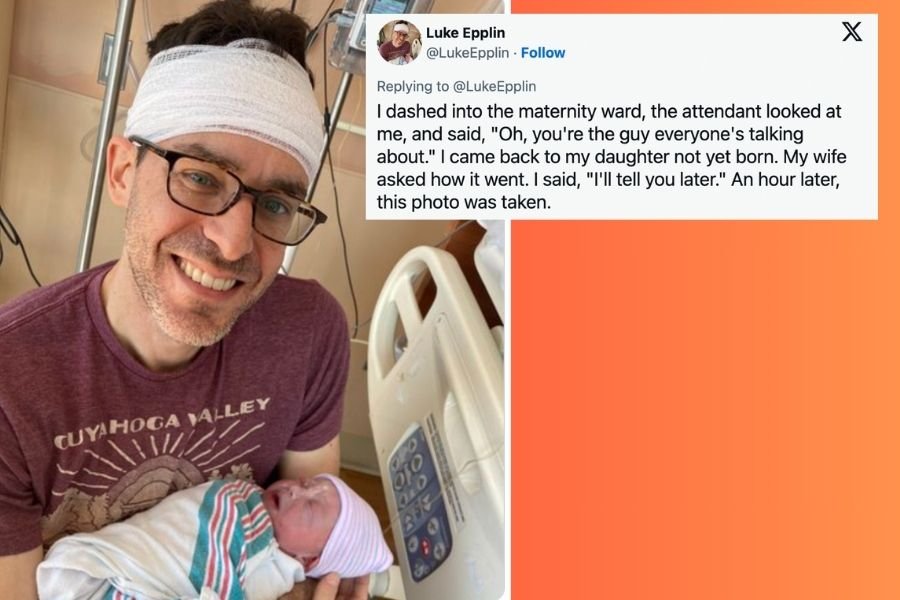
Epplin’s determination ultimately paid off. He had made it before his daughter Ava had been born. Below is their first photo together, head bandages and all.
I dashed into the maternity ward, the attendant looked at me, and said, “Oh, you’re the guy everyone’s talking about.” I came back to my daughter not yet born. My wife asked how it went. I said, “I’ll tell you later.” An hour later, this photo was taken. pic.twitter.com/cke7bbmlmS
“Every picture of me during Ava’s first day on Earth looks like this. I hope that she has a good sense of humor about it some day.”
It’s not completely uncommon for soon-to-be dads to faint in the delivery room. Often, as it seemed to be in Epplin’s case, the cause is low blood sugar. So it might be wise to pack snacks, drinks and meals in a cooler, according to Father Resource. Of course, packing snacks might be the last thing that’s on a father’s mind when the time comes.
But the point is: the situation is nothing to be ashamed of. In fact, it can make for a great birth story. Just ask Epplin!
In a small village in Pwani, a district on Tanzania’s coast, a massive dance party is coming to a close. For the past two hours, locals have paraded through the village streets, singing and beating ngombe drums; now, in a large clearing, a woman named Sheilla motions for everyone to sit facing a large projector screen. A film premiere is about to begin.
It’s an unusual way to kick off a film about gender bias, inequality, early marriage, and other barriers that prevent girls from accessing education in Tanzania. But in Pwani and beyond, local organizations supported by Malala Fund and funded by Pura are finding creative, culturally relevant ways like this one to capture people’s interest.
The film ends and Sheilla, the Communications and Partnership Lead for Media for Development and Advocacy (MEDEA), stands in front of the crowd once again, asking the audience to reflect: What did you think about the film? How did it relate to your own experience? What can we learn?
Sheilla explains that, once the community sees the film, “It brings out conversations within themselves, reflective conversations.” The resonance and immediate action create a ripple effect of change.
MEDEA Screening Audience in Tanzania. Captured by James Roh for Pura
Across Tanzania, gender-based violence often forces adolescent girls out of the classroom. This and other barriers — including child marriage, poverty, conflict, and discrimination — prevent girls from completing their education around the world.
Sheilla and her team are using film and radio programs to address the challenges girls face in their communities. MEDEA’s ultimate goal is to affirm education as a fundamental right for everyone, and to ensure that every member of a community understands how girls’ education contributes to a stronger whole and how to be an ally for their sisters, daughters, granddaughters, friends, nieces, and girlfriends.
Sheilla’s story is one of many that inspired Heart on Fire, a new fragrance from the Pura x Malala Fund Collection that blends the warm, earthy spices of Tanzania with a playful, joyful twist. Here’s how Pura is using scent as a tool to connect the world and inspire action.
A partnership focused on local impact, on a global mission
Pura, a fragrance company that recognizes education as both freedom and a human right, has partnered with Malala Fund since 2022. In order to defend every girl’s right to access and complete 12 years of education, Malala Fund partners with local organizations in countries where the educational barriers are the greatest. They invest in locally-led solutions because they know that those who are closest to the problems are best equipped to solve and build durable solutions, like MEDEA, which works with communities to challenge discrimination against girls and change beliefs about their education.
But local initiatives can thrive and scale more powerfully with global support, which is why Pura is using their own superpower, the power of scent, to connect people around the world with the women and girls in these local communities.
The Pura x Malala Fund Collection incorporates ingredients naturally found in Tanzania, Nigeria, Pakistan, and Brazil: countries where Malala Fund operates to address systemic education barriers. Eight percent of net revenue from the Pura x Malala Fund Collection will be donated to Malala Fund directly, but beyond financial support, the Collection is also a love letter to each unique community, blending notes like lemon, jasmine, cedarwood, and clove to transport people, ignite their senses, and help them draw inspiration and hope from the global movement for girls’ education. Through scent, people can connect to the courage, joy, and tenacity of girls and local leaders, all while uniting in a shared commitment to education: the belief that supporting girls’ rights in one community benefits all of us, everywhere.
You’ve already met Sheilla. Now see how Naiara and Mama Habiba are building unique solutions to ensure every girl can learn freely and dare to dream.
Naiara Leite is reimagining what’s possible in Brazil
Julia with Odara in Brazil. Captured by Luisa Dorr for Pura
In Brazil, where pear trees and coconut plantations cover the Northeastern Coast, girls like ten-year-old Julia experience a different kind of educational barrier than girls in Tanzania. Too often, racial discrimination contributes to high dropout rates among Black, quilombola and Indigenous girls in the country.
“In the logic of Brazilian society, Black people don’t need to study,” says Naiara Leite, Executive Coordinator of Odara, a women-led organization and Malala Fund partner. Bahia, the state where Odara is based, was once one of the largest slave-receiving territories in the Americas, and because of that history, deeply-ingrained, anti-Black prejudice is still widespread. “Our role and the image constructed around us is one of manual labor,” Naiara says.
But education can change that. In 2020, with assistance from a Malala Fund grant, Odara launched its first initiative for improving school completion rates among Black, quilombola, and Indigenous girls: “Ayomidê Odara”. The young girls mentored under the program, including Julia, are known as the Ayomidês. And like the Pura x Malala Fund Collection’s Brazil: Breath of Courage scent, the Ayomidês are fierce, determined, and bursting with energy.
Ayomidês with Odara in Brazil. Captured by Luisa Dorr for Pura
Ayomidês take part in weekly educational sessions where they explore subjects like education and ethnic-racial relations. The girls are encouraged to find their own voices by producing Instagram lives, social media videos, and by participating in public panels. Already, the Ayomidês are rewriting the narrative on what’s possible for Afro-Brazilian girls to achieve. One of the earliest Ayomidês, a young woman named Debora, is now a communications intern. Another former Ayomidê, Francine, works at UNICEF, helping train the next generation of adolescent leaders. And Julia has already set her sights on becoming a math teacher or a model.
“These are generations of Black women who did not have access to a school,” Naiara says. “These are generations of Black women robbed daily of their dreams. And we’re telling them that they could be the generation in their family to write a new story.”
Mama Habiba is reframing the conversation in Nigeria
Centre for Girls' Education, Nigeria. Captured by James Roh for Pura
In Mama Habiba’s home country of Nigeria, the scents of starfruit, ylang ylang and pineapple, all incorporated into the Pura x Malala Collection’s “Nigeria: Hope for Tomorrow,” can be found throughout the vibrant markets. Like these native scents, Mama Habiba says that the Nigerian girls are also bright and passionate, but too often they are forced to leave school long before their potential fully blooms.
“Some of these schools are very far, and there is an issue of quality, too,” Mama Habiba says. “Most parents find out when their children are in school, the girls are not learning. So why allow them to continue?”
When girls drop out of secondary school, marriage is often the alternative. In Nigeria, one in three girls is married before the age of 18. When this happens, girls are unable to fulfill their potential, and their families and communities lose out on the social, health and economic benefits.
Completing secondary school delays marriage, and according to UNESCO, educated girls become women who raise healthier children, lift their families out of poverty and contribute to more peaceful, resilient communities.
Centre for Girls’ Education, Nigeria. Captured by James Roh for Pura
To encourage young girls to stay in school, the Centre for Girls’ Education, a nonprofit in Nigeria founded by Mama Habiba and supported by Malala Fund and Pura, has pioneered an initiative that’s similar to the Ayomidê workshops in Brazil: safe spaces. Here, girls meet regularly to learn literacy, numeracy, and other issues like reproductive health. These safe spaces also provide an opportunity for the girls to role-play and learn to advocate for themselves, develop their self-image, and practice conversations with others about their values, education being one of them. In safe spaces, Mama Habiba says, girls start to understand “who she is, and that she is a girl who has value. She has the right to negotiate with her parents on what she really feels or wants.”
“When girls are educated, they can unlock so many opportunities,” Mama Habiba says. “It will help the economy of the country. It will boost so many opportunities for the country. If they are given the opportunity, I think the sky is not the limit. It is the starting point for every girl.”
From parades, film screenings to safe spaces and educational programs, girls and local leaders are working hard to strengthen the quality, safety and accessibility of education and overcome systemic challenges. They are encouraging courageous behavior and reminding us all that education is freedom.
Experience the Pura x Malala Fund Collection here, and connect with the stories of real girls leading change across the globe.
Children are all naturally born scientists, with an incredible curiosity about the world around them. As adults, our job is to foster that spark so they can carry it throughout their lives.
“Kids are sources of chaos and disorder. Get over that fact,” science communicator Neil deGrasse Tyson said on the Impact Theory podcast. “Where does the disorder come from? It’s because they are experimenting with their environment. Everything is new to them, everything. Your job is less to instill curiosity than to make sure you don’t squash what is already there.”
Another job we have as adults is to make sure children are learning science correctly, which is why a toddler’s pajama shirt featuring the solar system is going viral on Reddit. It seems nobody at the clothing manufacturer took the time to review the science behind the graphic. In fact, it’s safe to say most kids as young as six could easily spot the flaws in the PJs.
Jupiter appears on the shirt as spotted, rather than striped as it does through a telescope. Although it’s known for its Great Red Spot, here it looks more like a strawberry.
Saturn appears spotted, like a chocolate chip cookie, rather than banded as it does in real life.
Neptune, a giant ice planet, is shown as cratered, like Mercury.
Mercury, conversely, is shown as a black-and-blue striped planet, more like Neptune.
Uranus is shown as the largest planet in the graphic, but in reality, it is about the same size as Neptune.
This is total conjecture, but it seems the graphic designer may have mislabeled Mercury as Neptune and Neptune as Mercury.
Reddit commenters also pointed out the questionable font, noting that the “o,” with its cursive-style tail, makes the word “moon” look like “Meeh.” And, to get super nitpicky, if this is meant to be an unbiased look at the solar system, why is there only one moon on the shirt when there are hundreds in our solar system, depending on how they’re defined?
The PJs’ astronomically incorrect design even bothered those in the scientific community.
“As a professional science communicator who works a lot with space at this age group, I am disappointed to see an adult get something wrong that any 6-year-old in the U.K. would correct,” Dr. Mark Gallaway told Newsweek.
Although the shirt may be wrong in many ways, it could be a blessing in disguise. The parent who purchased these PJs now has an opportunity for a teachable moment. They can take the pajamas and compare them to the actual solar system to see where the designer got things right or wrong. It’s also a chance to bring up one of the sad truths about the universe: Pluto isn’t among the PJ planets, because it was demoted. Thanks, Neil deGrasse Tyson.
You probably couldn’t pay a Parisian enough money to visit the Eiffel Tower, or an Italian to swing by the Vatican, even though both landmarks are objectively extraordinary. It’s a fact of life that people take for granted what they see every day, no matter how naturally splendid or meticulously crafted it may be. But sometimes an outsider’s appreciation can help you marvel once again at the wonderful things in your own backyard.
Recently, non-Americans on Reddit offered this gift by sharing some quintessentially American things they’d like to witness or experience for themselves. At a time when political division is making many Americans feel disillusioned, the conversation offers some timely comfort—and maybe even a renewed sense of hope for the good things the country still has to offer.
It’s also interesting to see how much American pop culture shapes what visitors find intriguing. Many people suggested fairly mundane things simply because they’ve seen them again and again in American movies and TV shows. For instance, one person mentioned the allure of Chinese takeout because of the iconic white cartons that appear a bajillion American films and television shows.
Keep scrolling for American things people from outside the country are eager to experience, or grateful to have experienced in their lifetime.
Even Americans agree that these two spots are must-sees.
“I promise, standing at the base of a giant tree is an experience that cannot be replicated…If you have a chance, learn about the ecology and also about fire history.”
“As I’m American I always brushed off the Grand Canyon and never planned to see it. I got a random chance on a return trip from Vegas. Do it. See it. I’ve traveled a fair bit around the US and Europe and it remains the most amazing, breathtaking thing I’ve ever seen or experienced.”
“I’m also an American, and pretty well traveled. The Grand Canyon brought me to tears. It’s one of only two placed I’ve ever gone to twice in the same year because it’s just THAT good. (The second was the Cliffs of Moher in Ireland.)”
2. The rainforests of the Pacific Northwest
“I bet they smell AMAZING!!”
3. The French Quarter in New Orleans
“Nothing else like it. And you cannot get bad food there unless you just want to eat at McDonalds………”
4. Savannah, Georgia
“Savannah is great!! I stayed a couple nights there and always wanted to go back. Do a ghost tour! And a horse carriage tour!”
“I reallllyyy wanted to go to New England for the longest time lol. Such pretty leaves.”
6. Sedona, Arizona
“A friend said it was stunning but disconcerting because at times she felt things were off kilter. I like weird places and the geographic nature appeals, all those red rocks!!”
7. San Francisco
“I’m 30, an American and just landed in San Francisco this morning. It’s my first time here and I’m in love. Such a cool place. I’m actually moving here soon. Doesn’t feel real at all!”
“I lived in Mexico and Central America for many years, and one thing people kept asking me about was tornadoes…They thought it was an American thing, and a very common occurrence. Maybe because of Wizard or Oz. I had to sadly tell them I’ve never seen a tornado in my life. I’m from the west coast. They were definitely very disappointed. I also realized they don’t understand how dangerous they are. They thought it was more like lightning. Just happening in the background while people got on with their day.”
9. Gigantic stores
“Honestly just want to hit up some of those huge pc hardware stores…we don’t have anything like that scale here.”
“I wanna visit a Walmart. The closest thing to a giant store like that are some larger supermarket chains in Germany … In the Netherlands we don’t really have large stores where you can find EVERYTHING you wish for.”
“I have a good friend from Switzerland and the first thing she wanted to experience was getting to-go Chinese food and eating it out of those white cartons with chopsticks…I guess the whole Chinese food take-out in those particular cartons is pretty American, kinda like fortune cookies.”
11. Fast food restaurants
“I’m American, but my Irish colleague was so excited to try a Baconator from Wendy’s when he visited.”
“When my German friend visited she begged to visit In-N-Out because it looked ‘so fancy.’ She loved it. I surprised her by buying her a tshirt from there too.”
12. Items/places made famous by movies and TV
“Australian here, and I’ve always wanted to see a big yellow school bus, after being terrified of them in the opening scene of A Nightmare on Elm Street 2”
“I just wanna walk into a 24/7 diner at 3am and get a giant milkshake. No reason, just movie vibes.”
“My friend from England visited New York for business and thought it was wild that to-go coffee was served in the same blue and white cups she had seen on Law & Order.”
13. Halloween festivities
“I absolutely love American culture for Halloween, all those decorations, costumes and just the whole vibe about this holiday is something I would like to experience.”
“One thing that I really love about American culture is Halloween haunted houses. There’s haunted houses…There’s haunted hayrides, some where zombies attack you, and you have to try to get them with paintball guns.There’s haunted 5k runs, kids haunted houses (Not scary, just silly), even haunted car washes.”
14. Events that celebrate olden times
“I’d love to go to a Renaissance fair or at least a Medieval Times dinner show.”
Finally, people seem really eager to try rhubarb pie. Honestly, who can blame them?
The word “trending” may have gained a whole new meaning in the Internet age, but trends have always existed as a social phenomenon. A video of teens in the ’90s doing “Cat’s Cradle” has people pondering how trends spread, sometimes worldwide, without social media.
For those who are unfamiliar, Cat’s Cradle is a game of sorts involving a long loop of string wrapped around your hands and fingers in a specific pattern. The game involves transferring the string from one person to another without getting it tangled. Here’s what it looks like:
The video on X triggered a ton of nostalgia in those who remember playing Cat’s Cradle. But the most remarkable thing is that people from all over the world say they played it around the same time:
“HOW is this a universal thing. We did this exact thing, exact same moves, in Norway in the early 90s. Pre internet.”
“That’s a great question. I used to play that game back in the ’90s, too, and I’m from Brazil.”
“Same in Italy.”
“What? This is a global thing, greetings from Chile.”
“This is a game we used to play in Korea. Seeing it for the first time in a long while makes me miss my childhood memories.”
“We did this in Romania too.”
To be fair, Cat’s Cradle has been around for a long time. No one appears to know its exact origin. But a specific reference to the game appears in the 1768 novel The Light of Nature Pursued by Abraham Tucker:
“An ingenious play they call cat’s cradle; one ties the two ends of a packthread together, and then winds it about his fingers, another with both hands takes it off perhaps in the shape of a gridiron, the first takes it from him again in another form, and so on alternately changing the packthread into a multitude of figures whose names I forget, it being so many years since I played at it myself.”
It appears the game has seen surges in popularity at various times—but how? Why did it specifically trend in the ’90s? How did games, fashion, music, dance styles, and more become popular across the country or even the world before the Internet?
Those who remember life before social media have shared recollections of how trends spread on forums like Reddit and MetaFilter. It’s a fascinating glimpse into a nearly forgotten past:
“Everyone at a school would do it. Then, one group of people from this school would go to a youth group, and meet a group of people from a different school. It would become common throughout the youth group.
People from the youth group would go to their own respective schools, and it would spread around the rest of their school mates who don’t go to that youth group – but perhaps go to a different youth group.
Once something got popular enough, it might feature in magazines or even on TV.” – LondonPilot
“Cultural transmission was a lot slower previously. In the 60s it was said New Zealand was five years behind England, later it was three years.
Broadcast radio and later TV sped up cultural transmission immensely. TV shows were transported on film and played on telecine machines at the studios, up to six years behind the original release.
Magazines were a bigger thing than now. International magazine subscriptions by airmail were extremely expensive so surface mail added up to two months to delivery. Many people read magazines via public libraries.
Note none of the above are interactive, and only magazines allowed niche interests. Broadcast media had very few channels (until the US got cable TV) e.g. in NZ in the 70s a in a big city there might be six radio stations and one TV station. Later there were four major TV stations.
There was much less diversity. Record shops had knowledgeable staff who could make recommendations. These were important as an album was a significant investment.
People travelled and brought back new ideas. (In those days, Western countries were different to each other 😉
Schoolkids spread jokes and games – one person could infect a whole school with a good game.” – cyathea
“I think in the pre-internet days some trends and fashions were spread broadly via mass media, but many were regional and local. My wife grew up in small town Midwest and I grew up in the Boston area, both in the 70s to 80s. There were music, fashion and other cultural trends that were part of everyday life for me in the early- to mid-80s that were entirely unknown to her at that time.” –slkinsey
“I think the big thing was that trends moved more slowly. So you’d have a thing that happened on TV and your weekly magazine (Time, Newsweek) would talk about it. Or your monthly humor magazine (Mad, Cracked). A lot more people watched the same channels, so you’d see people dressed on shows and dressed in commercials… I lived in a rural area, and when I’d visit friends in the big city I’d get ideas and some of those would filter down. I assume it was like this for other people, getting ideas from people more cosmopolitan and then the trickle down. Same with radio, there were only so many stations and there would be a culture that built up around each one which might include shows they promoted (you’d go, you’d see other people) and maybe local events or stuff around them.” –jessamyn
“I think social media is more about an acceleration in the spread of trends, as well as an increase in the scope of their spread, than the absence of trend-spreading before. Prior to Facebook/etc, people talked to one another, in person…
Media wasn’t ‘social’ as we mean it today, but it was still… media. That, and people did what people do – watched the ‘in’ person or people among them and often copied/followed along. Based on my memories of summer camp, trends spread there practically in minutes, sans phones or the internet. Some of this had to do with most of the campers originating in the same hometown. They all just… knew… what was “in” (based on all knowing each other, they decided what that was, in turn based on movies, TV shows, etc) and good luck if you weren’t from their town. People set trends, and others follow, or try to follow – whether through gossip and magazines and MTV, or through social media. All that’s changed is the speed in which trends get set, and the size of the area that they reach.” – Armed Only With Hubris
“- Cool kids moving from other parts of the country to my rapidly-growing Minneapolis suburb were a vector for fashion trends in particular.
– Older siblings would see shows at local venues, interact with others in the audience as well as the bands themselves and people traveling with them, and then bring those influences back to their friends and younger siblings.
Record shops played a big role in music trends before the Internet. Photo credit: Canva
– A handful of shops played important roles spreading culture. Music stores were hangout spots where music was discovered and ideas mixed.
– Alternative radio stations and college radio had a big reach even out into the small towns and countryside.” – theory
It’s wild to see these explanations and realize how much the Internet has changed things. Newspapers, magazines, radio stations, and record shops have struggled just to survive in the digital age. Rarely do they serve as influential forces in what’s popular.
The people we used to think of as trendsetters are now “influencers.” Real-life social connections have morphed into social media connections that spread trends in the blink of an eye. It’s hard to remember a time when trends spread slowly, either in person or through influences we all shared. But it sure is fun to remember a time when a simple string game could keep us occupied for hours.
Procrastination is more common than some might think. In fact, according to an article by Forbes senior contributor Bryan Robinson, more than 78 percent of working people procrastinate even though “it makes them anxious.” Some think it’s due to laziness, while others believe the anxiety itself creates a loop: they’re too anxious to get a task done, but not getting it done makes them even more anxious.
However, one theory behind why people procrastinate turns the whole “laziness” argument on its head.
Dr. Rick Hanson, a psychologist, shares a fascinating idea. In a comment attached to a clip posted on Instagram, he offers an entirely different view: “Procrastination is rarely about laziness or poor time management. It is more often something much more subtle. If I finish this, then what? If the pile disappears, who am I without it?”
He explains how having something that still needs to be tackled can feel like “proof” that we matter.
“Unfinished tasks can start to feel like proof that we’re busy, needed, in motion. They create a kind of background hum of identity. As long as something is pending, we’re still becoming. Still almost there.”
The fear of not existing
In the video, Hanson says people procrastinate “even when there are no obstructions to completing something, because sometimes they’re kind of afraid, almost at a deep level, that if they complete things, they’ll disappear. There will be almost no more basis for being. It’s the incomplete cycles in their life—the unfinished tasks, the various piles here or there—that almost give them a sense of psychological substance and existence.”
Hanson has ways to address this, and the first is to truly examine your motivations (or seemingly lack thereof).
“Look closely and ask yourself, ‘Is this really true? Do I go on existing because I have a number of undone tasks that I’m going to get to tomorrow or eventually? Is that why I keep on existing?’ Well, no. And notice the ways you can go on being. Or you have others you know who complete a lot of things, and they continue to exist just fine and really, quite happily.”
He says we must rewrite our inner monologue.
“Gradually realize for yourself, ‘Oh, I can complete these various tasks. And they then disappear from my life, understandably. I took care of it. And I’m still here, having a good time. And getting ready to accomplish the next important thing.’”
Upworthy spoke with Cort M. Dorn-Medeiros, a professional counselor and addiction specialist, who first noted that there are many real reasons people might procrastinate.
“Fear of failure, doubts about self-worth, perfectionist tendencies, emotional avoidance, and potential diagnoses such as attention-deficit-hyperactivity disorder (ADHD) or generalized anxiety disorder (GAD).”
That said, he does give credence to Hanson’s idea as well.
“We have strong cultural messaging that if we are not doing something, if we are not being productive, then we are not useful. All of our human value lies in the ‘doing’ rather than the ‘being.’ A lot of this is derived from Internet-based hustle culture, where speed is prioritized above all else. Do more, make more money, and do it faster and faster.
If we are left with nothing to do, then we are left sitting with our own thoughts and feelings. Procrastination is a good way to unconsciously avoid sitting with our feelings. If we are constantly focused on our to-do list and maintain it in a way that prevents progress by crossing things off, we manage our anxiety about ‘being’ rather than ‘doing.’”
Matthew Baker, LCSW, tells Upworthy it’s all about avoidance.
“Procrastination is almost always about avoiding something uncomfortable. For some people, finishing a project is what becomes the problem, not starting it. This is often because the brain gets rewarded from simply planning and organizing, even without actually doing anything. So some people avoid completing tasks because they’re already getting a sense of satisfaction from planning, and finishing means that this dopamine stream just…stops.”
If you never seem to get tired of blasting the same handful of early 2000s songs—maybe the emo tones of My Chemical Romance or something a little more upbeat and ’90s like *NSYNC—it’s not just you.
It’s no longer a mystery why so many of us seem to be “stuck” on the music we listened to as teens. Our musical tastes may evolve over time, and we always have room for new favorites (and a seemingly endless capacity in our brains for catchy lyrics), but there’s something about the songs of our youth that just hits different.
What’s behind the phenomenon
A therapist is going viral for explaining this phenomenon perfectly. It’s not just nostalgia, she says. It’s neuroscience.
Singing along to your teenage throwback songs is good for your brain. Photo credit: Vitaly Gariev on Unsplash
Nikki Roy is a therapist from Canada who specializes in helping her clients with “self esteem, confidence, identity, emotion work (lots of anger), living authentically, creating a life of alignment, and breaking free from the oppressive systems the world operates on,” according to an interview with CanvasRebel.
She uses her vast social media following to break down big, complex topics in bite-sized ways that can reach and help a lot of people.
Recently, she tackled a concept she calls “neural nostalgia.”
“This is actually really well-researched,” she says in a recent Instagram Reel. “The research found that the music you listen to as an adolescent or teenager actually imprinted on your brain and nervous system differently than music you’ll ever listen to at any other time in your life.”
She goes on to explain that when you’re a teenager, the pathways in your brain are still being built. The blueprint is still being developed, and it can be influenced by the music you listen to regularly. When you’re an adult and hear the music that, quite literally, “built you,” a lot of things come rushing to the surface.
“Dopamine, seratonin, all those things start rushing back,” Roy says. “You literally feel it in your gut. That specific music does something to you.”
According to Marble Wellness, “When we listen to music from our youth, several brain regions become active.” These include:
The hippocampus, where memories are formed and retrieved
The amygdala, which regulates emotions
The prefrontal cortex, which manages complex cognitive behaviors
Reward centers
It’s no wonder that our entire brain and mood can light up just a few notes into one of our favorite throwback songs.
“Music is my safe space”
Roy says she likes to use neural nostalgia as a coping skill in her own life. She uses throwback tunes to boost her mood or process difficult emotions.
“My car and music is my safe space,” she says. “And the music that got you through an especially hard time during that age, is probably always going to hit.”
Fellow Millennials are feeling seen in the comments:
“I have been listening to all the millennial jams lately and it has made my life so much lighter!”
“When ‘it just hits different’ is backed by science”
“When I was a kid I used to wonder why old people prefer to listen to their ‘old’ music when there’s so many good new music to listen to, now as and adult I fully get it”
“yessss, i’ve been catching the sunset by the beach every evening in my ‘95 jeep with the top down blaring 90s R&B & 80s rock. i feel so whole. everything is like a nostalgic hug”
“play your grandparents tunes from their teenage years too. they’ll light up”
Some folks were fascinated by the fact that they could remember the lyrics of songs they hadn’t heard in 20 or 30 years.
“I turned 38 yesterday and listened to the Space Jam soundtrack while I ran errands,” one commenter noticed. “Still knew every word but couldn’t remember my shopping list I wrote 30 mins before.”
Song lyrics stick in our brains and are notoriously easy to remember. Musical melodies act as a “scaffolding” that helps us fill in the blanks, and the way music triggers emotions makes the words more memorable than other pieces of information.
Those songs that imprinted on our brains while they were still developing? Their lyrics are so deeply embedded that they may never leave us, which is pretty incredible.
In fact, this phenomenon may one day be useful for treating Alzheimer’s disease, dementia, and other memory diseases.
More generally, neural nostalgia has a ton of benefits, according to Marble Wellness. Listening to the songs you loved as a teen can boost your mood, reduce stress, and even lessen feelings of loneliness. Even more powerfully, it can connect you to a sense of your authentic self—to who you were before the world shaped you, and to all the versions of yourself that came before and after.
It’s heavy and complicated, but you know it when you feel it.
For more than 2,000 years, humankind has known that the Earth is round. That fact was widely demonstrated in 1522, when the Magellan-Elcano expedition sailed around the planet without falling off its nonexistent edge. So for more than 2,000 years, people have made globes to help them navigate the planet and hone their geographic knowledge.
In the second century AD, a major step in globe-making came when Claudius Ptolemy developed a scientific method for locating places using coordinates known as latitude and longitude. Initially, elites exchanged globes with one another. You might also find one in a classroom. But globes began to be mass-produced in the early 19th century, giving more people a way to understand the world from their own homes.
Video shows how globes were made in London in 1955
A charming video by British Pathé, created in 1955, offers an inside look at what it was like to manufacture a globe by hand before machines took over much of the process. British Pathé was a newsreel producer that covered world events from 1896 to 1978, and today its entire archive is available to view for free.
Globe construction in the 1950s was a painstaking process. It began with covering a solid wooden ball with papier-mâché, which was then coated with plaster. Nine separate layers of plaster were applied to the sphere, bringing it to a thickness of 1/8 inch; the entire molding process took more than six hours.
Once dried, the globe was sent to the covering room, where the map was pasted on in small portions, “like restoring the skin to a peeled orange,” the narrator said. After the map was added to the globe’s surface, workers painstakingly smoothed out any lumps and removed excess glue. It was then attached to an axis for display. The entire process took around 15 hours.
In 1955, globes were available in sizes ranging from one inch (£0.60) to six feet (£1,000), which would cost roughly $24 to $35,000 in today’s dollars.
How are globes made today?
Replogle Globes, one of the world’s largest globe manufacturers, shared a video offering a behind-the-scenes look at how globes are made today and how modern machines have made the process much faster.
One big difference from how globes were made in the ’50s is that the maps are printed directly onto chipboard, which is then precisely cut with a hydraulic press and formed into half a sphere. During the pressing process, three-dimensional mountains are embossed into the globe’s surface. After the northern and southern hemispheres are pressed together, they are attached to a central hoop, creating a complete replica of planet Earth.
Globes have been around for more than 2,000 years, and they remain one of the few educational tools that we still use today. You can put a child in front of a computer and show them a representation of the Earth, which they will probably understand. Still, nothing beats running your fingers across a globe and spinning it in your hands to realize what an incredible planet we live on.
As Los Angeles-based content creator Paige Thalia shared with The New York Post, she had been walking her dog just outside the Dolby Theatre where the Oscars are held as crews were setting up for the March 15 ceremony.
Apparently, Thalia had just moved into a nearby apartment and needed a rug “that wasn’t crazy expensive” for her living room.
Then, inspiration struck. Why not deck out her living room with the famous red carpet?
Apparently, when Thalia first moved to Los Angeles 10 years ago, she attended a post-Oscars event at the Dolby Theatre, where she was allowed to “take home a tiny piece.” So, the dream seemed at least somewhat attainable.
Sure enough, when she asked security if she could hop into the dumpsters to procure some pieces, they let her. In her now-viral reel, Thalia is seen with multiple large rolls.
Later in her apartment, we see her casually vacuuming a piece of fabric that so many celebrity feet had traipsed across just hours earlier. No big deal.
After Thalia’s video began making the rounds, several viewers criticized the apparent wastefulness of treating the red carpet as single-use.
“I’m sorry. You’re telling me the Oscars don’t have a storage unit or something in order to reuse it??? They buy/make the carpet for ONE NIGHT and then THROW IT AWAY????? I’m shocked!!!,” one viewer wrote.
Another said, “I was today years old when I learned how wasteful the Oscars are…cause WHAT DO YOU MEAN THEY BUY NEW CARPET EVERY YEAR?! but I can’t use a plastic straw.. Cool.”
Others hoped that Thalia’s story would inspire more sustainable measures in the future.
“Maybe next year they will not just throw it away,” a commenter wrote. “Let’s hope they donate or recycle it for some other use. It is crazy wasteful thank you for the attention you process.”
“That could make so many throw rugs for animal shelters!” someone on X added, while another wrote, “Could they not auction off sections of the carpet and donate portions of the proceeds to charity? Would make for better PR at least.”
It would seem that Event Carpet Pros, the company that has manufactured the carpet for the Oscars for more than 20 years, as well as events on both coasts like the Golden Globes, the Primetime Emmy Awards, and the Grammy Awards, has, in fact, been recycling its carpets as of 2023. Perhaps Thalia was lucky enough to go dumpster diving in a recycling bin. After all, the video shows the dumpster belonged to recycling removal company King Environmental.
Either way, we can probably all agree that, as one viewer wrote, walking through the streets with a random piece of the Oscars red carpet is “the most LA thing ever.”
In April 2020, Christina Marie was doing the math that millions of families were doing that spring, and the numbers weren’t adding up. A mother of four in Saginaw, Michigan, she was struggling to cover her bills as the pandemic ground everyday life to a halt. She had three packs of meat in her fridge and knew she’d need to make a grocery run soon, which meant going out during one of the most frightening early months of the outbreak. Then her landlord called.
His name was Alan, and he had something to tell her: don’t worry about rent this month. They’d figure it out later.
“SOOO My landlord Alan called me earlier and told me not to worry about rent this month and we will worry about it later i said okay!” Christina wrote in a Facebook post that would eventually rack up more than 500,000 reactions. She was grateful, she explained, and that was that. Or so she thought.
During the call, Alan had also asked her a simple question: did she have food? She told him about the meat, mentioned she needed to get to the store. He told her to be safe and hung up.
A little while later, her phone buzzed. It was a text from Alan, asking her to go check her front porch.
She opened the door to find 16 bags of groceries waiting for her. Cartons of milk, potatoes, diapers and more, quietly left without any fanfare. Alan had decided she shouldn’t have to go out at all.
“I couldn’t tell you how I feel right now for him to do this for my family my heart is so touched GOD BLESS YOU,” she wrote, alongside a photo of her porch overflowing with bags.
According to Goalcast, Alan had been inspired by another landlord, Nathan Nichols, who had publicly announced he was giving his tenants a rent-free April because of the “serious financial hardship” the pandemic was causing for hourly and service workers. Nichols had also put out a call to other landlords: “I ask any other landlords out there to take a serious look at your own situation and consider giving your tenants some rent relief as well.” Alan took that to heart, and then went further.
The post spread fast. Commenters poured in from across the country, many of them saying what a lot of people were thinking. “Better keep him as your landlord because it is really hard to find a good hearted person like that,” wrote Balentin Torres. Mivida Loca added, “It’s nice to know that we can stick together during such times and that there are decent human beings like that around.”
Others were more direct: they wished Alan was their landlord too.
The story keeps resurfacing because it captures something people were hungry for in those early, disorienting weeks of the pandemic, and still look for now. Not a grand gesture from a famous face or a corporation with a PR team, but one person quietly deciding that someone else’s situation was his business too, and doing something about it.
This article originally appeared earlier this year.