One dad is delighting readers on X with an epic tale of nearly missing his daughter’s birth after fainting. His story of rushing to make it in time feels like something straight out of a movie—complete with a happy ending.
Luke Epplin’s wife had gone into labor on a Friday. Most of that night, and all of Saturday, Epplin stayed awake, waiting. Finally, on Sunday, he began to doze off. That’s when he got word that his wife had gone into active labor.
And this is where our hilarious saga begins.
“I got on my feet, threw on my clothes, and then was thrust in the middle of the action. Whether because of exhaustion, lack of food, or having just gotten up, I don’t remember anything else. I fainted,” he wrote.
I was awoken at four in the morning today (Sunday) to active labor. I got on my feet, threw on my clothes, and then was thrust in the middle of the action. Whether because of exhaustion, lack of food, or having just gotten up, I don’t remember anything else. I fainted.
When he finally woke up, blood was “oozing” from his head and he was whisked away to the emergency room. EMT’s told him he might need a CT scan, “which would make me miss the birth of my daughter.”
Thankfully, all that Epplin ended up needing was staples. Which meant it was all smooth sailing from here on out, right? Guess again.
There was still a “massive” hospital to navigate, the nurse guiding him through the multiple hallways was called away on an emergency. Leaving him to make it through the labyrinth to the opposite side, with nothing but some verbal directions the nurse had given him. Which somehow got him to the bone marrow center.
“Granted, I’m in the clothes I slept in, with a massive white bandage wrapped around my head, like something you’d see in a World War I movie,” he wrote. As he frantically tried to tell another nurse that his was was in labor, she said, “I think you need to see security.”
I told him the same thing: “My wife is in labor!” Again, he looked at me, bandage and all, patient tag on my wrist, and said, “Sir, I’m gonna need to see some discharge papers.” I had no ID, no visitor’s badge, no cellphone, nothing. Suddenly, it dawned on me: I’m in trouble.
Cut to Epplin saying the same thing to a security guard, who asks to see some discharge papers. That’s when Epplin realizes he has nothing on him. No papers, no ID, no visitors badge. Not even a cellphone.
Pulling a Hail Mary, Epplin told the guard the truth: that he had fainted while his wife was in labor, cut a gash into his head, got that treated, and then got himself lost. That must have done the trick, because the guard let him out.
Epplin had to sprint down two blocks (in slippers, mind you) and get past a parking valet and yet another security guard before making it up to the 10th floor of the correct building and into the maternity ward. By this time, he had somehow become famous.
“The attendant looked at me, and said, ‘Oh, you’re the guy everyone’s talking about,” he recalled.
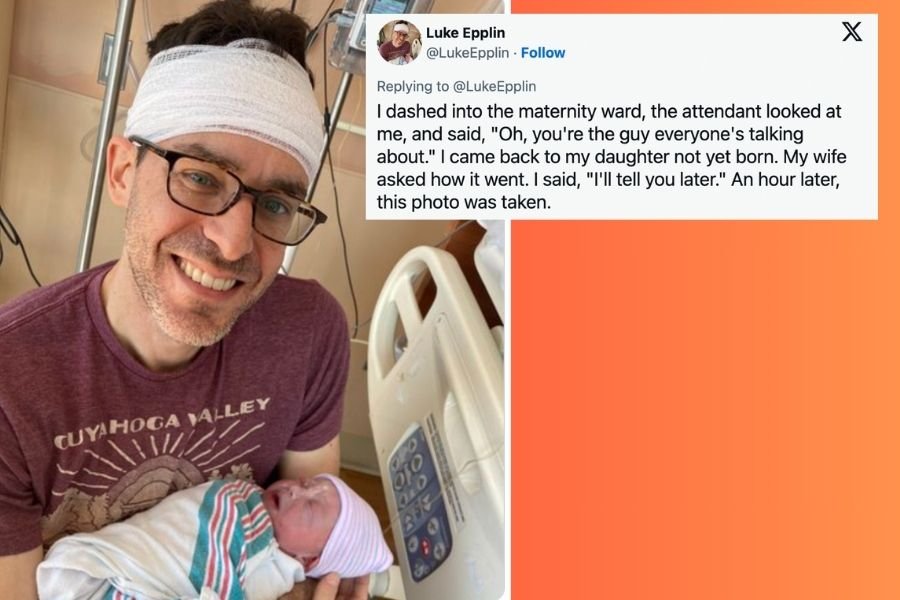
Epplin’s determination ultimately paid off. He had made it before his daughter Ava had been born. Below is their first photo together, head bandages and all.
I dashed into the maternity ward, the attendant looked at me, and said, “Oh, you’re the guy everyone’s talking about.” I came back to my daughter not yet born. My wife asked how it went. I said, “I’ll tell you later.” An hour later, this photo was taken. pic.twitter.com/cke7bbmlmS
“Every picture of me during Ava’s first day on Earth looks like this. I hope that she has a good sense of humor about it some day.”
It’s not completely uncommon for soon-to-be dads to faint in the delivery room. Often, as it seemed to be in Epplin’s case, the cause is low blood sugar. So it might be wise to pack snacks, drinks and meals in a cooler, according to Father Resource. Of course, packing snacks might be the last thing that’s on a father’s mind when the time comes.
But the point is: the situation is nothing to be ashamed of. In fact, it can make for a great birth story. Just ask Epplin!

In a small village in Pwani, a district on Tanzania’s coast, a massive dance party is coming to a close. For the past two hours, locals have paraded through the village streets, singing and beating ngombe drums; now, in a large clearing, a woman named Sheilla motions for everyone to sit facing a large projector screen. A film premiere is about to begin.
It’s an unusual way to kick off a film about gender bias, inequality, early marriage, and other barriers that prevent girls from accessing education in Tanzania. But in Pwani and beyond, local organizations supported by Malala Fund and funded by Pura are finding creative, culturally relevant ways like this one to capture people’s interest.
The film ends and Sheilla, the Communications and Partnership Lead for Media for Development and Advocacy (MEDEA), stands in front of the crowd once again, asking the audience to reflect: What did you think about the film? How did it relate to your own experience? What can we learn?
Sheilla explains that, once the community sees the film, “It brings out conversations within themselves, reflective conversations.” The resonance and immediate action create a ripple effect of change.
MEDEA Screening Audience in Tanzania. Captured by James Roh for Pura
Across Tanzania, gender-based violence often forces adolescent girls out of the classroom. This and other barriers — including child marriage, poverty, conflict, and discrimination — prevent girls from completing their education around the world.
Sheilla and her team are using film and radio programs to address the challenges girls face in their communities. MEDEA’s ultimate goal is to affirm education as a fundamental right for everyone, and to ensure that every member of a community understands how girls’ education contributes to a stronger whole and how to be an ally for their sisters, daughters, granddaughters, friends, nieces, and girlfriends.
Sheilla’s story is one of many that inspired Heart on Fire, a new fragrance from the Pura x Malala Fund Collection that blends the warm, earthy spices of Tanzania with a playful, joyful twist. Here’s how Pura is using scent as a tool to connect the world and inspire action.
A partnership focused on local impact, on a global mission
Pura, a fragrance company that recognizes education as both freedom and a human right, has partnered with Malala Fund since 2022. In order to defend every girl’s right to access and complete 12 years of education, Malala Fund partners with local organizations in countries where the educational barriers are the greatest. They invest in locally-led solutions because they know that those who are closest to the problems are best equipped to solve and build durable solutions, like MEDEA, which works with communities to challenge discrimination against girls and change beliefs about their education.
But local initiatives can thrive and scale more powerfully with global support, which is why Pura is using their own superpower, the power of scent, to connect people around the world with the women and girls in these local communities.
The Pura x Malala Fund Collection incorporates ingredients naturally found in Tanzania, Nigeria, Pakistan, and Brazil: countries where Malala Fund operates to address systemic education barriers. Eight percent of net revenue from the Pura x Malala Fund Collection will be donated to Malala Fund directly, but beyond financial support, the Collection is also a love letter to each unique community, blending notes like lemon, jasmine, cedarwood, and clove to transport people, ignite their senses, and help them draw inspiration and hope from the global movement for girls’ education. Through scent, people can connect to the courage, joy, and tenacity of girls and local leaders, all while uniting in a shared commitment to education: the belief that supporting girls’ rights in one community benefits all of us, everywhere.
You’ve already met Sheilla. Now see how Naiara and Mama Habiba are building unique solutions to ensure every girl can learn freely and dare to dream.
Naiara Leite is reimagining what’s possible in Brazil
Julia with Odara in Brazil. Captured by Luisa Dorr for Pura
In Brazil, where pear trees and coconut plantations cover the Northeastern Coast, girls like ten-year-old Julia experience a different kind of educational barrier than girls in Tanzania. Too often, racial discrimination contributes to high dropout rates among Black, quilombola and Indigenous girls in the country.
“In the logic of Brazilian society, Black people don’t need to study,” says Naiara Leite, Executive Coordinator of Odara, a women-led organization and Malala Fund partner. Bahia, the state where Odara is based, was once one of the largest slave-receiving territories in the Americas, and because of that history, deeply-ingrained, anti-Black prejudice is still widespread. “Our role and the image constructed around us is one of manual labor,” Naiara says.
But education can change that. In 2020, with assistance from a Malala Fund grant, Odara launched its first initiative for improving school completion rates among Black, quilombola, and Indigenous girls: “Ayomidê Odara”. The young girls mentored under the program, including Julia, are known as the Ayomidês. And like the Pura x Malala Fund Collection’s Brazil: Breath of Courage scent, the Ayomidês are fierce, determined, and bursting with energy.
Ayomidês with Odara in Brazil. Captured by Luisa Dorr for Pura
Ayomidês take part in weekly educational sessions where they explore subjects like education and ethnic-racial relations. The girls are encouraged to find their own voices by producing Instagram lives, social media videos, and by participating in public panels. Already, the Ayomidês are rewriting the narrative on what’s possible for Afro-Brazilian girls to achieve. One of the earliest Ayomidês, a young woman named Debora, is now a communications intern. Another former Ayomidê, Francine, works at UNICEF, helping train the next generation of adolescent leaders. And Julia has already set her sights on becoming a math teacher or a model.
“These are generations of Black women who did not have access to a school,” Naiara says. “These are generations of Black women robbed daily of their dreams. And we’re telling them that they could be the generation in their family to write a new story.”
Mama Habiba is reframing the conversation in Nigeria
Centre for Girls' Education, Nigeria. Captured by James Roh for Pura
In Mama Habiba’s home country of Nigeria, the scents of starfruit, ylang ylang and pineapple, all incorporated into the Pura x Malala Collection’s “Nigeria: Hope for Tomorrow,” can be found throughout the vibrant markets. Like these native scents, Mama Habiba says that the Nigerian girls are also bright and passionate, but too often they are forced to leave school long before their potential fully blooms.
“Some of these schools are very far, and there is an issue of quality, too,” Mama Habiba says. “Most parents find out when their children are in school, the girls are not learning. So why allow them to continue?”
When girls drop out of secondary school, marriage is often the alternative. In Nigeria, one in three girls is married before the age of 18. When this happens, girls are unable to fulfill their potential, and their families and communities lose out on the social, health and economic benefits.
Completing secondary school delays marriage, and according to UNESCO, educated girls become women who raise healthier children, lift their families out of poverty and contribute to more peaceful, resilient communities.
Centre for Girls’ Education, Nigeria. Captured by James Roh for Pura
To encourage young girls to stay in school, the Centre for Girls’ Education, a nonprofit in Nigeria founded by Mama Habiba and supported by Malala Fund and Pura, has pioneered an initiative that’s similar to the Ayomidê workshops in Brazil: safe spaces. Here, girls meet regularly to learn literacy, numeracy, and other issues like reproductive health. These safe spaces also provide an opportunity for the girls to role-play and learn to advocate for themselves, develop their self-image, and practice conversations with others about their values, education being one of them. In safe spaces, Mama Habiba says, girls start to understand “who she is, and that she is a girl who has value. She has the right to negotiate with her parents on what she really feels or wants.”
“When girls are educated, they can unlock so many opportunities,” Mama Habiba says. “It will help the economy of the country. It will boost so many opportunities for the country. If they are given the opportunity, I think the sky is not the limit. It is the starting point for every girl.”
From parades, film screenings to safe spaces and educational programs, girls and local leaders are working hard to strengthen the quality, safety and accessibility of education and overcome systemic challenges. They are encouraging courageous behavior and reminding us all that education is freedom.
Experience the Pura x Malala Fund Collection here, and connect with the stories of real girls leading change across the globe.
A deep clean usually involves getting rid of dust that has accumulated on various surfaces. While you might reach for a duster and swipe surfaces in one fell swoop, cleaning expert Sergio of EDGE Cleaning Service says most people are dusting completely wrong.
In an informative Instagram video, he explains why dust always seems to come back so quickly after you’ve cleaned. It all comes down to technique.
According to Sergio, most people pick up a duster and simply swipe it across surfaces, thinking the job is done. However, he explains that this method is just pushing dust back into the air, where it will soon settle again.
“Dust is such a massive problem for so many people simply because almost everyone cleans it the completely wrong way,” he says.
The goal, he says, is to “trap the dust instead of just moving it around.” To properly dust, he recommends first cleaning your duster by vacuuming it, a step many people neglect, often starting with an already “dusty” duster.
Next, he says you should adjust your dusting speed.
“Dust surfaces slowly so the dust sticks to the duster instead of flying into the air,” he says.
After dusting each room, he says you should vacuum your duster again to prevent trapped dust from spreading to the next room.
Finally, you should wipe down surfaces with a slightly damp microfiber cloth. “The damp cloth helps trap dust so it doesn’t float back into the air,” he says.
Reduce allergies by dusting
Dust is a leading cause of allergies in homes due to dust mites, which feed on human skin flakes shed every day and on moisture in the air, according to the Asthma and Allergy Foundation of America (AAFA).
Sergio offers an extra tip for managing dust in your home: clean and replace air filters regularly.
“Dirty filters can push dust around your house through the vents,” he says.
He also recommends dusting your home once a week to prevent buildup. If that’s not possible, aim for once every two weeks.
The AAFA notes that bedrooms are a haven for dust mites, where they tend to live more than anywhere else in your home. To reduce them, it recommends washing blankets and sheets weekly in hot water (at least 130 degrees Fahrenheit) and using dust-proof mattress and pillow covers to prevent mites from penetrating them.
Since humidity is also a factor, the AAFA notes that your home’s humidity should not exceed 50%. If it does, consider investing in a dehumidifier.
No one can resist a good mystery, least of all when love is involved. One woman recently captivated puzzle enthusiasts when she posted a juicy brainteaser in the form of a mysterious Valentine’s card she received in 1993.
In a viral post on Threads, Sarah Snop explained how she received the card on Valentine’s Day more than 30 years ago. The card was, to say the least, extremely bizarre.
The card was a blank-inside design from the German company GRUSS GmbH. That’s strange in and of itself, since Snop was living in the United Kingdom at the time. Inside, one side of the card featured a hand-drawn ace of hearts, with the central heart marked by a peculiar arrow.
The other side featured a cryptic, nonsensical, and likely encoded note:
“Dear Sarah I wish you quite a few unsloppy kiss es to the space where your head is. i hope that you enjoy to-day and to-morrow, and don’t forget to eat the broccoli on the shorts. (And dear V-alentines day two) … Bestwisheslovefromgetwellsoonyours.”
Other strange words and scratchings appeared around the edges of the card, and the copyright information on the back was scratched out, except for the word “HAPPY.”
What could it all mean?
“I kept it all these years because I have never figured out who sent it to me,” Snop wrote in the post. “It intrigued me as I always felt it was in some form of code that I just couldn’t crack.”
For all these years, she’s had no leads or clues. Snop told Upworthy the card must have come from someone at her college, as it was secretly slipped into her bag while she was on campus. Other than that, she didn’t recognize the handwriting or any references to inside jokes with her friends.
And no one ever came forward to claim responsibility.
The challenge
Not to worry—hundreds of amateur Internet puzzlers were more than eager to take on the challenge.
More than 400 users chimed in with observations and attempts to solve the puzzle, taking a multitude of approaches.
Some fed images of the card into AI chatbots like ChatGPT to spot patterns. ChatGPT “identified” an elaborate cipher in the note—a coded message that uses a key, or secret instructions, to encrypt and decrypt information.
“The line ‘Unsloppy kisses to the space where your head is’” was the “key clue,” it said. The AI tool was eventually able to extract a scrambled message from the note, which, when unscrambled, read: “Hi Sarah, I hope you enjoy today and tomorrow. Don’t forget I adore you.”
Adorable, but it doesn’t do much to identify the secret admirer. And for such an elaborate cipher, the hidden message isn’t all that fascinating—hardly worth going to such great lengths to conceal.
Another user chimed in with a much more interesting theory:
“Ok. FAITHFULL could be a columnar cipher key: after writing the letters in a grid under it, if you reorder the columns alphabetically according to the letters in the keyword then reading down the correct vertical column after reordering reveals the hidden name DAVID, and the rest of the letters form LOVE FROM DAVID. Does that make any sense?”
Others took a more human approach, looking for clues in the card, the drawing, and the handwriting itself.
“From the writing, the level of thought that went into it, neatness, I’d be pretty sure this is from a girl,” one user wrote.
Some speculated that, since the card was from Germany, the sender must have been as well, which might help explain the odd phrasing.
A few others didn’t have any codebreaking skills to contribute, but still got a kick out of the mystery.
“So much to unpack… the spacing and arrangement of the letters, the arrow next to the heart, the all one word ‘bestwishes…’, the bordered words, Faithfull … this is zodiac level,” one user marveled.
“Get the swifties on this STAT!!” someone else joked.
Sadly, Snop had to break the news to everyone following the post that she didn’t recall knowing anyone named David or Faith, or anyone who had spent significant time in Germany. For now, at least, the card remains a mystery—but a few dedicated cryptographers are still on the case, with plenty of new leads to pursue.
A fascinating tradition
Secret admirers and coded love letters are a fascinating tradition that dates back hundreds of years.
The Marginalian‘s Maria Popova writes of a gentleman in the 1850s courting a woman with an overprotective father. Knowing his letters would be read first, he brilliantly encoded them to avoid arousing suspicion. Secretly, they contained messages expressing his longing for the daughter:
“The young bachelor cleverly engineered his language so that the letter could be read two ways — line by line, as the unsuspecting father would, which renders the text a contemptuous disavowal of romance, or by skipping over all even-numbered lines and reading only the odds, which transmogrifies the message into a passionate declaration of love.”
In the Victorian era, the placement of a postage stamp on a letter could reveal the sender’s secret intentions. Edwardian Promenade‘s Evangeline Holland writes:
“They say that when a stamp is inverted on the right hand upper corner it means the person written to is to write no more. If the stamp be placed on the left hand upper corner and inverted, then the writer declares his affection for the receiver of the letter. When the stamp is in the centre at the top, it signifies an affirmative answer to a question, or the question, as the case may be; and when it is at the bottom, or opposite this, it is a negative.”
Even Julius Caesar is said to have written secret love notes to his mistress, which she kept concealed in a wooden chest.
When you combine encoded messages with a secret admirer, the titillation is irresistible. Snop’s old Valentine may be a forgotten and slightly strange piece of paper tucked among her belongings, but to the rest of us, it’s a fascinating, multilayered puzzle we can’t help trying to solve.
Since the 1980s, one particular phone number has earwormed its way into pop culture’s collective memory. That number? 867-5309 (which you probably just sang in your head). Today, however, that memorable number doesn’t belong to Jenny anymore. Thanks to Tommy Tutone’s frontman, dialing it now connects cancer patients to a support group.
Tommy Heath, the lead singer of Tommy Tutone, teamed up with the Cancer Support Community to secure the number for its free support helpline. In an exclusive interview with People, Heath shared how cancer has affected him as he’s gotten older, noting that he is dealing with “minor” skin cancer himself.
“I have some family members who are struggling with cancer,” he told People. “I’m out on tour with a lot of bands and suddenly somebody’s not there.”
The song’s prank-filled past
The song “867-5309/Jenny” reached No. 4 on the Billboard Hot 100 in 1982. However, its catchy, memorable chorus led to a wave of stories beyond music. It also sparked years of prank calls, with people asking for “Jenny” whenever they dialed the number—both during the song’s heyday in the 1980s and decades later.
The Cancer Support Community’s hotline provides expert support from trained specialists who offer personal guidance, information, and a listening ear for cancer patients. Having such a recognizable phone number helps ensure people know exactly which number to dial for help. After learning this, Heath stepped in, wanting to give back after getting so much from the number that made him famous.
“I need to give back to the community, the people who have supported me all these years,” he told People. “I’m going to do what I can…I’d be happy if this was an enduring legacy, and made people smile and give them hope.”
Now, when someone dials the number using the 272 area code (or “CSC,” for “Cancer Support Community”), it connects them to a professional who can help people with cancer.
At 78, Heath is still going strong, performing live. And yes, he still happily plays and sings “867-5309/Jenny” for the crowds that support him.
If you need additional or specialized support in your battle against cancer, visiting the American Cancer Society’s website can help. Searching for and connecting with professionals there can provide patients with additional resources, including in-person, local support.
Our bodies are miraculous, and much of the time, we don’t even know why. As we age, without any surgical help, our face shapes can change, shoulders can hunch, and teeth can shift. But one of the most obvious (and perhaps odd) differences is the size of our ears and noses.
In a recent post from the Instagram page Historic Moments, two profile photos of actor Robert De Niro are shown. In the earlier image—likely from his role as Travis Bickle in Martin Scorsese’s 1976 film Taxi Driver—his features appear proportionate. The other photo shows a more recent De Niro, where his ear (and possibly his nose) appears noticeably larger.
The caption reads, “Robert De Niro is living proof that our ears grow roughly 0.22 millimeters per year.” In the description, they write:
“Recent side-by-side comparisons of Robert De Niro vividly illustrate the physiological reality that human ears continue to grow throughout our lives. While many believe this is merely sagging skin, studies confirm that ear circumference increases by roughly 0.22 millimeters per year. This phenomenon is primarily due to the continuous growth of cartilage and the relentless effects of gravity over decades. De Niro’s evolving profile is a high-profile example of this unique aspect of the human aging process.”
The post has gone viral, suggesting that many people have wondered why this change happens. Fortunately, we have answers.
Doctors weigh in
Upworthy spoke with Dr. Ari Hoschander, the head plastic surgeon at the Rhinoplasty Center of Long Island, who shared:
“There are actually two things happening at once, and people conflate them. The nose and ears do genuinely grow, but they also appear larger because the face around them is losing volume. Volume decreases in the cheeks and temples, and the fat pads that used to provide roundness to the face start to descend or just disappear altogether. Suddenly your nose looks disproportionately larger compared to the rest of your face.”
Hoschander also discussed the cartilage issue:
“Cartilage also doesn’t behave the way bone does as you age. While bone mostly stops changing once you’re done growing, cartilage continues to slowly deform and lose its structural resilience over your entire life. The ears and nose are mostly cartilage, so the actual structure of your nose and ears continues to change over the course of your life.”
As for noses and ears?
“The nasal tip is where I see it most dramatically in practice. Gravity pulls the tip down, the supporting ligaments stretch out, and the skin loses its elasticity. So the tip droops and the nose looks longer and heavier than it did a few decades earlier. For the ears, the lobes are mostly fat and skin, so they elongate just from years of gravity, sometimes accelerated by heavy earrings. The upper ear cartilage is also slowly expanding, which is why older men in particular can end up with ears that look really big.”
A plastic surgeon explains the change
Dr. Jeffrey Lisiecki, a board-certified plastic surgeon, also shared similar insight with Upworthy. As for noses, he said they appear to grow for a couple of reasons:
“The cartilage of your nose essentially stops growing by adulthood, but the ligaments that hold those cartilages together can stretch with age, which can make your nose appear longer and more drooping with age. We also lose fat in our faces as we age, which makes our cheeks appear flatter and our nasolabial folds appear deeper, which can make the nose seem relatively larger.”
“Ears age in a similar way—the cartilage reaches its mature size before adulthood. The earlobe stretches out and becomes longer with age, which makes the ear appear larger. The earlobe also loses volume with age, and the thinning of it accelerates the process of lengthening.”
On the outside, Fiesta Fresh Market looks like just another neighborhood grocery store in New Castle, Delaware. Inside the produce section, however, customers can listen to local bands perform their latest songs live and in person. These “Mercadito Sessions” have since evolved from a simple community offering into a full-fledged live music event.
While grocery stores and live music don’t typically mix, at Fiesta Fresh Market, it’s part of the family. The Aguilar Garcia family, who run the store, have music in their roots—especially co-owner José Luis Aguilar Garcia, who works in the music industry.
In the hope of helping Mexican American bands gain more exposure, José and his family offered their produce section as a space for Latin musicians to perform for customers. They were inspired by National Public Radio’s “Tiny Desk Concerts,” which feature artists performing live in a confined space.
These produce section mini-concerts, dubbed “The Mercadito Sessions,” initially puzzled customers. Over time, however, shoppers came to welcome and enjoy the live music, with some even visiting just for the performances. Then, posts on the store’s social media featuring the bands began to go viral.
“The idea is to highlight independent artists from the area,” José told CBS Philadelphia. “Because it’s getting more attention online, people are excited. They’ll ask when we’re doing the next one.”
Commenters on the store’s Instagram celebrated the market’s concert concept:
“This is so cool. Not everyone wants to go to bars and/or have to stay up late to hear live music. I love this so much.”
“Honestly this is the absolute coolest thing ever.”
“Amazing music scenes going on everywhere, love the magic being shared.”
“We need this right now in the world…Real humans doing real human things.”
While the Mercadito Sessions showcase Mexican regional music, they are open to any genre. As the series gained attention online, many bands reached out to Fiesta Fresh Market to get booked. Several acts have come to perform and record as customers pick out fresh fruits and vegetables.
Concerts for the community, by the community
Musicians and customers alike say these concerts provide a sense of community among Latin Americans living in Delaware. They not only celebrate their culture, but also showcase it to others in New Castle.
“It gives us a platform to portray who we really are,” musician Jesús Beltran Méndez told CBS Philadelphia. “There’s a lot of misconceptions about who we are. There are bad people. There are good people. We are just human.”
Demand for the music has grown so much that the grocery store is now hosting and promoting a full-fledged concert event. What was once a place to buy groceries has become a spotlight for the community—all by offering a small space in an aisle.
One of the most striking things about real-life footage of Americans from the advent of the camera until around 1970 is that nearly all men, and many women, are wearing hats. In footage from the 1940s, for example, men boarding the subway to go to work are almost always seen in fedoras, trilbys, or homburgs. Earlier clips show them in bowlers and top hats.
It’s as if, before TV turned color, Americans were a nation of conformists who all dressed the same way. So how did men across the Western world go from wearing hats every day for decades to suddenly going bareheaded? Preston Schlueter of the Gentleman’s Gazette outlines four reasons in a YouTube video with more than 2 million views.
Four reasons why men stopped wearing hats
1. Climate control
“One of the biggest reasons for the loss of hat-wearing is likely that we now have better control over our indoor climate than we used to,” Schlueter says. “This is also why men can now go in and out of doors wearing sometimes fewer than two layers of clothing, and why things like gloves and scarves aren’t as popular as they used to be.”
2. Social class
“Social class was an incredibly important aspect of Western society, and people were absolutely expected to know their place,” Schlueter says. “But, after the horrors of war brought every social class just a bit closer, we began to focus more on the individual, rather than on the class in which they resided. As a result, then, the practice of wearing clothing and, particularly, hats to signify yourself as part of a distinct group has become largely extinct.”
Back in the day, when transportation consisted of subway cars, trolley cars, horse-drawn buggies, or horseback travel, there was plenty of headroom, even for someone wearing a top hat. However, with the advent of the automobile, headroom in vehicles changed drastically.
“Look up at the ceiling in your own car. How much headroom do you have there? The answer is probably not much, perhaps even for a relatively soft or short hat style,” Schlueter says. “Simply put, modern cars aren’t built to accommodate the hat styles of old.”
“In the last decade and a half or so, hats like the fedora and trilby have gained an increasingly negative reputation thanks to Internet memes from websites like 4chan, Reddit, and Tumblr,” Schlueter says. “Indeed, for some younger members of our audience, when we mention fedoras, they might first think of the infamous ‘tips fedora’ meme. Because there are now thousands of these easily spreadable memes all over the Internet, the fedora, in recent years, took on a decidedly less-than-cool reputation.”
Hats are due for a comeback
In the end, there are many reasons people stopped wearing fancy hats every day. It appears to be a confluence of historical events, technological progress, and social pressures that influenced this major shift in fashion. But that doesn’t mean the era of the hat is gone forever. If one thing is certain, what goes out of fashion is always bound to come back.
Saturday Night Live UK debuted over the weekend on Sky TV (and Peacock in America), and already, one performer is a fan favorite. In a skit titled “David Attenborough’s Last Supper,” the famed naturalist, played by George Fouracres, invites several of “history’s greatest Britons,” who have been resurrected thanks to his brother Richard Attenborough’s “Jurassic Park technology.”
Naturally, the sketch featured a slew of impressive celebrity impersonations, from Freddie Mercury to Winston Churchill to Agatha Christie. But even in a sea of notable performances, it was comedian Jack Shep’s Princess Diana who really stole the show.
Watch:
While Shep’s Diana does speak here and there—thanking Attenborough for the invitation and reassuring Freddie Mercury that if a menu item “has an asterisk next to its name, then it comes with free rice”—most of the laugh-out-loud moments come from her coy, flirtatious glances at the camera while others are speaking. The People’s Princess has, after all, long been a queer icon. But this takes things to a whole new level.
Reactions
One leisurely scroll through the YouTube comments makes it clear that Shep was a fan favorite. Many are eager for Diana to become an SNL UK staple.
Saturday Night Live UK premiered last night and we can’t stop thinking about Jack Shep’s impersonation of gay icon Princess Diana! The British version of the long-running US sketch show debuted with host Tina Fey and musical guest Wet Leg. ‘The Last Supper with David Attenborough’ saw a dinner party featuring a number of resurrected British icons, including Princess Di, Freddie Mercury and Elizabeth I 👏 #snl#princessdiana#diana#tinafey#saturdaynightlive
“I hope that Diana becomes a regular that randomly pops up in episodes to steal the show as she/he does here.”
“Princess Di was to die for.”
“I loved Princess Di but that Jack Shep impression was the funniest thing I’ve seen in ages.”
“Hope she’s a recurring visitor…”
“The Diana impression is an instant classic. Absolutely spot on.”
“The star of this show is definitely the person that played Princess Diana.”
Perhaps this comment says it best:
“Princess Di was uniquely special in real life and this actor does do her memory justice even though it’s a silly comedy skit. I feel she might have had a good laugh about the whole thing and it’s not disrespectful at all.”
Though Shep undoubtedly helped win favor among viewers, the overall reaction to an across-the-pond version of SNLhas been mixed.
Some things, like host Tina Fey’s opening monologue and the edgier “Weekend Update” segment, have been mostly well-received.
However, some critics have lambasted the show as a “tepid cosplay” of its American predecessor, arguing that it copies the format without adding a unique touch. Still, even those critics seem to agree that certain elements need time to develop before the show can be fully assessed.
One promising sign is that, much like SNL in the U.S., SNL UK can give relatively unknown comedians like Shep a chance to share their gifts with the world. That certainly seems like a win-win for everyone.
When it comes to actors doing accents across the pond, some Americans are known for their great British accents, such as Natalie Portman (“The Other Boleyn Girl”), Robert Downey, Jr. (“Sherlock Holmes”), and Meryl Streep (“The Iron Lady”). Some have taken a lot of heat for their cartoonish or just plain weird-sounding British accents, Dick Van Dyke (“Mary Poppins”), Kevin Costner (“Robin Hood: Prince of Thieves”) and Keanu Reeves (“Bram Stoker’s Dracula”).
Some actors, such as Tom Hardy (“The Drop”) and Hugh Laurie (“House”), have American accents so good that people have no idea they are British. Benedict Townsend, a London-based comedian and host of the “Scroll Deep” podcast, says there is one word that American actors playing characters with a British accent never get right.
And no, it’s not the word “Schedule,” which British people pronounce the entire first 3 letters, and Americans boil down to 2. And it’s not “aluminum,” which British and American people seem to pronounce every stinking letter differently.
What word do American actors always get wrong when they do British accents?
“There is one word that is a dead giveaway that an English character in a movie or a TV show is being played by an American. One word that always trips them up. And once you notice it, you can’t stop noticing it,” Townsend says. “You would see this lot in ‘Game of Thrones’ and the word that would always trip them up was ‘daughter.’”
Townsend adds that when British people say “daughter,” they pronounce it like the word “door” or “door-tah.” Meanwhile, Americans, even when they are putting on a British accent, say it like “dah-ter.”
“So, top tip if you are an actor trying to do an English accent, daughter like a door. Like you’re opening a door,” Townsend says.
Townsend later confirmed in a follow-up video that he and his wife identified the American actor in Netflix’s “A Good Girl’s Guide to Murder” within moments of hearing her speak. He also noted in an interview that “America” itself may be one of the hardest words for non-Americans to pull off convincingly in an American accent — which adds a pleasing layer of irony to the whole thing.
Some American commenters returned the favor by sharing the word that British actors never get right when using American accents: “Anything.”
“I can always tell a Brit playing an American by the word anything. An American would say en-ee-thing. Brits say it ena-thing,” Dreaming_of_Gaea wrote.
“The dead giveaway for English people playing Americans: ‘Anything.’ Brits always say ‘EH-nuh-thin,’” marliemagill added. “I can always tell an actor is English playing an American when they say ‘anything.’ English people always say it like ‘enny-thin,’” mkmason wrote.
What is the cot-caught merger?
One commenter noted that the problem goes back to the cot-caught merger, when Americans in the western US and Canadians began to merge different sounds into one. People on the East Coast and in Britain pronounce them as different sounds.
“Depending on where you live, you might be thinking one of two things right now: Of course, ‘cot’ and ‘caught’ sound exactly the same! or “There’s no way that ‘cot’ and ‘caught’ sound the same!” Laura McGrath writes at DoYouReadMe. “As a result, although the different spellings remain, the vowel sounds in the words cot/caught, nod/gnawed, stock/stalk are identical for some English speakers and not for others.” For example, a person from New Jersey would pronounce cot and catch it as “caht” and “cawt,” while someone from Los Angeles may pronounce them as “caht” and “caht.”
To get a better idea of the big difference in how “caught” and “cot” are pronounced in the U.S., you can take a look at the educational video below, produced for a college course on linguistics.
American actors owe Townsend a debt of gratitude for pointing out the one thing that even the best can’t seem to get right. For some actors, it could mean the difference between a great performance and one that has people scratching their heads. He should also give the commenters a tip of the cap for sharing the big word that British people have trouble with when doing an American accent. Now, if we could just get through to Ewan McGregor and tell him that even though he is fantastic in so many films, his American accent still needs a lot of work.