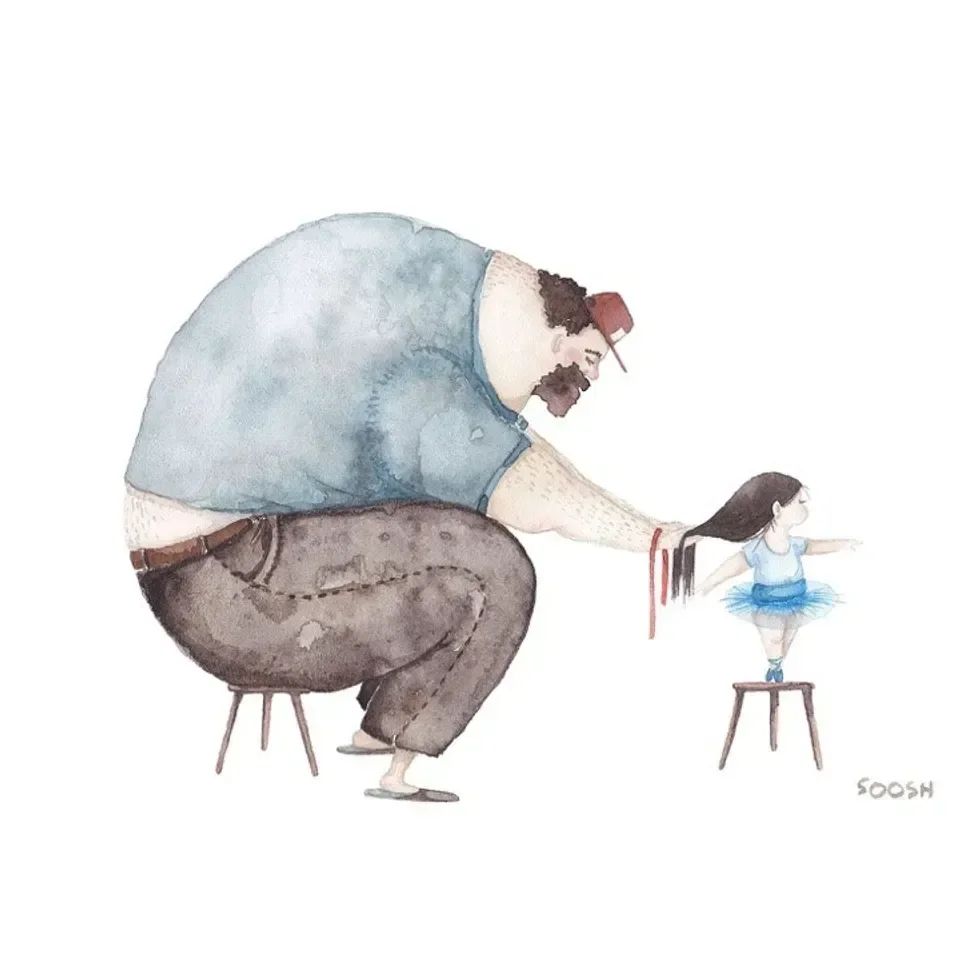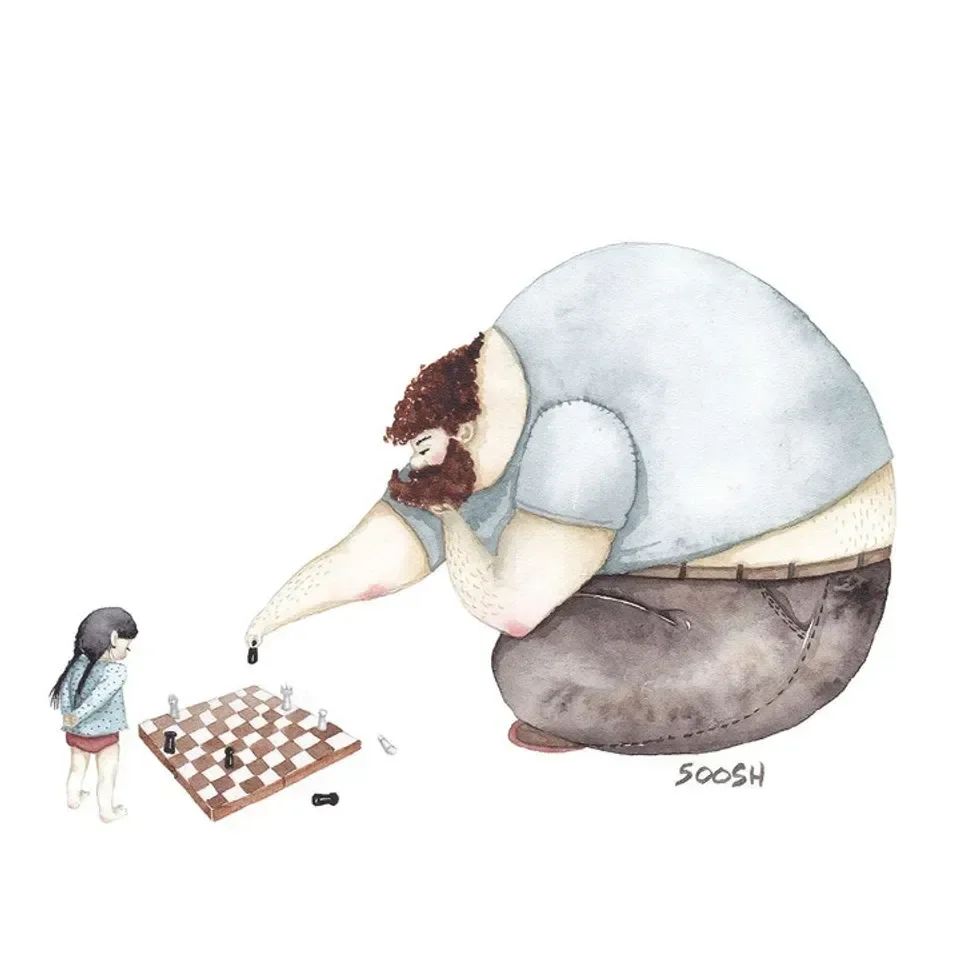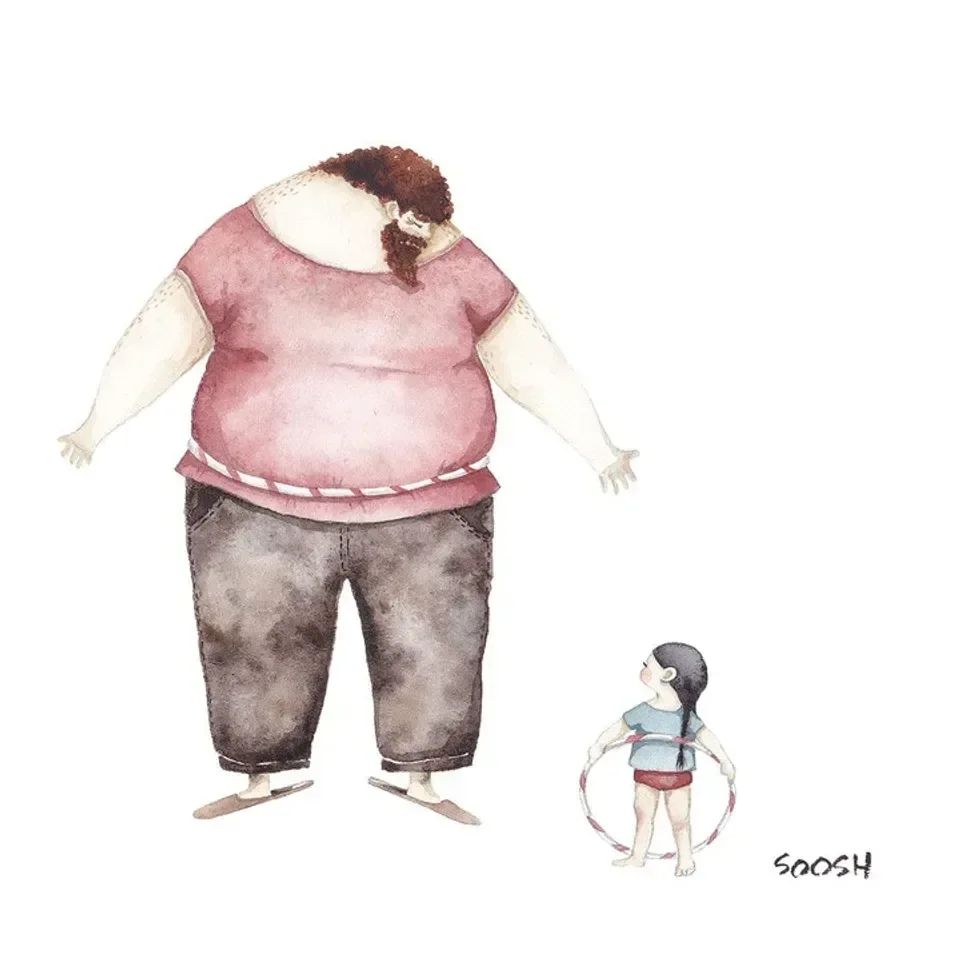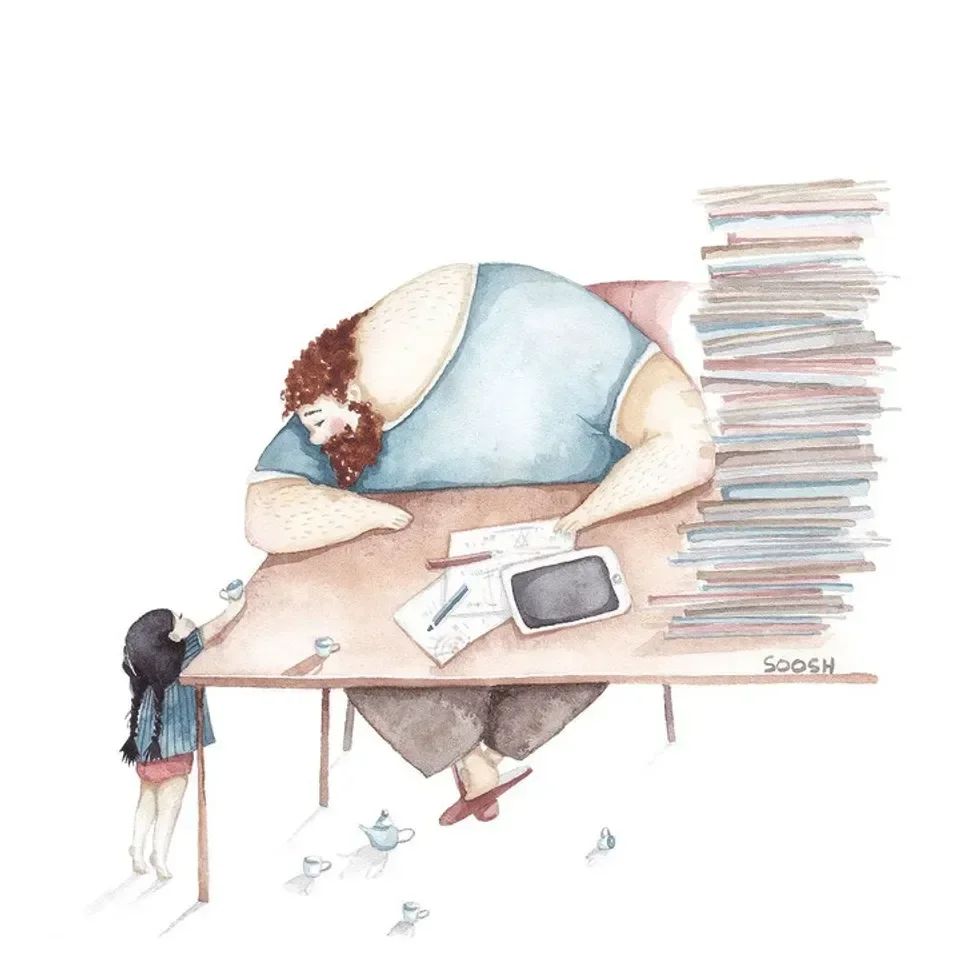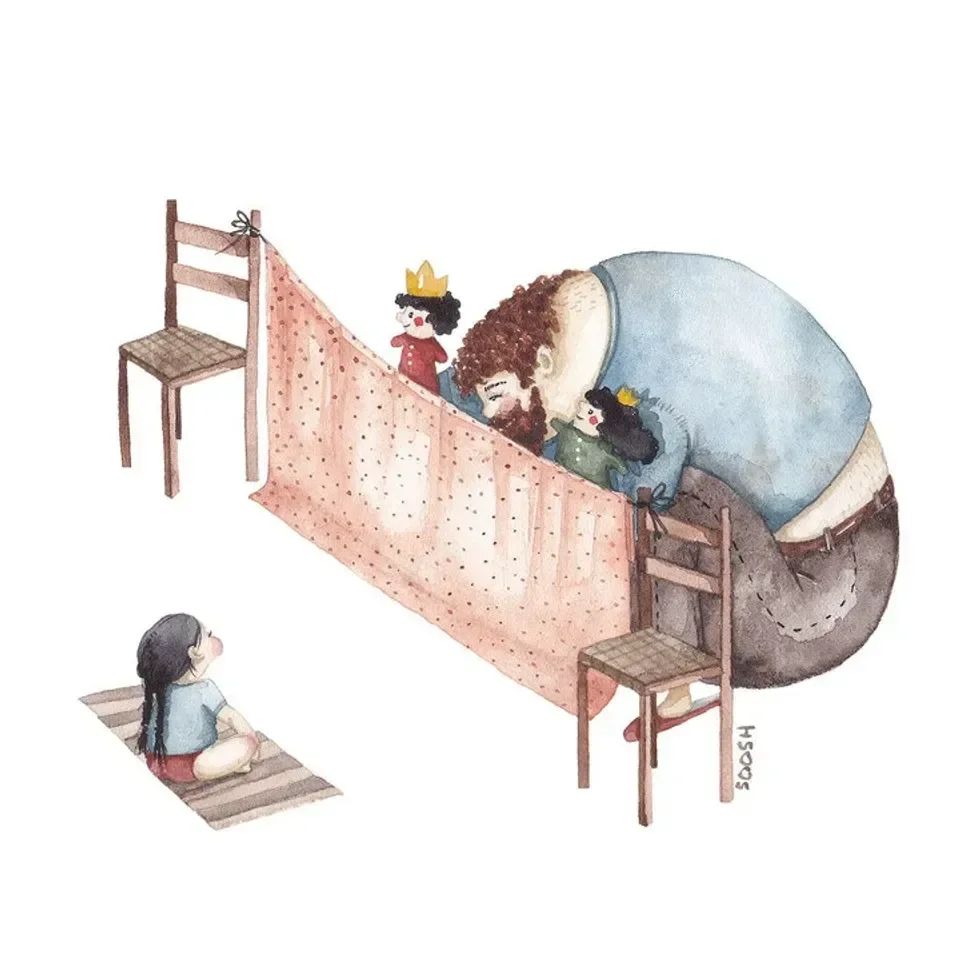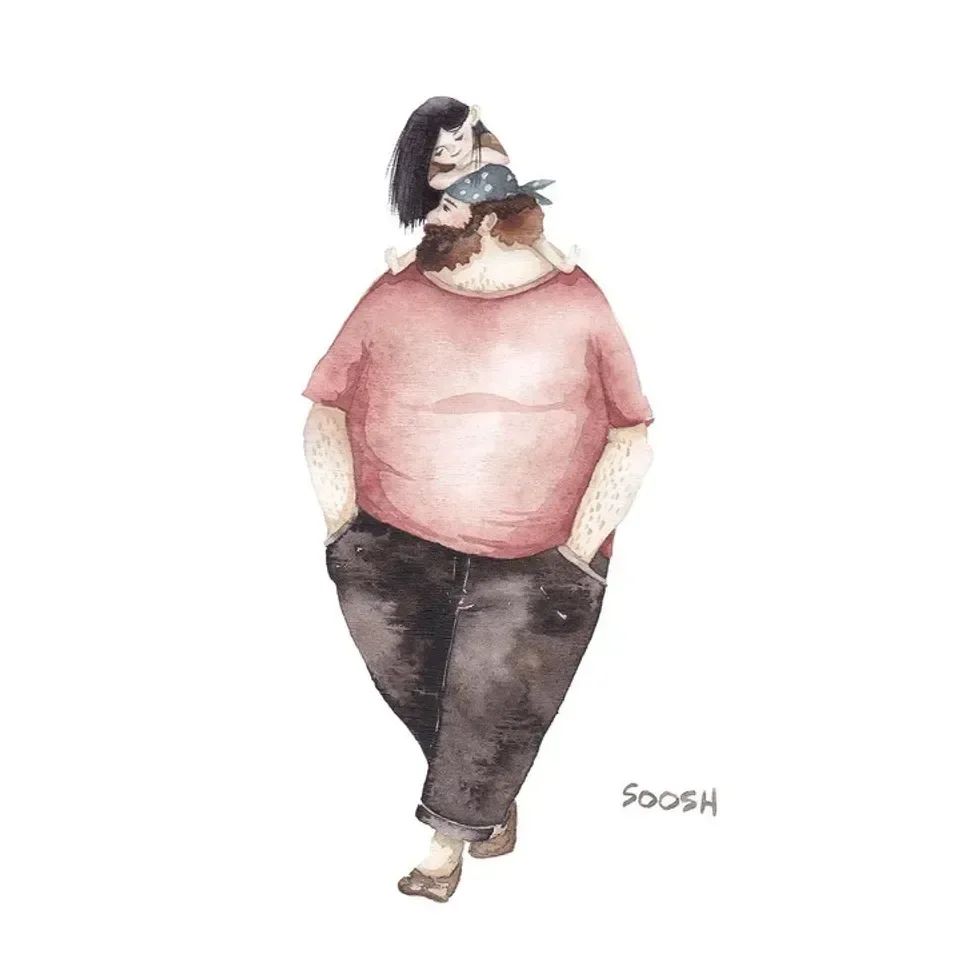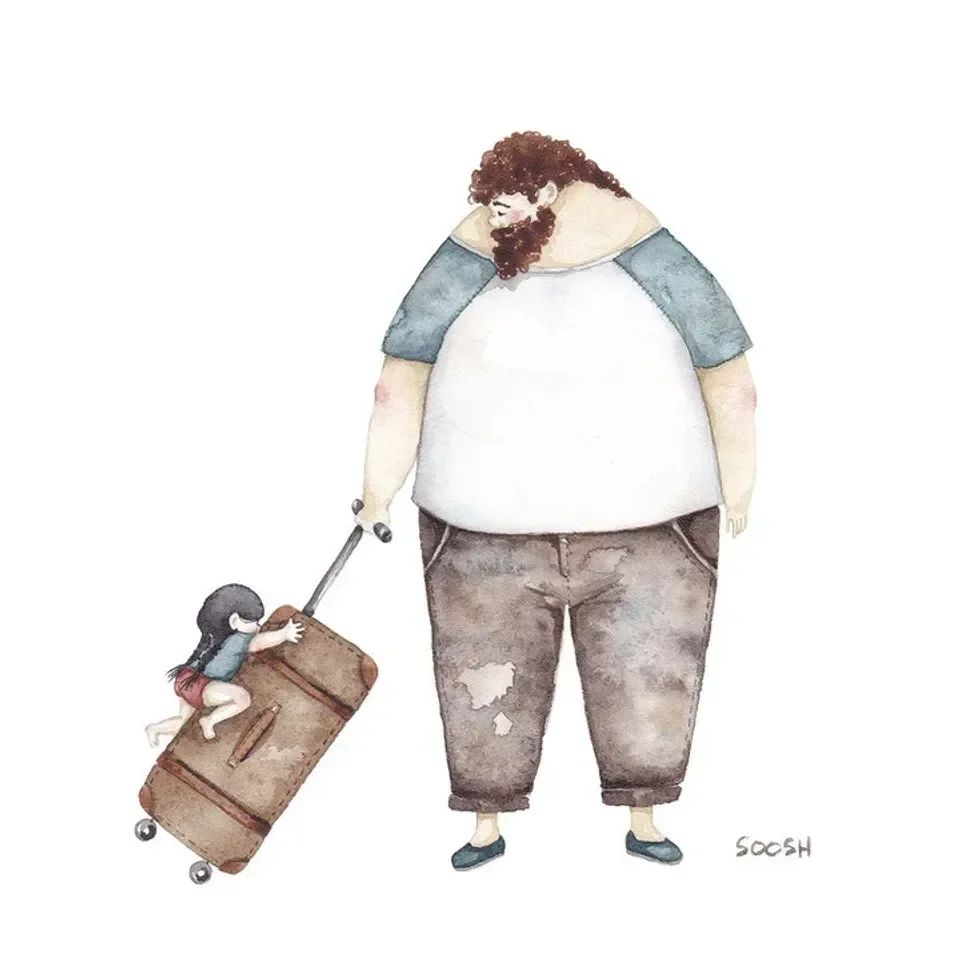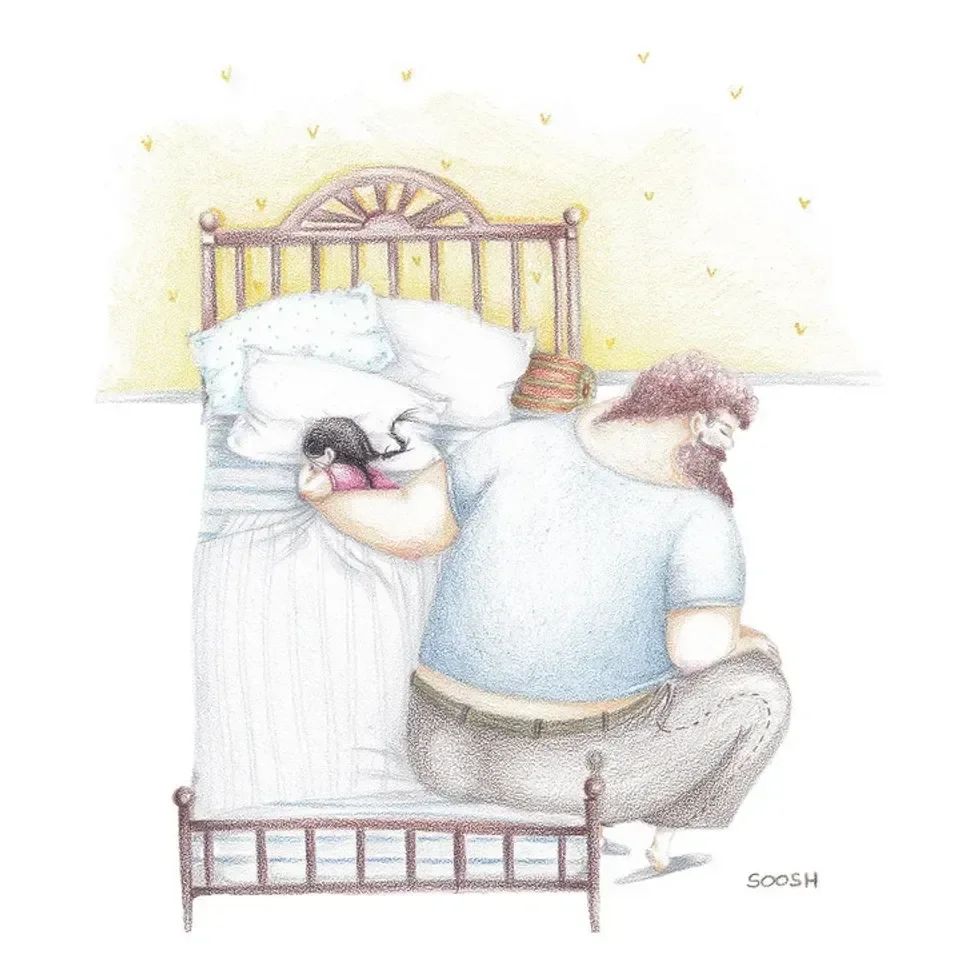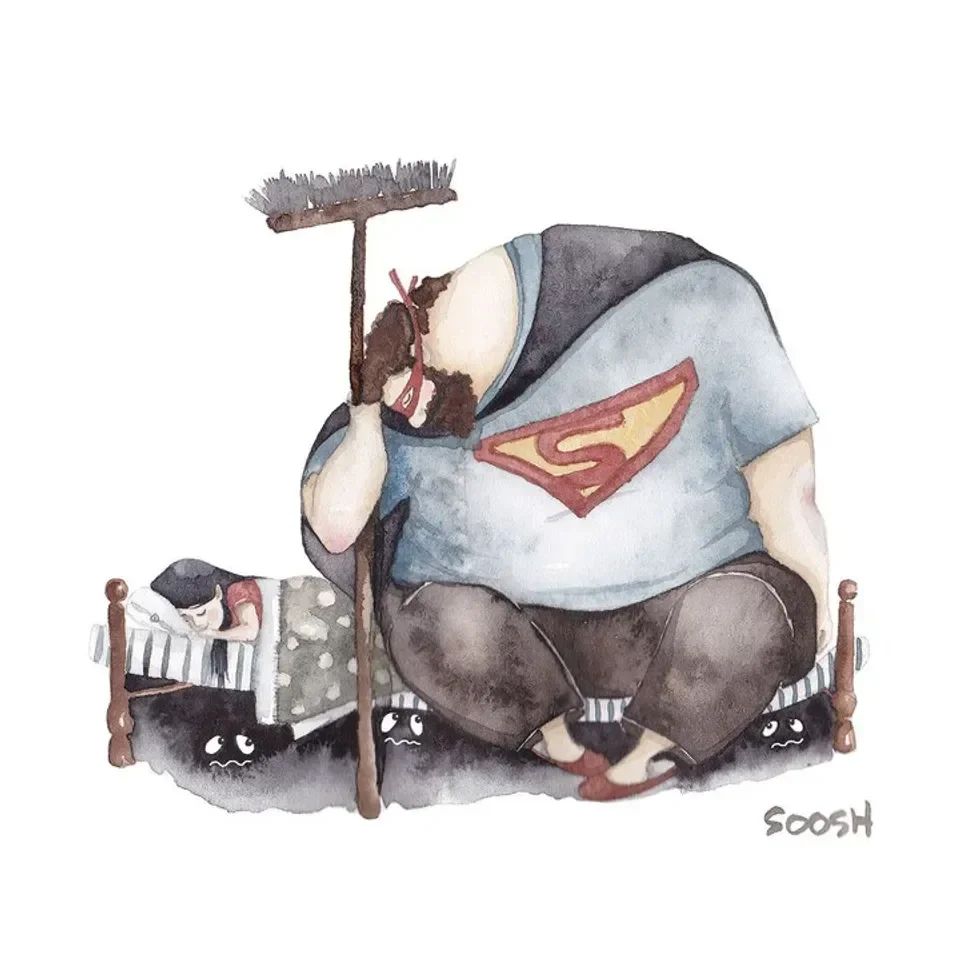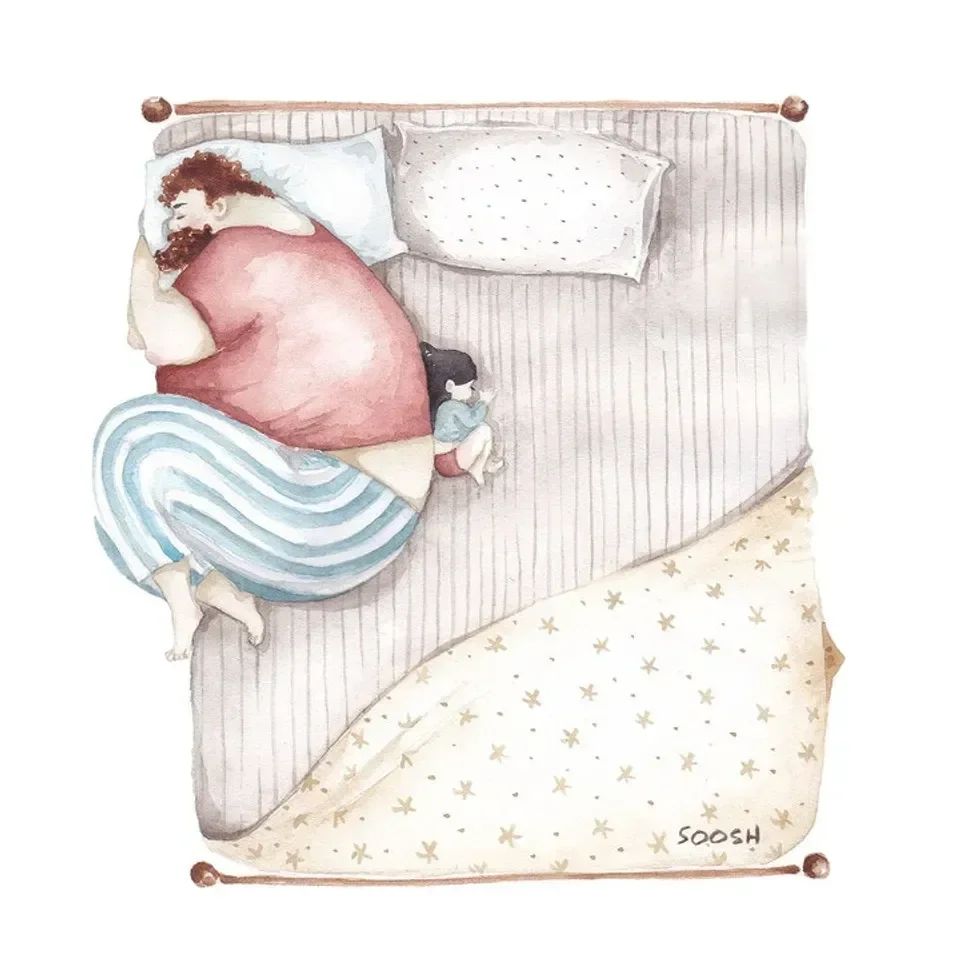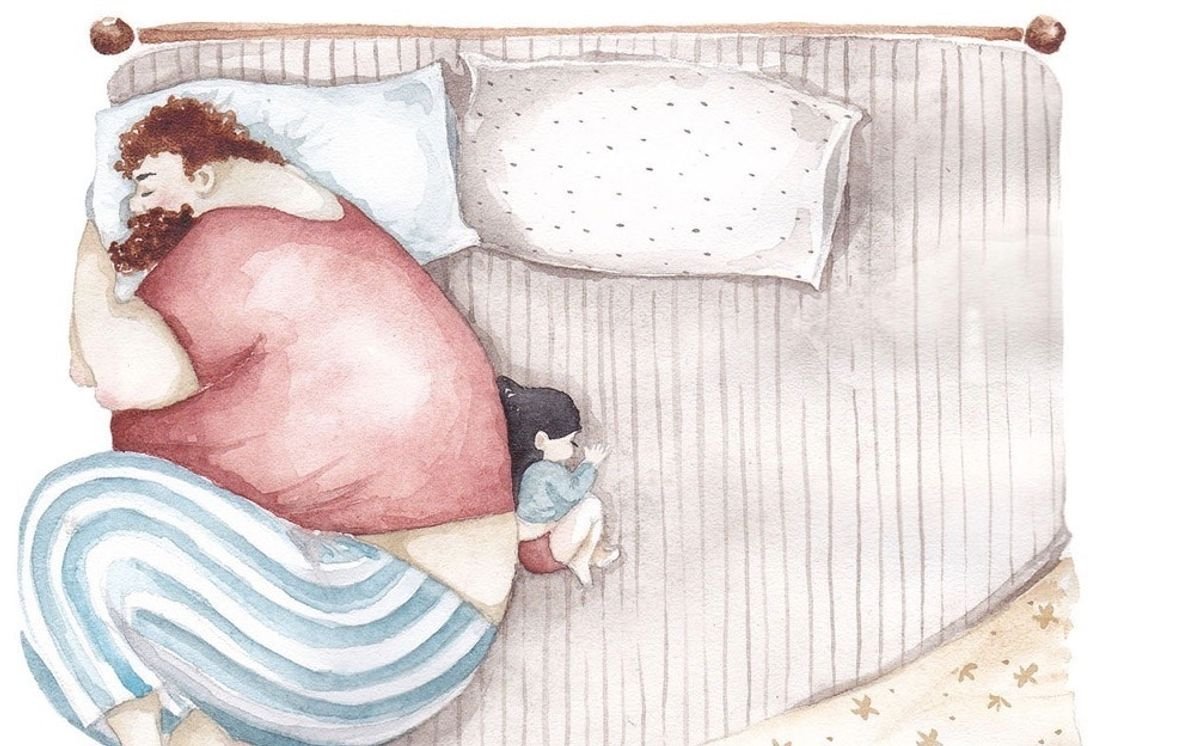
It’s hard to truly describe the amazing bond between dads and their daughters.
Being a dad is an amazing job no matter the gender of the tiny humans we’re raising. But there’s something unique about the bond between fathers and daughters. Most dads know what it’s like to struggle with braiding hair, but we also know that bonding time provides immense value to our daughters. In fact, studies have shown that women with actively involved fathers are more confident and more successful in school and business.
You know how a picture is worth a thousand words? I’ll just let these images sum up the daddy-daughter bond.
A 37-year-old Ukrainian artist affectionately known as Soosh, recently created some ridiculously heartwarming illustrations of the bond between a dad and his daughter, and put them on her Instagram feed. Sadly, her father wasn’t involved in her life when she was a kid. But she wants to be sure her 9-year-old son doesn’t follow in those footsteps.
“Part of the education for my kiddo who I want to grow up to be a good man is to understand what it’s like to be one,” Soosh told Upworthy.
There are so many different ways that fathers demonstrate their love for their little girls, and Soosh pretty much nails all of them.
From Pakistan to Tanzania, the most effective education solutions are community-led. Here’s how local leaders, in partnership with Malala Fund and supported by Pura, are mobilizing entire communities.
When asked to describe what Tanzania smells like, Grace Isekore closes her eyes and breathes in deep. For a moment, she’s somewhere else entirely. Tanzania is a rich tapestry of sights and scents, from the smell of sea mist that permeates the coastline to the earthy cardamom and cloves she cooks with in her kitchen. But when Grace emerges from her reverie, her answer is unexpected.
“Tanzania smells like peace,” she says, her eyes still closed. “I see a beautiful country where we are free to move, free to speak. And there is peace within the community.”
For Grace, that sense of peace isn’t just something she smells; it’s something she works toward every day. As a project coordinator with Pastoral Women’s Council (PWC), a women-led organization that empowers pastoralist communities in northern Tanzania, she has seen firsthand how girls flourish when they have the opportunity to attend school. Like scent, education not only connects girls to their own culture, but also helps broaden their horizons, realizing new possibilities for themselves and others. That transformation reshapes entire communities and ripples outward, with the potential to change countries and transform the world for the better.
Different scents, different approaches, and communities driving change
Spices in Tanzania. Captured by James Roh for Pura
For Grace and others around the world, education is freedom, as well as a pathway to a stronger community. Rooted in that shared belief, Pura, a home fragrance company, was inspired to build on their four-year partnership with Malala Fund to create something truly unique: a fragrance collection that connects people through scent to communities in Tanzania, Nigeria, Pakistan, and Brazil, where barriers to girls’ education are among the highest.
Using ingredients from each region, the new Pura x Malala Fund Collection uses scent to transport people to these regions directly. “Future in Bloom,” for example, invokes Pakistan’s lush valleys through notes of jasmine, cedarwood, and mango; while Tanzania’s fragrance, “Heart on Fire,” evokes the spirit and joyfulness of the girls who live there through cardamom, lemon, and green tea.
The new Collection honors the work Malala Fund does every day, partnering with locally-led organizations in these four countries to ensure every girl can access and complete 12 years of education. Each scent celebrates the joy, tenacity, and courage of the women and girls driving change on the ground, while also augmenting Pura’s annual grant to Malala Fund by donating eight percent of net revenue from the Pura x Malala Fund Collection to Malala Fund directly.
Just as each country’s scent is unique, so too are their needs related to education. But with support from Malala Fund and Pura, local leaders are coming up with creative ways to mobilize entire communities (parents, teachers, elders, and the students themselves, in their pursuit of solutions, understanding that educating girls helps everyone thrive. Here’s how their efforts are creating real, durable impact in Tanzania and Pakistan, and creating a ripple effect that changes the world for the better.
Parent-teacher associations help Maasai girls and their communities in Tanzania problem-solve
A girl’s school in Tanzania. Captured by James Roh for Pura
Northern Tanzania, Grace’s home, is home to pastoralist communities like the Maasai, a nomadic people who have moved with the seasons to nurture the land and care for their livestock for centuries. The nomadic nature of this lifestyle creates significant and unique barriers to girls’ education. Longstanding gender roles have enabled Maasai to survive in the harsh environment and have placed great value on both women and men. Over time, as nomadic life has been threatened by the privatization of land and stationary education models have been implemented, the reality of pastoralist livelihood has shifted and introduced new complexities. Now, the sheer distance to schools is both a practical challenge and one that often comes with danger from the landscape, predators, and potential exposure to assault along the journey. Girls shoulder the responsibility of household chores and there is often cultural pressure around early marriage – both leading to boys’ education being prioritized over girls’.
“There are very, very good [pastoralist] cultural practices, which are passed from generation to generation,” says Janet Kimori, an English teacher at Lekule Girls Secondary School in Longido, Tanzania. But when cultural practices act as educational barriers, “you have to sit down and look for where you are going to assist. As a school, as an individual, the school administration—all of us will chip in and know how we are going to deal with this problem.”
PWC works to ensure girls are able to exercise their right to an education while also preserving pastoralist culture. One successful approach, the organization found, has been the formation of Parent Teacher Associations (PTAs), created with help from Malala Fund. In PTA meetings, students, parents, teachers, elders, and government officials meet, discuss educational barriers, and come up with community-led solutions that preserve and honor their culture while advancing educational outcomes.
PTA meeting in Tanzania. Captured by James Roh for Pura
One recent PTA meeting highlights how these community-led solutions are often the most effective. At Lekule Girls Secondary School, the lack of fresh water forces girls to walk long distances to collect water for the school’s kitchen during the school day, and these long journeys not only disrupt class time but can leave girls vulnerable to sexual assault in isolated areas. Through facilitated discussion, PTA members landed on a solution: installing a borehole to pipe in fresh water to the school. Reliable access to water creates a better learning environment for the girls, but it also benefits the community at large, as local governments are then more likely to invest in health clinics and other community resources nearby.
With a solution in place, the PTA was then able to discuss ideas and map out a course of action. The women would raise money for the cost of the borehole, while the men would recruit workers to dig the hole and lay the pipe. Together, they would ask government officials to match their investment.
The benefits of PTA meetings within the pastoralist communities are undeniable. “The girls are talking and addressing issues in a confident way, and parents feel they are part of the resource team to solve challenges happening at school,” Grace says. One unexpected benefit: The larger cultural impact these PTA meetings have created. Thanks to the success of PTAs within pastoralist communities, the models are now being endorsed on a national level, and schools across Tanzania are starting to use them to solve problems in their own communities. When a community creates opportunities for girls to learn, everyone benefits.
Safe spaces in rural Pakistan help students and their parents connect, then drive change
Safe space for girls meeting in Pakistan. Captured by Insiya Syed.
A continent away in Pakistan, the country’s northernmost region of Gilgit-Baltistan seems like a land untouched by time. The region’s looming mountains, snow-capped peaks, lush valleys and crystalline lakes draw nature lovers and landscape photographers from around the world, but living among this kind of breathtaking scenery has its drawbacks. Schools in the region are few and far between, and the area’s harsh climate often makes roads inaccessible for travel. Poverty and gender-based discrimination are additional obstacles, making school even further out of reach, and girls are affected disproportionately. Going up against these barriers requires a persistent, quiet strength that’s found in the women who live there and reflected in Pakistan’s signature scent.
Saheli Circles are how local leaders in Gilgit-Baltistan are bridging the gap between girls and education. An Urdu term for “female friend,” Saheli Circles are after-school safe spaces where girls explore subjects like art and climate change, while also developing skills that help them manage emotions, set goals, and build positive relationships. Girls study in groups, visit the library, play sports, and tackle filmmaking and photography projects, all designed to develop self confidence and teach the girls how to advocate for issues that matter to them. But the work doesn’t stop there.
“What we’re trying to achieve here will only be impactful if it trickles down to the home environment and the school environment,” says Marvi Sumro, founder and program director of Innovate, Educate, and Inspire Pakistan (IEI), the local organization that developed the Saheli Circles model and partnered with Malala Fund in 2021 to make it a reality. Ever since, Saheli Circles have grown to involve teachers, elders, and parents to encourage relationship building that’s essential for young girls and adolescents. “Our spaces can give mothers and daughters an opportunity to interact a little differently—do an art activity, or have a cup of tea together, or some good conversation,” Marvi says.
The relationship building is what makes the biggest positive impact throughout the community. Recently, one Saheli Circle was able to bring together parents, teachers, and administrators to advocate for better education at their local school, and together they convinced the department of education to hire a science teacher. Another Saheli Circle organized a fund where members of the community can contribute monthly to pay for uniforms, books, and other school expenses for the girls in their village, eliminating those small, hidden costs that are often a barrier to education for many. A third Saheli Circle was able to produce a short film about how gender-based household chores can take away valuable study time from girls, leaving them at a disadvantage. “The girls put the film together and showed it to the mothers, and the response from the mothers was just beautiful,” Marvi says.
Girls smiling in Pakistan. Captured by Insiya Syed.
The education and relationship building that the girls receive in Saheli Circles connects them to larger opportunities and economic freedom that are not possible in their hometown. “For girls in Gilgit-Baltistan, education is extremely important because of the fact that we’re so far away from where the economy is, where the opportunity is. Education becomes this bridge for us, for our girls, to access all the opportunity and economy that exists in [larger cities].”
From rural Tanzania to remote Pakistan, local organizations prove every day that prioritizing girls’ education benefits everyone. Communities that lift up girls are able to secure resources like clean water and well-staffed schools, as well as build stronger relationships.
These outcomes are only possible because of the women and girls who work tirelessly in these regions to overcome barriers and drive progress. The Pura x Malala Fund Collection is a way to honor them, celebrate their achievements, and unite people the world over around a shared belief that education is freedom. Like scent, that belief can build, travel, and has the possibility to transform the world.
Experience the Pura x Malala Fund Collection here, and connect with the stories of real girls leading change across the globe.
A vacation to Disney World is still considered the gold standard by many when it comes to family getaways. It has everything from good food to thrill rides, childhood nostalgia, and more.
But all that joy and magic sometimes come at a cost. Not just the financial price tag, but also the hard work it takes to afford those tickets and arrange the trip—work that doesn’t necessarily end when you step foot inside the parks. One family learned this lesson the hard way, firsthand.
The Mouselets are three siblings who’ve teamed up, using their shared love of all things Disney, to run social media accounts and podcasts where they share their favorite tips and secrets about the parks.
Recently, they arranged to take their parents to Disney World, and the excitement was palpable:
Unfortunately, the work didn’t end there for their poor dad. In other clips shared by The Mouselets, he’s forced to whip out his laptop at lunch, tap away at his phone while waiting for a show to begin, and even take another urgent call while dressed in full Mike Wazowski garb, of Monsters, Inc. fame.
Their dad even brought an entire multi-monitor setup to their room at the Grand Floridian Resort to bang out a few spreadsheets (or something like that).
The siblings edited it all into a brilliant, horror movie–inspired supercut:
Even though they have well over a million followers on social media, The Mouselets could never have predicted how popular the video of their dad would become. To date, it’s received nearly five million views on TikTok and Instagram.
Overwhelmingly, people are showing respect for their dad’s hustle:
“Someone’s gotta pay for y’all’s vacation”
“Taking the call is what pays for those trips.”
“Disney doesn’t pay for its self”
“I respect this man. The family appreciates his hard work.”
In another post, The Mouselets clarified that they were the ones who arranged and paid for the trip, not their dad. Still, the video serves as a bittersweet reminder of what it must have taken to bring three kids to Disney World and instill in them a lifelong love—one that would later inspire them to start a business like The Mouselets.
Put another way, their dad knew he had work to do but simply couldn’t pass up the chance to spend time with his kids. So, like many parents, he decided to “do it all.”
“Work-life balance” and vacation, or time off, have become messy concepts
Gen Zers are pushing back hard against hustle culture, but a lot of modern companies still expect employees to go the extra mile, work well beyond 40 hours per week, and stay digitally connected even during personal and vacation time.
There’s something sad about watching Papa Mouselet miss out on what should be quality time, but apparently he’s not the only one. Commenters chimed in with their own “life goes on, even at Disney” moments:
“me taking my college exam while in line for guardians”
“i was in a meeting on the skyliner”
“I have a park photo from the ride of my husband taking a work call on Haunted Mansion. Dad had to pay for the next Disney trip somehow”
“Have done a full on Zoom on people mover”
“I had a job interview on the dumbo flying elephants”
“He’s not [alone], my husband does this too”
Disney magic is powerful stuff, but it doesn’t come out of nowhere. The hard work and planning it takes often go unseen and unnoticed. Other times, unfortunately, the work refuses to wait until you get home. But that doesn’t mean you can’t still have a great trip.
It all worked out for the whole family
As for Mr. Mouselet, viewers were relieved to know he did, in fact, have a wonderful vacation—once he’d handled his business, that is.
It’s one of the all-time classic “girl dad” problems: you’re out with your young daughter and she needs to “go potty.” Do you take her into the men’s room or the women’s room?
Most guys would go to the men’s room without a second thought. But one dad has people wondering if there might be a better way.
Alex Vigilante coaches high-achieving men to “live a more aligned life, be more present, [and be] more whole.” He also shares content about fatherhood and his own life as a dad.
Question goes viral
Recently, Vigilante posed a question to fellow girl dads on Instagram: “When you’re out in public and your daughter has to go to the bathroom, which restroom do you take her to if there’s not a gender-neutral restroom?”
He took his viewers by surprise with his answer: “Today, I took her into the women’s restroom. … I think that is the better route than taking her to the male restroom.”
In the caption to his post, Vigilante outlined his reasoning. One point in particular was especially thought-provoking.
“I would rather feel awkward or uncomfortable than having my daughter feel uncomfortable,” he wrote, adding that he didn’t feel it was appropriate to have his young daughter around grown men using the facilities. Vigilante also noted that he prefers to go in when no women are inside and will openly announce himself so as not to startle anyone.
The now-viral Reel drew more than six million views, and needless to say, a passionate discussion ensued.
First came the dads who vehemently disagreed and said they would never set foot inside a women’s restroom, even with a toddler girl in tow.
“Men’s restroom, respectfully. Handicap stall. Clorox wipes and Lysol travel size spray in hand. The potential for a misunderstanding isn’t one I’m willing to entertain.”
“Imagine two or three dads in the women’s restroom…no bro, just use the dudes’ and go in the stall with her if she’s a little one, if she’s older, find a better solution. Don’t go in the girls restroom.”
“The world doesn’t revolve around me or my daughter, & it’s not fair for an innocent adult female to walk into me in her safe place.”
Then moms and women at large began to chime in. Their collective response was surprising and heartwarming.
Though not a monolith, of course, a majority of women who responded to Vigilante’s video were strongly in favor of dads bringing their daughters into the women’s room. Many recalled being young and feeling intimidated by the presence of grown men in the men’s room, even with their fathers there.
“Please use the women’s restroom we really don’t mind. We were once little girls who needed protected too.”
“As a woman I support dads bringing their daughters to the woman’s room.”
“Absolutely! I have been in places before and if I see a man bringing his daughter towards the restroom I always offer to announce it in the bathroom and I stand at the entry door and keep everyone informed that comes in until they are finished. It takes a village!”
“I’d rather feel a little uncomfortable and know a child is safe in the women’s restroom than have a little girl in the men’s room where there’s urinals and what not.”
Honest discussion changed the minds of at least a few dads
Several admitted they always “hated” bringing their daughters into the men’s room but didn’t see another way. After the warm response from moms, they were inspired to give it a try.
“I’ve literally never considered this. Dude, thank you for bringing up. My first reaction was that I would never want to make other women afraid or uncomfortable if I was in there with my baby girl. And then I read the comments. WOW. Women are incredible. Sad that we have to even worry about this, but grateful to know my daughter has other women who freely have her back without even knowing her.”
However, the opposing view is also valid, making this a complex issue. It could even become a legal one. While it’s not generally considered illegal for a man to enter a women’s restroom, the situation can become murky if someone feels threatened and raises a complaint.
For his part, Vigilante said he’s never had an issue taking his daughter to the women’s room, but would happily leave if he made anyone uncomfortable.
A better solution?
It seems there should be a better solution by now, and fortunately, there has been incremental progress in this area.
For starters, more men’s rooms have changing tables than in years past. This not only allows dads with babies to avoid going into the women’s room to change them, but also helps rebalance the distribution of childcare labor, which has historically been skewed toward moms.
There’s also a push to “ditch the gap” in public restroom stalls, offering greater privacy for all.
There’s even been a steep rise in the availability of family or gender-neutral bathrooms in public spaces, which helps everyone. In some places, they’re required by law.
There are other solutions as well. For girls old enough to go in alone, many dads choose to stand outside the bathroom, sometimes with the door propped open so they can hear what’s going on and talk to their daughter for comfort.
In the end, it’s an individual choice that requires dads to be mindful of others, as well as their daughter’s comfort level.
“My daughter’s safety comes first…so I feel empowered to keep doing this,” Vigilante wrote in the comments. “I respect the opinion of parent who think otherwise, as they just want their kids to be safe as well.”
The holidays are supposed to be a time for enjoying special moments with family, but often they become a source of stress. Traveling, navigating familial relationships and tensions, talking politics at the dinner table, and handling the all-encompassing issue of “presents” can wear down even the most patient and even-keeled person. It can be especially challenging for parents with young kids who are expected to travel long distances in the name of “family togetherness.”
A TikTok video posted by @carrerasfam is going viral, with over 300,000 views, because so many millennial parents can relate to the frustration of grandparents having unrealistic expectations related to visiting with the kids.
In the satirical video, a husband stages a conversation with his “practically retired” baby boomer dad, in which he explains politely but firmly that he’s not taking his 3 young kids on a 400-mile drive to their house for the holidays.
Carerras Fam is a popular TikTok page about “all things postpartum and mamahood.” Together, the mom and dad share funny skits and slices of their life with three little ones.
The husband opens the conversation with his dad by explaining all the inconveniences of taking 3 young kids on a long road trip. “I know you want us to drive down for the holidays, but it’s kinda ridiculous that you want me to pack my 3 kids with their portable beds with my clothes, their clothes, the formula, everything that goes on with raising 3 kids and having them feel comfortable. Drive down for over four hours just so that we could spend some time in your house?” the husband says while absurdist music plays in the background.
A family prepares for a road trip. Photo credit: Canva
It’s obviously inconvenient for the couple to pack up their kids and drive 4 hours, but it’s also unsafe because the house is not baby-proof. “I’m gonna have to run around, make sure that they don’t break any of your stuff, and which you will ‘take care of them,’” the husband continues using sarcastic air quotes. Most parents eventually realize that visiting with the kids does not equate to getting help with them — no, it means chasing them around frantically yourself until it’s time to leave.
The dad brings up another great point: His parents are in good health, so why don’t they drive to their house? “You could visit—you don’t have little kids,” the dad continues. “You don’t have anything going on. Why is it that every time I have to make the effort for you, yet you can’t do the most basic thing for me?”
It’s clear from the phone call that the dad understands that traveling with the kids and staying in a house that isn’t correctly set up for young kids will make the holiday a struggle. Instead of making memories, they’ll most likely be running around bent over trying to save their kids from breaking something or hanging out at Target buying electrical socket plugs and a bottle brush because they left theirs at home. What’s especially frustrating is the pressure and expectations. Parents are often guilted for not wanting to pack up the kids and travel, even though it’s not hard to see why they hate it so much.
The video struck a chord with many millennial parents. Nearly 500,000 people watched the clip, with hundreds and hundreds pouring in to vent their own similar frustrations.
“First holiday with a kid… parents are confused why I won’t drive 9 hours with a 3mnth old for Christmas,” too_many_catz writes.
“The ‘not baby proofed’ part hit my soullllllll. It’s so stressful having to chase your kids around and ask to close doors, move pictures, block stairs, etc. And nobody takes you seriously!” OhHeyItsIndy added.
It’s also expensive for young families to travel. “Add to it they want us to spend money on gas, airfare, etc. when we live paycheck to paycheck and rent while they own homes and live comfortably off a pension,” another user wrote.
“My mom asked me to drive 13 hours with our 2 month old…she doesn’t work and has flight points,” one mom added.
This one hit hard: “They always act like you’re asking the world of them, yet they will willingly go on any other vacation that they choose,” Mackenzie Byrne wrote.
“They can never make the trip for us but they can make them trips to Europe and cruises to the Caribbean,” another user noted.
TX Travel Chick may have hit the nail on the head with her explanation for why boomer parents expect their children to road trip it to their house for the holidays. “Because we are used to following their orders!!! REVOLT,” she wrote.
Ultimately, it would be interesting to learn why boomer parents want to inconvenience their kids when it would be much easier for them to take a trip to see them, especially if they can afford a hotel. One wonders if they are being entitled or if they’ve forgotten how hard it is to travel with young kids. In some cases, it’s a little more complicated — many baby boomer grandparents are still working and have less time and resources than previous generations did to help with the kids.
“Yeah, not this time,” the dad sums up in the video. “I think for the holidays I’m just gonna stay in and relax.”
It’s a hilarious and relatable video, but ultimately, it’s a skit. The power of boomer-grandparent guilt remains undefeated in many households, so the smart money says the Carreras family sucked it up and traveled for the holidays despite their annoyance. Here’s hoping that together, we can eventually break the generational curse when our kids become parents one day.
This article originally appeared last year. It has been updated.
Present dads have an overwhelmingly positive impact on their kids’ lives—and the data supports it.
A 2026 study published in Early Childhood Research Quarterly found that father involvement is “closely and positively linked to children’s social-emotional development, playing a crucial role in fostering emotional well-being, social competence, and emotion regulation in early childhood.”
The study goes on to explain that this happens through direct engagement and interaction between dads and their kids, including play, teaching, and shared experiences. Even the smallest moments together can have a big impact, and one dad shared how he fosters that development through language.
A dad explains his role in developing emotional resilience
Reddit user Medium-Put-4976 opened up to fellow fathers on the platform about how he’s helping build his kids’ emotional resilience. He says he has a short list of impactful phrases he hopes to instill in them.
He writes, “10 things to say to your kids at least 100 times before a time/event when they’ll need to hear it. (And mean it. Clearly saying it, but not living it, is counterproductive).”
The post continues, explaining why repetition matters.
“I’d like to think in the right moment I’d say the right thing, but on the fairly decent chance I don’t, I will make sure my kids have heard these things enough before the time they really need it,” he adds.
He also shares the impact he hopes it will have on his kids.
“For the same reasons that routines make kids feel safe, being a predictable parent is a stabilizer,” he writes. “Start now to develop your own mouth-muscle-memory.”
He concludes the post with wisdom about his role as a father and about being someone his kids can feel secure with.
“When this stuff falls out of my mouth easily, and frequently, I’m more likely to get it right when it matters most,” he writes. “And if not, they’ll at least know where I stand, not just in a crisis.”
Here are the phrases he shared with fellow dads, which he hopes will inspire them in their fatherhood journey:
“I’m so glad you told me.”
“I love you.” and “I love you, no matter what.”
“I’m sorry.”
“I was wrong. How can I make it right?”
“I don’t know. Let’s figure it out together.”
“I’m ready to listen.”
“Do you want me to help, or just listen?”
“You can always come home.”
“I have your back.”
“The world needs your __. (Reference a specific attribute and be prepared to back it up with examples of how your kid has it. Eg: ideas, enthusiasm, energy, art, voice, grit, style, friendship, kindness.. whatever fits)”
Fellow dads share more impactful phrases
The inspirational post ends with a callout to dads to share the important parenting phrases they say to their kids. Here are six fathers and their go-to phrases:
Dad #1:
“I recently saw a video that had some good ones. Pasting details below:
Your feelings make sense. I was wrong. I love watching you figure things out. Tell me more about that. That took courage. You can change your mind.” – GrrATeam81
Dad #2:
“I have so much fun hanging out with you. I’m grateful for the person you are and the young man you’re growing up to be. I’m proud of you for doing the right thing even though it was difficult. Everyone makes mistakes, has accidents, and makes bad decisions. Learn from the consequences; we’ll get through it. What do you think about _?
Also, I’ve always told my son ‘I promise that you’ll never regret telling me about anything.’ My parents said I could talk to them but they’d get mad or hold it against me later. When my son tells me about something he did wrong upfront, I thank him for being honest and tell him that taking responsibility voluntarily and knowing when to ask for help shows maturity and good judgment.” – CertainMedicine757
Dad #3:
“This is a great list. I learned two other ones recently: ‘I’m so glad you’re here’ (i.e. their presence is worthwhile) and ‘I love watching you figure things out'(the process is what I love, not results).” – Friendly-Land-1873
Dad #4:
“‘We are problem solvers’ is something I’ve tried to engrain in my kids.” – slidingscrapes
Dad #5:
“I run a slightly more Star Wars flavor on 2B. ‘I love you more than anything you could ever do wrong.’” – jeconti
Dad #6:
“I got this from a video, I wrote it in my notes and say it to my kid often when dropping her off at school. She loves it and even responds adding to it lol.
It’s okay to not know it all. It’s okay to make mistakes. It’s okay to be yourself. It’s okay to ask for help. It’s okay to start over. It’s okay to say no. It’s okay to cry. It’s okay to feel upset.
And recently added this to my notes and have started saying this to her when she’s working on something unfamiliar (‘difficult’):
This feeling means your brain is growing. It’s okay that this is hard, hard is how we all learn. Stay with it. I believe in you and I’m right here.” – factsonlynomisinfo
There are a lot of challenging things about being a parent; take your pick. The sleep deprivation, the overwhelming responsibility, the lack of free time. But truly, one of the hardest parts of being a parent is never being sure whether you’re doing a good job or totally bombing it. If you’re conscientious enough to even wonder if you’re a good parent, you probably are, but parenting entails a million little choices and interactions, and there’s always a lingering voice in your head saying, “What if you’re really screwing this whole thing up?”
Reassurance and encouragement are always appreciated by parents, but not always received, which is why a note from one camping dad to another has people celebrating the kindness of anonymous strangers.
“You are killing it as a dad.”
Someone on Yosemite Reddit thread shared a photo of a handwritten note with the caption, “To the man who left this thoughtful note on my windshield at Lower Pines Campground this weekend, I extend my heartfelt gratitude; your acknowledgment of my efforts to be a good father means a great deal to me.”
I camped in the spot behind you last night. Let me just say, you are killing it as a dad. First off, I watched your wife guide you in as you backed up your trailer and nailed it on the first try without any yelling. Then your kids unloaded from the truck and were mild-mannered and well behaved. You told stories around the campfire and I had the pleasure of listening to the sounds of giggles and laughter.
From one dad to another, you are killing it. Keep it up.
P.S. Whatever you cooked for dinner smelled delicious!”
How often do we share these thoughts with strangers, even if we have them? And who wouldn’t love to get a surprise bit of praise with specific examples of things we did right?
Everyone needs to hear a compliment once in a while.
So many people found the note to be a breath of fresh air and a good reminder to compliment people when we feel the urge:
“That would make any daddy’s eyes water.”
“It’s always nice, as a guy, to get a compliment.”
“I complimented a guy’s glasses at work (I’m also a guy, and btw they were really cool glasses, I wasn’t just being nice) and now he keeps trying to tell me where he got his glasses and how I should get some. But I’m just having to be polite because I already have glasses and I’m not in the market. I finally had to tell him I’m not going to buy them lmao I just like them on him.
Made me feel like that’s the first compliment he’s had in years because he can’t stop talking about it. Also I mainly liked the glasses because I think he’s cute but he really thinks it’s just the glasses haha jokes on him that cute bastard.””I was in the store with my wife and one of our ‘adopted nephews’ yesterday (we’re close friends with his parents and we’ve known him and his brother since they were newborns and 2yo, respectively). A woman came up to me at checkout while my wife was running out to the car and said ‘I’m not sure what your family relationship is here, but I just have to tell you how nice and refreshing it is to hear all the laughter and joy from the 3 of you. You both seem like such a good influence on him and it warms my heart.’ It’s such a small thing but as a dude, I can’t remember the last time someone gave me a compliment in public and it made my freaking day.”
“10/10 letter. The and not yelling part gave me a good chuckle lol.”
“We need so much more of men getting such heartfelt and sincere compliments. Thanks for sharing. ❤️”
“I’ve never considered leaving a note, but when I see a harmonious family with good parenting, it’s healing for me. My childhood was awful.”
“Such an awesome compliment! Even though I don’t have children myself, I like to remind my friends too that they’re doing great & it brings them happy tears.”
“This made me cry. I love that you are getting your ‘flowers.’ My dad sucked, I’m so glad you are one of the good ones.”
“This made me cry too. It’s so hard to be a human. Let alone a parent. Getting a good job sticker every now and then really means a lot these days.”
“I’m a big bearded guy and I would cry if I got this note. More people like this, please.”
The best part of this story is that no one knows who the dad who wrote the note is, not even the dad who shared it. It wasn’t written for clout or notoriety, it wasn’t to get attention or make himself look good. No name or signature, just an anonymous act of kindness to uplift a stranger whether he needed it or not.
We all need to hear or read kind things said about us, and sometimes it means even more coming from an anonymous stranger who has nothing to gain by sharing. A good reminder to share it when you feel it—you never know how many people you may move and inspire.
This article originally appeared two years ago. It has been updated.
When Stephen Spencer got his PhD in music theory and composition, he likely never imagined how he’d one day use that training to propel himself to viral fame. The composer and songwriter has always enjoyed turning everyday things into little musical ditties, or even full songs. But when he became a dad to a precocious…
When Stephen Spencer got his PhD in music theory and composition, he likely never imagined how he’d one day use that training to propel himself to viral fame.
The composer and songwriter has always enjoyed turning everyday things into little musical ditties, or even full songs. But when he became a dad to a precocious and creative daughter, he suddenly found himself with more inspiration than he knew what to do with.
Spencer began paying close attention when his daughter’s stories became longer and more elaborate. “She started giving me these stories—real narratives that had a beginning, middle and end combined with toddler logic and grammar—they just sounded like songs to me,” he tells Muse.
At first, he thought he’d record a few as a fun experiment to share with friends and family—sort of a musical photo album. But almost as soon as he began posting the songs on Instagram, they went far more viral than he ever could have imagined.
Spencer currently has more than 300,000 followers, even though his first “toddler songs” clip was uploaded only a few months ago.
The effortless creativity of toddlers is a joy to experience. Photo credit: Canva
The first song goes like this:
“There was a little woman/Who liked wigglin’ so much (she liked wigglin’, she just really liked wigglin’)/Her mom said/Her mommy said ‘you can’t’/So she goed to her room/And she wiggled again…”
Cute, right? Yes, it’s all very adorable—until you actually take the time to listen to Spencer’s song. Then you’ll be blown away.
His voice. The production value. The arrangement. It’s all top-notch. Frankly, the songs—which commenters have dubbed “toddler yacht rock” or “tot rock”—are far better than they have any right to be.
It’s no wonder that the very first clip received nearly three million views on Instagram
And just a week or so later, Spencer was back with another banger:
“There was a purple bear princess/She was a grown up dog/She was a grown up purple bear princess dog/(What was her name?)/Uh ‘Blossom’/ (That’s a nice name)/Actually it’s ‘Crudda’”
It’s beautiful lyricism, and all parents of toddlers will relate to the hazy logic, made-up words, and impeccable improvisational skills. The fact that Spencer can turn them into genuine hits is incredible.
Parents and their kids—heck, anyone with ears—can’t stop listening to Spencer’s tunes on repeat
“Phil Collins could have co-produced this one,” one commenter wrote.
“I may have listened to this 948572 times,” added another.
But probably the thing that’s really sticking with viewers is the amazing, unspoken bond between dad and daughter hidden in the lyrics.
“I’m imagining how happy your daughter will be once she’s older, maybe a parent herself, and revisits these videos,” someone wrote under a recent video. “You’re an amazing musical talent & a even better dad.”
In fact, Spencer says that the pure, unfiltered, joyful creativity that pours effortlessly out of his daughter has inspired both him and his music students.
“I think that children are the perfect model for how we should create as adults. There’s this unfiltered joy. You’re in the sandbox playing and not worrying about how things should be judged or appraised. … And yeah, it has inspired me as a creator. It’s also inspired me as an educator,” he says, adding that he hopes he can teach his students to follow the threads of their own joy and curiosity, the way his daughter does.
For now, Spencer has a few songs up on Spotify and potentially a handful of music videos in the works. Meanwhile, he and his daughter are still churning out new songs and will continue to do so as long as it brings them both happiness.
Watching kids grow up is one of the great honors of parenthood, but it comes with many bittersweet moments. For one man, it was letting go of a nine-year-long bedtime routine he had created with his preteen son. Redditor YoTeach68 shared his gut-wrenching and all-too-familiar parenting story with his fellow dads. He explained that he…
Watching kids grow up is one of the great honors of parenthood, but it comes with many bittersweet moments.
For one man, it was letting go of a nine-year-long bedtime routine he had created with his preteen son. Redditor YoTeach68 shared his gut-wrenching and all-too-familiar parenting story with his fellow dads.
He explained that he was a divorced dad with 50/50 custody. One way he made the most of his time with his son was by continuing a cherished bedtime routine they had done since his son was just two years old.
“We developed a whole bedtime routine that included me reading aloud to him, then talking about our day (highs and lows, that kind of thing), then me singing the same three short songs to him (songs that I learned at a summer camp when I was a kid, and the camp where he currently goes) while rubbing his back,” he shared.
As a single dad, he acknowledged that some nights were harder than others. He also knew things wouldn’t be this way forever, adding, “Obviously I couldn’t be singing to him and rubbing his back his whole life.”
After getting advice from fellow dads on when it would be appropriate to cut it off, the consensus was to let his son decide.
Parent of pre-teen/ late grade school aged kids. light up every time your kid walks into the room. This is going to teach them that attention is not earned, it is just part of being in loving, caring relationship. And that attention is going to be returned back to you when they turn into a teenager. Because the number one issue parents of teams report to me is the indifference of their teenager toward them. Follow for more tips on how to have a better relationship with your kids. #parentsofteens#teeangers#raisinggoodhumans#raisegoodkids#respectfulparenting#discipline#teachrespect
Unfortunately, when the time finally came, he shared how he knew it was time.
“He’s 11 now, and over the past two weeks or so he’s been telling me each night that he was just going to go to bed after giving me a quick hug and that I didn’t need to read to him or anything,” he explained.
Sensing the change, he decided to talk to his son about it.
“I finally sat him down and asked him if he felt he was outgrowing the bedtime routine, and he said yes. I told him how much the bedtime routine had meant to me, because I have no memories of my own parents putting me to bed (I do have memories of a cassette player in my bed that read books aloud). I told him I hoped it had meant something to him. I asked if he would indulge me and let me put him to bed one last time, and he obliged.”
The two then did their final bedtime routine together.
“Last night we went through the routine one last time (and I even pulled out one of his favorite picture books from when he was about 5). We talked about our day. I sang the songs. I rubbed his back. Then I kissed him on the cheek, told him I would cherish the memories of putting him to bed the last nine years, turned off his light, and closed his door behind me).”
Many dads shared their emotional responses to the story:
“Welp I’m f*cking crying on the toilet as my wife and my son nap lol.”
“❤️ that was lovely. My daughter is 5 and we put her to bed with a routine every night. Sometimes it’s fun and lovely and sometimes it’s a struggle. And sometimes it’s both. And part of me is looking forward to her doing to bed herself and part of me knows I’ll miss it.”
“I’ve been thinking about this a lot with my boys lately. They’re still young, and still love the bed time routine with me and their mum. But I’m already getting emotional over the idea that one day, like you, I’ll have to do it one last time. Treasure the memories forever, as I’m sure you will. I don’t really know what else to say, but…yeah, this made me feel things even more. Kudos.”
“Lying in bed now with my snoring 4 year old, after doing our bedtime routine and this post hit hard. Giving him a big hug and kiss before I leave as always but I’m going to do it more mindfully. Hopefully he still wants me to do this until he’s 11 too. You are a great dad.”
“Damn, f*cking onions.”
A therapist explains how dads can cope
Hillary Pilotto, therapist and founder of Better Balance Counseling, Ltd., told Upworthy that this transition is a normal (albeit painful) experience that many parents face.
“At 11, kids are right in the middle of the individuation process; developmentally, they are supposed to be pulling away,” she explained. “Wanting more independence, more privacy, more of their own identify separate from mom and dad. That’s not rejection. That’s healthy.”
And this may bring some relief: it’s actually a sign of good parenting.
“A child who feels secure enough in their attachment to say ‘I’m ready to do this on my own’ is actually a sign that the bedtime routine worked,” she added.
While these may be “good” things, Pilotto acknowledged that none of that makes it easier for the parent.
“There’s a grief in these transitions that doesn’t get talked about enough,” she shared. “It is not a dramatic loss; no one died, nothing went wrong, but something real is ending and it’s okay to feel sad about that. I tell parents: you’re allowed to mourn the little kid even while you’re proud of the one standing in front of you.”
She recommended that other parents take notes from the dad who shared his story if they are going through a similar transition.
“The best thing a parent can do in these moments is what the dad did; honor it. Name it,” she said. “Show your kid that transitions matter and that it’s okay to feel two things at once. That’s a lesson that will stay with them long after the bedtime routine is gone.”
About a decade ago, the first classes for dads who wanted to learn to braid their daughters’ hair began to pop up in the mainstream. Traditionally, in many households, moms have been the default hair-doers. After all, they’re the experts with a lifetime of experience styling and braiding their own hair or practicing on their friends.
But this setup was problematic for a few reasons. For starters, as the modern generation of dads began wanting to get more hands-on with childcare responsibilities, many of them found they were hopelessly lost when it came to the morning hair routine. Classes began to pop up all over the country offering practical training for dads who wanted to learn the basic rope braid or French braid.
Over the years, these courses have only grown more popular. Now, the movement is about so much more than the physical task of styling hair, or even rebelling against old-fashioned, restrictive ideas of masculinity.
One group of dads recently experienced this firsthand after attending a “Pints and Ponytails” event.
More and more dads have been learning to braid hair over the last decade or so. Photo credit: Canva
Mathew Carter and Lawrence Price, who run the popular podcast Secret Life of Dads, set up the event with instructors from Braid Maidens. They filled out the guest list with their network of fellow dads and supplied beers and mannequins for all.
The guys had a terrific time. They quickly mastered the practical skills they needed to dive headfirst into the morning and nighttime routines with their daughters. In an Instagram post sharing the experience, Carter and Price wrote that in the course of just a few hours they went from “barely being able to do a ponytail to [perfecting] the Elsa by the end of the class.”
Elsa, of Frozen fame, is legendary for her signature Dutch braid that many little girls want to emulate.
After the dads went home and began implementing their newfound skills, they realized that the event was so much more than a “cute” dismissal of old-fashioned masculinity.
For starters, dads getting involved in doing girls’ hair takes an enormous load off mom’s shoulders. In households with multiple girls, a mom can spend hours getting everyone’s hair just so. Often, kids demand specific styles, but moms also know that sending their girls off to school with messy bedhead will (unfairly) reflect poorly on them socially. There’s a lot of pressure tied to this daily task. Having a tag-team partner to pitch in is incredibly valuable.
One attendee wrote that it was “wonderful to meet so many fellow girl dads who wanted to share more of the unpaid emotional labour at home.”
Even more importantly, the dads say that after the event, doing their daughters’ hair revealed incredible moments they never even knew they were missing out on.
“What’s going on in that room is something much deeper,” Carter and Price wrote in a follow-up post over footage of the men practicing on mannequins. “Learning to braid my daughter’s hair changed what is often seen as just a task … into a moment of connection. That’s when she gets to tell me about her day. That’s when she shares with me things that are happening in her life. And it’s a time that happens at the beginning of each day that I just get to be with her and listen and ask questions and connect. And that has opened the aperture of love between me and my daughter.”
Even modern, hands-on, engaged, and well-meaning fathers sometimes have difficulty connecting with their daughters as they get older.
There are many reasons for this phenomenon. It’s well-studied and was recently documented in The Atlantic article, “The Father-Daughter Divide.”
Meanwhile, Kimberley Benton of Oak City Psychology wrote, “Many men have difficulty connecting with their children on an emotional level because their dads didn’t know how. It’s no ones fault, we just aren’t very good at teaching men about connecting with others.”
Providing, supporting, and being physically present in our kids’ lives is only part of the equation. Being emotionally present requires carving out quiet one-on-one time where discussion can flow freely and honestly. Kids need to feel they have the time and space to open up—something that only gets more difficult for them as they become teenagers.
Many dads never realize that those crucial minutes spent sitting together and styling hair are the perfect opportunity to connect. If you can get good enough to make your daughter look just like Elsa, that’s gravy.